
Glass
Baccarat marks
Baccarat marks are associated with crystal tableware and vases from Baccarat, Meurthe-et-Moselle, France. Baccarat was active from 1823.
- Active years
- From 1823
- Country
- France
- City / region
- Baccarat, Meurthe-et-Moselle
- Products
- crystal tableware, vases, chandeliers, paperweights, decorative sculptures
- Marks
- 5
Glassworks founded 1764; crystal manufacture developed in 1816–1817; continues in operation.
What to look for
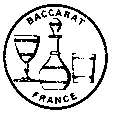
- Look for BACCARAT FRANCE around a carafe and two drinking vessels. Distinguish an applied paper label, a moulded relief and a frosted acid mark before using it as a dating clue.
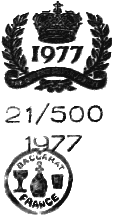
- Check the base and any bronze mount. A designer signature, edition fraction or commemorative year supplements the factory mark; the year is not the first-use date of the circular logo.
- Early pieces can have lost their labels. Compare the complete form and cutting with the pattern; weight or brilliance alone cannot identify unmarked glass.
Marks & lettering
5 marks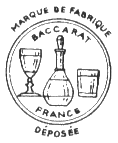
Undated
label · glass
label · glass · France
Paper label. An acid-etched version dates from about 1930.
Undated
glass
Seen on a Silver Jubilee paperweight dated 1977.
glass · France
Acid-etched mark; the dated paperweight does not establish a general use interval.

About Baccarat
Baccarat began as a glassworks in the Lorraine town of Baccarat in 1764, following royal permission obtained by the Bishop of Metz. Its early output included window glass, mirrors and drinking vessels. Aimé-Gabriel d’Artigues, already associated with the Vonêche glassworks, acquired the works in 1816 and converted it to crystal manufacture. The business subsequently traded under names including Compagnie des cristalleries de Baccarat.
During the nineteenth century Baccarat made cut and coloured crystal, table services, decorative vessels, chandeliers and paperweights. Royal commissions and international exhibitions helped establish its market beyond France. Its millefiori paperweights had a particularly important production period between 1846 and 1855. Later production included sculptural ornaments and collaborations with outside artists and designers.
Marking changed with the product and period. Paper labels appeared in 1860 and were often removed in use. Factory-name stamps occur on some moulded glass and bronze mounts from 1875; perfume bottles received signatures before the general adoption of acid marking in 1936. Later pieces may have engraved edition numbers or designer signatures in addition to the house mark. Laser marking was introduced in the early 2000s.
Also known as: Compagnie des cristalleries de Baccarat · Compagnie des Cristalleries de Vonêche-Baccarat · Verreries Sainte-Anne
Look-alikes & how to tell them apart
Saint-Louis crystal
Both houses made French cut crystal and paperweights.
Read the factory name inside the seal: SAINT-LOUIS or ST LOUIS identifies a different works; Baccarat’s familiar circular emblem contains a carafe and two glasses.
Unsigned nineteenth-century French and Bohemian crystal
Cutting patterns and glass forms were shared across several factories.
Match the pattern, dimensions and mount to a period catalogue or a securely attributed object; an absent Baccarat label cannot by itself identify its maker.