
bottleinfo.historicbottles.com
c. From 1923
Hazel-Atlas Glass Company
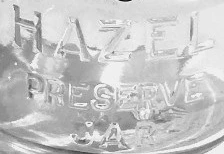
HA monogram between HAZEL and PRESERVE; other examples place the monogram on the base.
Read the stamp
Atlas jar dating depends on the ATLAS logo, secondary wording and manufacturer mark; a small base number is not an automatic year.
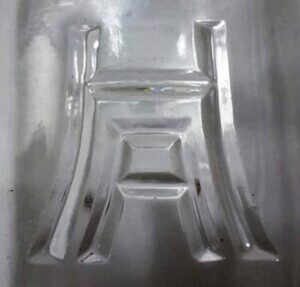
The H-over-A device is associated with Hazel-Atlas, while ATLAS MASON or other wording identifies the jar line. Keep the trademark apart from mould or capacity numbers and from a later removable lid.
Photograph the side embossing, base and closure together. Compare the exact brand and wording with the manufacturer’s jar types. A patent date or a numbered mould can recur on jars made over several years.
bottleinfo.historicbottles.com
c. From 1923
HA monogram between HAZEL and PRESERVE; other examples place the monogram on the base.

bottleinfo.historicbottles.com
Undated
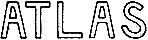
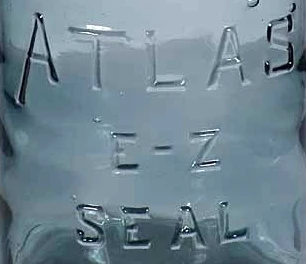
Large arched ATLAS above E-Z SEAL on a wire-bail jar; full product wording distinguishes the design.
bottleinfo.historicbottles.com
Undated
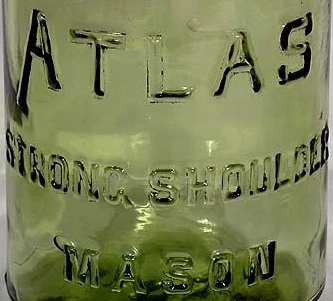
Three-line product inscription; the STRONG SHOULDER wording differentiates this jar from E-Z Seal and plain Atlas marks.
Undated
glass
Caption identifies the Hazel-Atlas H-over-A trademark on a clear Atlas Mason jar.
Undated
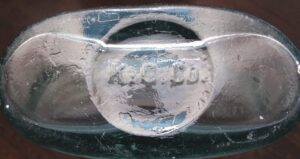
The caption dates the pictured aqua ammonia-type bottle to circa the 1890s.
impressed · glass
…………..Kearns-Gorsuch Bottle Company, Zanesville, Ohio (1886-1937). Monogram seen on fruit jar. Initials also appear spelled out and are known embossed on the base of a pickle bottle. A number of Hutchinson-style soda bottles are found with this mark, and they generally date in the 1890s-1910 period. This mark presumably dates before 1920, when Hazel-Atlas bought the plant. Also, see “K” and “K-G” marks. “ ” on base of aqua ammonia-type bottle, circa 1890s.
Undated
glass
………………………….. A & J Manufacturing Company, Binghamton, New York. A&J specialized in manufacturing kitchen-related products such as mixers and egg beaters, and evidently the company had a business arrangement with Hazel Atlas Co. to mark certain accompanying products. The most commonly seen item marked with those initials is a pitcher or large measuring cup that also served as the bottom container for a food mixer. That pitcher was patented in 1923. A & J was acquired by EKCO, of Chicago, IL, in 1929. Since those pitchers (in a medium green typical of Hazel Atlas during the Depression era) are fairly common and must have been made in large numbers, it is probable that many were made after 1929, continuing to carry the “A & J” marking after EKCO acquired the company.
Undated
glass
…………………….. Airko Manufacturing Company, Clermont, Florida. This mark (often hard to read, and at a glance may be mistaken for Anko, Arko, Aiko or Aiiko) is seen on at least two styles of clear shakers. The most common type features horizontal raised rings or ribs encircling the shaker, similar in appearance to the Depression-era “Manhattan” pattern made by Anchor Hocking. Those shakers apparently date from the 1930s-1950s and their actual manufacture is attributed to Hazel Atlas Company and/or Anchor Hocking (if you know which is correct, please let me know!). They were advertised as featuring a special design that helped keep the salt dry and free-flowing in humid weather. For an example of an advertisement, please see this page: Airko Shakers Advertisement – Chataboutdg.com
Undated
glass
……….Atlas Company, Washington, Pennsylvania (1896-1902), and the Hazel-Atlas Company , Wheeling, West Virginia and other plant locations. (1902-1964). The ATLAS fruit jars were made in large numbers, with many minor variations, over a very long time.
Undated
glass
………….Berney-Bond Company (1905-1930). A merger of the Bond and Berney companies, plants were located in Bradford, Hazel Hurst, Smethport, Clarion, and Knox, all in the state of Pennsylvania; the Winslow Co. plant at Columbus, Ohio was purchased in 1927. Berney-Bond was bought by Owens-Illinois in 1930. Most of these plants were closed down in later years, until by the early 1970s only the Clarion plant (Owens-Illinois plant #17) was still making bottles.
Undated
glass
………………… Housewares, Chicago, Illinois. Maker of all types of kitchen-related cookware and accessories. Brand name occasionally seen marked on cookware, measuring pitchers, coffee carafes, etc. Most of these pieces date anywhere from the 1950s to the present. I’m not positive what manufacturer produced these items. I would hazard a guess (repeat: guess!) that some items were made by Hazel-Atlas Company , Anchor Hocking Corporation , Indiana Company, Federal Company and/or Corning .
Undated
glass
……………….. Gilchrist Jar Company, Elmer, New Jersey (1898-c. 1901). Jars with this monogram were made by several firms including Elmer Works (S. M. Bassett Company at the “Upper Works”), Gilchrist Jar Company, and some jars were also evidently made by Atlas Company and later, Hazel-Atlas Company, up to about 1906. Other Gilchrist-related marks seen on fruit jars include the “R A G” monogram (for Ruth A. Gilchrist) and “Doolittle”. For more history and background information on this mark and others used by the Gilchrist firms, check out this extensive article by Bill Lockhart et al: Gilchrist Jar Company.
Undated
impressed · glass
……………………………….. H. J. Heinz Company, Sharpsburg, Pennsylvania (c.1892-1946). Heinz (started by entrepreneur Henry J. Heinz) is best known in the United States (and worldwide) for their iconic brand of ketchup, as well as a wide variety of other condiments, sauces, soups and other food products. Bottles marked “Heinz” or “H. J. Heinz” and other variations were made for many years, possibly dating back to the first incarnation of Heinz’ company circa 1860. From c. 1860 to about 1892, bottles with those markings would have been manufactured by unidentified glassmakers. Heinz acquired a factory in Sharpsburg for his own products, evidently beginning production sometime in late 1892 or early 1893. Several years later he built a new, larger factory at Sharpsburg for producing bottles for his products. After 1946, many of Heinz’s bottles were again made by other manufacturers such as Hazel-Atlas (H over A) and Owens-Illinois Company. Please see “H” and “H-28” marks. Note : for a discussion on Heinz, with pictures of dozens of the older HEINZ-embossed food bottles that have been found, check out Betty Zumwalt’s ground-breaking reference work Ketchups, Pickles, Sauces (1980). For much more background information the complicated history of Heinz and various HEINZ markings found on containers, please see this article from Bill Lockhart and the Bottle Research Group: The H.J. Heinz Co. and the H.J. Heinz Co. – SHA.org.
Undated
glass
…………………………. Hazel-Atlas Company , Wheeling, West Virginia; started operations at Washington, PA; later plants included Clarksburg, WV; Zanesville, OH; Ada, OK; Montgomery, AL; Oakland, CA; Pomona, CA and other locations (1902-1964). This trademark is often confused with the “H superimposed over an Anchor” mark used by Anchor Hocking Corporation. For more information on this mark, please see my Hazel-Atlas page.
Undated
glass
…………………… National Fruit Product Company, Winchester, Virginia. The mark was likely used sometime in the mid- late 1920s? (Thank you to Cullen Dunham for calling my attention to this mark).
Undated
impressed · glass
……………brand name seen on the base of many cold cream containers. This indicates Soap Company, begun in 1870, originally from Albany, New York, and later based in Cincinnati, Ohio, manufacturer of a variety of personal care / cosmetics products. Most of the typical white milk cold cream jars with the marking on the base seem to date from the 1920s-1950s era, but I don’t know exactly when they were first made, or how late they were produced. I have also seen “ ” embossed on a “beach ” bottle base accompanied by the makers mark “BALL” in cursive lettering (standing for Ball Bros Company). Many of the milk jars were made by Hazel-Atlas Company , as their “H over a smaller A” is seen on some of them. There were probably other companies involved in their production over the years. This “ ” has nothing to do with the older Works, , NJ, that made fruit jars in the late 1800s.