
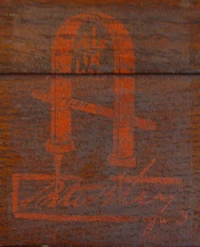
c. 1902–1903
Als ik kan; Stickley
Compass above an underlined or boxed Stickley signature; no fully spelled Gustav below.
decal · furniture wood; paper for labels · Eastwood, Syracuse, New York
Other maker marks
The name “Als ik kan; Stickley” appears among Gustav Stickley marks on furniture wood; paper for labels from Eastwood, Syracuse, New York.
Independent company and Craftsman Workshops, 1898–1916. Gustav Stickley lived 1858–1942 and worked in earlier partnerships; successor Stickley businesses continued separately.
c. 1902–1903
Compass above an underlined or boxed Stickley signature; no fully spelled Gustav below.
decal · furniture wood; paper for labels · Eastwood, Syracuse, New York
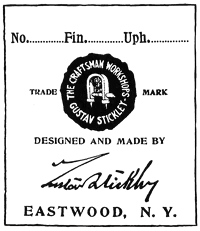
c. 1905–1907
Black rectangular label has a round Craftsman emblem, signature and three production fields; Eastwood is prominent at the foot.
paper label · furniture wood; paper for labels · Eastwood, Syracuse, New York
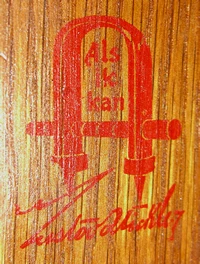
c. 1905–1912
Open red compass device above a large, unboxed full-name signature, with sharp descending initial strokes.
decal · furniture wood; paper for labels · Eastwood, Syracuse, New York
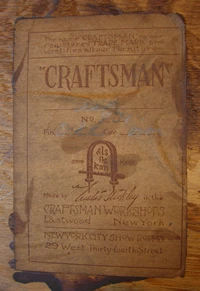
c. 1907–1912
Brown vertical label combines large CRAFTSMAN heading, model and finish fields, red device, workshop and New York showroom wording.
paper label · furniture wood; paper for labels · Eastwood, Syracuse, New York
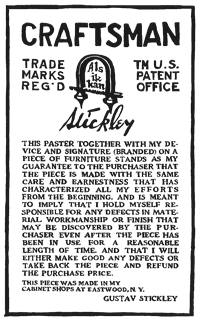
c. 1912–1916
Black rectangular late label carries the compass and signature above a dense guarantee paragraph, with Eastwood workshop wording at the foot.
paper label · furniture wood; paper for labels · Eastwood, Syracuse, New York
Gustav Stickley learned furniture making in an uncle’s chair factory in Pennsylvania. In 1883 he entered business with his brothers Albert and Charles. After later partnerships, including Stickley-Simonds at Eastwood near Syracuse, he established the Gustave Stickley Company in 1898. He subsequently dropped the final e from his first name. His new furniture moved away from elaborate Victorian forms towards plain surfaces, visible construction and quarter-sawn oak.
The business became United Crafts in 1901 and The Craftsman Workshops in 1903. Stickley made chairs, settles, tables, desks and cabinets, using both machinery and handwork. Copper or iron fittings and exposed joints were characteristic features. He began publishing The Craftsman in 1901, expanding his interests into houses, interiors, textiles and the wider Arts and Crafts movement. Designer Harvey Ellis contributed to the workshop’s lighter and sometimes inlaid furniture in 1903.
Stickley expanded his New York operations and developed Craftsman Farms in New Jersey. The expense of the large Craftsman Building and declining business contributed to bankruptcy in 1915. The magazine ended in December 1916, and Craftsman Farms was sold in 1917. His brothers’ businesses and later combined Stickley enterprises continued under their own marks.
Also known as: Gustave Stickley · Gustave Stickley Company · United Crafts · The Craftsman Workshops · Craftsman · Gustav Stickley and The Craftsman Workshops
The brothers used a red handscrew clamp with L. & J.G. Stickley and Handcraft wording. Gustav’s device is a pointed joiner’s compass with Als ik kan. Read the names as well as the red tool outline.
The successor mark combines the compass with the handscrew clamp. It belongs to a later combined enterprise, separate from Gustav’s earlier independent workshop.