
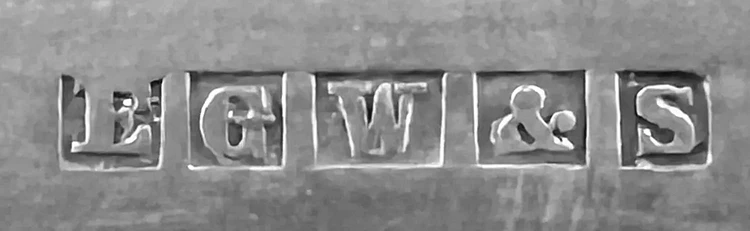
From 1886
E G W & S
Plain serif E G W and S replace the curled Gothic lettering; EPNS can accompany examples of this family.
stamped · silverplate
Silver
Eg Webster and Son silver marks include stamped “BROOKLYN SILVER PLATE CO. / TRIPLE / PLATE” on silverplate dated c. 1895–1900.
The predecessor business was active around 1860. E. G. Webster & Son formed 1886; independent business sold to International Silver in 1928. Webster branding continued afterward; Webster-Wilcox was in use by 1954.
From 1886
Plain serif E G W and S replace the curled Gothic lettering; EPNS can accompany examples of this family.
stamped · silverplate
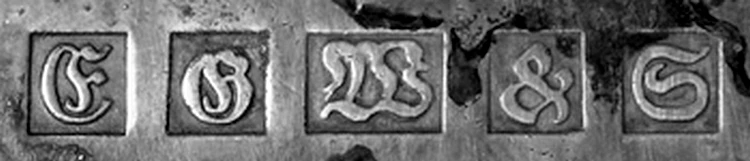
From 1886
Highly curled Gothic E and G distinguish this set from the plain block-letter version.
stamped · silverplate
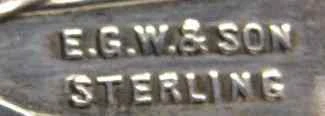
From 1886
Full & SON wording and STERLING distinguish this from EGW&S silverplate formats.
stamped · sterling silver
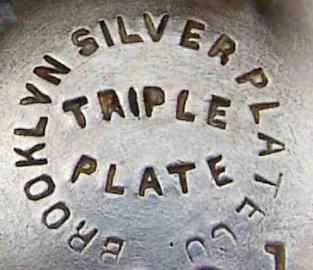
c. 1895–1900
Brooklyn name replaces Webster wording entirely; central TRIPLE PLATE is part of the illustrated format.
stamped · silverplate
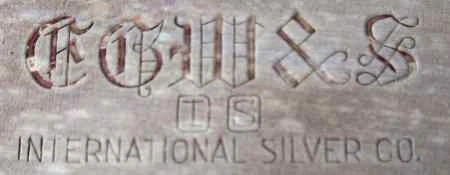
From 1928
Added I S and INTERNATIONAL SILVER CO. distinguish it from EGW&S used alone.
stamped · silverplate
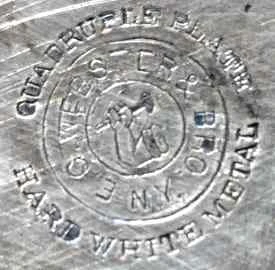
Undated
& BRO. and the circular arm device identify the predecessor rather than an & SON initial group.
stamped · silverplate
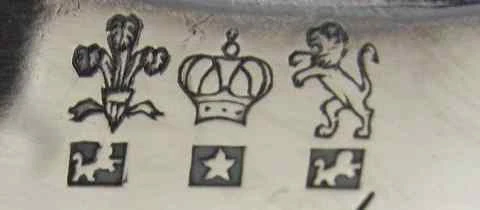
Undated
This composite pictorial device has a crown and lion rather than the five separate EGW&S letter punches.
stamped · silverplate
Elizur Goodwin Webster established a silverplating business in New York around 1859–1860. Early partnerships included William Dupree and Webster’s brother Adelbert Ashley Webster. The enterprise used both Webster Manufacturing Company and E. G. Webster & Brother as business names, with manufacturing in Brooklyn and sales premises in New York. It supplied plated table and serving wares, including tea services, trays, dishes and elaborate ornamental pieces.
In 1886 Adelbert left the partnership and Elizur’s son Frederick Hezekiah Webster joined him under the name E. G. Webster & Son. Frederick developed methods of decorating metal hollowware and received a patent in 1890. The firm made silverplate and some sterling silver. Its marks included complete company names, groups of initials and decorative devices. Brooklyn Silver Plate Co. was another name used on figural napkin rings.
Elizur died in 1900 and Frederick continued the business. International Silver acquired the firm in 1928 and moved production to Meriden, Connecticut. The Webster name survived the acquisition. By 1954 contemporary advertising identified a Webster-Wilcox division, combining the Webster and Wilcox lines within International Silver.
Also known as: E. G. Webster & Brother · Webster Manufacturing Co. · E.G.W.&S. · Brooklyn Silver Plate Co. · Elizur Goodwin Webster / E. G. Webster & Son
This separate firm used an interlaced W/C with a feathered arrow. E. G. Webster’s New York and Brooklyn marks use the EGW&S name sequence and other distinct devices.
Adelbert’s separate Brooklyn business followed his departure in 1886. Check for A. A. rather than E. G., and for & CO. rather than & SON.