
Undated
Archimede Seguso
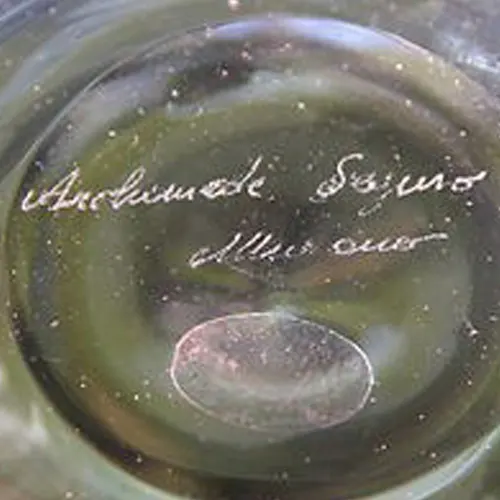
Archimede Seguso Murano signature above a separate oval worked area; lettering and base finishing are different features.
Read the stamp
A polished pontil is the ground-and-polished area where a holding-rod scar was removed from blown glass, often leaving a smooth, shallow depression on the base. It identifies a finishing operation rather than a particular maker or date.
A pontil, also called a punty, is a rod used to hold a hot glass vessel while the glassmaker works its opposite end. It is attached to the base, commonly with hot glass, and leaves an irregular patch or ring when detached. Grinding removes the broken surface. Further polishing restores a smooth finish to the worked area, which can remain slightly hollowed or dished. On tableware, that finished depression is often what collectors mean by a polished pontil. It is a manufacturing feature, separate from any maker’s signature.
Look at the base in reflected light. An unfinished pontil can have a jagged broken surface; a ground area is smoother but may look matt or show abrasive traces. A polished area has received a further finishing operation. It can be a small circular or oval zone, while some makers finished the entire base flat instead. Whitefriars examples include both dished and flat polished finishes. Compare the surface and profile together. A matt ground patch should not be described as highly polished simply because its original sharp scar has been removed.
A mold seam is a raised line formed where mold sections meet. A machine-made bottle can also carry a circular valve or ejection mark, or an Owens machine scar, without ever having been attached to a pontil rod. Roundness alone therefore does not identify a pontil. Ordinary base scratches are another feature: they follow contact and use rather than defining the worked attachment area. Examine the whole foot, the central surface and any seam continuing up the body. A smooth circular patch needs to be read with that construction.
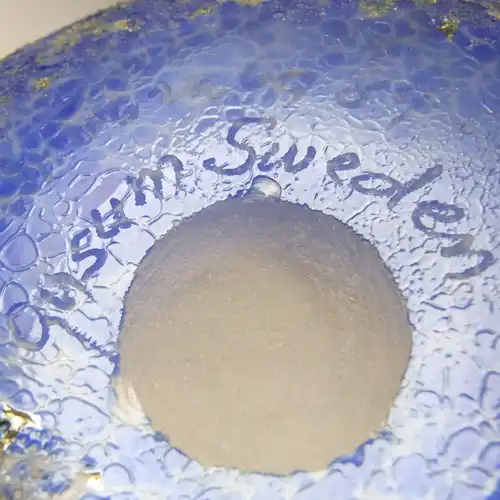
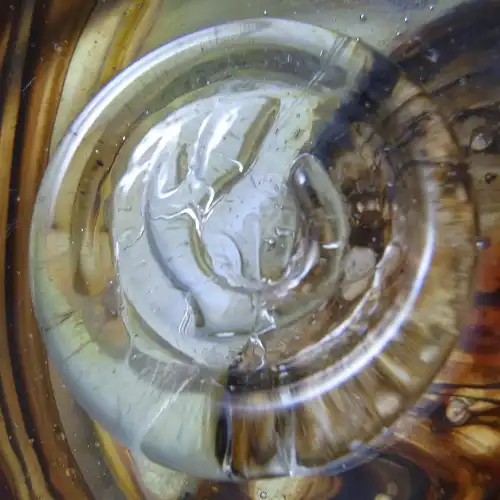
A polished pontil shows how the base was finished, rather than naming a factory. Several glassmakers used this technique, and hand-made art glass can still carry a genuine pontil area. Bottle dating rules developed for early utilitarian containers do not transfer directly to modern studio glass or tableware. Read a signature independently: the illustrated Archimede Seguso lettering sits above an oval worked patch, while GUSUM SWEDEN curves around a matt central area. The Isle of Wight comparison has a raised device within its base. Those differences are useful visible comparisons, not three identical finishing methods.
Undated
Archimede Seguso Murano signature above a separate oval worked area; lettering and base finishing are different features.
Undated
Gusum Sweden around a matt central ground area: a comparison for the distinction between ground and polished surfaces.
c. 1973–1979
Isle of Wight raised device in a glass base: compare its relief with the ground or polished attachment areas, rather than calling every circular base mark a polished pontil.
It is a holding-rod attachment area that has been ground and polished after the vessel was detached.
Modern hand-made glass also uses pontil rods and polished finishes. The form, signature and other construction details establish a closer comparison.
Grinding smooths the scar; polishing is a further finishing stage. A matt ground area can remain visibly different from a polished one.
Both regions or makers can provide comparisons, but the finish was shared by other glassmakers. Match the complete object and any signature.