
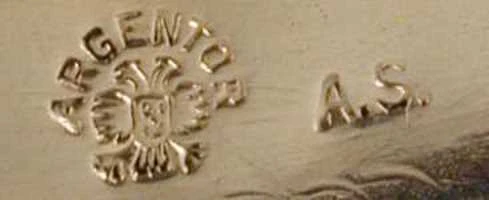
Undated
ARGENTOR / A.S.
The eagle replaces the triangle cluster; A.S. is separate from the name and emblem.
stamped · silver-plated metal · Vienna, Austria
Company dates describe the business, not a dated sequence of these punches.
Silver
The name “ARGENTOR / WIEN / 0’25 / PRIMA” appears among Argentor silver marks on silver-plated metal from Vienna, Austria.
1902 is the Argentor name change; predecessor Vienna branch founded in 1887. NGV gives closure c.1970.
Undated
The eagle replaces the triangle cluster; A.S. is separate from the name and emblem.
stamped · silver-plated metal · Vienna, Austria
Company dates describe the business, not a dated sequence of these punches.
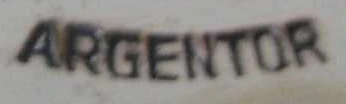
Undated
The unframed name lacks the city, eagle and triangle emblems.
stamped · silver-plated metal · Vienna, Austria
Company dates describe the business, not a dated sequence of these punches.
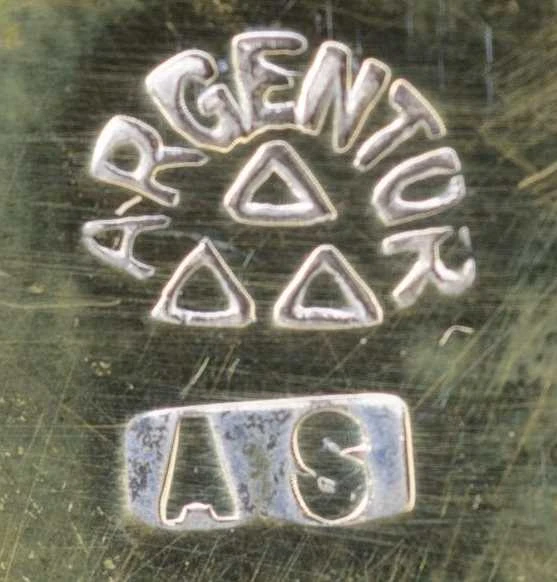
Undated
Three triangles form a compact cluster; compare the eagle device and the circular WIEN stamp.
stamped · silver-plated metal · Vienna, Austria
Company dates describe the business, not a dated sequence of these punches.
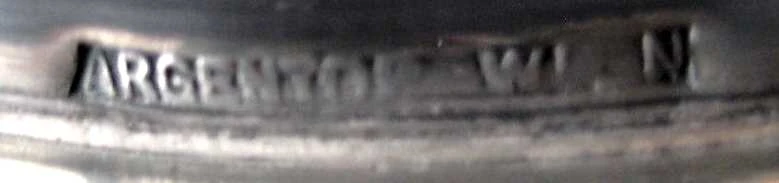
Undated
WIEN appears beside ARGENTOR in one line, rather than beneath it.
stamped · silver-plated metal · Vienna, Austria
Company dates describe the business, not a dated sequence of these punches.
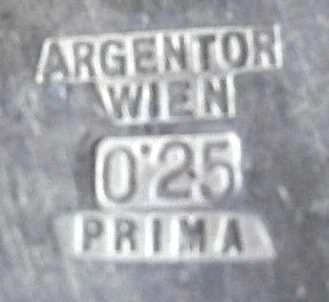
Undated
WIEN is on a second line; 0’25 and PRIMA are separate from the maker device.
stamped · silver-plated metal · Vienna, Austria
Company dates describe the business, not a dated sequence of these punches.
Argentor-Werke Rust & Hetzel was a Viennese manufacturer of decorative metalwork and tableware. Its immediate predecessor was the Vienna branch of C. A. Münchmeyer & Co., established in 1887. Georg Ferdinand Ernst Rust and Adolf Wilhelm Hetzel bought that branch in 1898, and the name changed to Argentor-Werke Rust & Hetzel in 1902. The factory operated in Kaiserstraße, with shops and distribution premises elsewhere in Vienna.
Electroplated and gilded metalwork formed an important part of the range. The firm produced cutlery, serving dishes, centrepieces, tea and coffee services, picture frames, lamps and flower holders. Some pieces combined metal mounts with iridescent glass made by Joh. Lötz Witwe. Pattern Book No. 13, dating from 1904 onward, illustrates hundreds of designs. A company publication of 1912 described a range of approximately 9,000 article numbers.
Argentor supplied international markets and maintained outlets in Budapest and Brno. It became an imperial court supplier in 1907 and exhibited at international fairs during the following years. The company adopted limited-liability status in 1927, continued manufacturing after the Second World War and closed around 1970.
Also known as: Argentor Werke · Argentor Wien · Argentor-Werke Rust und Hetzel · Argentor-Werke Rust & Hetzel
Both made silver-plated Art Nouveau tableware and used supplementary letter stamps such as AS. The maker name ARGENTOR identifies this firm; WMF pieces carry the WMF name or its own registered devices.
Some Argentor mounts surround Loetz glass. The metalwork stamp identifies the mount maker; the glass and metal can have different manufacturers.