
Undated
stg silver mark
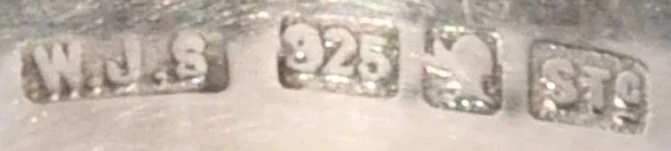
W.J.S., 925, elephant-head device and STG: a literal STG example with a separate maker identity.
stamped
Read the stamp
STG abbreviates sterling silver, the alloy containing at least 92.5% silver. STG SIL, STG SILVER, STER, STERLING and 925 describe that silver standard; EPNS instead identifies silver plating over nickel silver.
STG is shortened sterling wording. Sterling contains at least 925 parts silver in every thousand parts of alloy, or 92.5%; the remaining 7.5% is other metal, commonly copper. That alloying makes silver more suitable for jewelry and tableware than soft fine silver. STG, STER and STERLING are wording variants, while 925 gives the standard numerically. The abbreviation describes the silver component; it is separate from the maker’s initials, a pattern number or an assay date letter.
Australian silverware frequently carries STG SIL, STG SILVER or STG, sometimes with a maker’s mark. A W J Sanders spoon in the Powerhouse collection, dated 1930–1940, has W.J.S., 925, a maker symbol and STG on the back of its stem. The lettering and number repeat the material information while the maker’s punch supplies the identity. Prouds silverware also shows several combinations of STG and 925. A retailer’s name and a manufacturing silversmith’s mark can occur on the same piece.
On a ring, check the inner shank. On a necklace or bracelet, examine the clasp and adjacent tag; on a pendant or charm, inspect the back. For a spoon, inspect the reverse of the handle or stem. Copy any stops and adjoining words as well as STG. A sponsor’s initials or name can identify the business, but STG alone cannot do that job. A full UK hallmark has separate sponsor, fineness and assay-office components; the material abbreviation is not that entire hallmark group.
EPNS expands to electroplated nickel silver. The underlying nickel-silver alloy is mainly copper with nickel and zinc, with no silver of its own; silver is applied as a surface coating. Sterling is a silver-rich alloy rather than just a coating over that base. Read the whole inscription when a silver-looking object is being described: a bright polished surface can occur on both. The words silver plate or the letters EP and SP point to another construction from a plain sterling designation.
Sterling can darken through tarnish, so a blackened surface does not turn STG into a plating designation. Equally, a shiny surface does not establish purity. A stamp records the claimed standard; when the object and its marking conflict, the alloy needs checking as well as the wording. Preserve the small maker punch and its outline in photographs, since polishing can remove the detail needed to identify it.
Undated
W.J.S., 925, elephant-head device and STG: a literal STG example with a separate maker identity.
stamped
Undated
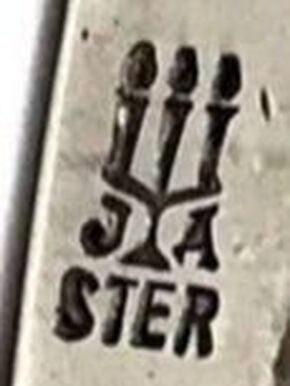
James Avery JA with STER: another shortened form of sterling, separate from the maker emblem.

Undated
Coro STER: the company name and the sterling abbreviation serve different purposes.
STG means sterling silver, containing at least 92.5% silver.
Yes, as a silver fineness description: STG spells sterling in shortened form, while 925 expresses the silver content in parts per thousand.
No. It abbreviates sterling silver. EPNS, EP and silver-plate wording identify plating constructions.
No. Look for the adjoining initials, name or symbol. Sanders examples, for instance, combine STG with W.J.S. and an elephant-head device.