
Mappin & Webb LtdMaker name
Undated
silver
Seen on objects dated 1952, 1958, 1962 (registered Jan 1953).
silver
Royal Works, Queens Road, Sheffield
Silver
Object dates of 1952, 1958, 1962 (registered Jan 1953) accompany Mappin and Webb marks on silver ashtray, bottle opener, and box.
John Newton Mappin established the separate business in 1859; the Webb partnership and successive styles followed. The wider family tradition dates to Jonathan Mappin’s 1775 mark registration. Sheffield manufacturing ended in the early 1970s; the retail brand continues.
Undated
Seen on objects dated 1952, 1958, 1962 (registered Jan 1953).
silver
Royal Works, Queens Road, Sheffield
Undated
Seen on objects dated 1913–1920, 1976–1977.
silver
Condiments set, cup, vase
Undated
Seen on objects dated 1901.
silver
Oxford Street, London W & The Royal Works, Sheffield
Undated
Seen on objects dated 1912–1916.
silver
Oxford Street, London W & The Royal Works, Sheffield
Undated
Seen on objects dated 1918, 1959.
silver
Oxford Street, London W & The Royal Works, Sheffield
Undated
Seen on objects dated 1983–1989.
silver
Oxford Street, London W & The Royal Works, Sheffield
Undated
Seen on objects dated 1902–1911.
silver
Oxford Street, London W & The Royal Works, Sheffield
Undated
Seen on objects dated 1898–1929 (registered Jul 1898).
silver
Oxford Street, London W & The Royal Works, Sheffield
Undated
Seen on objects dated 1923–1937 (registered Mar 1911).
silver
Oxford Street, London W & The Royal Works, Sheffield
Undated
Seen on objects dated 1895–1902 (registered Sep 1904).
silver
Royal Works, Queens Road, Sheffield and Queen Victoria Street, Oxford Street & Regent Street, London For other Mappin & Webb marks see Mn&Wb
Undated
Seen on objects dated 2000–2008.
silver
Oxford Street, London W & The Royal Works, Sheffield
Undated
Seen on objects dated 1917.
silver
Oxford Street, London W & The Royal Works, Sheffield
Undated
Seen on objects dated 1998–2002.
silver
Oxford Street, London W & The Royal Works, Sheffield
Undated
Seen on objects dated 1904–1926 (registered Jun 1912).
silver
Oxford Street, London W & The Royal Works, Sheffield For other Mappin & Webb marks see
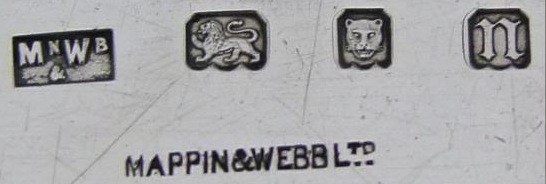
Undated
Captioned hallmark examples: London 1921; Dublin 1919; Birmingham 1920.
London
Attributed to Mappin & Webb Limited.
Undated
Seen on objects dated 1915–1947.
silver
Oxford Street, London W & The Royal Works, Sheffield
Undated
Seen on objects dated 1937–1939.
silver
Oxford Street, London W & The Royal Works, Sheffield
Undated
Seen on objects dated 1912 (registered Sep 1904).
silver
Royal Works, Queens Road, Sheffield and Queen Victoria Street, Oxford Street & Regent Street, London For other Mappin & Webb marks see Mn&Wb
Undated
Seen on objects dated 1899–1979 (registered Dec 1899).
silver
Oxford Street, London W & The Royal Works, Sheffield
Undated
Seen on objects dated 1952, 1958, 1962 (registered Jan 1953).
silver
Royal Works, Queens Road, Sheffield and Queen Victoria Street, Oxford Street & Regent Street, London For other Mappin & Webb marks see Mn&Wb
Undated
Seen on objects dated (registered Jun 1912).
silver
Oxford Street, London W & The Royal Works, Sheffield For other Mappin & Webb marks see
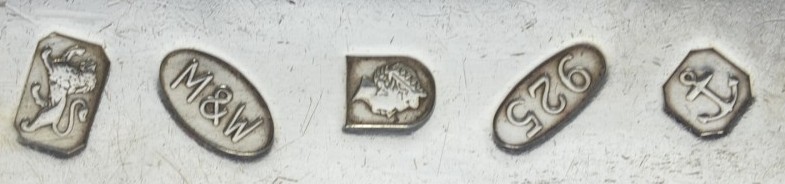
Undated
Birmingham hallmark example dated 1976; a Queen Elizabeth II Jubilee mark is a separate device.
Birmingham
The example date is not a general use interval for the maker stamp.
Undated
Seen on objects dated 1905–1997.
silver
Oxford Street, London W & The Royal Works, Sheffield
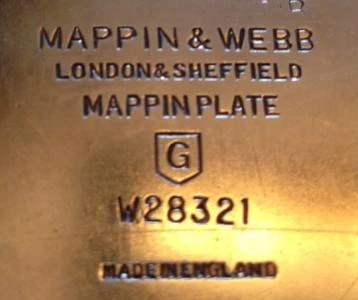
Undated
Plain block lettering and Mappin Plate replace the sunburst and Prince’s Plate arrangement; the shielded G and W number do not supply a proven year.
stamped · silver-plated metal · Sheffield / London, England
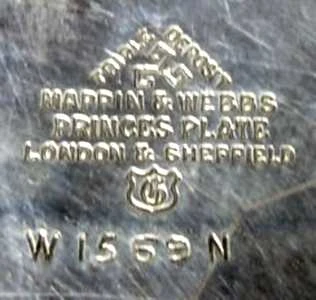
Undated
The Prince’s Plate trade name distinguishes this plated range from sterling sponsor punches. The letter G is a factory code, not an independently decoded assay date.
stamped · silver-plated metal · Sheffield / London, England
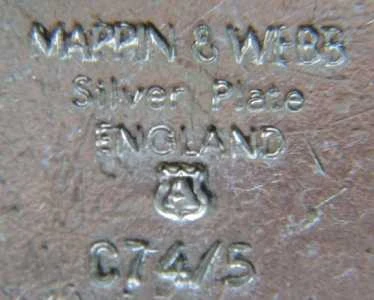
Undated
Explicit Silver Plate wording separates this format from the branded Prince’s Plate and Mappin Plate stamps. A shielded factory letter and item number accompany it.
stamped · silver-plated metal · Sheffield / London, England
Mappin & Webb grew out of a Sheffield family trade in silverware and cutlery. Jonathan Mappin registered a silver mark in 1775, and later generations developed the business into Mappin Brothers. In 1859 John Newton Mappin left that partnership and established Mappin & Co. George Webb, his brother-in-law, joined him, and the business adopted the Webb name during the following decade.
The firm combined Sheffield production with London showrooms. It supplied cutlery, tea and coffee services, presentation silver, plated tableware, jewellery and fitted travelling cases. Prince’s Plate became an important trade name for its electroplated wares. Mappin & Webb became a limited company in 1898 and acquired the rival Mappin Brothers business in 1902, reuniting the separated family interests.
A new Royal Works opened on Queen’s Road, Sheffield, in 1922. Hotel, railway and shipping contracts supported a large output of tableware alongside the retail luxury trade. In 1963 the manufacturing business joined Elkington and Walker & Hall within British Silverware. The Sheffield factory closed in the early 1970s, while the shops and brand continued. Its long history therefore includes both a manufacturing concern and a surviving jewellery retailer.
Also known as: Mappin and Webb · Mappin & Co. · Mappin, Webb & Co. · Mappin & Webb & Co. · Mappin & Webb (John Newton Mappin & George Webb) · John Newton Mappin
A competing family firm after the 1859 split, reunited in 1902. Read Brothers or Bros and its Queen’s Plate wording instead of assuming every Mappin mark belongs to Mappin & Webb.
Both made Sheffield plate and later shared British Silverware ownership. Walker & Hall’s W&H flag device is distinct from the Mappin & Webb name and sunburst.
Elkington also used framed letters on electroplate, but its own company marks and dating sequence must be used. An Elkington date table cannot decode a Mappin & Webb factory letter.