

c. From 1898
GRUEBY FAIENCE CO. BOSTON U.S.A.
FAIENCE CO. is the earlier lotus wording; it was still used after POTTERY appeared.
impressed · earthenware · Boston, Massachusetts, United States
Pottery & porcelain
Grueby pottery mark includes impressed “GRUEBY POTTERY / BOSTON.U.S.A.” on earthenware in Boston, Massachusetts, United States.
Company-family scope through 1919 sale; art pottery c.1894–1911. Saint Louis instead uses 1897–1920.
c. From 1898
FAIENCE CO. is the earlier lotus wording; it was still used after POTTERY appeared.
impressed · earthenware · Boston, Massachusetts, United States

c. From 1899
POTTERY wording appears after the FAIENCE CO. version, but both overlapped.
impressed · earthenware · Boston, Massachusetts, United States
The POTTERY lotus design also occurs as a printed paper label. This is the impressed version.

Undated
BOSTON MASS. distinguishes it from BOSTON U.S.A.; an example dates to about 1897.
impressed · earthenware · Boston, Massachusetts, United States
Drawing dated 1904.

Undated
A single word without a lotus or city is an early format.
impressed · earthenware · Boston, Massachusetts, United States
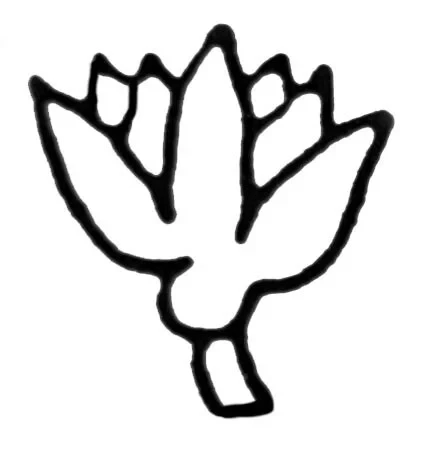
Undated
Isolated lotus omits both company-name rings; it cannot supply an exact date alone.
impressed · earthenware · Boston, Massachusetts, United States
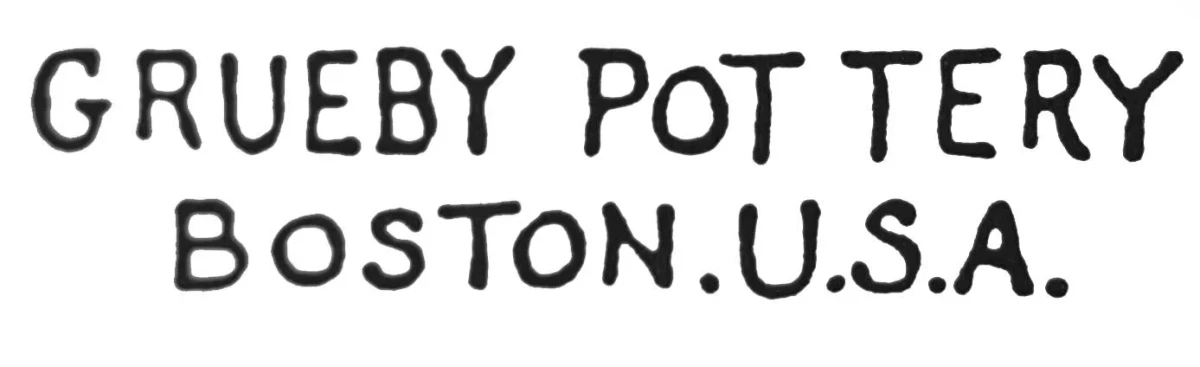
Undated
Straight-line wording distinguishes it from the later circular lotus stamps.
impressed · earthenware · Boston, Massachusetts, United States
William Henry Grueby established the Grueby Faience Company in Massachusetts in 1894, following earlier work in architectural ceramics and a partnership with Eugene Atwood. The business became associated with Boston and produced architectural terra cotta, glazed bricks and tiles before developing its celebrated art pottery. George Prentiss Kendrick helped design the vessels, bringing stylized leaves and flowers to simple, substantial forms.
Grueby showed art pottery at the Society of Arts and Crafts exhibition in Boston in 1897. The firm developed a soft matte green glaze that became its best-known finish, alongside yellow, blue, brown and other colours. Modelers applied or incised plant decoration by hand; their initials sometimes appear beside the factory stamp. Vases, bowls and handled vessels formed part of the range, while the architectural business continued to produce tiles.
Financial difficulties led to bankruptcy in 1908. Art-pottery production continued on a reduced scale until about 1911, while the reorganized Grueby Faience and Tile Company concentrated on architectural ceramics. C. Pardee Works acquired the business in 1919. The circular lotus marks occur with both FAIENCE CO. and POTTERY wording; the two versions overlapped rather than forming a simple before-and-after sequence.
Also known as: Grueby Pottery Company · Grueby Faience and Tile Company (later architectural business) · Grueby Faience Company
Matte green glazes and plant-inspired forms can resemble Grueby. Read the factory lettering: TECO and HAMPSHIRE are separate factory names; Grueby uses its own name or lotus device.
Small initials beside a Grueby factory stamp identify a modeler rather than another factory. Read the large factory stamp separately from initials such as WP, ERF or RE.