Date a Ball jar chiefly by its embossed logo, accompanying wording and construction. The number on the base usually identifies a mould; 1858 patent wording dates the closure patent rather than the jar.
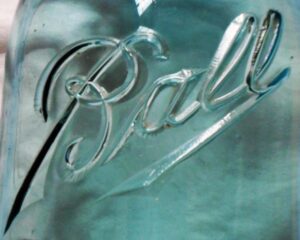
The Ball name on the side of a jar is the main dating clue. Examine the shape of the capital B, the position of the a and whether the script has an underline. Early lettering and later simplified script belong to different production eras. The triple-L nickname describes a decorative curl at the start of the underline that resembles another letter l. Record PERFECT MASON, PERFECTION, IDEAL or other wording with the logo: these identify different jar lines, and the Ball script alone does not identify a single year.
Ball logo eras
For the older script sequence, a triple-L logo generally points to about 1896–1910. The dropped-a script with an underline follows at about 1910–1923; the simplified version without an underline is about 1923–1933. An underline returns in the familiar curled-B version from about 1933–1960. The simplified B without its central curl begins around 1960. These are approximate logo periods, so a transition between styles is better expressed as an era than as an exact birthday.
Read a jar as a worked example
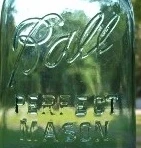
A blue PERFECT MASON with a dropped a and an underline belongs with the early underlined script group, approximately 1910–1923, provided its other features agree. A PERFECT MASON with no underline instead belongs with the approximately 1923–1933 group. On either jar, a large 5 on the base is a mould identifier rather than shorthand for a production year. Mould numbers helped the factory trace defective jars back to the mould position that produced them.
Patent dates and replacement lids
MASON’S PATENT NOV 30TH 1858 refers to John Mason’s threaded screw-closure patent. It does not mean the jar was manufactured in 1858. The patent wording occurs on jars made by different manufacturers, so identify the maker separately. A screw band or lid can be exchanged between compatible jars. Read the embossing in the glass to date the jar; lettering on a removable closure identifies that closure rather than proving the age of the glass.
Blue jars can be modern
The blue Ball Heritage Collection pint jars were released in 2013 to commemorate the Perfect Mason anniversary. Their period-inspired colour and front logo can resemble early jars. Turn the jar around: commemorative back wording, including AMERICAN HERITAGE and anniversary dates, distinguishes this modern issue. Side measurements and the complete front and back inscriptions add useful context. A blue colour by itself cannot separate an antique jar from a modern commemorative one.
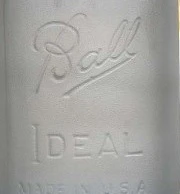
Ball IDEAL with the returning underline and curled B: the approximately 1933–1960 logo family.
embossed
Frequently asked questions
Is there a Ball jar date chart?
Yes. Compare the embossed script with the approximate logo eras, especially the triple-L curl, dropped a, missing underline and later simplified B. A logo chart gives a period rather than an exact production year.
Can I date a Ball Mason jar by the number on the bottom?
The large base number normally identifies a mould position. A 5 does not establish 1905 or 1955.
Does 1858 on a Ball canning jar mean it was made then?
No. That wording refers to Mason’s screw-closure patent, which was repeated on later jars.
Are all blue Ball jars antique?
No. The blue Heritage Collection includes jars issued in 2013. Read the back anniversary wording as well as the front logo.