
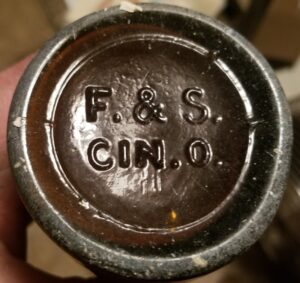
c. 1877–1884
F. & S. CIN. O.
glass · Cincinnati, Ohio
The image caption identifies Foss & Schneider Brewery, , with this mark used approximately .
Glass
United Kingdom · 1,529 marks.
c. 1877–1884
glass · Cincinnati, Ohio
The image caption identifies Foss & Schneider Brewery, , with this mark used approximately .
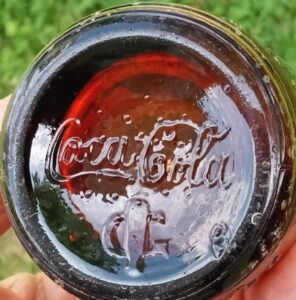
c. From 1913
glass · Evansville, Indiana
The source identifies Graham Company’s inverted-bottle-over- logo, introduced . The image caption shows it on an amber straight-side Coca-Cola bottle.
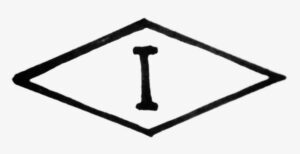
c. 1915–1929
glass
Diamond …………………….. Illinois Company, Alton, Illinois (mark used circa ). “ inside a diamond” mark used by Illinois Company, Alton, Illinois
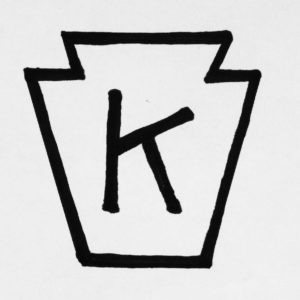
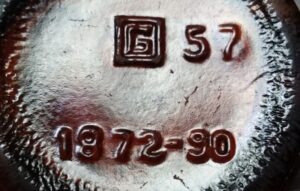
From 1932
The illustrated amber bottle is captioned as made in 1957; 1872-90 is a style code.
glass · Glenshaw, Pennsylvania
The source reports that Glenshaw Company’s -in-square mark has been used . In the caption, is a factory code for the bottle style, not a date.
c. 1934–1998
The source gives circa 1934 to circa 1998, but explicitly questions the final year.
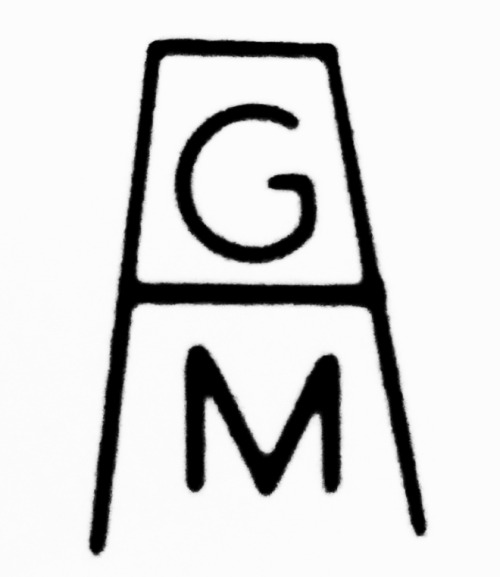
glass · Australia
G and M are separated by a horizontal bar inside an open-bottomed A-shaped monogram.
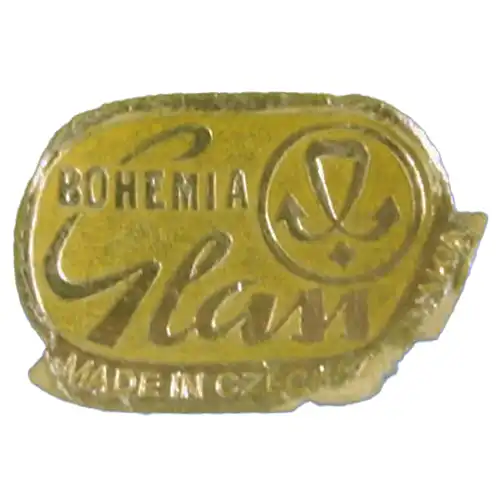
c. 1950–1969
label · yellow, gold · glass · Czechoslovakia
" " generic yellow & gold foil label. C 's - 1960's.
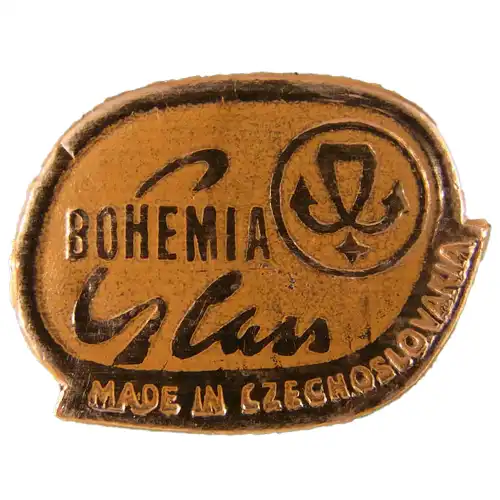
c. 1960–1979
label · yellow, gold · glass · Czechoslovakia
" " generic yellow & gold foil label. C 's - 1970's.
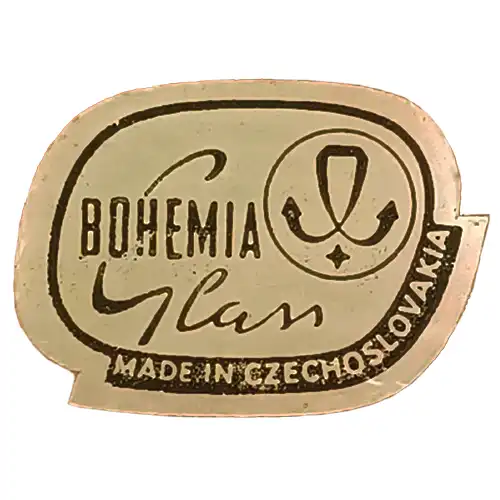
c. 1970–1989
label · black, gold · glass · Czechoslovakia
" " generic black & gold foil label. C 's - 1980's.
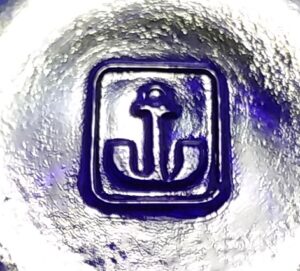
From 1977
glass
The image caption identifies the boxed anchor as Anchor Hocking, used to or possibly later, on a small cobalt blue dessert dish.
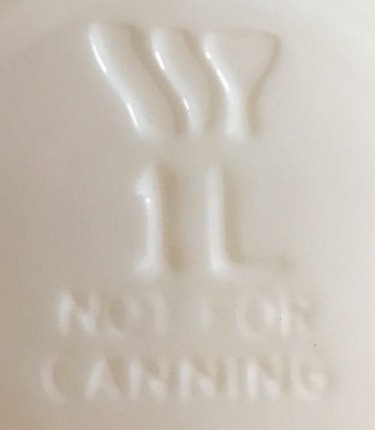
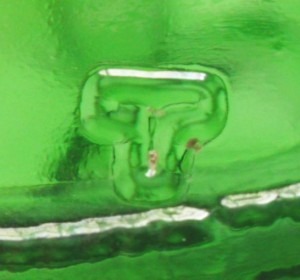
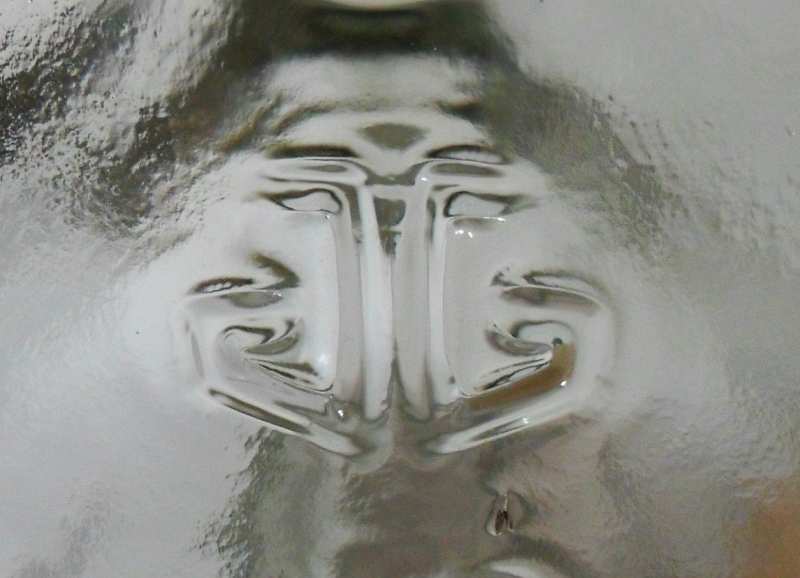
c. 1983–2014
The illustrated jug carries a 2006 date code; the caption dates introduction of the logo to September 1983.
impressed · glass
The image caption identifies the stylized AG anchor as Anchor Container Corporation, introduced in September and replaced ; shown on a Jim Beam handled liquor jug.
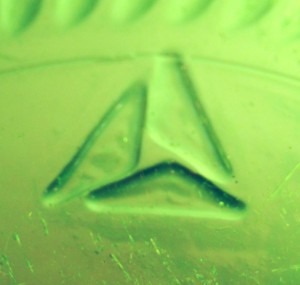
c. 1985–1988
glass
National Can Company triangular sailboat logo following the Triangle Industries acquisition.
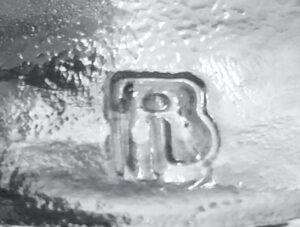
1987–1994
glass
The image caption identifies a B-I or I-B monogram as Ball-Incon Packaging, used .
1987–1994
glass
The image caption identifies Ball-InCon Packaging Corporation, with the mark used .
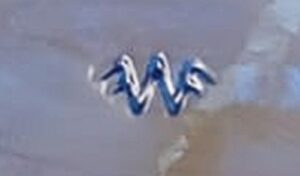
c. 1990–1999
label · gold on red · glass
010 metallic label (gold on red) c 1990s
c. 1990–1999
label · glass
paper label c 1990s
c. 1990–1999
label · gold on clear · glass
011 plastic label (gold on clear) c 1990s
c. 1990–1999
label · glass
paper label c 1990s
c. 1990–1999
incised · glass
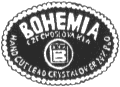
Vibro-pen mark on the same piece as the source's plastic Murano label.
c. 1990–1999
label · glass
paper label c 1990s
c. From 1993
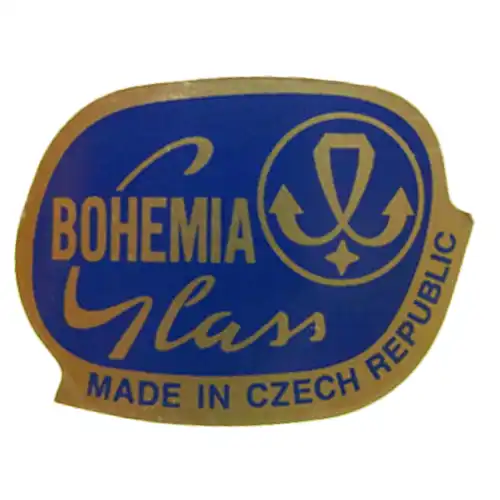
label · blue, gold · glass · Czech Republic
Generic blue and gold label, dated approximately onwards in the source.
From 2014
The illustrated Yoo-Hoo bottle has a 2022 date code; this dates the example.
glass
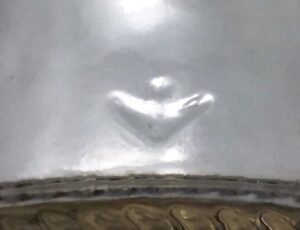
The image caption identifies the stylized anchor or downward arrow as Anchor Container Corporation, introduced in , on the heel of a clear Yoo-Hoo bottle.
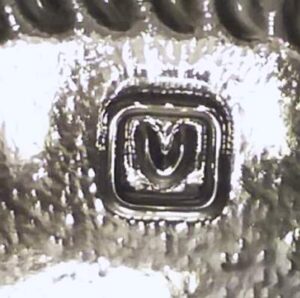
From 2019
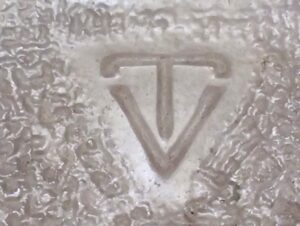
glass
Verallia boxed- trademark; its rounded lower notch can resemble U.
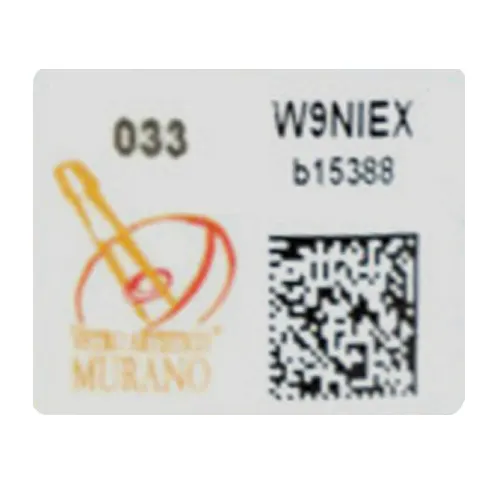
Undated
label · red · glass · Italy
Red Vetro Artistico Murano (VAM) label with " " code and QR code.
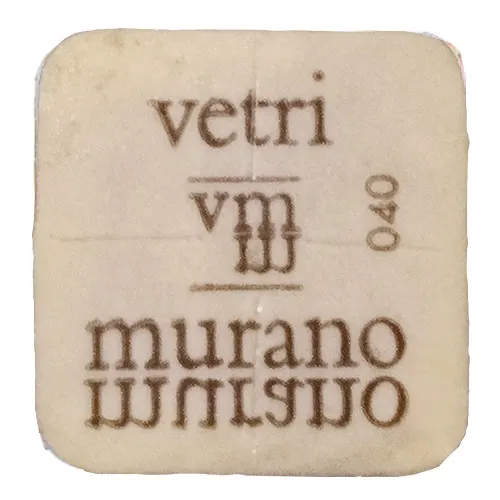
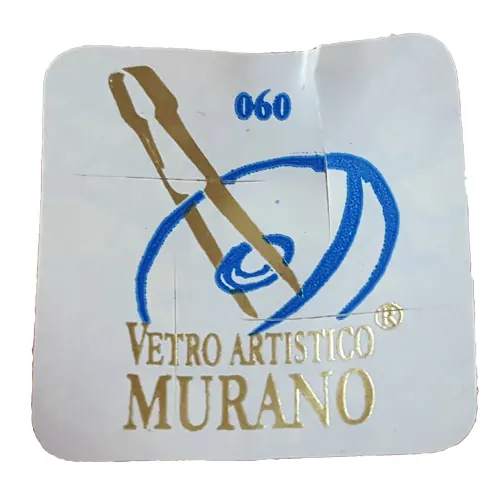
Undated
label · blue · glass · Italy
Blue Vetro Artistico Murano (VAM) label with " " code.
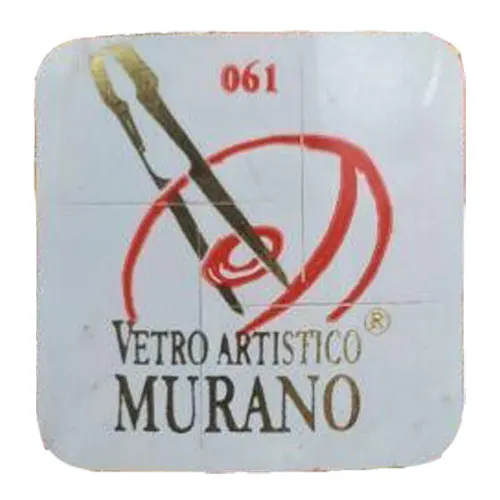
Undated
label · red · glass · Italy
Red Vetro Artistico Murano (VAM) label with " " code.
Undated
glass
…………..when seen on the base or the heel of early 20th century American-made soda and beer bottles, in most cases indicates production by the American Bottle Company, at their Streator, Illinois plant location. (The “S” stands for Streator). The number usually precedes the letter, but in some cases the order may be reversed, with the number positioned to the right of the letter. These marks were used by ABCO at least during the 1916-1923 period, and evidence from bottle collectors indicate these date code markings may have been used as early as 1905 (when American Bottle Company was incorporated), all the way up to at least 1931, possibly even 1933 in a very few cases. Owens Bottle Company, which purchased the six plants of the American Bottle Company in 1916, continued the operation of only two of those ABCO plants (their Newark, OH & Streator, IL locations) under the American Bottle Company name until 1929, and used this type of marking on many of their bottles. Also, see “AB”, “A.B.CO.” and “17N” marks. For more background information and context on these bottles, please see this article written by archeologist/researcher Bill Lockhart (along with input from several other researchers). In particular, check out the chart shown on page 347 of the document. This is a .PDF file: American Bottle Company – SHA.org
Undated
glass
………………… on the heel or base of soda and beer bottles, usually American Bottle Company, at their plant located in Newark, Ohio. On some bottles the letter may precede the number. Evidence indicates the date codes (16, for instance, is believed to indicate 1916) may have been used earlier, as well as later —- perhaps from ABCO’s beginning in 1905, all the way up to 1929, at least on a few bottles. I have received a report that some bottles carried apparent date codes as late as 1933, several years after the former A.B.CO. plants had become part of Owens-Illinois Company. Also see “16S”, “AB”, and “A.B.CO” entries. For more background information on American Bottle Company and their number/letter codes, please check out this webpage article by archeologist Bill Lockhart (and other researchers), especially the chart shown on page 347 of the document. This is a .PDF file : The American Bottle Co.: A Study in Contrasts and Contradictions – SHA.org
Undated
glass
……………… what appears to be a weird looking number “3” with an extra stroke at the top, often seen on medicine bottles)………………. please check the entry on the “Weird 3” symbol in the “hard to classify” marks near the bottom of the listings on this page. This logo is an apothecary symbol for “OUNCE”.
Undated
glass
…………… Three Rivers Company, Three Rivers, TX (1922-1937)
Undated
glass
……………. Three Rivers Company, Three Rivers, TX (1922-1937). Ball Bros. Company bought this plant in 1937, and operated it for around 10 years before shutting it down.
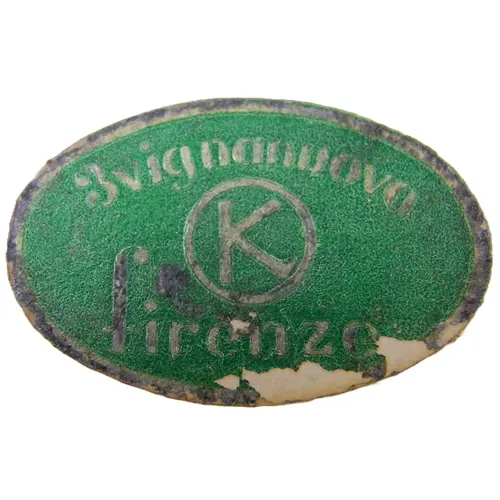
Undated
label · green, silver · glass · Italy
" " green & silver oval foil label.
Undated
glass
……………….please see “FF inside a circle” mark listed on Page Three ………… Foster-Forbes Company based in Marion, Indiana. This “cursive FF” mark is often indistinct and difficult to discern, and has occasionally been described as “ ” by some observers. The cursive F’s might appear to be “flat-topped number 3’s”.
Undated
glass
…………………………. ℥ (apothecary ounce symbol)…………… often seen on druggist/prescription bottles. P lease see the “Weird 3 symbol” entry near the bottom of the listings on this page . The characters placed to the immediate right of the symbol are Roman numerals indicating the bottle capacity in ounces.
Undated
impressed · glass
…………………………. this address positively identifies this insulator to be a product of the Brookfield Company, made at their Brooklyn, New York location. The Cliff Street address was a business office address, and indicates the insulator was most likely made sometime in the 1882-1890 time frame. See my page on Brookfield Company for more information.
Undated
impressed · glass
……………. see full article on webpage here: Star Works/Company, New Albany, IN (1869-c.1879). In 1879, W. C. DePauw acquired entire ownership, and the factory then (or soon afterward) became known as DePauw’s American Plate Works, with the window / fruit jar division being called “W. C. DePauw Company” in city directories. The operation produced fruit jars (some are marked “W C D” on the base), and continued to operate until the Panic of 1893 caused the plant to shut down. Sporadic attempts to revive the works failed. This star marking is usually quite boldly embossed, has five points, and has a characteristic “look” that is different from several other types of stars seen on the bases of bottles from the 19th century. Probably the most well-known bottle variant found with this bold, heavy star mark on the base is a “squat quart” Cream Ale bottle made for Alonzo Templeton of Louisville, Kentucky in the very late 1860s and early 1870s. It is found in shades of amber, including orange amber, red amber, and a dark olive amber that looks almost like black in reflected light. Note: this is only one type of star. There are other types of stars seen on a wide variety of bottles that have no connection to the firm in New Albany, Indiana. A star on the base of certain bottles found mainly on the west coast might be attributed to Pacific Works, San Francisco, CA (see entry below). Also, see “3 Rivers” and “N next to or within a star” marks. There are also many cases in which bottles exhibit a star in the design or on the base which has nothing to do with the glassmaker, usually being a decorative device or a mold identifier. See “W.C.D.” and “X” entries, also please see all other “Star” entries on this page).
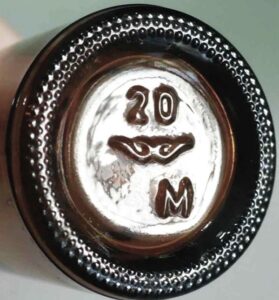
Undated
glass · Essen, Germany
The image caption identifies on a miniature sampler whiskey bottle made by Wisthoff & Company Glashutten, .
Undated
glass
………………………. this address positively identifies an insulator to be a product of the Brookfield Company (Bushwick Works), at their first manufacturing facility in Brooklyn, New York. The address (a business office address) indicates the insulator was probably made sometime in the 1868-1882 time period. For more information on this glassmaker, please see my page on Brookfield Company.
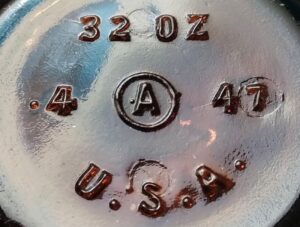
Undated
The caption identifies 47 as a 1947 date code on the illustrated bottle; this is an object date.
glass
The image caption identifies in circle on 32-ounce chemical bottle made by Armstrong Cork Company.
Undated
glass
………. Alexander & David H. Chambers, Pittsburgh, Pennsylvania (c. 1852–c.1889). This was one of the most prolific companies in Pittsburgh during the mid-to-late 1800s. Huge quantities of bottles, flasks, and fruit jars were made, as well as window (which was ostensibly their primary product). Many local, regional, and nationally distributed sodas, ales, mineral waters, beers, bitters, tonics, and other types of products were packaged in bottles made by A&DHC. Most commonly, bottles with this mark seem to date from the 1870s and 1880s, but the mark was evidently in use from around 1860. Most bottles made by A & D H C in the earlier years (1840s and 1850s) evidently did not bear a manufacturer’s mark. For more detailed background on A&DHC, please check out this article by Bill Lockhart et al here: A. & D. H. Chambers, Pittsburgh – SHA.org
Undated
glass
………………………….. A & J Manufacturing Company, Binghamton, New York. A&J specialized in manufacturing kitchen-related products such as mixers and egg beaters, and evidently the company had a business arrangement with Hazel Atlas Co. to mark certain accompanying products. The most commonly seen item marked with those initials is a pitcher or large measuring cup that also served as the bottom container for a food mixer. That pitcher was patented in 1923. A & J was acquired by EKCO, of Chicago, IL, in 1929. Since those pitchers (in a medium green typical of Hazel Atlas during the Depression era) are fairly common and must have been made in large numbers, it is probable that many were made after 1929, continuing to carry the “A & J” marking after EKCO acquired the company.
Undated
glass
………………. on the bases of Courtenay & Co. Worcestershire Sauce bottles, the initials stands for The Great Atlantic & Pacific Tea Company (the large chain of grocery stores). Although Courtenay & Company was based in Worcester, England, evidently their brand of sauce was marketed and sold for a long period of time by A&P in both Great Britain and the United States. The bottles thus marked are colorless (or nearly so) and were almost certainly made by an unidentified glassmaker in England. They generally appear to date from the 1880s to the 1920s period. Trade cards were published illustrating the product and the bottle, and many variations of those trade cards are known – bearing addresses of cities around the US, mainly Eastern and Midwestern locations, on the reverse of the cards.
Undated
glass
……………. probably Agnew & Wilcox, Pittsburgh, Pennsylvania ( 1868-1872). Jay W. Hawkins ( Glasshouses and Manufacturers of the Pittsburgh Region 1795-1910 ) gives this date range and writes on page 20-21 that this mark is attributed to Agnew & Wilcox, who made coffin flasks and soda bottles among other containers. Also, a flask marked “Guaranteed Full Pint” posted on the antique-bottles.net discussion site bears “A & W” on the bottom, but that bottle appears to date from sometime in the period of 1895-1915 and likely stands for a later, unrelated and unidentified company.
Undated
glass
…………..Alexander Arbogast / Arbogast & Company, Pittsburgh, Pennsylvania (c. 1860-c.1863). Mark is pictured in Bottles on the Western Frontier by Rex L. Wilson (1981:113), seen on a cylinder whiskey. See “Arbogast & Co. Pitts Pa”.
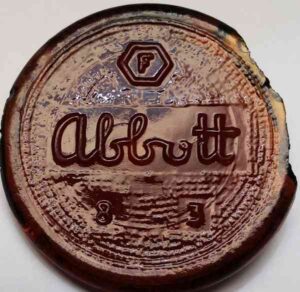
Undated
impressed · glass
The image caption identifies on an amber bottle-base shard made by Fairmount Company.
Undated
glass
……………..Atlantic Bottle Company, Brackenridge, Pennsylvania (c.1916-1930). First only a distributor (pre-1916), Atlantic was later an actual manufacturer of bottles. The Brackenridge plant was purchased by Owens-Illinois in 1930.
Undated
glass
……………… please see the “A. B. G. M. CO.” entry below. On some beer bottles made by Adolphus Busch Manufacturing Company, what is supposed to be the letter “G” more closely resembles a “C”. This seems to have been a fairly common occurrence with some bottle mold makers during the late 19th century and early 20th century. There may or may not be a faint, tiny “tail” on the lower right side of the letter.
Undated
glass
……………………….. American Bottle Company (1905-1929). Chicago, Illinois (office – 1905-1916); Toledo, Ohio (office – 1916-1929). plants were located at Streator, Illinois; Newark, Ohio; Belleville, Illinois; Massillon, Ohio & Wooster, Ohio. The American Bottle Company was purchased by Owens Bottle Machine Company in 1916 (with some of the plants being closed soon afterwards) but the Streator and Newark plants continued to operate under the American Bottle Co. name until 1929, when they became part of the merger that resulted in Owens-Illinois Company . (For Streator and Newark plant marks from 1916 to 1929, see “17N” and “16S” entries). Most, if not all, of the “AB”, “AB CO.” and “A.B.CO.” marked bottles are believed to date between 1905 and 1916. However, it is possible that some bottles with these markings might date between 1916 and 1929, but, if so, could only have been made at either the Streator or Newark plants. See also “AB (letters connected)” page .
Undated
glass
………….. Adolphus Busch Company (1886- c.1893) with a slight company name change to “Adolphus Busch Manufacturing Company” (c.1893-c.1921). Also see the “A.B.G.M.CO.” mark which was used after about 1893 up to c. 1921, and this page on the AB Connected mark seen on Antique Beer Bottles .
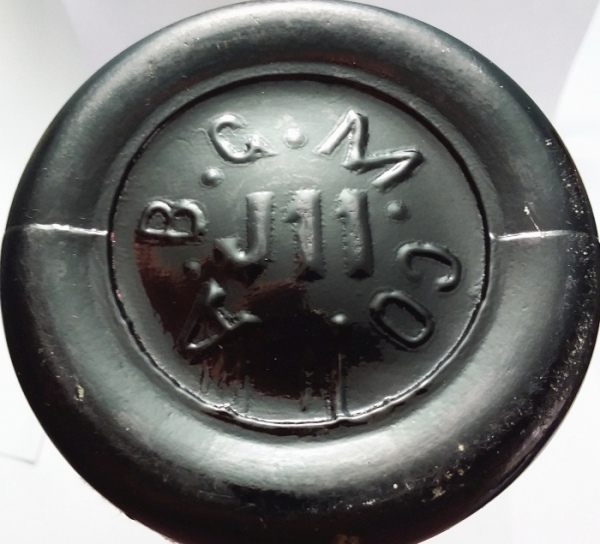
Undated
glass
The caption identifies on a dark amber export beer bottle as Adolphus Busch Manufacturing Company; J 11 is a mould identifier.
Undated
glass
…………… Adolphus Busch Manufacturing Company, denotes beer bottles made at their Belleville plant (1886-c.1905). This marking is not very common, compared to other marks used by Adolphus Busch, so it is likely they used that mark for a relatively short time, with only a few shops (teams of glassworkers) producing them. The mold numbers “1” through “4” are known, but perhaps higher numbers exist that have not yet been reported.
Undated
label · glass
………………. Adolphus Busch Manufacturing Company, plants at Belleville, Illinois (1886-c.1905) and St. Louis, MO (c.1893 – c. 1921). The Belleville factory became part of American Bottle Company c. 1905. (See AB (connected ) and A.B.CO. marks). ABGMCO produced huge quantities of beer bottles for Anheuser-Busch Brewing Association, but also beer bottles for other brewers and bottlers, as well as other types of containers including soda bottles and wax sealer style fruit jars. Without the original label intact, it would be difficult or impossible to be sure what brand of beer any particular bottle marked “A.B.G.M.CO.” originally contained. The lettering is typically arranged in a circular fashion, and usually accompanied by a mold letter/number combo placed in the center of the base. In some cases, the lettering appears to be “A. B. C. M. Co.” as the mold engraver frequently made the letter “G” look more like a “C”. Also see “A B G CO”, which was evidently used in the first few years of operation.
Undated
glass
…………. Adolphus Busch Manufacturing Company, bottles made at their St. Louis plant location. See above entries, and AB Connected mark.
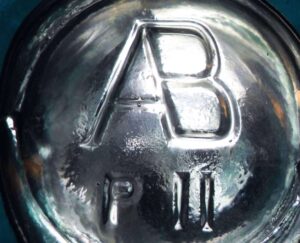
Undated
glass
The caption identifies connected on a light aqua beer bottle with P 11 code. The source entry concerns unconnected A B and is uncertain between American Bottle Company and Adolphus Busch Manufacturing Company.
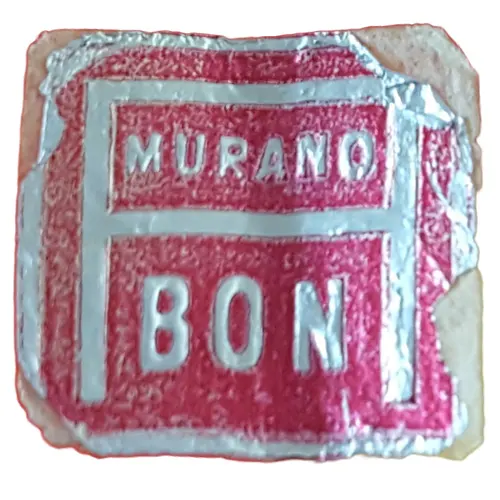
Undated
label · red, silver · glass · Italy
Red and silver foil Aldo Bon label, reads " " .
Undated
impressed · glass · Bellaire, Ohio
The image caption identifies an acorn logo used by Bellaire Bottle Company, .
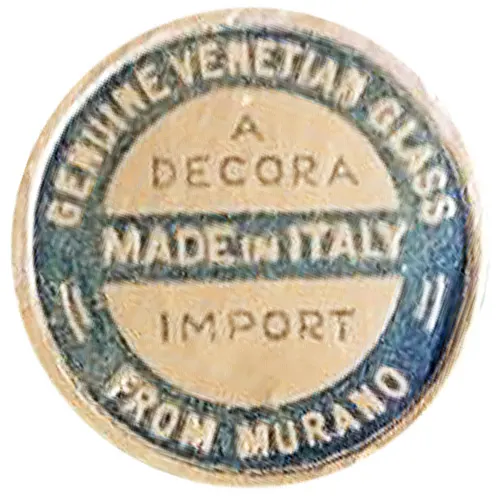
Undated
label · blue · glass · Italy
Blue Decora import label, reads " " . Very commonly found on AVEM glassware.
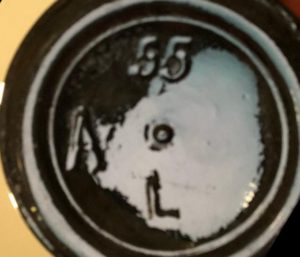
Undated
incised · glass
The image caption identifies A / L / 55 on a dark olive green bottle as unknown.
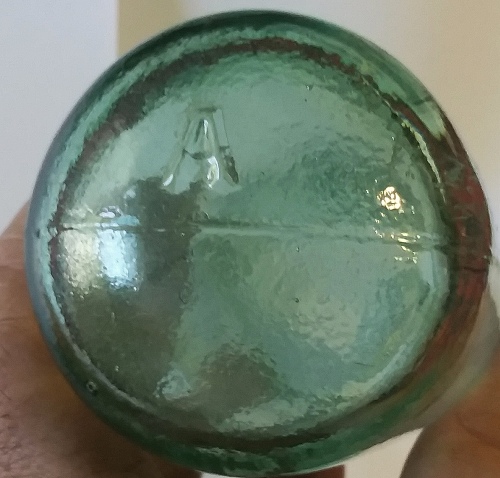
Undated
glass · United Kingdom
The caption describes alone on the rounded base of light green torpedo mineral-water bottle with an applied crown lip, made in ; Alloa Work is suggested but explicitly unconfirmed.
Undated
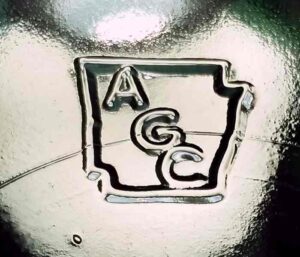
glass · Jonesboro, Arkansas
The caption identifies inside the outline of Arkansas on a clear half-gallon packer jar.
Undated
glass
………………. Evidently used by at least three different companies including: Atlanta Company, Atlanta, Georgia (1887-c.1892), Annapolis Company, Annapolis, Maryland (1885-c.1887) and Alexandria Company, Alexandria, Virginia (1905-1916). The mark appears on the base of certain liquor flasks, soda bottles and other types of containers. Also, on the face of certain fruit jars, the initials “A.G.CO.” might stand for the American Grocery Company. For much more in-depth analysis of this mark and several related marks, (detailing different types of bottles that carry this mark, and info on which companies are more likely candidates for attribution to a specific type of container), please check out “The A.G.Co Logo” (Bill Lockhart et al), a pdf file, here: A G Co. – SHA.org
Undated
glass
A G M (letters “G” and “M”, separated by horizontal line, inside a rectangularly drawn “A” with flat top) ……….. Australian Manufacturers Co., Kilkenny, South Australia. Please see entry under “G M” on Page Three , with line drawing showing this mark.
Undated
glass
…………….Australian Manufacturers Company, Australia. Exact time period when this mark was used is unclear. A few examples are shown on this page: Australian Bottle Marks ~ The Bottle Depot
Undated
glass
…………… A. G. Smalley & Company, Boston, Massachusetts (1877-1915). (Albert G.) Smalley & Co. was a distributor of fruit jars and other types of bottles for many years, and apparently did not manufacture the themselves but sold the product of unidentified makers – presumably located in the eastern US. The mark is seen on several jar variants, as well as on a few other bottles including a “Palmer & Madigan, Providence, R I.” liquor flask variant. For more details on Smalley and the they sold, see this article by Bill Lockhart & the Bottle Research Group: A G Smalley & Company.
Undated
glass
…………same as above.
Undated
glass
…………………in some cases, American Works, Pittsburgh, Pennsylvania (c. 1866-c.1905). American Works reportedly manufactured mostly window prior to 1880, but also produced bottles and jars for many years. A number of different firm names (partnerships, business names) were involved in the operation of the works over the years. The exact time periods during which the AGW mark was used on bottles by the Pittsburgh operation is somewhat unclear, and the subject can be very confusing for researchers and bottle collectors. (See next 2 entries also). For several years the name of the company was changed to “American Works, Limited”, and then changed back again, removing the “Limited”. For more detailed information on this mark and the “A G. W. L.” mark, see Bill Lockhart’s article here: American Works – Pittsburgh . Also, check Jay W. Hawkin’s entry on this company in his reference book Glasshouses & Manufacturers of the Pittsburgh Region – 1795-1910 , pages 24-31. NOTE: It is also possible that some flasks with an “A G W” on the base might have been made by Arsenal Works, Pittsburgh, PA (see entry for that company, farther down on this page). Also, please see next two entries.
Undated
glass
………………..American Works, Richmond, Virginia (1907-1925) and Paden City, West Virginia (1918-c.1935). Bottles (especially crown lip style soda bottles) of the teens and 1920s from the VA and surrounding area with “ .” marked on the base are virtually certain to be products of this company (not to be confused with the earlier American Works of Pittsburgh, an unrelated company). Machine-made bottles date after 1916 (Toulouse 1971:23). The Richmond plant burned in 1925 and was not rebuilt. This company also used an “A in a circle” mark on some bottles such as coffin flasks and pumpkinseed flasks. In any case, that mark was primarily used by the Armstrong Cork Company from 1938 to 1969.
Undated
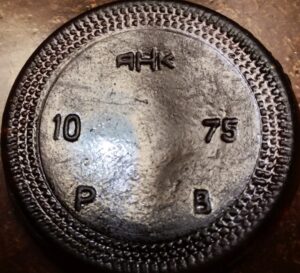
The illustrated shard is captioned as dated 1975; this dates the example.
glass
The image caption identifies as Alexander H. Kerr on an amber beer-bottle shard.
Undated
glass
…………………. Attributed to Alloa Work, Alloa, Scotland. Julian Toulouse writes “Probably circa 1900 to date”.
Undated
glass
…………….. Armstrong Cork Company ( Division), Lancaster, Pennsylvania; Millville, New Jersey [former Whitall Tatum Co. plant] and Dunkirk, Indiana [former Hart Manufacturing Co. plant, acquired by Armstrong in 1938]. Mark was used from 1938-1969 on bottles, jars and electrical insulators. If there is a line underneath the “circled A”, this indicates the bottle was produced at the Dunkirk, Indiana factory location. The entire name “Armstrong” (with a circle around the “A”) is also seen on some bottles. Please see “Armstrong”, as well as the next entry.
Undated
glass
…………………. on earlier handblown or machine-made bottles (unrelated to Armstrong), probably American Works, Richmond, Virginia ( 1907- 1925). This mark has been seen on the bottom of a few light aqua or colorless shoofly (“coffin”) flasks, picnic (“pumpkinseed”) flasks, and rectangular medicine bottles. Those bottles may date before around 1913. See “A G W” entry on this page. For more information on this particular “ ” mark and American Works, please see this article by Bill Lockhart and the Bottle Research Group: American Works – SHA.org
Undated
glass
…………Unknown
Undated
label · glass
see pic). This marking is on the base of a handblown “three-piece mold” dark olive green liquor bottle, with a label for W. Williams & Company, Aberdeen, Scotland, which was in business c.1897-1919. The bottle itself may be American, as the bottle was filled with whisky (in Chicago) that had been shipped over in casks from Scotland. Either the “A” or the “L” could be the first initial of the unknown glassmaker.
Undated
glass
………………. unknown. These initials may stand for a distributing company. They are seen on the base of green floral containers which are similar to types marked “E.O. Brody Co.” and “Hoosier ”.
Undated
glass
……..Adelbert M. Foster & Company, Boston & Chicago (1893-1928). This was almost certainly a jobber / distributor, not an actual manufacturer. The mark appears on the bottom of druggist bottles. For more detailed info on A.M. Foster and related companies, see this article by Bill Lockhart et al: A. M. Foster & Company – SHA.org.
Undated
impressed, painted · glass
…………………. uncertain meaning. These initials have been recorded on the bottom of at least three different bottles: a cylindrical generic chemical or druggist bottle; a rectangular colorless bottle lettered “Dr. Gunn’s Antiseptic – Made for Waco Electric Medicine Co / Waco, Texas” on the front; and a slug-plate type embossed druggist bottle from San Francisco. One possibility could be the “A. O. Goshorn Company” of Cincinnati, OH (a distributor of paint, , chemicals and other goods), but proof of any such connection remains elusive! The initials might stand for an obscure factory.
Undated
glass
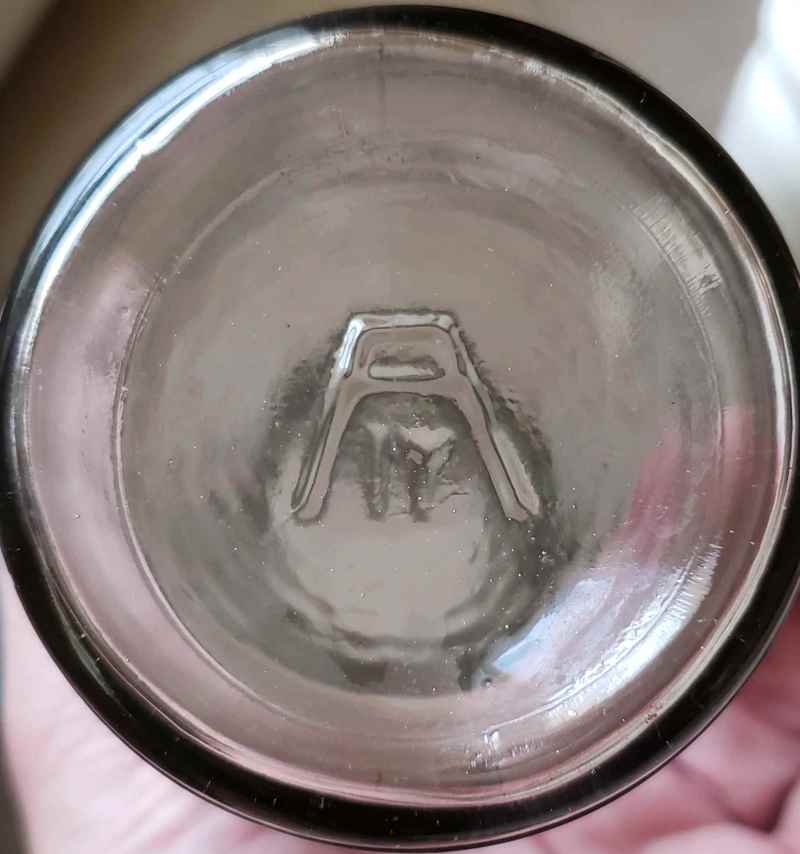
The image caption describes stylized or sawhorse with IT or IY below on clear ketchup-bottle base.
Undated
glass
A (stylized “A” with smaller letters “IT” placed below, somewhat resembling a sawhorse)…………………..unknown meaning. This mark seen on the bottom of a colorless, machine-made ketchup bottle of unknown age, possibly early to mid-20th century. This mark is likely that of a company located outside of the United States.
Undated
glass
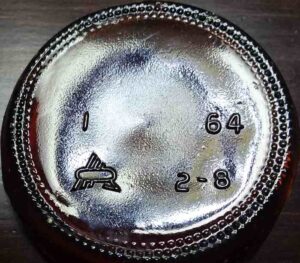
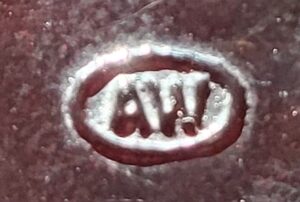
barred triangular design overlain by an oval, as shown in photo above)…………………… American Can Company – Products Division, Cliffwood, New Jersey; Terre Haute, Indiana and Shakopee, Minnesota (c.1963- c.1968). Successor to American-Wheaton Corporation. (See “A W inside an oval” entry on this page, below). Bought out in 1968 by Midland (see Midland mark – stylized M logo, frequently seen on the bottom of stubby type beer bottles). Some more information on this mark and other “A” marks can be found in this article by Bill Lockhart and the Bottle Research Group: Other A Marks – SHA.org
Undated
The illustrated bottle bears a 1964 date code; this is an object date.
glass
The image caption identifies an American Can Company Products Division trademark on an amber beer or soda bottle.
Undated
glass
………….abbreviation for American Telephone & Telegraph Company. See AM TEL & TEL CO entry. The insulators with the marking “A. T. & T. Co.” were all made by Brookfield Company , Brooklyn, NY.
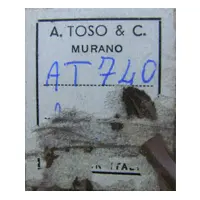
Undated
label · glass · Italy
" " paper pattern number label for Alberto Toso.
Undated
glass
………………………….. American-Wheaton Corporation (headquartered in Millville, NJ), Terre Haute, Indiana (1960-c. 1964). Became American Can Company, Products Division in 1962, that name lasting until about 1967, then operated by Midland Company in 1968. Midland was based in Cliffwood, New Jersey but also operated plants at Shakopee, MN as well as the Terre Haute facility. The marks on actual bottle molds were not always changed (retooled) immediately so there is some date inconsistencies seen on actual bottle bases. Please see “A” stylized logo on this page also.
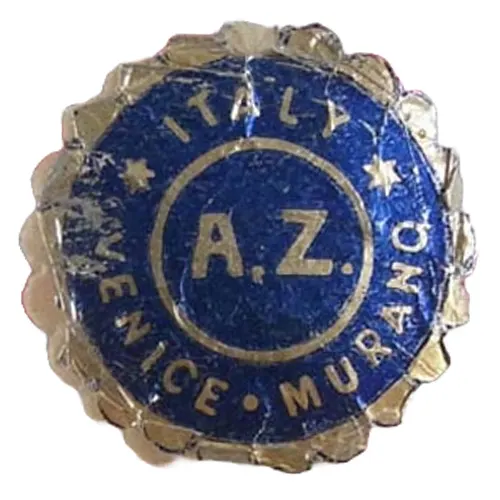
Undated
label · blue, silver · glass · Italy
" " scalloped circular blue & silver foil label.
Undated
glass
…………….. Adolphus Busch Manufacturing Company (1886-c. 1921) and American Bottle Company (1905-1929). Please see link above, and also the “A.B.CO.” mark entry.
Undated
glass
………………….. Please see this page where this mark is discussed in more detail: AB-connected mark on beer bottles
Undated
impressed · glass
………….. Abbott Laboratories, headquartered in Chicago, Illinois (1888- to present) . Although the surname “Abbott” is occasionally seen on bottles from several other, unrelated companies (such as on the C. W. Abbott bitters bottles from Baltimore), in this particular case the name, in a characteristic, rather stylish lettering, pertains to the pharmaceutical giant based in Chicago. The name was evidently embossed on a variety of bottles and jars that contained their pharmaceutical products. In the accompanying photo, the Abbott name is shown as it appears on an amber bottle base. The shard is from a bottle made by Fairmount Company of Indianapolis, Indiana (F inside a hexagon). That bottle probably dates from the 1940s or 1950s.
Undated
glass
……….Bellaire Bottle Company (Works), Bellaire, Ohio (1882-1922). Logo is occasionally seen on the base of handblown clear prescription/medicine bottles. This logo possibly dates from the earlier years of the company, perhaps up to circa 1895. (Thanks to David Bethman for emailing me with info on the source of this mysterious acorn mark!). He reports that the mark appears on a Bellaire Bottle Company letterhead shown in a reference book by Scott Tyson called “ Houses of the 1800s” (1971). For an article with more extensive background material on Bellaire Bottle Company, check out this .pdf file by researcher Bill Lockhart et al: Bellaire Bottle Company – SHA.org
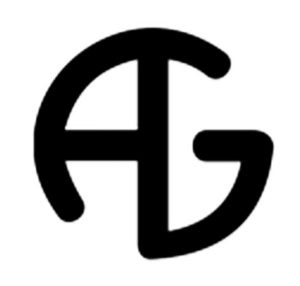
Undated
glass
The image caption identifies the joined A and G monogram as ARCYA Corporation.
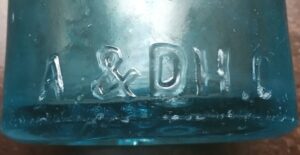
Undated
glass
The image caption identifies on the heel of a blob-top squat Schanzenbacher mineral-water bottle from Louisville, Kentucky.
Undated
glass
……..Anchor Container Corporation. See “Anchor….” entry, farther down on this page.
Undated
glass
……………. Arcya Corporation, Calamba, Laguna, Philippines and Makati City, Manila, Philippines (1966- c.2021?). Exact timeline for this mark is uncertain. The official Arcya website seems to have disappeared from the web by mid-2021. The factory was undergoing employee layoffs and chaos in November and December of 2020, evidently related to the Covid-19 pandemic. I believe this company was later acquired by another firm (possibly BestPak Packaging Solutions ?) sometime after 2021 but don’t have further information/clarification on that.
Undated
glass
……………….. Arkansas Container Corporation, Jonesboro, Arkansas (1956 – to the present). This operation began as McSwain Company in 1948, according to information posted on the company website history page: Arkansas Container Corporation – Our History . McSwain Company had previously operated (as McSwain or under other business names) at factories located at Fort Smith, AR and later at Memphis, TN (producing lamp chimneys and minnow traps at both locations) before moving to Jonesboro. In 1956 the company was purchased by J. T. White along with other investors and renamed “Arkansas Container Corporation”. The first actually produced at Jonesboro under the new ownership was in the fall of 1957. The period of use of this particular mark is unclear, although it seems to have been used at least as far back as the very late 1980s and is still in use today [2024]. The mark is seen currently on grocery store shelves, for instance on packer jars containing certain brands of jellies, preserves and other food products. AGCC apparently specializes in “packer ware” for a large variety of food products sold at retail as well as canning jars for consumers’ home use. An earlier mark used by Arkansas was “g A c” (larger capital “A” with smaller upper case “G” and “C” placed to left and right). See that mark under the “gAc” entry on Page Three . For more background on Arkansas, the McSwain Company and other predecessors of Arkansas , see this recently posted article by Bill Lockhart et al: Arkansas .
Undated
glass
…………See “A & CO.”
Undated
glass
………..See “A & CO.”
Undated
glass
……………….. Alexander H. Kerr & Company (see Kerr Manufacturing Corporation ), making plants at Altoona, Kansas (1909-1912); Sand Springs, Oklahoma (1912-1992); later plants at Huntington, West Virginia (1933-1983); Santa Ana, California (1943-1992); Plainfield, Illinois (1964-1996) and several other locations. Business offices were located in Los Angeles after 1919. The exact name of the Kerr company changed several times over the years. The first use of the AHK trademark by Kerr, according to U.S. Patent & Trademark Office records, was stated to have been on September 9, 1944. This mark was most commonly used on packer ware (jars, jugs and bottles for pre-packaged products sold at retail – such as mayonnaise, pickles, applesauce, coffee, etc.) as opposed to fruit jars for home canning. Most of the packer ware containers do not carry date codes so they can be harder to date than beverage bottles, such as soda and beer bottles which normally do bear date codes. The earliest beverage bottles I’ve seen with the AHK mark have “72” date codes. Julian Toulouse ( Bottle Makers and their Marks, page 44) mentions the 1944 date, but also stated (in the same book) on page 544 that the AHK mark was used “since 1968” which seems contradictory. I believe he may have given that date in reference to when the first beverage bottles were marked with the AHK trademark? Or when Kerr acquired the former Whitall Tatum/Armstrong plant in Millville, New Jersey? For more detailed background info on Kerr and various marks used, see this article by Bill Lockhart et al: Kerr – SHA.org
Undated
impressed · glass
…………… , Castleford, Yorkshire, England (c.1836 – c.1913). This embossed marking is spelled out in a circular formation on the base of a dark olive-amber chemical/packer/utilitarian type bottle, probably dating from sometime in the 1855-1880 period. Also please see “A C B Co” entry.
Undated
glass
…………………….. Airko Manufacturing Company, Clermont, Florida. This mark (often hard to read, and at a glance may be mistaken for Anko, Arko, Aiko or Aiiko) is seen on at least two styles of clear shakers. The most common type features horizontal raised rings or ribs encircling the shaker, similar in appearance to the Depression-era “Manhattan” pattern made by Anchor Hocking. Those shakers apparently date from the 1930s-1950s and their actual manufacture is attributed to Hazel Atlas Company and/or Anchor Hocking (if you know which is correct, please let me know!). They were advertised as featuring a special design that helped keep the salt dry and free-flowing in humid weather. For an example of an advertisement, please see this page: Airko Shakers Advertisement – Chataboutdg.com
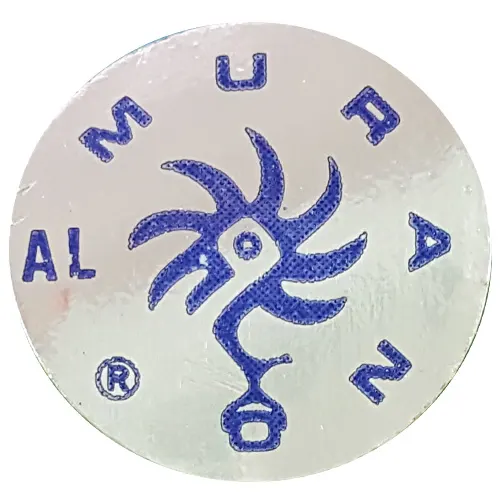
Undated
label · silver, blue · glass · Italy
Murano silver and blue foil circular Rooster label, with " " code.
Undated
glass
………… , Albany, New York (1847-1851). There WAS an earlier factory also called “ ” that existed near Albany (at Guilderland, NY) and that firm lasted from 1785 to 1815. But the bottles marked “ ” are from a later, unrelated company that bore a similar name. An iron-pontiled blob-top soda bottle in cobalt blue, and two types of historical flasks with the bust of Washington on them are lettered with this company name across the front, and those bottles evidently date between 1847 and 1851. HOWEVER, the great majority of flasks with this inscription found today are modern reproductions dating after the 1930s, with most having been produced up into the 1960s or 1970s or even later. If you have a flask with the marking “ ”, it is best to assume it is a repro until proven otherwise!
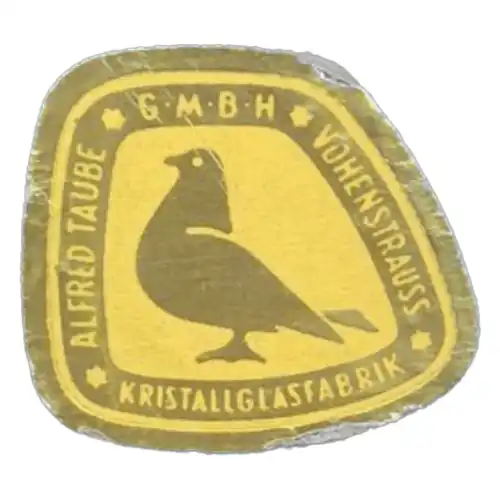
Undated
label · yellow, gold · glass · Germany
" " yellow & gold foil label.
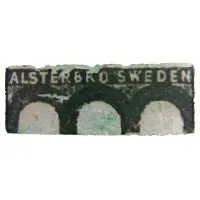
Undated
label · black, white · glass · Sweden
" " black & white rectangular paper label.
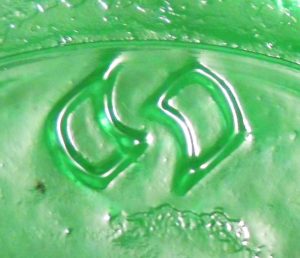
Undated
The caption dates the illustrated bottle to 1990; this is an object date.
glass
The caption identifies the American National Can Company logo on the base of a green soda bottle.
Undated
glass
………………… American Telephone & Telegraph Company (formed in 1885), now known as “A T & T Corporation”, a subsidiary of parent company A T & T, Inc.. Most of the insulators marked with these initials are “toll” (long distance) style units. They were typically installed on long distance telephone lines that often ran alongside roads and highways connecting cities. That type is classed as “CD 121” in the Consolidated Design numbering and identification system used by insulator collectors. They were made by several manufacturers, including Hemingray Company , Brookfield Company , and others. These insulators date primarily from the 1895 to 1915 period.
Undated
glass
………………. mark seen on base of clear whiskey flask, apparently of recent manufacture (c. 2000+). , based in Montreal, Quebec, Canada, maker/distributor of both and plastic containers.
Undated
glass
………………………. Anchor Hocking Corporation.
Undated
glass
………………see Corporation webpage (link above).
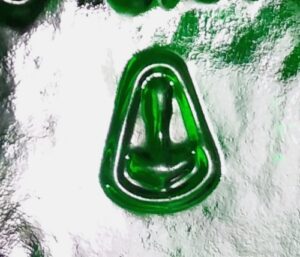
Undated
Listed as active in 1971; the illustrated bottle appears to be from the 1970s–1980s. The duration of mark use is uncertain.
glass · Bernsdorf, Germany
The source identifies an anchor or pickaxe inside a rounded triangle as BSN-Glasspack GmbH & Co, . The illustrated mark is on a green Jägermeister bottle.
Undated
glass
stylized angular “AG” letters, forming an anchor)……………..Anchor Container Corporation, Tampa, Florida [head office], plants at Salem, NJ; Connellsville, PA; Winchester, IN; Shakopee, MN; Henryetta, OK; Jacksonville, FL; Elmira, NY; Warner-Robins, GA and Lawrenceburg, IN (1983-to date). ( Anchor Container Corporation was “spun off” from Anchor Hocking Corporation in 1983). AGCC has produced vast quantities of bottles and jars…………..liquor bottles, food containers, etc. This mark was used from 1983 to 2014. The mark has also been described as a “Mirrored G”. For some more info on this and related Anchor Hocking marks, please check out this webpage on Anchor Hocking Corporation.
Undated
impressed · glass
……………….The pictorial representation of an anchor appears on many liquor flasks spanning (approximately) the 1830-1910 period, and many of these seem to be found in the general Baltimore, Maryland area. It is certain they were made by more than one glassmaker. Baltimore Works certainly made some of them, and no doubt other companies in the Baltimore area also made them. The anchor may be placed either on the base, or on the front of the bottle. A variety of these would make an interesting collection in and of themselves.
Undated
impressed, label · glass
…………..trademark used by Anchor Hocking Corporation. This mark dates from 1945 and was used into the 1950s or possibly later. Most items marked with this trademark have (or had) a foil label affixed, as opposed to permanent raised lettering (embossing) in the . Some Miller beer bottles in ruby red bear the word embossed on the bottom of the bottle. Please see my page on Anchor Hocking Corporation.
Undated
incised · glass
………………………… Kerr Manufacturing Company , Sand Springs, Oklahoma; Huntington, West Virginia; Santa Ana, California and other locations. This logo was used on the base of jelly glasses made by Kerr. I’m not sure about the exact time period it was used, but perhaps during the 1920s-1940s? Sometimes it is hard to be sure what the “angel” graphic is supposed to represent, although I would call it a “Winged Creature”. Dozens of different molds have been identified, each one with the image engraved a bit differently, since the engraving was done laboriously by hand on each mold. On some examples the figure has been characterized as a “bee” or some other type of winged insect.
Undated
glass
………….. see Airko.
Undated
glass
………. APG Europe. Aluglas Packaging Group (based in Uithoorn, North Holland, Netherlands) merged with Verbeeck Packaging Group (based in Belgium) to form this company in 2017, specializing in a variety of and plastic containers, especially for the pharmaceutical industry, but for food and other products also.
Undated
glass
…………………Arbogast & Company (Alexander Arbogast), Pittsburgh, Pennsylvania (c. 1860-c.1863). See “A. Arbogast” entry. Obscure manufacturer that specialized in blackglass bottles. More detailed information on this operation (and many others) can be found in Glasshouses and Manufacturers in the Pittsburgh Region 1795-1910 (2009) by Jay W. Hawkins.
Undated
glass
……………… Brand name used by Arc International, France, for their commercial-grade glassware. Please see my page on .
Undated
glass
………….. see the “AG mark” entry, above on this page.
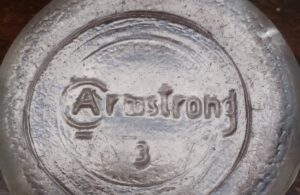
Undated
glass
two arrows, attached, but pointing in opposite directions)………………… Beatson Clark & Co. (Beatson Clark Limited), Rotherham, South Yorkshire, England, UK (first incarnation of firm dating back to 1751)………… please see illustration near bottom of Page Five – listed there along with some other marks that are hard to describe or categorize.
Undated
glass
…………………….. Anchor Container Corporation (1983-to date). Although this mark is another version of a “stylized anchor logo”, I would also characterize it as a “downward pointing arrow”. This is the most recent mark used by Anchor Container on their bottles and jars, and typically appears on the lower heel area of the container. This mark was introduced in 2014. Anchor Container Corporation is based in Tampa, FL (business headquarters) with 6 bottle manufacturing plants (as of 2019) located at: Shakopee, Minnesota; Lawrenceburg, Indiana; Elmira, New York; Henryetta, Oklahoma; Warner Robins, Georgia and Jacksonville, Florida. Two support locations (mold fabrication, equipment repair, etc.) at Zanesville, Ohio and Streator, Illinois, were closed in 2018. For more info on this company and related companies, please see the “Anchor” marks, shown above, and my page on Anchor Hocking Company.
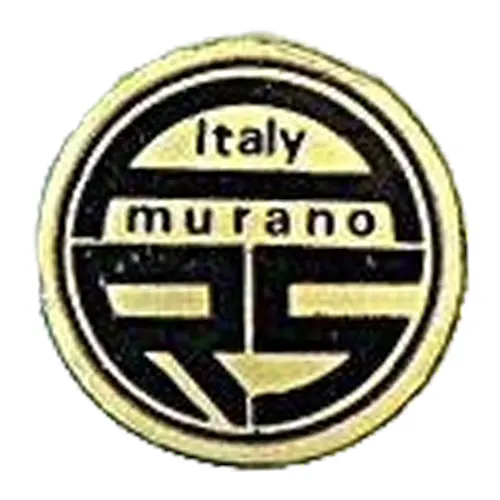
Undated
label · black, gold · glass · Italy
" " oval black & gold foil label.
Undated
impressed · glass
………. Arsenal Works, Pittsburgh, PA (1865- c. 1869). The lettering embossed inside oval frame on lower front of figured flask, with eagle design on one side, and the image of a prospector, miner or traveler (with a “hobo stick” or bindle on his shoulder) on the reverse of the flask. The flasks are found in 3 different styles and are uncommon. (See also A. G. W.)
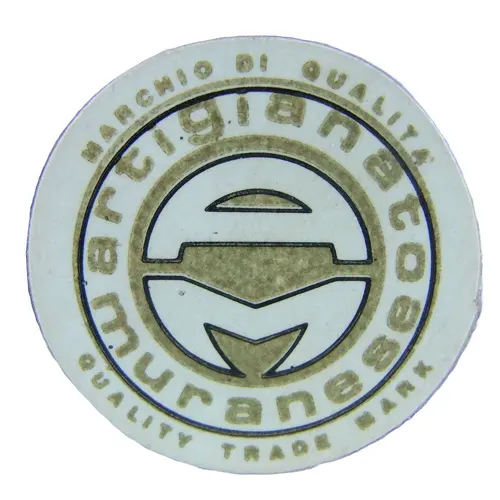
Undated
label · glass · Italy
" " paper label.
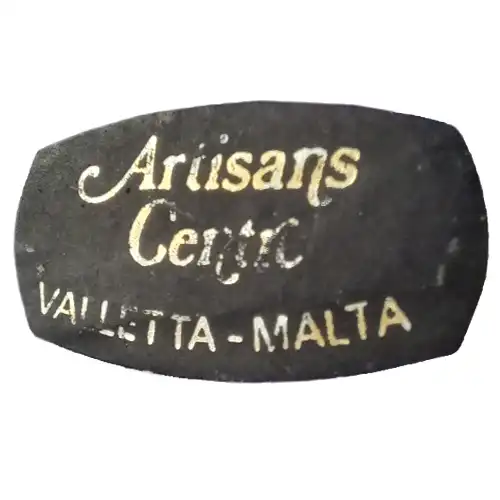
Undated
label · black, gold · glass · Malta
" " black and gold oblong paper retailer label.
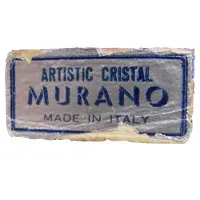
Undated
label · silver, blue · glass · Italy
" " silver and blue rectangular foil label.
Undated
glass
………………. brand name seen on the base of clear druggist bottles. This line of druggist bottles was manufactured by Obear-Nester Company, East St. Louis, Illinois (1894-1978). (See the Obear -Nester Company – “N in a square” webpage ). The bottles might have been produced sometime in the 1917-1926 period. One example, marked “ T. Ed Litt Drugs, Tucson, Ariz .” can be seen illustrated on page 105 of Michael R. Miller’s reference book “ A Collector’s Guide to Arizona Bottles & Stoneware “(1999).
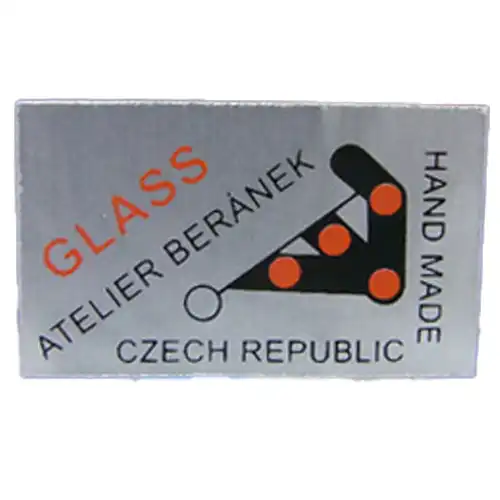
Undated
label · black, red, silver · glass · Czech Republic
" " black, red & silver rectangular foil label.
Undated
glass
………………….. Hazel-Atlas Company .
Undated
glass
……….Atlas Company, Washington, Pennsylvania (1896-1902), and the Hazel-Atlas Company , Wheeling, West Virginia and other plant locations. (1902-1964). The ATLAS fruit jars were made in large numbers, with many minor variations, over a very long time.
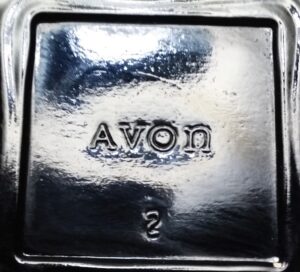
Undated
The caption dates the illustrated bottle to around 1970; this is an object date.
impressed · glass
The image caption describes embossed on a black- Pot Belly Stove men’s cologne bottle, around 1970.
Undated
The illustrated Orange Crush bottle bears a 1964 date code.
glass
The image caption identifies inside an oval on an amber Orange Crush bottle.
Undated
glass
………… Baker & Adamson Chemical Company (1881-1913). Producer of acids and other chemicals. Although not the mark of a factory, this may be mistaken for one. Seen on the base of chemical and acid jars and bottles, most of which probably date from the early period — 1881 to 1900. B&A was bought by General Chemical in 1900, and in 1913 General became a division of Allied Chemical & Dye Corporation, later Allied Chemical Corp. ACC merged into Allied-Signal and that company is now part of Honeywell, Inc.
Undated
glass
……………………. Bagley & Company, Knottingsley, Yorkshire, England, UK (1871-c. 1960s) . All three variations of the mark have been observed, and are believed to be from the 1890s-1920s period. They are seen on various pickle bottles and other condiment/food bottles. Bagley & Company Limited was incorporated as such in 1898 so the marks that include the “LD” or “LTD” presumably date after that year. For more background information on this company, please see Bill Lockhart’s article at this URL: Bagley & Company – SHA.org
Undated
impressed · glass
…………….. Uncertain, but possibly Bagley & Company, Knottingsley , England (see next entry). Triangle has number “500” embossed within, on the example reported, but perhaps a different number appears on other containers? Handblown, odd lip jar, off-clear w/perhaps faint grey-amethyst tint. (Reported by Sam Lawson).
Undated
glass
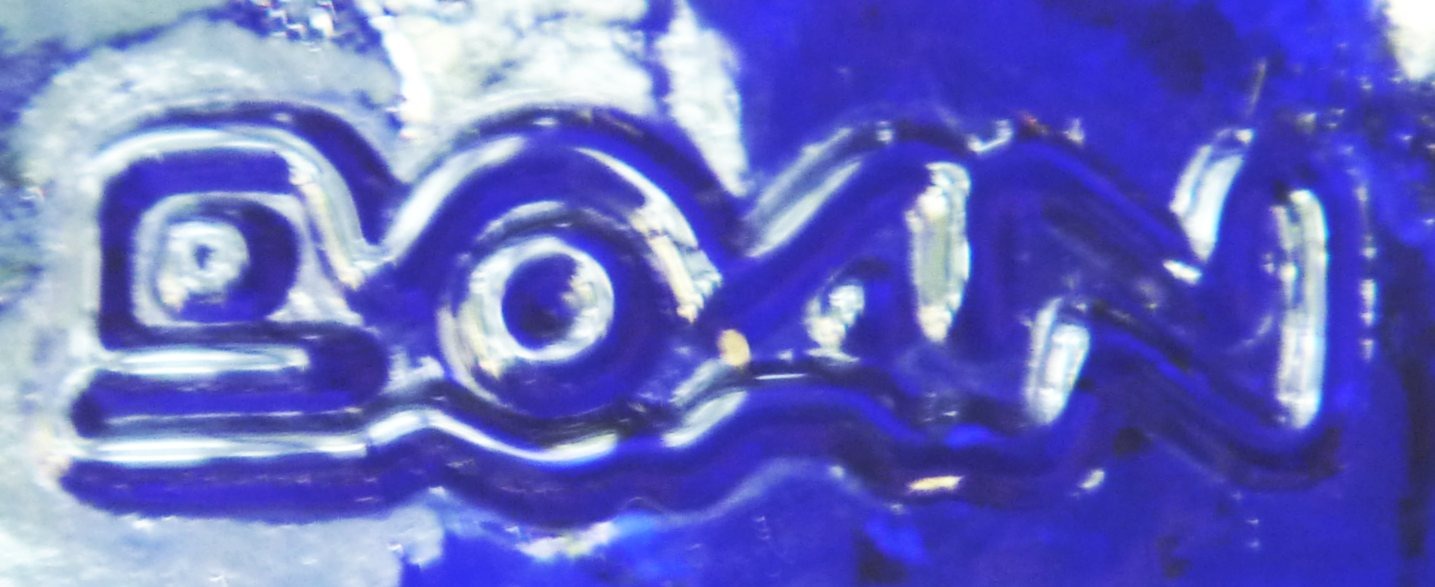
The caption identifies on the bottom of a cobalt blue Roman Gladiator jar or vase.
Undated
glass
…………….unidentified with certainty. Seen on base of pickle or “chow chow” bottle, probably from Great Britain. A possibility would be Thomas Barron & Sons, an obscure bottle maker operating circa early 1890s. The initials are also found on the bottom of some Worcestershire Sauce bottles, also indicating an English origin.
Undated
glass
……….. possibly Burgin & Wood, Millville, NJ (c. 1827-1829)
Undated
glass
……………….. uncertain meaning.
Undated
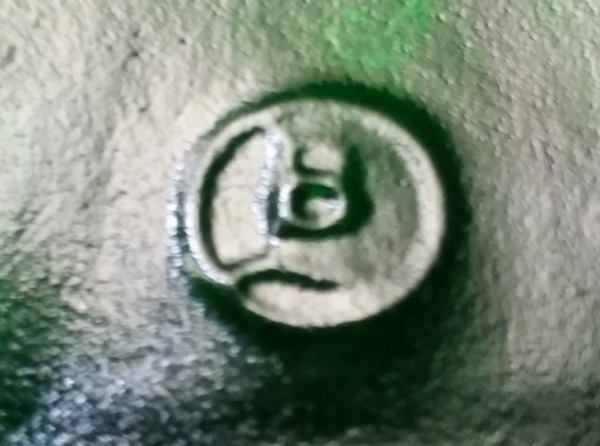
The caption tentatively dates the illustrated bottle to the 1970s or 1980s; no use interval is established.
glass · Germany
The image caption identifies with a wavy underline inside a circle as Glashutte-Budenheim GmbH, , on a green Jägermeister bottle.
Undated
glass
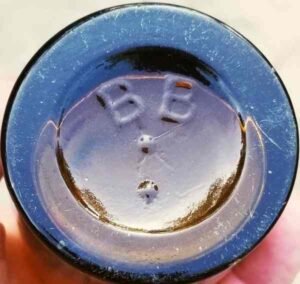
The image caption describes on an unidentified applied-lip yellow olive amber mineral or soda-water bottle, probably from Great Britain.
Undated
glass
……………… Baker Bros. & Company (proprietors of the Baltimore Works), Baltimore, Maryland (1852-1905). Mark seen on the base of Baltimore-area aqua blob beer bottles from the c. 1880-1895 period. (Thanks to Greg Franklin for supplying info on this mark!)
Undated
glass
B B (as seen on base of “generic” yellow olive amber mineral water or soda bottle with applied lip, probably of British origin)……………………..unidentified with certainty, but this mark might stand for Bateson Brothers, Liverpool, England. The Bateson Brothers glassworks operated for many years from the late nineteenth century and well into the 20th century. (Thanks to Jimmy Bray for the photo, and Sandi Ratch for her help with research info).
Undated
glass
……………in most cases, probably Bell Bottle Company, Fairmount, Indiana (c. 1913-1915). Bell Bottle made milk bottles, so if the mark is on a milk bottle, Bell is the most likely source. Other possibilities include Berney-Bond Company (1905-1930, see B.B. G. Co. entry below), and Bellaire Bottle Company, Bellaire, Ohio (c.1885-1921+). The “ ” or “BB Co” initials are also sometimes seen on the front of some beer bottles and other types of unrelated bottles and in those cases the initials don’t pertain to a manufacturer.
Undated
glass
………….Berney-Bond Company (1905-1930). A merger of the Bond and Berney companies, plants were located in Bradford, Hazel Hurst, Smethport, Clarion, and Knox, all in the state of Pennsylvania; the Winslow Co. plant at Columbus, Ohio was purchased in 1927. Berney-Bond was bought by Owens-Illinois in 1930. Most of these plants were closed down in later years, until by the early 1970s only the Clarion plant (Owens-Illinois plant #17) was still making bottles.
Undated
impressed · glass
…………Bartlett-Collins Company, Sapulpa, Oklahoma (1915-1929); Bartlett-Collins Company (1929-2008). mark (the letters enclosed in conjoined circles) was evidently used on milk bottles for a relatively short time – as early as 1917 (see sha.org article link below). This mark was registered as a trademark in 1947 with “first use” stated as June 23, 1932 – but on pressed tableware such as tumblers, goblets, coasters, sherbet glasses, etc. Manufacturer of a wide line of tableware over the years, Barlett-Collins later became a subsidiary of the Lancaster Colony Corporation (owner of Indiana Company after 1957). Bartlett-Collins produced items such as jars, mugs, canisters and votive candle holders under the brand name “Indiana ”. The Bartlett-Collins plant was eventually purchased by Anchor Hocking Company, and shortly thereafter closed down (as of June 2008). Items made there during the Lancaster Colony Corporation years, in general, do not carry an embossed maker’s mark. A sister plant operated by Lancaster, located at Dunkirk, Indiana (the original “Indiana Company” factory) ceased production of in 2002. See “Indiana ” and “LCC” marks. For much more detailed info on Bartlett-Collins and the history of the Premium Company and other organizations involved in the earlier history of the plant, see this article written by Bill Lockhart et al: Bartlett-Collins – SHA.org
Undated
glass
………………….Beaver Flint Company, Toronto, Ontario, Canada (1896-1939). Maker of druggist, nursing, and other medicine bottles in clear and cobalt blue , mostly found in Canada. The Beaver Flint Co. was evidently primarily a jobber, not an actual bottle manufacturer, and probably sold ware made by Diamond Flint Company, Diamond Company and later Dominion Company in Canada. Also, see next entry.
Undated
glass
………. Beaver Falls Company, Beaver Falls, Pennsylvania (1869-1879). This mark is seen on a few early telegraph insulators (all rather uncommon) as well as on certain blob top soda/mineral water bottles of the 1870s. Of course, this company had no connection whatever with the Canadian firm mentioned in above entry. Here’s an article listing the various types of insulators attributed to Beaver Falls Co: Beaver Falls Co – Insulators.info.
Undated
glass
…………. this mark was used by a number of different companies, and there is still uncertainty on absolute attribution in many cases. On earlier blob-top “export style” beer bottles and soda bottles, usually Belleville Company, Belleville, Illinois (1882-1886). The Belleville factory was purchased by Adolphus Busch Manufacturing Co. in 1886, and presumably the B G CO mark was discontinued soon after, being replaced by A. or A.B.G.M.CO. The “ ” mark was also used by Burlington Works, Hamilton, Ontario, Canada (1875-1909) on the face of their “Burlington” fruit jars. A Moxie soda bottle variant with a crown lip carries the mark, and in that case would have been made by an unidentified factory some time after 1892 (the year the “crown” style lip was introduced). “ ” is also reported on the heel of a light green crown lip Anheuser-Busch Brewing Association beer bottle that appears to date from the 1910s or 1920s. The maker is uncertain. On some milk bottles, B. G. CO. was apparently used by Buck Company, Baltimore, Maryland. (Buck normally used just a “B”). Binghamton Company, Binghamton, NY (which used a “B in a diamond” mark on a few bottles) is another possibility in some cases, although there is no proof of this. If you have information that could shed more light on the BGCO marks, please contact me.
Undated
glass
B G W (on the side of a “fat” dip mold ale or stout bottle, possibly c. 1800-1830, found in the Baltimore, MD area) ………………… Uncertain meaning, but it is possible the initials, in this particular case, stood for the Baltimore Works. See this webpage: Black Ales of 1780-1820 – The Bottle Den . (Also, see “Baltimore Works” above, also next entry).
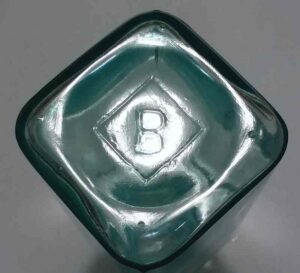
Undated
glass
The image caption identifies inside a diamond on a blue-aqua horseradish or pickle bottle made by Binghamton Company.
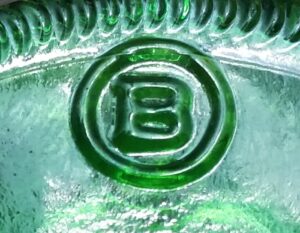
Undated
glass
The image caption identifies Brockway Company’s in a circle on an emerald green soda bottle.
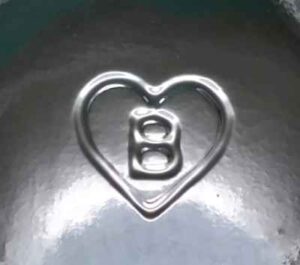
Undated
glass · Chicago, Illinois
The image caption identifies inside a heart as Berlin Packaging, , on a clear packer jar.
Undated
glass
……………. this mark has been seen on the bottom of some aqua ink bottles made in England and they have been attributed to Bateson Bros, Liverpool (1891- 19??), according to info in the reference book Ink, Glue, Polish & Blacking Bottles 1750-1950 by Guy Burch (2023).
Undated
glass
……………. Binghamton Company, Binghamton, New York (1880-1957). This mark has been verified on a few bottles. It likely dates from sometime in the 1880s-1910s period. For more information, please see this page: Binghamton Company, Binghamton, NY. Also, see next two entries.
Undated
glass
……………….. Berlin Packaging L.L.C., corporation headquarters based in Chicago, Illinois (1988 to present). This company is a large supplier of , plastic and metal containers, with many distributing warehouses located worldwide. Berlin evidently wholesales the products of a number of glassmakers around the world, so the exact manufacturer ( factory) that produced any particular container bearing this mark may not be easily identified. According to information on Justia.com, the “B in placed inside a heart” trademark has been in use by Berlin Packaging since June of 2016.
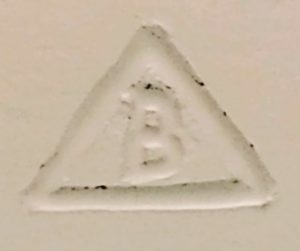
Undated
glass · Cambridge, Ohio
The source identifies in a triangle with Guernsey Company, ; the stands for proprietor Harold Bennett. The illustrated mark is on a frosted light green rabbit dish. Only a small proportion of the firm’s products may have carried it.
Undated
glass
……………..Fahnstock, Fortune & Company, Pittsburgh, Pennsylvania (1866-1873). Mark seen on the base of wax sealer and “Kline stopper” type fruit jars. This company was evidently sold to Evans, Sell & Company in 1873. See “F. A. & Co” and “E. S. & CO.” marks.
Undated
impressed, label · glass
………………….. Benton, Myers & Company, Cleveland, Ohio (c. 1876-c. 1904). This mark appears boldly embossed on the bottom of a mouthblown, applied lip “ginger oval” or bluing type bottle in light aqua . That bottle is a standard “generic” type with embossing only on the base, and the example bears a paper label for “Dr. Frazier’s Root Bitters” which was an obscure brand of bitters from Cleveland. The bottle itself was made by an unidentified glassworks, likely of 1870s or 1880s vintage. The mark has also been seen on the front of two variations of clear “turtle” style baby nursing bottles from the 1880s – one type has the B M & Co lettering placed inside an eight-pointed star, and another one with the lettering inside a diamond. Benton, Myers & Company, apparently a longtime wholesale jobber of drugs, liquor and other items, was previously named “Benton, Myers & Canfield” – at least as early as 1864, possibly earlier.
Undated
impressed, painted · glass
………………………… Unknown meaning (Seen on base of amber quart “blob lip” beer bottle, c. 1885, shown here in pic). The bottle is an “Apollinaris” or “Champagne” style (profile) bottle. “PAT 85” is referring to William Painter’s patent for his so-called “Baltimore Loop” seal, issued on September 29, 1885 (Patent number 327,099). The “Pat 85” embossing appears on the bases of many bottles (both beer and soda) made by a number of companies in the mid and late 1880s. Although it has been proposed by some researchers that this mark is merely a mold-cutting error for “D.O.C.” (see that entry), I am doubtful and believe that this actually does stand for an obscure, short-lived company, brewer, or beverage bottling company with those corresponding initials. ( NOTE : Some local Louisville-area bottle collectors believe the “ ” stands for BOCHART (F. & P. Bochart), a bottling company based in New Albany, Indiana (c. 1890-1907). This may be correct, however, no definitive proof has been so far discovered, and it is extremely unusual, if not unknown, for a base marking to consist of the first few letters of a surname. But, the fact that the only known examples of this bottle were found within less than 30 miles of New Albany is evidence this COULD be Correct!!). The embossed lettering is very strong and bold on this bottle. Note: If anyone comes across a bottle with the “ ” mark on the base, I would love to hear from you (see the Contact Information page ). If the location of finds can be noted, this may give us more clues pointing to the area (city, state) where these bottles were most likely made and used. Currently I know of only two examples of the bottle, both found in southern Indiana towns near Louisville, KY. There are surely others out there hiding in collections, tucked away in attics, or just waiting to be dug!
Undated
glass
…………Uncertain. In some cases, perhaps Buck Company. See next several entries. The letter “B”, in some cases, might be just a mold identifier letter, with no indication of the glassmaker.
Undated
glass
…………………Bakewell, Page & Bakewell, Pittsburgh, Pennsylvania (1824-1836)
Undated
glass
………… Beck, Phillips & Company, Pittsburgh, Pennsylvania (c.1866-1871). Mark seen on the base of wax sealer fruit jars. Some similar jars are found lettered “Beck, Phillips & Co. Pitts. Pa” in a circle on the base. The firm name was changed in 1871 to “Phillips & Company”, so presumably the “B.P.& Co.” mark was no longer used after the name change. By about 1882 the company was producing only window , and finally closed around 1900. More detailed info in Jay Hawkins’ reference book about Pittsburgh area glassmakers.
Undated
glass
……………Brunswick Pharmacal Company, New Brunswick, New Jersey. Seen on small cobalt medicinal bottles, dating perhaps from about 1895-1930. Bottles are also marked with a “back-to-back PP” inside a circle. Actual manufacturer is unknown, but Maryland Corporation, Baltimore, MD (a prolific maker of cobalt blue bottles after 1907) could be one possibility. The “ .” marking bears no relationship to the next entry.
Undated
glass
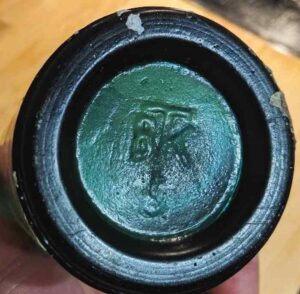
……… Uncertain. See “W superimposed over B” entry on page 5 (S-Z marks).
Undated
impressed · glass
The image caption describes on a teal aqua-green bottle without identifying its maker.
Undated
glass
……………….. B. W. O’Neil & Company, Boston, Massachusetts (c. 1882- c. 1918). Initials seen on the base of strap side style liquor flasks. Although this firm claimed to manufacture , it was actually a distributor / jobber of glassware, bottles, tumblers, druggist’s items, etc. So the actual glassmaker of bottles with this marking is uncertain. See a 1911 ad for the company on this article by Bill Lockhart and the Bottle Research Group: Other “B” Marks – SHA.org
Undated
glass
…………….sometimes Brockway Company, Brockway, Pennsylvania (1907-1988). See Brockway Company: “B in a circle” mark.
Undated
glass
………often the Chas. Boldt Company, (also at times known as Chas Boldt Company or Chas Boldt Manufacturing Company), Cincinnati, Ohio and Huntington, West Virginia, at least on many of their early liquor bottles and other ware made in the circa 1900-1919 period. NOTE : Manufacturer attributions of bottles with a “B” on the base are very confusing and (in my opinion) not completely certain. More information on the Chas. Boldt marks can be found here: Boldt Company – SHA.org .
Undated
glass
…………… Glashütten Budenheim GmBH, Budenheim, Rhineland-Palatinate, Germany. This operation was formed in 1904 and bottle production was started in 1905 (making green champagne bottles in the very beginning). The company later became part of Gerresheimer . This mark is illustrated with a line drawing in Toulouse (BM&TM, 1971-page 578), and stated to date from 1965. Uncertain how long the mark was used after 1965, perhaps into the 1980s? See photo of mark (above) as it appears on base of an emerald green Jagermeister bottle. That bottle is also marked “W. GERMANY” on base which would presumably date it before 1989.
Undated
glass
………….in some cases, perhaps Buck Company, Baltimore, Maryland (c.1909-1961). Buck was sold to Knox , Inc. in 1961.
Undated
glass
B Z (Letter “B” positioned above a larger “Z”, on the base of paperweights)………….. Zimmerman Art Company, Corydon, Indiana (1963-to present). This particular mark indicates a piece made by Bart Zimmerman (one of two sons of owner Joseph Zimmerman) who joined the company in 1983. Tragically, in August of 2008, Bart (along with another victim) drowned in an attempt to help rescue some fishermen whose boat had overturned in a boating accident on the Ohio River below Cannelton Dam. Also, see “K Z” and “Z” entries.
Undated
glass
…………. B A Vidro (B A Group or B A ) , based in Avintes, Portugal, the “2” indicating production at Marinha Grande, Portugal (1912-to date). B A (originally Barbosa e Almeida) has a long history of production with various mergers and acquisitions over the years, now owning/controlling factories in Portugal, Spain, Germany, Poland, Romania, Bulgaria, and Greece. According to the Bucher Emhart punt mark database, they use various plant numbers (from “1” to “12”) positioned to the right of the “B A” to identify various manufacturing locations, as shown in the database here: Punt Marks on Containers Worldwide ~ Emhart . According to their website, BA now exports containers to about 80 countries worldwide. A history / outline of the company is here at this webpage: BA – History page
Undated
glass
…………………… Brothers Manufacturing Company/ Brothers Company ( Corporation after 1969), Muncie, Indiana and other locations (1888-1998) . Please see Bros Manufacturing Company page for a brief summary of this company.
Undated
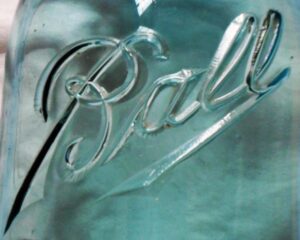
The illustrated BALL PERFECT MASON jar is captioned as approximately 1910–1923; this dates the example.
glass
This PERFECT MASON jar dates to about 1910–1923; cursive lettering changed several times.
Undated
glass
…………….see the Jars page for a brief summary of this popular jar, as well as some background info on the Ball Bros Manufacturing Company page.
Undated
glass
………………. , Baltimore, Maryland (c.1800-1905, which includes a succession of firms). Various flasks and bottles are marked with the full factory name, and the majority of these probably date between 1830 and 1870. Also, see B.B. & Co.
Undated
glass
…………. trademark used by Obear-Nester Company , East St. Louis, Illinois (1894-1978), for one of their lines of druggist bottles. Confirmed on the base of a clear rectangular pharmaceutical/prescription bottle. According to Arthur G. Peterson’s “400 Trademarks on ” this was used beginning in 1899. No information on ending date.
Undated
glass
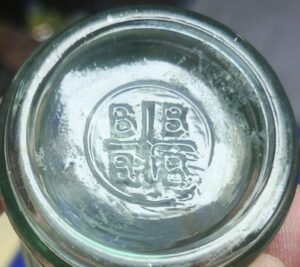
The image caption describes on a light green-aqua ink bottle without identifying its maker.
Undated
glass
BBBB / B B B B (Cross or “Plus” sign (+) with four letter “B”s – one letter placed in each quadrant)…………… Unknown / unidentified (shown here). This mark has been seen on the base of a few handmade ink bottles, possibly made in Great Britain sometime in the late 1800s or early 1900s. If you know what this mark stands for, please let us know!
Undated
glass
……..Ball Brothers Manufacturing Company, Buffalo, New York (used on fruit jars c.1886-1888 before move to Muncie, IN.) See “Ball” .
Undated
label · silver, blue · glass · Italy
Murano silver and blue foil rectangular Rooster label, with " " code.
Undated
impressed · glass
Bee (insect, an image of a bee with the letters “H” in left wing, “I” on body and “G” on right wing)………………. John B. Higbee Company, Bridgeville, Pennsylvania (1907-1918). Seen on pressed tableware and novelties, most commonly in clear . NOTE: this mark, or a very similar mark, has also been embossed on reproductions made by other companies in later years, although in those cases the “Bee” is said to have no letters visible. I would strongly recommend more in-depth research on Higbee and the they made before attributing a particular item to that factory.
Undated
glass
“Belt Buckle” logo (oval shape with line through center) ……….Western Manufacturing Company, Valverde (Denver), Colorado (c.1900-1909).
Undated
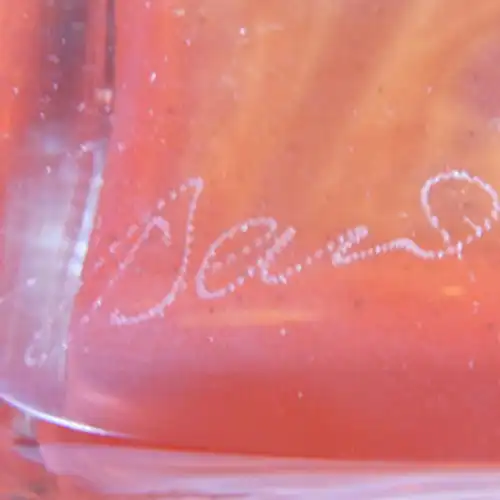
glass
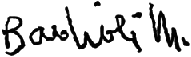
The source tentatively reads this signature as and reports it on Atelier Beranek .
Undated
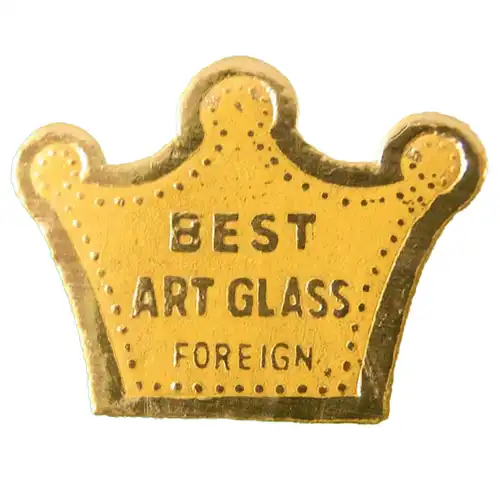
label · yellow, gold · glass · Japan
" " yellow & gold crown shaped foil import label, found only on Japanese .
Undated
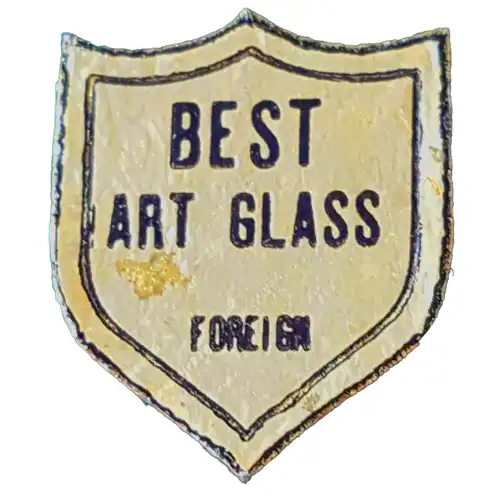
label · black, gold · glass · Japan
" " black & gold shield shaped foil import label, found only on Japanese .
Undated
glass
……………….Ball-Foster Corporation (mark used 1995-2000). In 2000 became Saint-Gobain Containers, with the SG mark being instituted. See Ball Bros Company .
Undated
glass
BI (or “I B”, a stylized logo/monogram consisting of “B” with lower-case dotted letter “I” incorporated within the letter “B”)……………………Ball-InCon Packaging Corporation (mark used 1987-1994). Ball-Incon was formed as a merger of the plants owned by Ball Corporation, combined with the Indianhead Container Corp which consisted of plants at Laurens, SC (the Laurens Works plant); Port Allegany, PA; Madera, CA and other locations. See Ball Bros Company.
Undated
glass
………………….. three logos were used by Phoenix Packaging, based in Montreal, Quebec, Canada (1980- to date). A reader of this page, Dawn High, who was trying to find the user of one of these “bird logos” as it appeared on the base of an olive oil bottle/cruet, introduced me to this (formerly unidentified) mark. Now, thanks to Joel B. Miller, more info can now be published revealing the user of these marks! Two “older” logos (both with a more “horizontal” look) were used from approximately 1980 to 2014. Their third bird logo (with a somewhat more “vertically oriented” design) is currently in use, introduced on new molds in 2014. Phoenix Packaging contracts with many customers around the world to have special container designs produced to their specifications. Many different bottles and jars have been made, as well as packaging in other mediums such as ceramic, plastic, wood, metal, etc. Several dozen manufacturers have been involved at some time over the last few decades, including well-known container firms such as O-I and Verallia. (Thanks very much to Joel B. Miller for info and photos of those logos shown here).
Undated
glass
………………… S. M. & Company, New York, New York. (1862-19?). For a brief summary of this company, see this page: S. M. Company Bottles .
Undated
label · glass
………………………….. Blenko Company (began 1893, later, at Milton, West Virginia since 1921). Maker of beautiful hand-made blown in a wide range of bright colors; the most popular item ever produced would be their widely-recognized “Water Bottle” with a very characteristic shape. This bottle has been made in many, many colors since 1938. A wide variety of handmade items are produced, some of them from hand-carved wooden molds as well as iron molds. Very few Blenko articles were marked (in the itself), but here is a page with more info on various Blenko marks and labels: Blenko Marks – BlenkoCollectors.com The official Blenko Company website is here: Blenko.com
Undated
impressed · glass
…………………. Standard Company, Marion, Indiana (1906-1933). Trademark is found embossed on the bottom of their line of clear (“flint”) rectangular druggist/drugstore/pharmacy/prescription bottles. The bottles are found in a range of sizes, and either “plain” (unlettered), or with a “plate mold” embossing – bearing personalized raised lettering for a local druggist, often with street address, city and state. This “ ” trademark was first used in 1908, according to information published in Arthur G. Peterson’s 400 Trademarks on (1968). Standard Company was bought by Foster-Forbes Company in 1933.
Undated
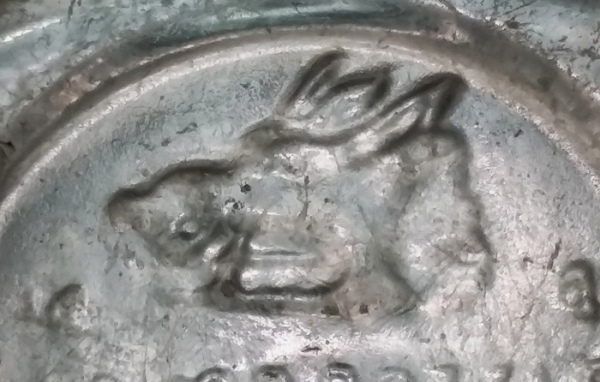
impressed, label · glass
The image caption identifies a boar’s-head trademark on a colourless Gordon’s Dry Gin bottle base.
Undated
glass
………………………. trademark seen on base of “Gordon’s Dry Gin” liquor bottles. Gordon’s Gin was introduced in 1769 by Alexander Gordon who established a distillery in London. The product was originally sold in pottery/stoneware/ceramic bottles, but bottles were introduced in about 1904. (Some sources state the transition started as early as 1898). The boar (wild pig) design varies somewhat from one bottle to another, since hundreds of different bottle molds have been produced over many decades – made by many companies, and a number of different mold-cutters (mold engravers) have produced the designs since 1904. The raised design is sometimes poorly delineated, crude or unclear, and has occasionally been likened to the representation of a wolf, wild dog, crocodile, peccary, dragon, wild hare, or other untamed beast. The boar is usually pictured with an open mouth, facing left, showing bared, dangerous-looking teeth -the teeth more prominently visible on some bottles than on others. The photo above shows the emblem on the base of a colorless Gordon’s Gin bottle base shard – heavily scratched and worn. Whole or partial bottle bases with this trademark are sometimes found as “beach ” or “sea ”. Gordon’s Gin bottles have been found in clear, off-clear, light aqua, light green and shades of darker green. Most of the green bottles were/are produced in Great Britain, and clear or off-clear bottles have been typically produced outside Europe. A distillery was established in Linden, New Jersey in about 1934, and some bottles bear that city name on them. I’ve seen bottles made by Brockway (B in a circle), Owens-Illinois (Diamond/oval/I, and later, I inside an O) and Diamond Company, Royersford, PA (plain Diamond logo), although there are likely bottles out there made by many other glassmakers. (Most of the Gordon’s Gin bottles made in the first several decades of container packaging were produced in England or Scotland).
Undated
glass
can be quite variable in appearance, usually with a wide-open mouth and strong teeth, facing left, design sometimes mistaken for a wolf, hare, dragon or other wild beast, as seen on the bottoms of Gordon’s Gin (“Gordon’s Dry Gin”) bottles, often found as beach/sea . For more info, please see my entry for “Boar’s Head” on Page One of the marks pages.
Undated
impressed · glass
…………….. Extract Company, Chicago, Illinois (Gustav Augustus , proprietor). Mark seen on the heel of a few hutch soda bottles. evidently manufactured bottles from c. 1890 to 1892 (or contracted with an unidentified glassmaker to have them produced with his name embossed on the heel), but thereafter concentrated on the production of extracts. He passed away in 1900. Thanks to Joel Ferguson for sending me this info!
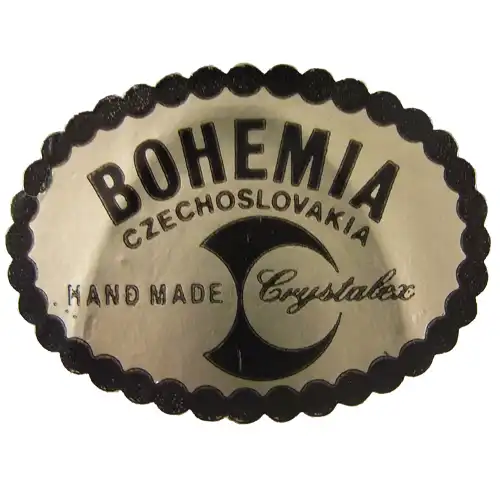
Undated
label · black, gold · glass · Czechoslovakia
" " " black & gold oval foil label.
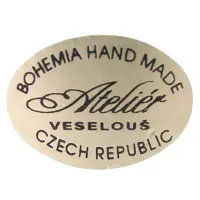
Undated
label · black, gold · glass · Czech Republic
" " black & gold oval foil label.
Undated
glass
………………. Chas Company, Cincinnati, OH and Huntington, WV (1900-1926). For much more detailed info on the various marks used by this company, see this webpage: Charles – SHA.org
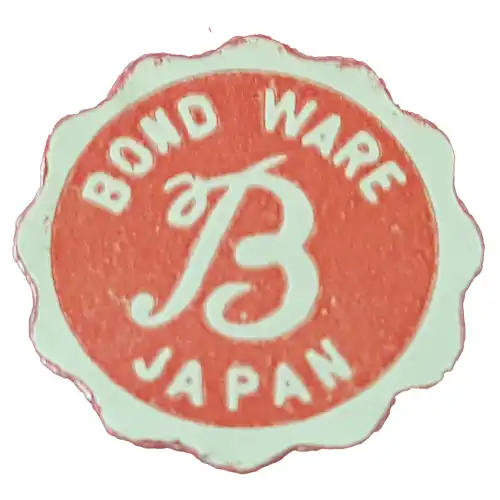
Undated
label · red, white · glass · Japan
" " red & white scalloped circular paper import label.
Undated
impressed · glass
Bottle inside an oval (embossed design/emblem showing a bottle inside an oval, seen on the base of green “Ten Pin” or bowling pin style soda or mineral water bottles which appear to be of British origin)…………….unknown meaning, but presumably the mark of an unidentified bottle manufacturer from Great Britain. Please see this webpage: Bottle within an oval mark.
Undated
glass
…………… marking seen on white milk inserts (discs, small “saucers” or lids) used with zinc lids on “Mason” type fruit jars. Please see this page for more information: Boyd’s Genuine Porcelain Lined Cap.
Undated
glass
…………… , Bridgeton, New Jersey (c. 1855-c.1870) . The full factory name is spelled out across the face of several known soda bottles. This factory operated under the ownership of at least three or four different business firms during it’s long history, including J. Bodine & Sons. The bottles with the actual “ ” embossing are generally believed to date from the 1855-1870 period, but it’s possible some bottles with that marking might date somewhat earlier.
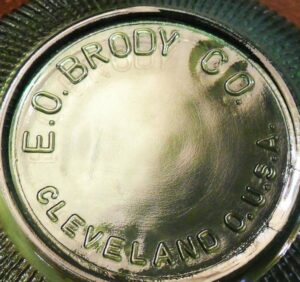
Undated
impressed · glass
The image caption identifies on a green florist bowl.
Undated
glass
………………… E.O. Brody Company, Cleveland, Ohio (1958-to date). This is not a company, but a distributor of products made especially for the florist industry. For more information please check out this page: E. O. Brody Company .
Undated
impressed · glass
………………………. Bromo-Seltzer was an extremely popular drug, in the form of a powder, introduced by Isaac Emerson circa 1888. The great majority of Bromo-Seltzer bottles were made in cobalt blue, although a few are also found in light aqua. This is one of the most common antique bottles found today- and they were made in the millions by half a dozen or more glassmakers – in at least six different sizes, and in many types and subtypes, both mouthblown and machine-made. Some examples have been dug in other shades of blue such as a dark “ink” or “midnight” blue. There is some uncertainty about some of the “off-color” blue and green shades – some are unquestionably irradiated (“nuked”) bottles – but others may be authentic and “as found” – actually dug in dumps and privies. For more information, please see the Bromo Seltzer page.
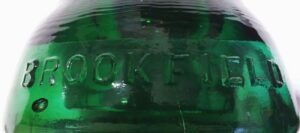
Undated
impressed · glass · Old Bridge, New Jersey
The caption identifies embossed on a green CD 152 telegraph-line insulator made by Company at .
Undated
glass
………………… See this page on the Brookfield “Baby Face” milk bottles.
Undated
impressed · glass
…………………….. Brooklyn & Manufacturing Company, Brooklyn, NY (c. 1897-c. 1899). An amber strap-side liquor flask is known with the marking “BROOKLYN & MFG CO / 338 B’WAY / BROOKLYN NY” embossed on the base. This seems to be a very scarce mark and I have not seen another bottle with this lettering on it. This firm appears to have been in operation much later than – and probably had to relation to – the “Brooklyn Bottle Works” noted above.
Undated
glass
……………….. , Brooklyn, New York. Time period when this plant was in operation is uncertain. From the type and general style of bottle which carries the mark (early cylinder whiskey), it looks like the company was probably in operation during the 1860s or 1870s.
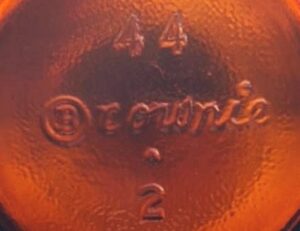
Undated
The illustrated amber bottle bears a 1944 date code; this dates the example.
glass
was Brockway’s brand for an early non-returnable beer-bottle line. The source describes the bottles as from the mid-1940s; this is distinct from soda bottles.
Undated
glass
……………… This mark, which might also be read as “TBK” or “BKT”, appears on the base of a crown-lip style soda, beer or mineral water bottle (of an “Apollinarus” style) in a rather dark teal/aquamarine , found by Eric Hulten when diving off the coast of Guam. [Update 2/11/2023] – archeologist Nina Peck reported a similar bottle also found on Guam – during excavation for utility lines – and she was able to contact a retired professor and manufacturing industry researcher named Mr. Shoji, (庄司太一) of Tokyo, who relayed that the mark almost certainly stands for the Kirin Brewery Company’s Tonda bottle manufacturing plant, located in Suotonda-cho, Shinnanyo, Shunan City, Yamaguchi Prefecture, Japan. According to one website (kirinholdings.com), the Tonda bottle plant was started in 1938. That bottle factory was sold to KYC Corporation in 1992. (Thank you to Nina Peck for your kind help with this mark!!)
Undated
glass
………. please see my entry under “Dots” on Page Two .
Undated
glass
………………………… Philadelphia Works, Philadelphia, Pennsylvania. See “Philada Works”.
Undated
glass
………………….. This was actually a hair dressing made with Coconut Oil, promoted as a product guaranteed to give the hair a more luxurious, healthy appearance. Contrary to what some collectors might assume upon finding a bottle with this embossing, the product did not contain cocaine (unlike some of the products being sold in the mid and late 1800s that did indeed contain that ingredient). First sold in 1857 by Joseph Burnett of Southborough, Massachusetts, it was a popular product for many years and was still available into the early 20th century. Several variations of the bottles exist. The glassmaker is uncertain, but it is probable that one or more bottle companies located within or near the Boston area manufactured these bottles. This webpage from the Southborough Historical Society has some information on Joseph Burnett: Joseph Burnett Chronological History .
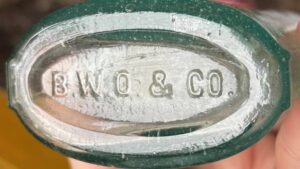
Undated
glass · Boston, Massachusetts
The caption identifies these initials on a handmade light aqua strap-side flask as B.W. O’Neil & Company, Boston, a jobber rather than a manufacturer.
Undated
glass
……………….. On containers, sometimes this might be simply a mold identifier, but in many cases the letter probably stands for a specific company. A capital letter “ ” is seen on the bottom of quite a few older handmade bottles of various types (that generally date from the . 1870s-1890s) and there is no conclusive evidence to indicate exactly who made them. One fairly strong possibility is Cunningham & Company of Pittsburgh (see & Co marks on this page). Other possibilities include Clyde Works, Clyde, New York; Canton Company, Canton, Ohio; and Cohansey Mfg. Company, Bridgeton, New Jersey. See this article by Bill Lockhart and the Bottle Research Group (pages 621-623) in which some “ ” bottles are discussed: Cunningham Family Holdings – SHA.org . I have been told (by longtime bottle digger and collector Dave Beeler) that a lot of bottles of various kinds with just a “ ” on the bottom have been dug in the St. Louis, MO area over the years, and he believes the mark may stand for John K. Cummings (proprietor of the St. Louis Works for a number of years) – Cummings was involved with that factory beginning in 1861 and lasting until its apparent closure in 1888. Although I can’t say whether Dave is correct or not, he certainly brings up an interesting question. Several notable bottles are found with a “ ” on them. Just three examples: The GIX-25 type scroll or violin flask (found in a number of colors including aquas and greens) bears the letter “ ” on the front. The scroll flask type is generally of Midwestern origin. Some collectors believe this particular flask originated from Pittsburgh (in particular, Cunningham’s works). Another pictorial flask, lettered “The Great Western” across the front, and catalogued as GX-30 (in McKearin’s historical flask charts) is marked with a “ ” on the base. It’s provenance is unknown, although believed to date from sometime in the 1865-1875 period. Note: there was a factory in St. Louis, . 1856 named “Western Company” that failed after a short time, and also a much later, unrelated glassworks named “ Great Western Works “ (1874- .1887). A clear nursing bottle marked “St. L. G. W.” across the front (the lettering probably standing for St. Louis Works) is marked with a “ ” on the base. Whether there is any connection between those three bottles is unknown.
Undated
glass
………………… probably Crosse & Blackwell. These initials have been confirmed on the lower side of a light green handblown cylindrical pickle bottle or “Chow Chow” food bottle that looks exactly like the bottles described above that bear “C B / M” or similar lettering on their bases (see above entry). The “ ” mark has also been verified on the bottom of an applied-lip ale or beer bottle (made from a 3-piece mold) which appears to date from the 1870-1900 time period. That bottle, in sun-colored amethyst, was found recently in a secluded high desert setting in the southwest. Julian Toulouse (BM&TM, 1971, page 114) stated that containers made for Crosse & Blackwell were made by a number of companies in Great Britain including Davey & Moore; Cannington Shaw & Company; Kilner Bros. Co; Kilner Bros, Ltd; Bagley & Company; John Kilner & Son; Edgar Breffit & Co., and Redfearns .
Undated
glass
………Cunningham(s) and Company, Limited, Pittsburgh, Pennsylvania (1886-1907)
Undated
glass
……………Cunningham(s) and Company, Pittsburgh, PA (c.1879-1907)
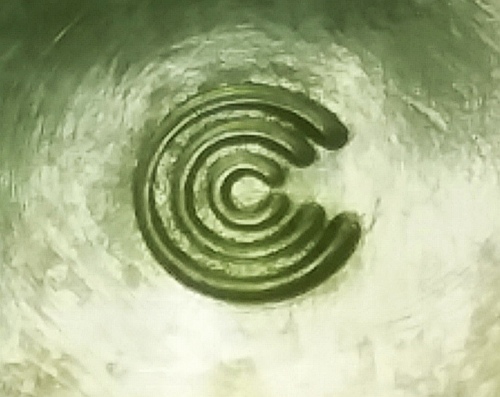
Undated
glass
The image caption identifies three concentric Cs as Continental Can Company, shown on an avocado green Optic Dot juice .
Undated
impressed · glass
……………… Unidentified. The initials might stand for a glassmaker or a food distributer from Great Britain, possibly from the 1875-1900 time period. But this is only a guess !
Undated
glass
……………Coffin & Hay, Hammonton, New Jersey.
Undated
glass
…………Cunningham and Ihmsen, Pittsburgh, Pennsylvania (c. 1865- c. 1878)
Undated
glass
……..Same as above.
Undated
glass
C and I intertwined (“C” and “I” monogram)………….. please see “I superimposed over a G” entry on Page Three . The IG monogram mark used on tableware made by Imperial Company, Bellaire, Ohio, might be mistaken for an IC mark.
Undated
glass
…………………. Unknown. These initials appear on the base of an American-made, vertically ribbed pepper sauce bottle that probably dates from sometime in the 1865-1890 period. If you have information on the meaning of these initials, please contact me!
Undated
glass
………………….. Chesapeake & Potomac Telephone Company. This marking is seen on the skirt of CD 121 type “toll” or long distance line insulators. C&P Tel Co. began in 1883 but eventually became part of the AT&T and Bell Telephone systems, now part of Verizon. The insulators probably date from sometime in the c.1895-1915 period and all were manufactured by Brookfield Company. They are found in shades of aqua and green.
Undated
glass
……………..almost certainly Charles Borron & Company, Newton-le-Willows, Lancashire, England (1866-1898?). This mark is seen on the bases of dark olive green ale/beer bottles which appear to have been made sometime in the 1870s-1910 period. It is unclear how late this company continued to operate. An old illustration showing this glassworks appears here on the Newton-le-willows.com website. The operation was evidently quite large assuming the picture was reasonably accurate in its depiction of the works. Also, please see my page on the CBM / CBK / CBB pickle bottles and the entry on the “C & B” mark, above.
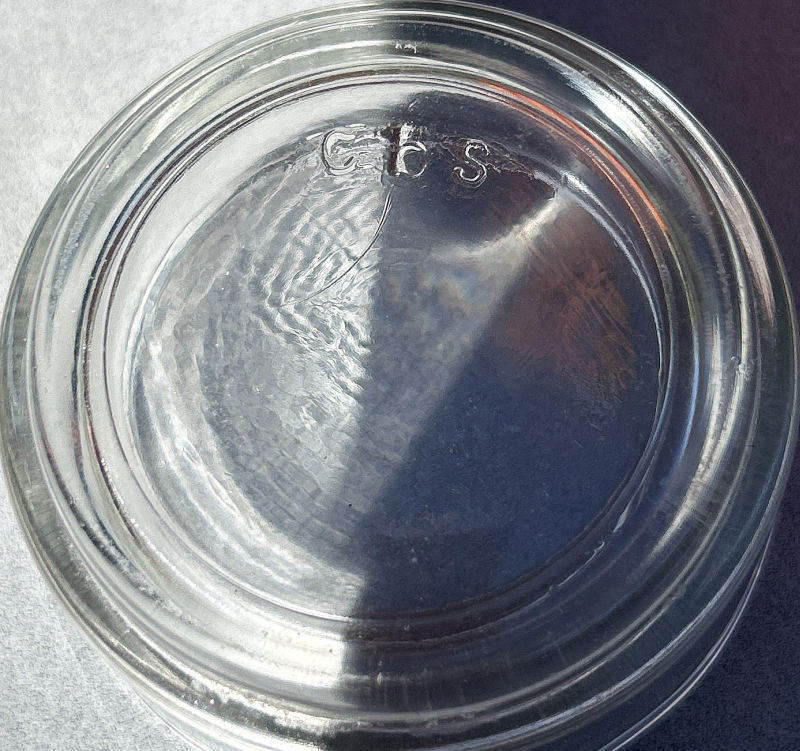
Undated
glass
The image caption describes on a clear ramekin, soufflé dish or custard bowl.
Undated
glass
……………………uncertain meaning, but the “C B” probably stands for Crosse & Blackwell, a food distributing company in London, England dating from 1830. These markings are seen on the bases of various handmade, light green, wide-mouth round cylindrical pickle or “Chow Chow” food jars made in England that appear to date from the 1860s-1910s time period. They tend to be rather heavy, thick and somewhat crudely made with rolled or “square band” applied lips. At least some of these jars were evidently made by Kilner Bros., but other factories in England also made some of them, including Davey & Moore. Please see this page with more on the C.B.M. and related marks.
Undated
glass
………………Charles Boldt [ ] Company, Cincinnati, Ohio (1900-1919). See also “B with 2 serifs” “Boldt Co.” and “Boldt” entries. For much more detailed info on this company, see this webpage article (pdf file) written by researcher Bill Lockhart et al: Charles Boldt.
Undated
glass
…………….Chattanooga Bottle and Manufacturing Company (later Chattanooga Company), Chattanooga, Tennessee (mark used c.1901-c. 1927?). I had also seen a reference to a bottle (or bottles) marked “C.B. & G. CO.” (note the ‘&’) on the bottom, but have lost track of where or when I heard of it several years ago. If anyone knows of a bottle with this latter marking and can confirm its existence with more info and a photo, I would be grateful for your assistance. Also, see “CHATT” and “C in a circle” entries. “C inside a circle” is Chattanooga’s most well-known mark that was used from around 1927 to 1988 on tremendous numbers of bottles, especially sodas such as Coke.
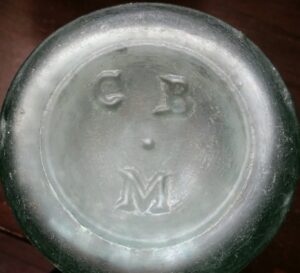
Undated
The source dates bottles with C B approximately 1860–1910; this is an object-based estimate.
glass · United Kingdom
The caption describes C B / M on an antique light green pickle or chow-chow bottle made in . The entry tentatively suggests Crosse & Blackwell for C B but does not establish the manufacturer.
Undated
glass
…………………….. Clevenger Brothers Works, Clayton, New Jersey (1930-1999). Clevenger Brothers specialized in producing handblown flasks and other glassware made in the tradition of the early factories of New Jersey. Some examples can be very difficult to distinguish from the originals, although there are always subtle differences upon close examination, especially concerning the exact appearance of the base pontil mark. Most of their earlier bottles and flasks were unmarked, although a few pieces were marked with a small “CB” on the bottom, beginning in 1955. After 1966, all of their glassware was marked with “C B” although the lettering is typically larger and bolder. For some good info on Clevenger Bros. and how to tell some of their repro ware from older items, such as the “Fislerville Works” Jenny Lind flasks and the cabin-shaped “Booz” whiskey bottles, check out this webpage: Have You Been Fooled by the Clevengers? ~ Real or Repro site
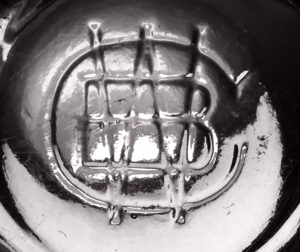
Undated
glass
The image caption describes on a possible food bottle or jar with ten fluted or panelled sides.
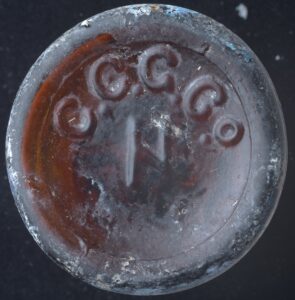
Undated
impressed · glass · Milwaukee, Wisconsin
The caption identifies on an amber beer-bottle base shard as Cream City Company, .
Undated
glass
…………………. Cream City Company, Milwaukee, Wisconsin (1886-1892). Although most bottles with this mark are beer bottles made at Milwaukee, on a few bottles found in the West the initials could stand for Colorado City Company, Colorado City, Colorado (1889-1893)
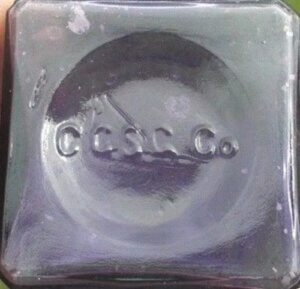
Undated
glass · New York
The source identifies C.C. Stutts Company of as a bottle jobber, not a manufacturer. These initials occur on square schoolhouse/carmine bottles used for benzene in pyrography kits. Research dates the business approximately 1897–1915, rather than establishing an exact mark-use interval.
Undated
glass
C.C. (seen on the base of a mouthblown cylindrical pickle or “Chow chow” jar, in a light/medium green-colored that is very characteristic of British food bottles of that time period – c. 1870s – c.1900) …………………Uncertain meaning. The jar in question is almost identical to the “C B / M” jars described on this page, and almost certainly is a product of England – not an American-made container.
Undated
glass
……… in some cases the “G G W” monogram (with the center letter somewhat larger than the other two) indicating Gayner Works might be misread as CCW. Please check the “G G W” entry on Page Three.
Undated
glass
………….Chase Valley Company, Milwaukee, Wisconsin (1880-1881). Occasionally seen on bases of cylindrical utility bottles. For more information and photos of bottles and marks used by this and several closely related companies in Milwaukee, please see this webpage: Wisconsin Gallery on MrBottles.com website.
Undated
glass
………………Cunningham(s) and Company, Pittsburgh, Pennsylvania (c.1879-1907)
Undated
glass
……………..see next entry.
Undated
printed · glass
………………Central District & Printing Telegraph Company, Pittsburgh, PA. This firm was organized in 1874, and lasted under that exact name until 1913, the name being changed slightly to Central District Telephone Company at that time. In 1918 it became part of the Bell Telephone Company of Pennsylvania. All insulators seen with this marking are of the CD 121 “toll” (long distance) style, most commonly seen in pale aqua , and generally appear to date from sometime within the 1895-1915 period. Most, if not all, were made by Brookfield Company at their factory in Brooklyn, New York. (Also, see “C.& P. TEL.CO” entry).
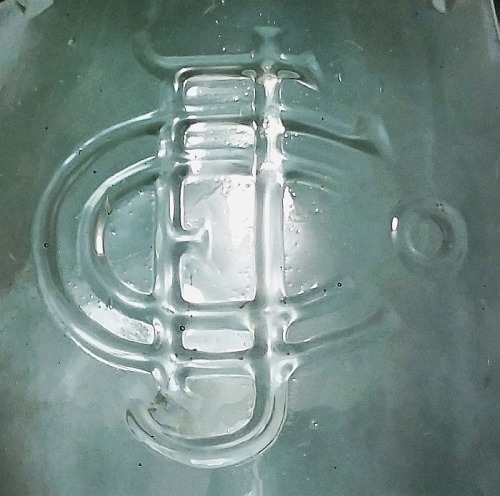
Undated
impressed · glass
The image caption describes the monogram on the face of a MASON’S PATENT NOV 30TH 1858 aqua fruit jar.
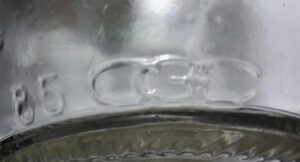
Undated
The illustrated soda bottle is captioned as made in 1985; this dates the example.
glass
The image caption identifies on a clear soda-bottle heel as Container General Corporation.
Undated
glass
…………….California Company, California, Pennsylvania (c.1890s). Harvey Teal, a researcher and historian on South Carolina history, (author of a published book on the SC Dispensary flasks) reports that he has documents proving that some of the SC dispensary liquor flasks dating from the c.1893-1897 period marked “C.G.CO.” were definitely made by California Co., although Phillip Kenneth Huggins ( The South Carolina Dispensary -1997), attributed the marking to the Carolina Company, Columbia, SC (1902- c. 1911). Apparently, both companies made the dispensary bottles AND used a C.G.CO. mark on them, although during different time periods. More information and discussion on the C.G.CO marks on South Carolina dispensary and other bottles can be found in this article by Bill Lockhart et al: Cohansey .
Undated
glass
………………..This mark was evidently used by four (or more) different companies in the United States. Most bottles with this mark on the lower heel are believed to be products of the Coshocton Company, Coshocton, OH (1902-1921), a prolific manufacturer of beer & soda bottles distributed widely but especially throughout the Midwest. Other possibilities include Canton Company, Canton, OH (1883-1890) & Marion, Indiana (1890-1958) [See Canton] and Cohansey Manufacturing Company, Bridgeton, NJ (c.1870-c.1900) and/or its successor Cohansey Company, East Downingtown, PA (1900-1909). ALSO, please see the two following entries!
Undated
glass
C. G. Co. (on “POLAR BEAR” pattern bread tray) ……………… believed to be Crystal Company, Bridgeport, Ohio (1883-1907). This particular Crystal Company was started in c.1868 at Pittsburgh, and later moved to Bridgeport. The C.G.Co. initials which are known on the bread tray from approximately 1885 (and may be on other items in the “Polar Bear” pattern as well) were attributed to Crystal Co. by Ruth Webb Lee in her groundbreaking reference work “Early American Pressed ” (1931 and later editions) from a personal conversation she had with an elderly knowledgeable Pittsburgh-area glassblower. Crystal Company made mostly pressed tableware items (usually classed under “Early American Pattern ”, known to collectors as simply EAPG) and was not a producer of blown commercial containers, so this mark is virtually certain to be UNRELATED to the “C.G.Co.” seen commonly on beer bottles.
Undated
impressed · glass
………………… California Insulator Company/California Works , Long Beach, CA (1912-1914).
Undated
glass
…………..Campbell Manufacturing Company, West Berkeley, California (1885). In some cases (especially bottles found in the eastern U.S.) the initials might stand for the Cohansey Manufacturing Company, Bridgeton, NJ (c.1870-1900) or Cumberland Manufacturing Company, Bridgeton, NJ (1880-1920).
Undated
glass
……………..Campbell Works, West Berkeley, California (1884-1885), on certain bottles known to be from California, especially the San Francisco area. This company is given as the source of the “ .” mark by Julian Toulouse ( Bottle Makers and their Marks , 1971 ). Since it operated for less than four months, and Toulouse included no information on why he believes this mark can only be attributed to Campbell (other than the fact that the initials fit), I am very skeptical that all bottles with this mark originated from that company, especially bottles and flasks with this mark found in the East. Another possible source (in my opinion, which may be no better than Toulouse’s!) could be any one of several Eastern region companies, for instance Clyde Works, Clyde, New York; Cumberland Works/Cumberland Mnfg. Co., Bridgeton, New Jersey; or Camden Works, Camden, New Jersey (1875-1884). Also, see next entry.
Undated
glass
…………………….. this may be a case of misreading the “GGW monogram” – which is believed to stand for Gayner Works – please check the G G W monogram entry on Page Three .
Undated
glass
……………….. Castle-Hanson Corporation, Rochester, New York (1959-circa 1970s??) . Castle-Hanson took over the former Reed Company plant in Rochester (see “R in a triangle” mark) and operated through the 1960s and later. Castle-Hanson plant at Rochester was eventually purchased by/became part of Leone Industries, based in Bridgeton, New Jersey (see “L in an unconnected square” mark). Some ware with this “L” mark was made at Rochester as well as Bridgeton. Exact beginning and ending dates of Castle-Hanson and Leone Industries operations are unclear……anyone with solid info, please contact me!
Undated
glass
…………………Chicago Heights Bottle Company, Chicago, Illinois (1912-1913). These initials are confirmed to exist on at least one bottle (info courtesy of Bill Lockhart) and are almost certainly that of the Chicago Heights concern. For another mark attributed to this short-lived company, see “SIGNET”.
Undated
glass
………………. unidentified. This mark, accompanied by a mold number, is seen on the base of dark green handmade British ale bottles. They appear to be typical of ales from the 1870s-1900 period. They have been reported to me by several readers. At the present time (4/2019) I am unaware what the marking stands for.
Undated
glass
……………Cristalerias Cattorini Hermanos, Buenos Aires, Argentina, South America. (1952-to date). This mark is most frequently seen in the US on the base or heel of imported emerald green (“forest green”) beverage bottles, often marked “WATER” and/or “JUICE”. These containers were often saved and re-used as refrigerator bottles. I believe most, of not all, of those bottles were made in the 1960s or very early 1970s, but some may date later. The trademark is evidently still in use and appears on the Emhart punt marks database.
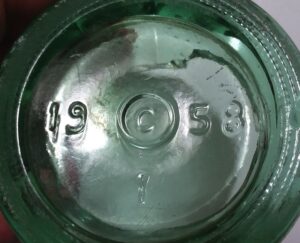
Undated
The illustrated bottle shard is captioned as made in 1958.
glass
The caption identifies in a circle on a Coca-Cola bottle-base shard as Chattanooga Company.
Undated
glass
………. Christian Ihmsen & Sons, Pittsburgh, PA. (c. 1855- c. 1875)
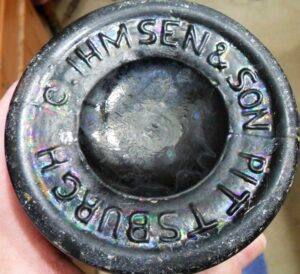
Undated
glass
The caption identifies on the base of a dark amber squat ale bottle.
Undated
impressed · glass
…………….. Christian Ihmsen & Son, Pittsburgh, PA (c. 1855- c.1861 or possibly later). Embossed lettering is seen on the bottom of amber ale bottles and aqua wax sealer fruit jars. I think bottle and jar molds with both the “SON” and “SONS” lettering might have been in use simultaneously, at least for some limited period of time. Please see next entry.
Undated
glass
…………. Christian Ihmsen & Sons, Pittsburgh, PA (c. 1855- c. 1875). The exact time period for the “proper” business names used by this and the preceding firm is unclear. Scroll flasks were made by “Christian Ihmsen & Sons” in 1856, as a number of flasks of this type were recovered from the ARABIA steamboat that sank in the Missouri River on September 5, 1856. The packing crate was lettered “Christian Ihmsen & Sons, Pittsburgh, PA”.
Undated
glass
……………Chattanooga Company, Chattanooga, Tennessee & other plant locations in later years (1901-1988), this mark was used c.1927-1988. The circle reportedly may be either “single line” or “double line” on some earlier bottles. Chattanooga Company made tremendous quantities of the classic “hobbleskirt” shaped Coca-Cola bottles, and the “ ” is often seen on the side or the base of these bottles, as well as on lots of soda bottles from other firms. Also see “C B G CO”, “CHATT”, “CGC” and “C inside a diamond”.
Undated
glass
…….Unknown. Seen on base of figurines.

Undated
impressed · glass · Guadalajara, Spain
The image caption identifies inside a horizontally divided hexagon as Vidriera De Castilla, .
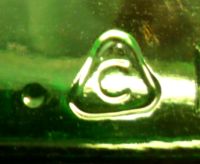
Undated
glass · Montreal, Canada
The caption identifies inside a triangle as Consumers Company, .
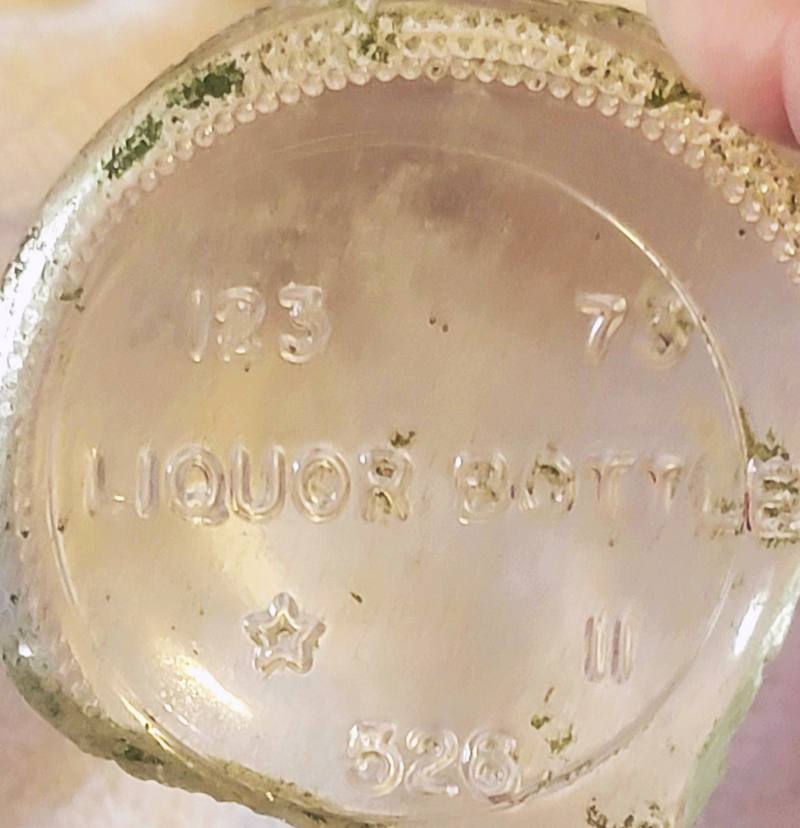
Undated
The bottle has a 1973 date code and the diagnostic 123 liquor-bottle permit number.
glass
The image caption identifies the clear liquor-bottle base as Star City Company, probably from Coventry, Rhode Island, with liquor permit 123 and a star whose C is unclear.
Undated
glass
…………………………….Consumers Company, Ville St. Pierre, Montreal, Quebec, Canada (1917-2002). Mark was an inverted triangle (point down) from 1917 to 1961, and a slightly rounded “right-side up” triangle after 1962 (shown in pic, above), according to information per Toulouse. Consumers (division of Consumers Packaging, Inc) was acquired by Owens-Illinois, Inc. (O-I) in 2002 and is now known as O-I Canada. I am assuming ( but do not know this to be true ) that all bottles produced after O-I acquired Consumers are marked with the Owens-Illinois identification (i.e. “I inside an O” or “O-I”) and the “ with rounded corners” logo has been discontinued.
Undated
glass
…………………………Cambridge Company, Cambridge, Ohio (1901-1958). Cambridge produced high-quality, handmade pressed and blown tableware, art and novelties, NOT utilitarian container . Their “ ” trademark was used between about 1922 and 1937, but only on some items, as much of their was not marked. Usually the triangle is oriented “right side up” (with the “flat” side down), but when viewing some transparent items from the top of the piece, the mark might then appear with the C placed inside an “inverted triangle” (pointing up). For more info please see this page with a brief history of the company, from the National Cambridge Collectors, Inc. website: Cambridge Co. History – Cambridgeglass.org
Undated
glass
………………….Chattanooga Bottle & Manufacturing Company, Chattanooga, Tennessee (mark possibly used c.1901 – c.1913). See also “C.B.G.Co.” “CHATT” and “C in a circle”.
Undated
glass
…………………. Vidriera de Castilla, S.A., Azuqueca de Henares, Guadalajara, Spain. This mark was illustrated on page 597 of Bottle Makers and their Marks (Julian Toulouse, 1971), but I don’t have an exact timeline on it’s use. I presume it was used in the 1960s – 1980s and possibly later?
Undated
impressed · glass
……………………. C. L. Flaccus Company, Pittsburgh, Pennsylvania (1879-c. 1927). This particular mark is uncommon but is embossed on the base of a small, clear, mouthblown strap-sided druggist/apothecary/prescription bottle that looks to date from the 1880s. The bottle is a “generic” style with no lettering on the front. See next 2 entries, also see “F in a keystone” mark.
Undated
glass
…………..Same as above. Occurs on the bases of South Carolina Dispensary bottles. See next entry.
Undated
glass
……………….. C. L. Flaccus Company, Pittsburgh, Pennsylvania (offices); manufacturing plants were located at Tarentum (their main plant) as well as Leechburg, Beaver Falls, New Brighton, California, and Charleroi, PA (1879-c. 1927). This particular mark seen on base of wax sealer fruit jar. For more background info on Flaccus, see this article by Bill Lockhart et al: C.L. Flaccus Co.
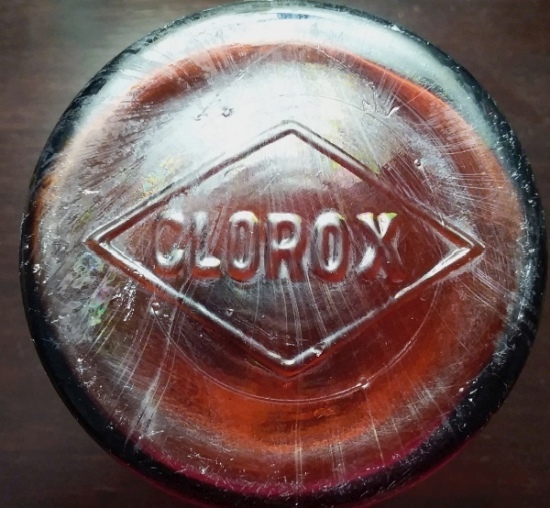
Undated
The illustrated bottle is captioned as approximately 1929; this dates the example.
glass · San Francisco
The caption describes in a diamond on an early bleach bottle made by Illinois Pacific Corporation, ; an IPG-in-triangle heel mark is not shown.
Undated
glass
………….. Unknown (Seen on base of fruit jar, c.1870s).
Undated
glass
…………… See “C Co 2 MILW”.
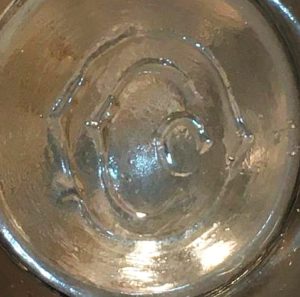
Undated
glass
………………Co-Operative Company, Los Angeles, California (1923-c. 1930). Makers of milk bottles, usually found in CA. This mark was mentioned by Jeffrey Giarde ( Milk Bottles: Their Makers and Marks, 1980) and (at that time) he listed it as “unknown”. More recent research by Bill Lockhart and the Bottle Research Group (BRG) have filled in some of the blanks. For a detailed article, check out this file: The West Coast Co-operative Company – SHA.org
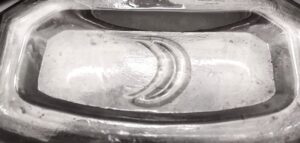
Undated
impressed · glass
The caption identifies a crescent-moon logo on a clear druggist or prescription bottle as Crescent Bottle Company.
Undated
glass
…………………..see next entry.
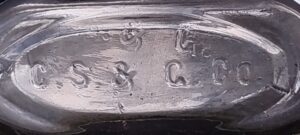
Undated
glass
The image caption describes on the base of a Warranted Flask.
Undated
glass
…………….. almost certainly Cooper, Silica & Company, Salem, Virginia (c. 1907-c. 1914). This mark was reported to me as seen on the lower heel of a “Huntsville Bottling Works” crown-top soda bottle. The mark has also been confirmed on the base of a full pint strap side “Warranted Flask” as reported by David Weaver.
Undated
glass
…………………………….see “S & L C”.
Undated
glass
…………. same as above.
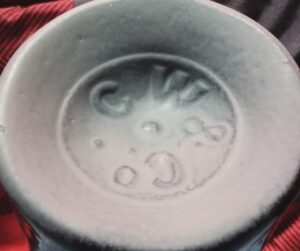
Undated
glass
The caption identifies on a Carson, Warren & Company blackglass ale or wine bottle. The surface was lightly sprayed with grey primer for photography; the grey appearance is not original mark colour.
Undated
glass
………Chase Valley Company, Milwaukee, Wisconsin (1880-1881). For more information and photos of many bottles made by this and related companies, see this page: Wisconsin Gallery on MrBottles.com website
Undated
glass
………. Chase Valley Company Factory 2, Milwaukee, WI (1880-1881)
Undated
glass
…………………. Carson, Warren & Company, Port Dundas, Glasgow, Scotland (c. 1847 – c. 1879). Initials are seen on bases of mouthblown black (very dark olive green or olive amber) ale and wine bottles, usually made in three-part molds. These bottles were evidently exported far and wide around the world as they have occasionally been found in such places as the Panama Canal, the Caribbean region, Australia, New Zealand, Canada and Asia, as well as the UK and the U.S. These initials had been a mystery for many years, but with help from the BRG (Bottle Research Group) and in particular from recent in-depth research by BRG member Bob Brown, this is virtually certain to be the correct user of the initials. The earliest reference found so far is from 1847 – The Journals of the House of Commons , Volume 102, page 184, in which an entry is found referring to “Carson, Warren and Company, Bottle Manufacturers” and David Carson and Timothy Warren as partners in that business firm. The physical factory itself was called the “Milton Works”. The operation might have been under other business names at times during the period, but in any case it apparently failed in or about 1879. One example of a very rare black bottle has also been recorded (evidently found in Australia), marked with the full embossing “CARSON WARREN & CO. GLASGOW / MANUFACTURERS” on the base. Assuming that this works was in operation for at least 32 years, and made countless bottles over that period of time, it seems apparent that the great, great majority of its bottle production was unmarked. There is little doubt that many of the “generic” black bottles exported from Great Britain during the mid-19th century could be unmarked products of Carson, Warren & Company.
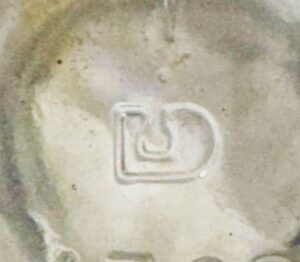
Undated
glass · Montreal, Canada
The caption identifies a stylized on a clear packer jar as DOMGLAS, based in .
Undated
glass
C with an “R” inside (mark seen on clear bottle base that appears to date from the early or mid-1970s)……….. Unidentified meaning.
Undated
glass
……………………..Central New York Bottle Company, Auburn, New York (c. 1978-1994). In 1994, Central was purchased by Owens-Illinois, to become their plant #35, which is still in operation as of 2016. See “NY within a C” entry on page four.
Undated
glass
……… unidentified, but likely the initial of the company that marketed the sprayers. This marking has no connection with the Crystal Company above. The sprayer jars may also carry the “R inside a triangle” mark which identifies them as a product of Reed Company of Rochester, New York.
Undated
glass
Caldwell’s (“Dr. W. B. Caldwell’s / Monticello, Illinois” or “Caldwell’s Syrup Pepsin”) …………………. Patent medicine bottles found in many, many variants, with slight differences in exact wording or arrangement of lettering. Please see the Dr. W. B. Caldwell’s page for more information .
Undated
impressed · glass
…………………………. California Insulator Company/ California Works , Long Beach, CA (1912-1914)
Undated
glass
………… , Camden, New Jersey (1875-1884).
Undated
label · blue, gold · glass · Italy
" " oval blue & gold foil label.
Undated
impressed · glass
…………………………. Company, , Ohio (1883-1890), Marion, IN (1890-1958) and Hartford City, IN (1958-1991+). Fruit jars embossed “The Jar”, “The Fruit Jar” or a similar embossing are products of this company. Those jars date from the earlier years of the company, i.e., in the 1880s & 1890s. is also known for having produced tableware in a variety of patterns which are sought after by some EAPG (Early American Pattern ) collectors. joined the National Company combine and operated under that umbrella company from 1899 to 1902. In September 1902, a new firm under the name of “ Company” was organized, and a new factory building was erected in Marion right across the street from the old. After 1902, most of ’s production consisted of non-bottle, non-jar items including tableware and a large variety of other types of specialty such as lantern globes, bird baths and seed cups, sidewalk and skylight , hospital & laboratory glassware, bar & soda fountain glassware, etc. moved to Hartford City in 1958, and was reportedly still in business there as late as 1991. It is unclear exactly how much and what types of glassware were being produced during this later period.
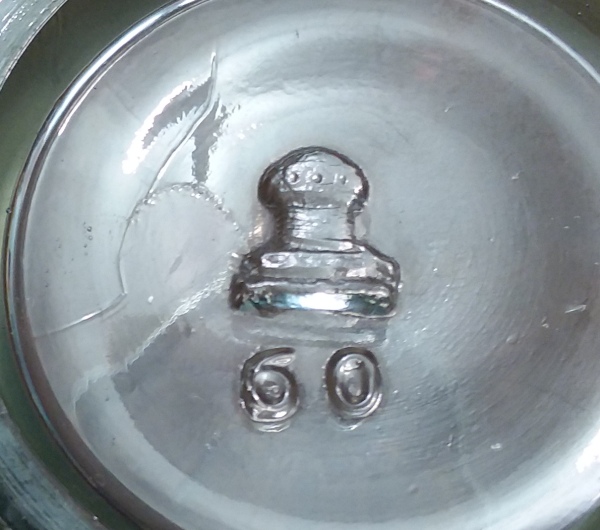
Undated
glass · Connellsville, Pennsylvania
The image caption identifies a ship’s capstan emblem, sometimes mistaken for a chess pawn, as Capstan Company, . 60 is a mould or catalogue item number.
Undated
glass
Capstan logo (looks somewhat like “pawn” chess piece, shown above)………………. Capstan Company, Connellsville, Pennsylvania (1919-1938). Please see Capstan Company page.
Undated
glass
……………….. please see “C. W. & Co.” entry, below.
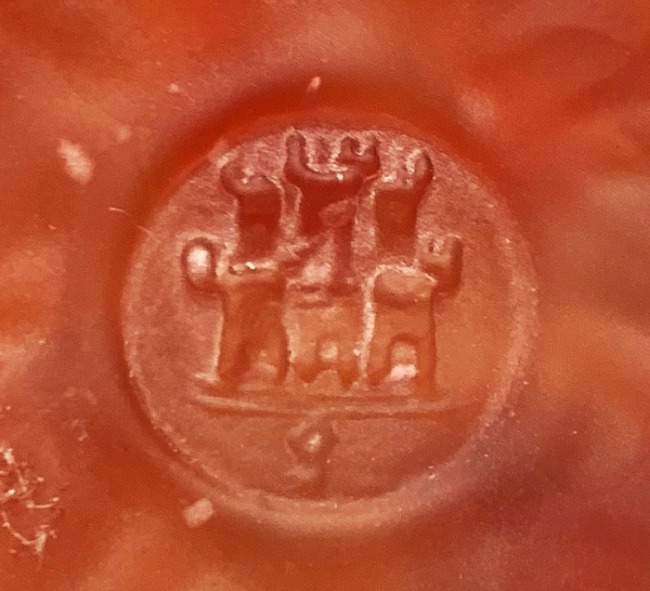
Undated
impressed · glass
The image caption identifies a castle-over-key logo as Gibraltar Crystal.
Undated
label · blue, white · glass · Italy
" " blue & white paper label with separate stock number label.
Undated
label · black, white · glass · Italy
" " black & white paper label.
Undated
label · red, white · glass · Italy
" " red & white paper label with separate stock number label.
Undated
label · black, white · glass · United Kingdom
" " rectangular black & white paper label. Brand label used by Wood Brothers.
Undated
glass
………………………….Gibraltar Crystal, Gibraltar (1995-2019). This company produced a lot of beautiful multi-colored handmade glassware including many types of vases and stemware. According to information posted recently on the internet, this firm closed permanently in August of 2019. The mark is stamped into the base of pieces. In some cases this mark is rather crudely drawn and thus it might be difficult to recognize what it’s supposed to represent. The figure below the castle may be mistakenly thought to be a lower-case letter “g”, and although it does bear a resemblance to that letter, it is meant to be the representation of a Key.
Undated
glass
………………………….please see page on Fletcher’s Castoria .
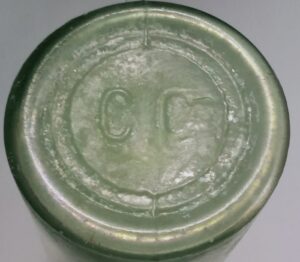
Undated
The caption dates the illustrated bottle approximately to the 1870s–1900; this is an object estimate.
impressed · glass
The image caption describes on a green pickle jar or bottle, probably from Great Britain.
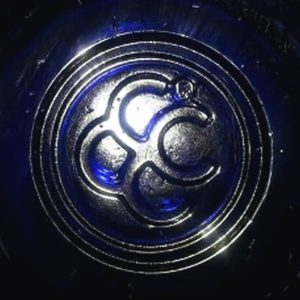
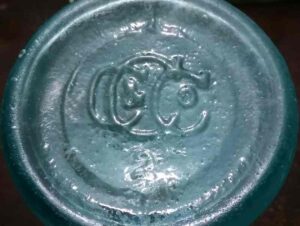
Undated
glass
The image caption identifies the C C & Co monogram on an aqua Carl Conrad beer bottle made for Anheuser-Busch.
Undated
glass
CD (logo that might be interpreted as two highly stylized cursive capital letters “C” and “D”, as seen on the bases of green and clear soda bottles………. please check my entry with photo of this mark , used 1988 to 1995, under “American National Can Company” on Page One .
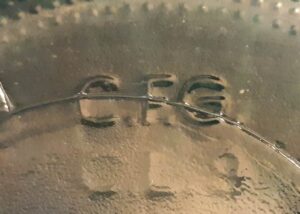
Undated
impressed · glass
The caption identifies on a green florist vase as Continental Floral Greens.
Undated
glass
……………… Consolidated Fruit Jar Company, New Brunswick, New Jersey, with main business offices in New York City, New York (1871-c. 1924 or later). Consolidated did not make their own jars, but had a number of factories manufacture them bearing the company logo. Consolidated was primarily a manufacturer / distributor of so-called “fruit jar trimmings”, i.e. zinc lids, bands and gaskets for the jars, as well as other sheet metal and tin ware items including watering can sprinkler heads, oiling cans and assorted kitchenware. Factories that are known to have made jars for CFJCO included: Clyde Works (Clyde, NY); A. & D. H. Chambers, Pittsburgh, PA); Whitney Works (Glassboro, NJ); Illinois Company (Alton, IL); Poughkeepsie Works (Poughkeepsie, NY) and likely others. Some of the CFJCo monogram jars are also marked with the name or initials of the glassmaker. But many are not – and in those cases the factory is not known – with absolute certainty, anyway. It is quite possible that a number of unidentified factories in the East and Midwest made many of the jars, but there are (probably) no extant records to prove they did so. The CFJCo monogram was placed on fruit jars, zinc lids, and jar liners (inserts) beginning about December of 1877. That trademark (#5,947) was officially registered by the US Patent Office on April 23, 1878. The trademark document indicates “first use” of the monogram had occurred approximately four months before April 3, 1878, the day the application for the trademark was made. Assuming that information was correct, the first jars with the CFJCo trademark were probably made in early December of 1877. There is uncertainty on how late jars marked with that monogram were manufactured, but most appear to date from the 1870s and 1880s – some possibly into the early or mid-1890s? Jars with the CFJCo monogram on the reverse are believed to be earlier than the jars with the monogram placed on the front. The jars are seen with a variety of base markings, usually consisting of a letter followed by a two or three-digit number – for example “J 26”, “A 120”, “D 339”, etc. On some jars, the numbers on the base are backwards, so of course will appear correct when looking down through the mouth of the jar. A large number of different molds were used over many years at the various factories that produced the jars. Many slightly different shades of color are known, although the most common color seen, by far, would be classed as a light aqua or blueish-green. A few jar examples have been seen bearing a Christian cross along with the mold letter/number on the bottom. For more background info, check out Bill Lockhart’s detailed article here: Consolidated Fruit Jar Company – SHA.org . Note : there are also some modern reproduction fruit jars with this “CFJCo” monogram on them as well, so careful research is needed.
Undated
glass
……………………. Container General Corporation, Chattanooga, Tennessee (1983-1985). This was a short-lived merger of Chattanooga Company (Chattanooga, TN) and Containers Corporation (based in Fullerton, California).
Undated
glass
…………Graham Company, at their Checotah, Oklahoma bottle plant. See Graham.
Undated
glass
……………Charles Boldt Company/ Chas Boldt Company/Charles Boldt Manufacturing Company, Cincinnati, OH (1900-1919) and Huntington, West Virginia (1900-1929). Seen on lower heel of a clear packer bottle, probably made for vinegar. Presumably this would date from the earlier time period at Cincinnati. Please see “Boldt”, “C.B.CO.” and “B with 2 serifs” marks.
Undated
glass
……………….. please see Fletcher’s Castoria page .
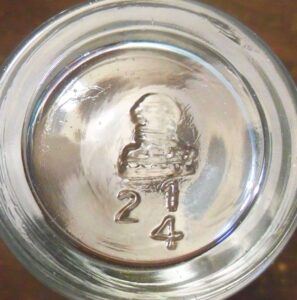
Undated
impressed · glass
The caption identifies a capstan emblem on a jelly as Capstan Company and notes that it is often mistaken for a pawn.
Undated
impressed · glass
York. This marking (or a similar variation) is seen embossed on many jars that held Vaseline (brand of petroleum jelly). See this page for more information: Chesebrough Manufacturing – Vaseline Jars
Undated
glass
………………. see Capstan Company .
Undated
glass
Circles (group of four circles or letter “O’s” connected as a monogram, as seen on the bottoms of mugs, tumblers and drinking glasses)………….. Libbey St. Clair, Canada. Please see entry under OOOO on Page Four .
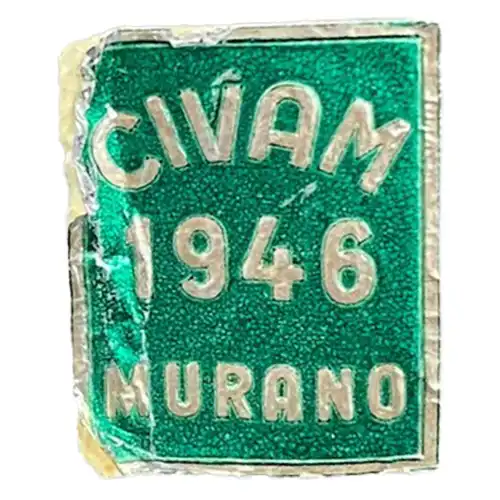
Undated
label · green, silver · glass · Italy
" " rectangular green & silver foil label.
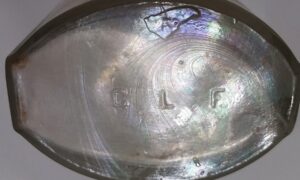
Undated
glass
The caption identifies on a handblown druggist bottle made by C.L. Flaccus Company.
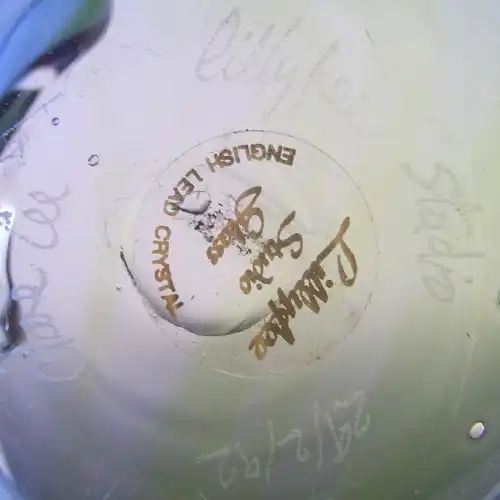
Undated
The illustrated Clare Lee, Lillyfee Studio signature includes a 1992 date; this dates the example.
glass · United Kingdom
" " signature, with 1992 date.
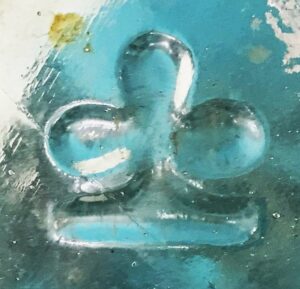
Undated
label · glass · Germany
The caption identifies a clover-like logo on a pharmacy bottle as Hermann Heye Glasfabrik, .
Undated
glass
Clover-like symbol as seen on base of light aqua apothecary/pharmacy bottle, reported to me by Lynne Wertz who shared picture at right. This mark was used by Hermann Heye Glasfabrik, Obernkirchen, Germany (1843-to date), although that particular mark may date from around 1900 up to the 1970s. It has been seen on other types of containers including “Codd” type soda bottles. The logo is illustrated on page 579 of the original hardcover edition of Bottle Makers & Their Marks (Toulouse, 1971). For more detailed information on this and related marks, please see this article written by Bill Lockhart et al, on the Heye company: Hermann Heye – SHA.org
Undated
glass
……………………. Works, , New York (the entire stretch of glassworks operation extended from about 1828 to 1915, under many business firms that operated the works including Southwick, Reed & Co., and Ely, Reed & Co.). The works reportedly made mostly window until around 1864. The factory produced bottles and jars from around 1864 until 1915. (There was also a brief reboot of the glassworks under a different name in about 1921-1922). Large numbers of “Mason’s Patent / CFJCo (monogram) / Nov 30TH 1858” type fruit jars (with “ , NY” on the reverse) were made for Consolidated Fruit Jar Company, most likely from late 1877 or early 1878 into the early or mid-1880s. The business was officially incorporated under the name “ Works” beginning in 1895 (even though that had already been the casual name of the factory for several decades), and operated as such until about 1915 when it closed down. Also see “E. R & Co.”, “S&R”, “S R & Co”, “E Son & H” and “E S & H” entries.
Undated
glass
…………………. , Clyde, New York. See above entry.
Undated
glass
………………….. Manufacturing Company (c.1870-1900). Factory: Bridgeton, New Jersey. Business offices in Philadelphia, PA.
Undated
glass
…………..Colorado City Company, Colorado City, CO (1889-1893)
Undated
glass
……..Colorado City Company, Colorado City, CO (1889-1893)
Undated
glass
…………same as above.
Undated
glass
………..Colorado Works Company, Golden, Colorado (1887-1888)
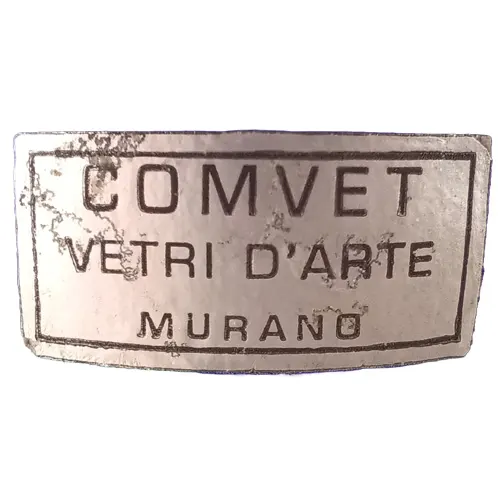
Undated
label · black, silver · glass · Italy
" " rectangular black & silver foil label.
Undated
glass
………… Cooper & Wood, Portobello, Scotland (c. 1859-1866). (Portobello is now part of Edinburgh, Scotland). Seen on bases of black ale or wine bottles. On some bottles the lettering on the base may include the word “Manufacturers”. Many of these types of bottles were exported to the US, Australia and other countries. For more background information on this and several related glassworks, see this article: Cooper & Wood – SHA.org
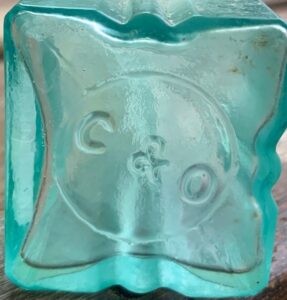
Undated
impressed · glass
The image caption describes on the base of an aqua pepper-sauce bottle.
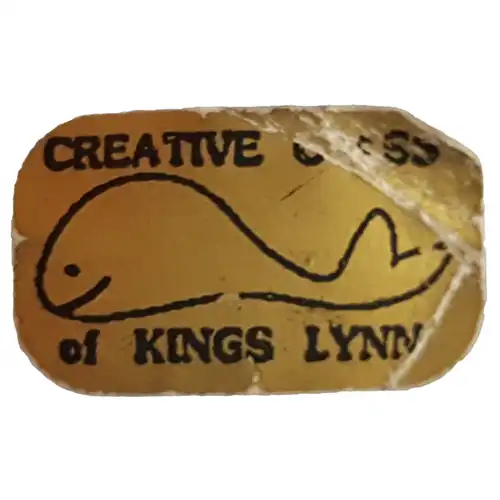
Undated
label · black, gold · glass · United Kingdom
" " rectangular black & gold foil label.
Undated
impressed · glass
………………..Crescent Bottle Company, McDonald, PA (1911-1916) and Hawthorne, PA (1916-c.1922). This mark is seen on the bases of handmade, clear druggist / pharmacy / prescription bottles with tooled lips, on both unmarked “generic” examples, as well as on personalized, lettered “slug plate” bottles from a number of druggists in Vermont and Massachusetts. (Thanks to VT bottle collector/specialist Barry Conolly for bringing this particular mark to my attention!) Also, this mark has also been reported on the bases of prescription bottles from St. Stephen, New Brunswick, Canada – thanks to Glen Phillips! (NOTE – added 5/17/2022: I’ve recently realized that druggist bottles bearing this mark have also been found from quite a few other states across the US. Some of these embossed druggist bottles include: Walkers’ Pharmacy, Schenectady, NY; Sommers Drug Stores, San Antonio, TX; Comstock-Moore Drug Co., Horse Cave, KY; Chubbuck Pharmacy, Freeport, NY; G. A. Walker & Co., Loogootee, IN; Pinehurst Pharmacy, Pinehurst, NC, and S.G. Wright, Lincoln, NE). There are surely many others out there, and if you know of one, please contact me!
Undated
The illustrated bottle bears a 2005 date code.
glass · Vergèze, France
The caption identifies a cross on an emerald green Perrier Lime bottle as VDL Company, .
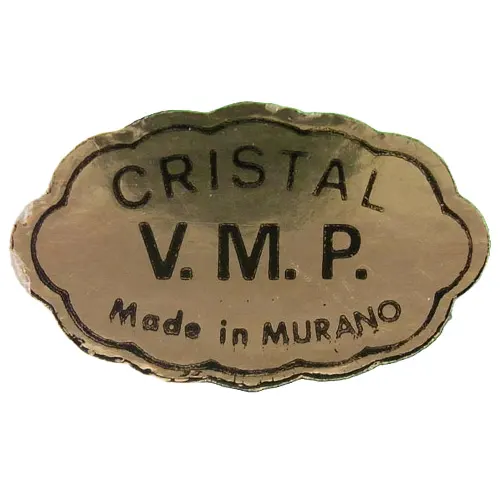
Undated
label · black, gold · glass · Italy
" " scalloped oval black & gold foil label.
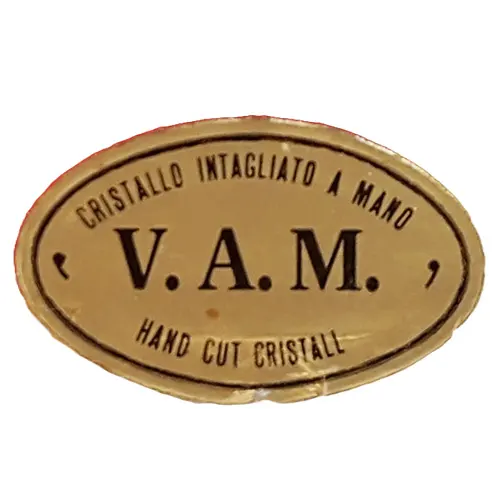
Undated
label · black, gold · glass · Italy
" " black & gold foil label.
Undated
glass
Cross (double-lined cross, abstract design similar to a “fourchee cross” or “crosslet”, as shown above) ………………… seen on heel of Perrier mineral water bottles. This mark was used by VDL Company, Vergèze, Languedoc-Roussillon, France. VDL Co. produced all of the bottles for Perrier mineral water; later acquired by Owens-Illinois Inc., who now runs this operation effective August 1, 2011, and more recent Perrier bottles are now carrying the “O-I” mark on the heel. (I presume that the “O-I” mark was instituted very soon after the acquisition, but do not know exactly when the bottle molds were re-tooled with the mark of Owens-Illinois).
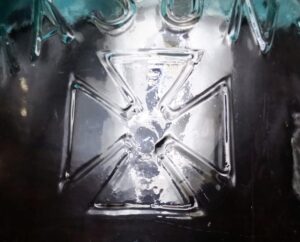
Undated
glass
The image caption identifies a Maltese-cross emblem on a fruit jar made by or for Hero Fruit Jar Company. No exact mark-use dates are established by this record.
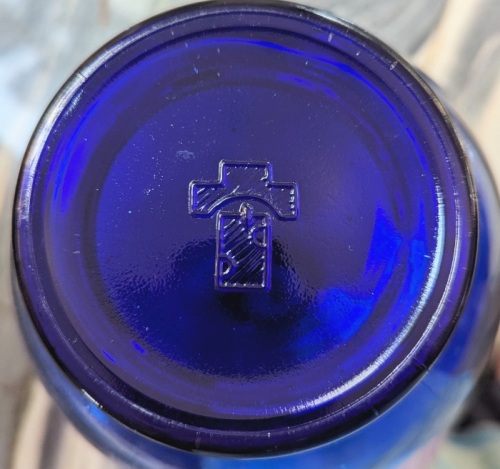
Undated
glass
The image caption describes a cross on a cobalt blue globular miniature lamp, probably made in Hong Kong.
Undated
glass
…………..unknown meaning.
Undated
impressed · glass · Mexico
The image caption identifies a crown logo from an unidentified company in .
Undated
impressed, printed · glass
………………..many types of bottles produced over the years are seen that bear a crown logo on them – in some cases as part of a brand name or trademark but sometimes as a decorative feature or perhaps just a mold identifying mark (equivalent to a mold number). In particular this entry is referring to a rather ornate, fairly well designed “King’s Crown” that appears (often boldly embossed) on the base of aqua, “square footprint” pickle bottles that appear to date from sometime in the 1870s-1890s era. They are similar to the “Cathedral” style pickles but rather plain with less ornamentation. I think they were produced somewhere along the Eastern seaboard of the US, or perhaps in PA? Most are rather tall, usually between 9 and 14 inches in height. I am not aware of the meaning of this particular crown design. Perhaps the trademark of a pickle/condiment distributor? A wholesale food company? A company logo? If you have information on the user of this particular crown design seen on the bases of these pickle bottles, please contact us! Thank you!
Undated
glass
…………………. this seems to be a very recent manufacturer’s mark, which I believe to be from a company in Mexico. I haven’t identified the maker (yet) and am asking for help! If you know the name of the company, or if this is a “new” mark from a company I already have listed, please advise! This is on the heel of a green-aqua 12 oz. Topo Chico mineral water bottle, imported to the US from Mexico. It bears a 2019 date code (19) placed to the left of the trademark.
Undated
glass
………………………… please see this page on Crownford China Company.
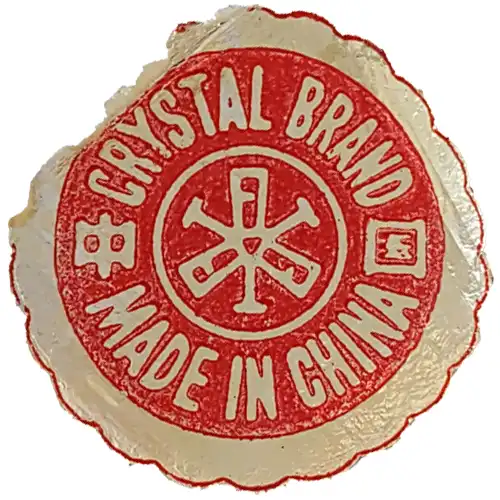
Undated
label · red, gold · glass · China
" " red & gold circular foil label.
Undated
glass
…………….. Unknown origin. This mark is presumably the brand name of a “generic” druggist/prescription bottle style, as used by an unidentified US bottle maker or perhaps marketed by a drug supplies distributor. From the scarcity of this mark, it was probably used for a very short time by an obscure company or in a very localized area.
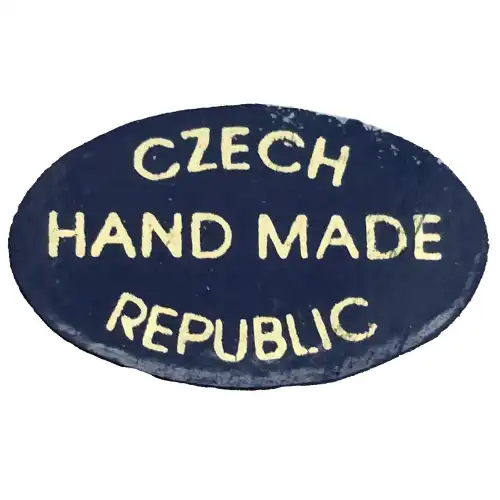
Undated
label · blue, gold · glass · Czech Republic
" " dark blue & gold oval plastic label.
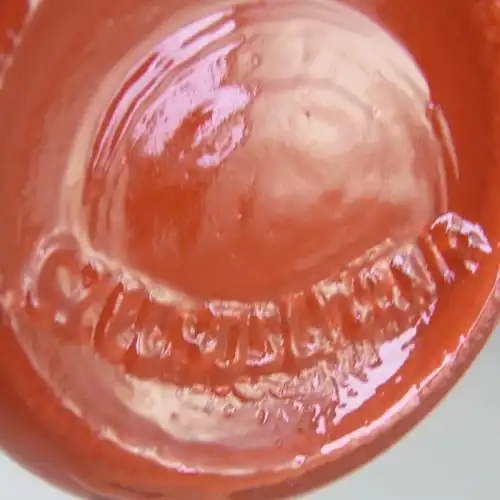
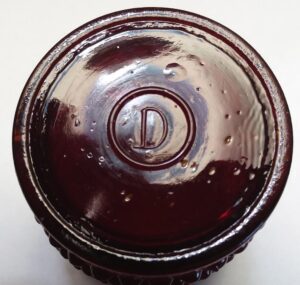
Undated
glass
The image caption describes inside a circle on a ruby-red hobnail votive candleholder.
Undated
glass
……………………….Davey & Moore, Limited, Brimsdown, Middlesex (London), England (c. 1805- 1980). Julian Toulouse ( Bottle Makers and their Marks , page 153) stated this mark dated after 1900, relying on information supplied to him from a contact (Mr. P.E.W. Harrison) who worked for Davey & Moore. The mark has been verified to exist on several bottles, including an aqua handmade round pickle bottle with crudely applied lip that was listed on ebay in 2021. That bottle looks older than 1900 (to me) but it may in fact be post- 1900, as Toulouse wrote that Davey & Moore continued to make handblown bottles even as late as 1925. Information about the early days of Davey & Moore are virtually nonexistent on the internet and I have found no concrete evidence to show any -making firm under the exact name “Davey & Moore” even existed until c. 1873, and that according to a brief mention on a .pdf file article indexed at the planning.islington.gov.uk site [URL was moved or deleted in recent years, and I can’t find it now], indicating that the company had just moved to a location on Albion Road (now 55 Balfe Street) and later (circa 1895-1897) moved to 33 Blundell Street, Caledonian Road. The Statistics of British Commerce (Braithwaite Poole, 1852) with stats probably collected in the 1849-1850 period, does not have a listing for this company. Davey & Moore engaged in the manufacture of “drain pipe (stoneware)” according to a business listing in J.A. Berly’s British, American and Continental Electrical Directory published in 1883. The making operation located on Lockfield Avenue in Brimsdown may have began much later, perhaps not until the 1930s. Davey & Moore was absorbed by United Bottle Manufacturers, Ltd (UGB) in the 1960s or ’70s and eventually closed down in 1980. Also, see the “D” entry, said to be an earlier mark also used by Davey & Moore.
Undated
glass
……………..Dodge & Olcott, pharmaceutical company. A variety of medicinal bottles, including those made in amber and cobalt blue , and of various shapes, were marked with these initials on the bottoms. Most probably date from the late nineteenth century and into the first few decades of the 20th century.
Undated
glass
………………… Unidentified mark seen on “ten pin” style soda bottles that appear to be from Great Britain, perhaps dating from the 1890-1920 period.
Undated
impressed · glass
…………………… DuBois (or Du Bois) Company, Falls Creek, Pennsylvania (1914-c. 1918, possibly later?). Lettering seen on the lower heel of a few milk bottles. Apparently the only types of containers they produced were milk bottles. One example is a bottle embossed “Weidner Clouser / N. Buttonwood” on the front.
Undated
glass
……………….almost certainly Dodson-Braun Manufacturing Company, St. Louis, Missouri (c.1898-1914+) This embossing was a mystery to me for a long while, and had been reported (by at least 3 separate contacts) as seen on a small, round, clear (or with slight amethyst tint) bottle that evidently held some type of food condiment. Recent info submitted by Chad Fitzgerald indicates Dodson-Braun as the source of this mark. D.B. Mfg Co., according to info published in Ketchup, Pickles, Sauces (1980) by Betty Zumwalt, was a food products firm, specializing in packaging pickles, as well as various relishes, sauces and other condiments.
Undated
glass
…………. D. C. Jenkins Company, Kokomo and Arcadia, Indiana (1906-1933)
Undated
glass
……….Dean, Foster & Company, Boston, Massachusetts (c.1874-c.1911) and Chicago, Illinois (1883-1893). This company evidently sold mostly medicinal/druggist bottles, and was probably a jobber rather than an actual bottle manufacturer, selling ware made by Sheldon-Foster and other companies. See “Dean Foster & Co.” entry, as well as “A.M.F.& CO” for a related mark.
Undated
glass
………..Dean, Foster & Dawley, Chicago, Illinois ( 1883-c. 1893) . See above entry and “Dean Foster & Co.” mark on this page.
Undated
glass
…………… (seen on the heel of Hutch and Crown lip type soda bottles and beer bottles), Diamond Company, Royersford, PA (1886-1990), and also possibly the Duquesne Company of Paden City, West Virginia (1905-1920) – especially the latter glassmaker in the case of the mark on the HEEL of soda bottles. A very few bottles have been found with a “D G CO” on the base and in those cases the maker of the bottle is uncertain – but Diamond of Royersford may be the more likely source. Other possibilities for some of these marks include Dixie Company, Tallapoosa, Georgia (1898-c.1906 or later). There is ongoing uncertainty about some of these bottles and their true maker. See this page on the DGCO mark by Bill Lockhart and the Research Bottle Group.
Undated
glass
………….. unknown meaning. Seen on the base of handmade, tooled-lip aqua food bottle, likely circa 1890-1910, that might have held pickles, olives or perhaps another type of preserved food product. The initials might stand for a jobber or wholesale food distributor.
Undated
glass
………………………….. Degenhart Crystal Art , Cambridge, Ohio (1947-1978). Seen on upscale handmade art and novelty such as salt cellars, toothpick holders, hen-on-nest dishes and figurines. For an article with some good background information on Degenhart, check out this webpage: The Degenhart Crystal Art Story . The “ ” emblem was used on much of their produced after 1964, and may be marked on the inside bottom instead of the outside of the base. Glassware made by Degenhart from 1947 to 1964 was evidently unmarked, although a “D inside a circle” is said to be an earlier mark used before the “ ” (see entry above). The Degenhart operation was sold in 1978 and the factory became Boyd’s Crystal Art .
Undated
glass
……………Denver Bottle Company, Denver, Colorado (1946-1951)
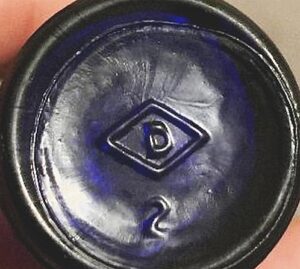
Undated
glass
The caption identifies in a diamond on a cobalt blue Bromo-Seltzer bottle as Dominion Company; 2 is a mould number.
Undated
glass
…………………… Dominion Company, based in Pointe Ste Charles (Montreal), Quebec, Canada with other factory locations including Hamilton, Ontario; Wallaceburg, Ontario; Redcliff, Alberta; Burnaby, British Columbia; and Bramalea (in Brampton), Ontario, Canada. (1913- c. 1976). The “D within a diamond” mark was reportedly first used by Dominion in 1928 and continued to be used until about 1976. Dominion started as Diamond Company, Limited in 1890. Dominion became Domglas, Ltd. in 1976, Domglas Inc. in 1978, then was purchased by Consumers Packaging, Inc. in 1989, later Consumers . (See “C in a triangle” for their mark). Consumers was acquired by Owens-Illinois Canada Corporation in 2001 (now [2024] O-I Canada). Dominion was the largest container manufacturer in Canada, producing huge quantities of many types of bottles and jars over a long period of time. The mark used from 1913 to 1928 was evidently just a plain diamond with no letter inside (at least on their electrical insulators), but I don’t know if the mark used on their bottles followed the same appearance or timeline. See “Diamond logo” farther down on this page. For more information on Dominion and the marks and codes they used, this link supplies a more in-depth discussion: Parks Canada document on Dominion Company bottle mould numbers . Also, check out the extensive article by Bill Lockhart, Beau Schriever & Bill Lindsey: Dominion Companies of Montreal, Canada – SHA.org.
Undated
impressed · glass
………………… D. O. Cunningham / D. O. Cunningham Company, Pittsburgh, Pennsylvania (1880-c.1938). This company was owned and operated by Dominick O. Cunningham (born 1834) until his death in 1911. A prolific producer of soda and beer bottles, especially Hutchinson-style sodas (“hutches”) as well as crown-top bottles after the mid-1890s. The company produced both mouthblown and machine-made bottles. The initials are often found embossed on the lower heel of the bottle along with a mold number. For some background information on this operation and other Cunningham-related companies, see Jay Hawkins’ reference book “ Glasshouses and Manufacturers of the Pittsburgh Region 1795-1910 “. See “C & CO” and “C & CO LIM”.
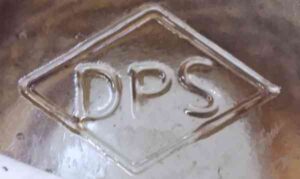
Undated
glass
The image caption describes inside a diamond on a decorative jar.
Undated
glass
The image caption identifies the mark as used by Owens-Illinois Company.
Undated
glass
D (stylized “D” logo, shown above)…………………. Domglas Ltd., (Domglas Inc. after 1978) business name used by Dominion Company, based in Montreal, Canada after reorganization in 1976. This “weird D” or “notched capital D” mark was presumably used on containers from 1976 until 1989 when the firm was acquired by Consumers Packaging, Inc. Please see “D in a diamond” below on this page.
Undated
impressed · glass
" " embossed mark. JHQ are the of the designer, Jens Harold Quistgaard.
Undated
label · green, gold · glass · Sweden
" " green & gold rectangular foil label. JHQ are the initials of the designer, Jens Harold Quistgaard.
Undated
label · red, black, white · glass · Sydals, Sonderborg
" " red black & white rectangular paper label, with separate "Ahle Jensen" designer label.
Undated
glass
………………………..DeSteiger Company, LaSalle, Illinois (1878-c.1889). This mark variation reported to me by Joe McAllister. (Also see “D. S. G. Co.”). It is likely that most, if not all, bottles with this and the much more common “D. S. G. Co.” mark were made during the 1878-1883 time period. The DeSteiger factory burned in 1883 but was evidently rebuilt and taken over by a new owner (Alfred A. Paddon) in 1884, who continued to run that factory under the DeSteiger name for several years- until about 1889. For more background information, see this .pdf article from Bill Lockhart et al: De Steiger Co. and the “Twister” Blowers
Undated
glass
………….Dean, Foster & Company, Boston, Massachusetts (c. 1874-c.1911) and Chicago, Illinois (1883-1893). Seen on the base of a nurser bottle. See D.F.& CO.
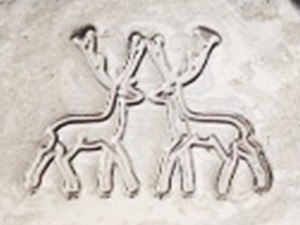
Undated
impressed · glass · Parma, Italy
The caption identifies two facing deer as the logo of Cerve S.p.A., .
Undated
glass
…………. Cerve S.p.A, Parma, Italy. (1953- to date). This company markets a wide variety of decorated glassware, especially tableware for household use, perfume bottles, etc. No information on the exact date range this mark was used, or if it is still being used. If you know, please write!
Undated
glass
……………….. embossing variant for DeSteiger Co. See next entry.
Undated
glass
……………………..There are a number of bottles with this marking on the bottom, especially Owens-Illinois bottles mostly from the 1930s and 1940s. For instance, DES. PAT. 92148. This means “Bottle design was patented and assigned #92148 by the U.S. Patent and Trademark Office in Washington, DC.” A search online might bring up more information on some of these bottles, for example, searching the “Google Patents” database with that particular number shows that a patent was issued for that design in 1934. Keep in mind this does not mean that the bottle itself was made in that exact year, since a design may have been used for several years afterward, with many bottles produced for years after the patent was issued.
Undated
glass
Diamond entwined with/superimposed over an oval [letter O] with an “I” in center (shown)………………………. Owens-Illinois Company (1929-to date – formerly with headquarters at Toledo, OH; now at Perrysburg, OH). This particular mark was used from 1929 to the mid-1950s, with a few bottles carrying the mark into the late 1950s. It is easily the most common manufacturer’s mark seen on containers made in the mid-twentieth century in the US, and the most plentiful mark on found at dump sites that date from the 1930s-1950s era. Please click on the link above for more in-depth information and illustrations of the marks used by Owens-Illinois.
Undated
glass
…………… in some cases, containers with this mark might be products of Diamond Company, Montreal, Quebec (1890-1913) which became Dominion Company and still later, Domglas. In a few instances, a plain diamond might indicate Illinois Company (if the “I” in the “ I inside a diamond “ mark is invisible), BUT I believe the great majority of bottles with a plain diamond found in the United States are products of the Diamond Company, Royersford, PA (1886-1990).
Undated
glass
………………Diamond Company, Montreal, Quebec (1890- c. 1901); Diamond Flint Company (c. 1901-1913), and successor Dominion Company (1913-to c. 1928, after which time new insulator molds included a “D” placed inside the diamond). Note: some insulators carry the “plain diamond without letters inside” but are also marked with “DOMINION” so those would be products of the Dominion Company and made after 1913. See Insulator Manufacturers page.
Undated
glass
………. Please look for a relevant entry listed under the specific letter, although I do have a few entries that are also cross-referenced under the shape.
Undated
glass
……….. please see my listing under “Jewel” on Page Three .
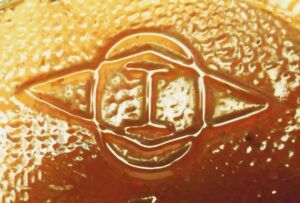
Undated
glass
The caption identifies the interlaced diamond, oval and as Owens-Illinois Company.
Undated
glass
Diamond with a “D” inside……………. Dominion Company, Montreal, Quebec, Canada. Mark used from c. 1928 to at least 1976. See “D in a diamond” entry.
Undated
glass
Diamond with an “H” inside (seen on elegant tableware, stemware, high quality decorative glassware, not utilitarian container )……………….. A. H. Heisey Company; please see “H inside a vertical diamond” entry on page two.
Undated
glass
Diamond with an “I” inside……………. Illinois Company, Alton, Illinois. This mark is seen on huge numbers of machine-made bottles from the 1910s and 1920s. Please see “ I within a Diamond ” page.
Undated
glass
……………. Illinois Company, Alton, IL, produced most if not all of these containers. Please see “ Illinois Co – I within a Diamond mark “.
Undated
glass
Diamond (with “wave” design inside, in upper half)……………… see Unidentified logo at the bottom of Page Five .
Undated
glass
……….Dillon Company, plants at Converse, Indiana and Fairmount, IN (1889-1894)
Undated
glass
……………….. Company, Tallapoosa, Georgia (1898-c.1906 or later)
Undated
impressed · glass
Dixon & Co. / Liverpool (embossed in a circular formation on base of black cylinder whiskey bottle with “PATENT” on shoulder)…………………Francis Dixon & Company, Liverpool, England (1845-c.1872). This mark may date between 1845 and about 1854. A brief mention of Francis Dixon & Company is made in this article about an old bottle works located at Thatts Heath, near Liverpool: Was this the Cradle of Bottle Making? – Lancashire Telegraph . “F. Dixon & Co” is also listed as a bottle maker on page 174 in Statistics of British Commerce (Braithwaite Poole, 1852), with stats apparently collected in the 1849-1850 period. Francis Dixon was known in later years as Francis Dixon-Nuttall.
Undated
impressed · glass
………….DoRay (or Doray) Lamp Company, Chicago, Illinois. Mark seen embossed on automobile tail light lenses, traffic signal lenses, railroad lenses and similar items. No information on dates of operation. Circa 1950s-1960s?
Undated
glass
……………….. Company (now Domglas), Canada. Seen on electrical insulators. See “D in a diamond” entry, and page on Insulator Manufacturers.
Undated
glass
…………………… On some older bottles, primarily handmade examples, several raised dots or bumps are found on the base. In most cases, they served the purpose of a mold number — merely a unique “mark” that identified a particular mold in a factory, especially when a number of identical molds were being used to make a certain type of container. The dots may be arranged in various orientations or geometric patterns. They are seen on case gins, snuff jars, ale, beer and soda bottles, and some older fruit jars and other bottles. In the case of snuff jars, myths have circulated for decades among bottle collectors that the dots seen on the bases of those jars indicate the strength of the snuff, or are date codes. This is not true, as explained in an article published in Old Bottle Magazine , February 1972 issue, page 10. (The number of dots – and their exact orientation – merely identified bottle molds on the automatic machine). Also, please see my entries under “X”, “Star” as well as my page on Numbers seen on the Bottoms of Bottles . Also, this is not in reference to a single raised bump often seen in the very center of the base – that is called a mamelon ). (Note: These types of marks on old handmade bottles are not to be confused with an unrelated subject: the series of raised dots, similar to braille, seen along the lower heels of modern-day beverage bottles. This link points to information on a patent involving a sophisticated system of quality control at the factory) : Device for reading a mold code on a bottle – Google Patents .
Undated
glass
……………………. Beatson, Clark & Company, Rotherham, South Yorkshire, England, United Kingdom. (Now, officially Beatson Clark Limited). This company dates back to 1751, under several firm names. Since 1783 it has been in the Beatson family. They are still in business today (2026). This trademark is shown on page 552 of Toulouse’s Bottle Makers & their Marks (1971) , as well as on their company website, and is shown oriented vertically. Although I have the photo oriented horizontally, the mark might be interpreted as either vertical or horizontal as it appears on actual bottle bases. Also, the “top” arrow is oriented pointing to the right on their website, but on a bottle I have seen, (emerald green “Cromessol / Glasgow” cylindrical packer style bottle that held a disinfectant product) the top arrow is pointing to the left. According to Toulouse, this particular mark was introduced in about 1935.
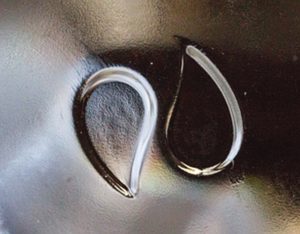
Undated
glass · Turkey
The image caption identifies the two teardrops or water drops logo as Paşabahçe, .
Undated
glass
……………. See W. B. Caldwell’s Medicine bottles
Undated
glass
…………………… See Caldwell’s link, above.
Undated
glass
Drops/droplets (Two teardrops or drops of water, reminiscent of the Chinese “Yin/Yang” symbol)……………….. this mark indicates the brand Paşabahçe (pronounced PAH-shah-BAH-cheh), one of several brands owned by Şişecam, (pronounced SHEE-shee-jahm), based in Istanbul, Turkey (1935-to date). The Paşabahçe Factory was started at Beykoz, Istanbul, Turkey in 1935. The operation has grown over the years, now with a number of factory locations in Turkey as well as Russia, Bulgaria and Egypt. Şişecam produces many types and designs of glassware for home, commercial and restaurant use under the Paşabahçe brand. Their products are exported to many countries around the world, being sold through a number of stores/outlets/distributors in the US including Circleville, Old Time Pottery and Le’raze. I don’t know what year this particular mark was introduced (please tell me if you know!). Some of their glassware bears a “P” on the bottom. This page has more background on the history of this operation: Sisecam.com – History
Undated
glass
………………… Owens Illinois Company , Toledo, Ohio (1929-to date). For more information please check out my page on the trademark. This trademark was used by Owens-Illinois Company beginning in 1940. Most containers with the brand embossing appear to date from the 1940s-1970s. Click here for more info on Owens-Illinois Company . Other marks used by Owens-Illinois include OWENS, LOWEX and KIMBLE as well as many others.
Undated
glass
……………………..Dyottville Works, Philadelphia, Pennsylvania (c. 1833-c. 1899). This operation, located in the suburb of Kensington in Philadelphia, had long been known as Kensington Works (c. 1816 to 1833). Dr. Thomas W. Dyott (1771-1861) was heavily involved in the works early on, and by about 1821 was part, if not full, owner and manager of the operation. Beginning in the early 1820s and possibly into the early 1830s a number of flasks were made that bear the marking “KENSINGTON WORKS PHILADELPHIA” and / or “T. W. D.” on them. (See “Kensington Works” entry on page three). Dyott gradually expanded the works and implemented the building of an extensive complex or small “town” around the glassworks which became known as “Dyottville”, with the factory itself – consisting of several separate factory buildings and accompanying outbuildings – being known as the Dyottville Works – by around 1833 if not before. Dyott filed for bankruptcy in 1838 and the works were shut down for some period of time between 1839 and 1842, later to be reopened, continuing on and off under several other operating firms until about 1899. (The exact ending year has not been determined with certainty). The Dyottville Works produced large numbers of pictorial / historical flasks (such as some of the Washington/Taylor “The Father of His Country” flasks, in particular GI-37 and GI-38 (in the McKearin figured flask classification system) and those could date from the late 1840s and possibly into the early or mid-1850s. (Note – reproductions of those particular flasks have been made in modern times by other makers including Clevenger Brothers – consult knowledgeable flask experts to determine if a particular example is a real Dyottville flask or a later copy). Other bottles found with the Dyottville embossing include a large number of lettered blob top soda and porter style bottles that probably date mostly from the 1850s-1860s period, as well as cylinder whiskey bottles that likely also date from that general time period and some possibly as late as the 1870s or 1880s. Some of the cylinder whiskies are lettered “PHILA” instead of “PHILAD’A”. Most of the Dyottville production over the many years it was in business, under several owners, was not marked. For more information check out this Lockhart article about Dyottville : Dyottville Works.
Undated
glass
……………… see next entry.
Undated
glass
………….. Unidentified, but on some early (handmade) bottles, this letter could possibly stand for any of a number of early bottle companies, including Ellenville Works of Ellenville, New York (1836-c. 1894 – operating under several slightly different factory names), as well as several Pittsburgh operations such as T. A. Evans & Company (c.1860-1869), Enterprise Company (1 st of that name, c. 1871-1873) or Eclipse Works (c.1875-1893). (Eclipse Works was located in the “Temperanceville” area of Pittsburgh – one of several factories operated by Thomas Wightman & Company). Another possibility would be Edward H. Everett Company of Newark, Ohio. See “ . H. . Co” and “ N next to (or within) a star “ marks. (In a book about Edward H. Everett and his company – Edward Hamlin Everett – The Bottle King by G. Wallace Chessman & Curtis W. Abbott, 1991 – a graphic is shown that includes “ 1” through “ 5” as marks used by Everett. However, no indication is presented on the source of that information or what types of bottles were marked thus). In some cases it is possible the letter could be merely a mold identifier or “shop letter”, as seen on the bottom of some beer bottles. The type of bottle most commonly seen with a single letter “ ” on the base, often accompanied by a mold number (1, 2, or 3) placed below the letter, is the Doyle’s Hop Bitters , usually found in some shade of amber. In those cases, judging from the years in business and the fact that Doyle’s was based in Rochester, NY, I think Ellenville Works is the more likely contender for the “ ” mark – at least on those particular bottles! Ellenville is known to have manufactured Hop Bitters bottles ( Poughkeepsie Eagle-News , May 10, 1881 issue, page 1).
Undated
glass
……………. see above entry.
Undated
glass
…………………. uncertain, but probably Edgar Breffit & Company, Castleford, Yorkshire, England. (c. 1844-1913). This firm was the operating company for the Aire & Calder Bottle Company (see A.C.B.Co. mark) for many years. For more info see this article by Bill Lockhart & the BRG: Edgar Breffit & Company – SHA.org
Undated
glass
……….. see “E.B.” entry.
Undated
impressed · glass
…………….Elk Flint Bottle Company, Shinglehouse, PA (1904-1912 or 1919). Although most references in bottle/jar related research material state 1912 or 1913 was the end date of this company, information on this webpage on Shinglehouse history indicates this firm was in business until 1919 : Shinglehouse Borough History . Also, this company produced wire bail type fruit jars embossed “TRADEMARK / KEYSTONE / REGISTERED” across the front of the jar.
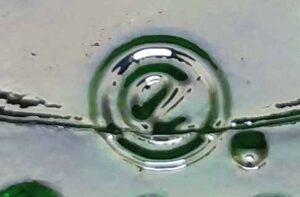
Undated
glass
The image caption identifies lowercase in a circle on an emerald green Jameson whiskey bottle as Encirc, a Vidrala subsidiary.
Undated
glass
……………. these initials on bottles could stand for any one of at least three different operations including: Everett Company, Everett, PA (three firms with that name operating over the period of 1885-1905); Evansville Company, Evansville, Indiana (1903-1907); or Eastern Company, Cumberland, Maryland (1909-1913). For more background details on these firms, please see this article by Bill Lockhart et al: The and E. G. Co. Logos – SHA.org
Undated
impressed · glass
……………….. unidentified, seen embossed on a clear urinal of uncertain date. Possibly, the maker was one of the 3 firms listed in the entry above.
Undated
glass
………………Edward H. Everett (c. 1881-1885). This was the second owner/operator of the Newark Star Works . Officially incorporated as “Edward H. Everett Company” in 1885 (also called “Edward H. Everett Works”). The “E H E” mark may have been used after 1885, concurrently with the CO. mark. Please see next entry, as well as “ N next to (or within) a star “.
Undated
glass
…………………. Edward H. Everett Company (operating company of the Newark Star Works), Newark, Ohio (1885-1904). Plant merged in 1904 to become part of the Ohio Bottle Company and in 1905 Ohio Bottle became part of the American Bottle Company. American was purchased by Owens Bottle Company in 1916, and in 1929 this plant became part of the merger that resulted in the formation of Owens-Illinois Company . Also, see “S. K. & CO” and “ N next to or within a star ” marks.
Undated
glass
……….. Eli Lilly and Company, Indianapolis, Indiana (1876 to date). This mark is seen on a variety of medicine bottles, most often made in amber . Bottles bearing this mark on the bottom appear to date from sometime in the 1890-1930 time period. Most, if not all, of these bottles were made by Fairmount Company , located first at Fairmount, Indiana and later in Indianapolis. As a side note, Eli Lilly & Company marketed some amber figural “Fish bottles” in the 1920s that contained cod liver oil (which were patterned after similar-looking handblown bottles originally made in the 1860s-1870s). The Eli Lilly fish bottles were made by Fairmount at the Indianapolis factory, and are typically marked with an “F” on the base.
Undated
glass
…………………….. see more information on the Brody company on this page.
Undated
glass
E (oddly shaped lower case “e” inside circle)…………………… here seen on base of emerald green Jameson Irish Whiskey bottle, this recent mark stands for Encirc (founded in 1998) with container factories located in Derrylin, Ireland; Elton, Cheshire, England and The Park, Bristol, England. The mark is also used by Corsico Vetro S.r.l., Corsico, Milano, Italy, according to a recently updated Emhart bottle punt mark .pdf file. All of these operations are now [2024] subsidiaries of Vidrala S.A.
Undated
glass
…………..E. Packham Jr. & Company, Baltimore, Maryland (c. late 1890s-1900s?)
Undated
glass
E.R. & Co. (on base of “ MASON’S PATENT NOV 30TH 1858 ” fruit jar)………………… Ely, Reed & Company, Clyde, NY (c.1874?-1880). ER&Co were successors to “Southwick, Reed & Company”. The exact year of transition from S.R.& Co. to E.R.& Co. is a bit unclear but surely within the 1873-1875 time period. This was just one of the many proprietor firms that operated the Clyde Works factory at Clyde, New York. See “Clyde”, “E. S. & H.” and “S. R. & Co”.
Undated
glass
………………… Evans, Sell & Company, Pittsburgh, Pennsylvania (1873-1877)
Undated
glass
…………….Ely, Sons & Hoyt, Clyde, NY (Proprietors of the Clyde Works during part of the time that factory was in operation, initials possibly used circa 1886-1895).
Undated
glass
………… Ely, Son & Hoyt, Clyde, New York (c. 1880-1886). See above entry. Also, see S & R, and Clyde entries.
Undated
glass
…………………… same as above.
Undated
glass
………E. Wormser & Company, Pittsburgh, PA (c.1854-1875). Later known as Wormser Company (1875-c.1927).
Undated
glass
…………..Essex Company, Mt. Vernon, Ohio (c.1906-1920).
Undated
label · black, silver · glass · United Kingdom
" " square black & silver foil import label, found on a Murano paperweight.
Undated
impressed · glass
…………. Graham Company, Evansville, Indiana (see Graham). Often found in conjunction with “G23” or “G26” or similar numbering. These markings are often seen on light green soda bottles of the 1920s.
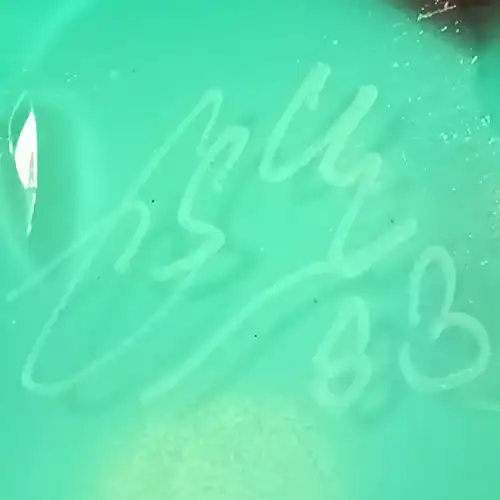
Undated
The illustrated Eisch signature includes the year 1983; this dates the example.
glass · Germany
" " signature, for Erwin of Glashütte, with 1983 year date.
Undated
glass
………………… Housewares, Chicago, Illinois. Maker of all types of kitchen-related cookware and accessories. Brand name occasionally seen marked on cookware, measuring pitchers, coffee carafes, etc. Most of these pieces date anywhere from the 1950s to the present. I’m not positive what manufacturer produced these items. I would hazard a guess (repeat: guess!) that some items were made by Hazel-Atlas Company , Anchor Hocking Corporation , Indiana Company, Federal Company and/or Corning .
Undated
glass
……………. , Ellenville, New York (1836- c.1894). This factory operated under several different names over the years. The factory produced many bottles with the “ ” lettering on the bottom arranged in a circular orientation. They also produced a number of popular bottles of the 1870s and 1880s including Doyle’s Hop Bitters and Drake’s Plantation Bitters.
Undated
label · black, silver · glass · United Kingdom
" " rectangular black & silver foil retail label, found on Nazeing .
Undated
impressed · glass
Emerald (rectangular “Emerald cut” gemstone – embossed design seen on the skirt of electrical insulators)……………….. see “PRISM” entry on Page Four. This mark was embossed on insulators made for (and sold by) C.S. Knowles of Boston, MA.
Undated
label · blue, silver · glass · Sweden
" " blue & silver shield shaped foil label.
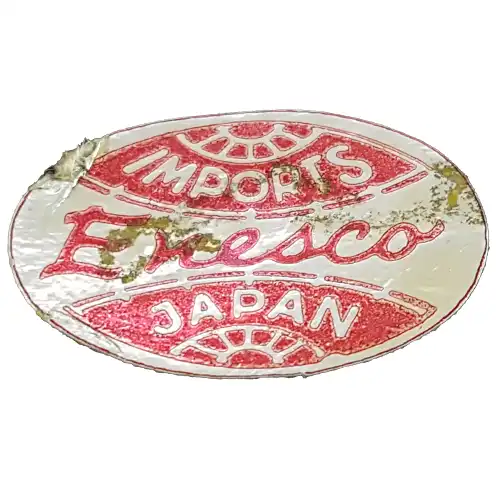
Undated
label · red, silver · glass · Japan
" " red & silver oval foil import label.
Undated
glass
………….Graham Company, Evansville, Indiana. See Graham. Usually found on pale green “crown lip” soda bottles of the 1920s period.
Undated
glass
………….. Graham Company, Evansville, Indiana. See Graham.
Undated
glass
…………… see “T.A. Evans & Co.” entry on Page Five.
Undated
glass
……………Edward H. Co. (Newark Star Works), Newark, Ohio (c.1881-1904). See “E.H.E.CO.” and “N next to (or within) a star” entries.
Undated
glass
……………………. Owens-Illinois Company, Toledo, OH (Kimble Company, division of O-I). Trademark used for borosilicate formula, used for laboratory glassware, chemical bottles, etc. circa 1950s.
Undated
glass
………………….occasionally the “Diamond and oval entwined with an I in the center” trademark used by Owens-Illinois Company has been loosely described as an “Eye” or as resembling the planet Saturn. Please see this page on Owens-Illinois Company for more information and photographs of a number of examples of that mark on bottles.
Undated
glass
……….Fahnestock, Albree & Co., Pittsburgh, Pennsylvania (c.1860-c.1872).
Undated
glass
………….Fahnestock, Albree & Co., Pittsburgh, Pennsylvania (c.1860-c.1872).
Undated
glass
F and dots (The letter “F” accompanied by, or partially surrounded by dots , often in a circular pattern, as shown above, usually seen on the bottom of clear cylindrical bottles)……………………….. this mark was one of several similar “letter with dots” marks used by Owens Bottle Company for an undetermined number of years – perhaps 1916-1919- before they adopted their standard “O inside a square” trademark that was instituted in 1919. These are machine-made bottles. For more info see this link: The Owens Bottle Co. Part 2 – Dating Logos and Codes – Nate Briggs & Bill Lockhart.
Undated
glass
F. & S. CIN. O. (on base of amber “export beer” style bottle) …………. Foss & Schneider Brewery, Cincinnati, Ohio. Foss-Schneider Brewing Company was in business for many years but the exact business name of the company changed several times and was “Foss & Schneider Brewery” circa 1877-1884, according to this webpage: Foss & Schneider Brewery
Undated
glass
……Fairmont Bottle & Fruit Jar Company, Fairmont, West Virginia (1892-1893). This company was dissolved in 1893, and a few months later a new company (located at the same factory site) was organized under the name of “Johns Bros”. See J.Bros. mark.
Undated
glass
……………. Findlay Bottle Company, Findlay, Ohio (1888-1893). Occasionally seen variation, not as commonly used as “F. B. Co”.
Undated
glass
……………Findlay Bottle Company, Findlay, Ohio (1888-1893) . Most commonly seen on the bottom of aqua “wax sealer” style fruit jars.
Undated
impressed · glass
…………..mis-reading of “F.C.G.CO.”, below. The “G” is often embossed to appear more like a “C”.
Undated
glass
…………….. Falls City Company , Louisville, Kentucky (1884-1892)
Undated
glass
………….. same as above – Falls City Company , Louisville, Kentucky (1884-1892).
Undated
glass
…………………see “F G C” entry.
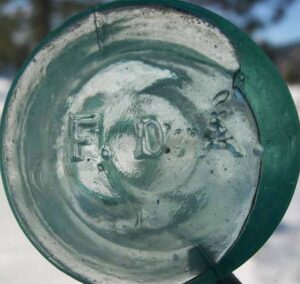
Undated
glass
The image caption identifies as Fred D. Alling on an aqua cone-ink bottle base.
Undated
impressed · glass
…………………. Fred D. Alling, Rochester, New York. These initials stand for Frederick Dwight Alling (sometimes the last name is mistakenly spelled Allings). Alling (1843-1910) was an ink and mucilage manufacturer based in Rochester, NY who started his business in about 1867. He began by selling stationery and related goods and then expanded into manufacturing inks, eventually selling a wide variety of inks and related products for many years thereafter. A number of different types of ink bottles (including cone, igloo, and schoolhouse or carmine types), are known with his name or initials embossed on them.
Undated
glass
……………… Fairmount Works/Company, Fairmount, IN (1889-1906) & Indianapolis, IN (c.1906-1968). Most commonly seen on the bottoms of various machine-made utilitarian bottles and jars, in amber or clear , that date from the c. 1920 – 1945 era. For more info see the Fairmount page. Also, see next entry.
Undated
glass
……………..F. E. Reed Company (Reed Company), Rochester, New York (1899-1956). Mark used from c.1899-1927. For more detailed company chronology, see under “Rochester Wks” entry. Also see next entry.
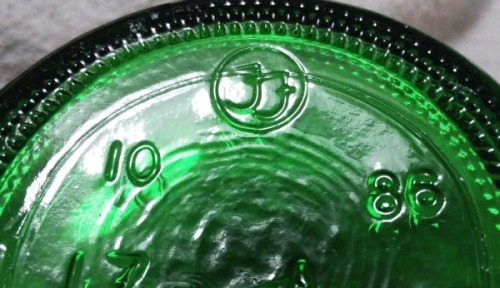
Undated
The illustrated soda bottle is captioned as made in 1986.
glass
The caption identifies in a circle as Foster-Forbes Company on an emerald green soda bottle.
Undated
glass
…………….. Fox, Fultz & Company, Boston, Massachussetts (c. 1894-1911+). (Date range info courtesy of Taylor McBurney).
Undated
glass
…………Fox, Fultz & Webster, Boston, Massachusetts (c. 1885 or earlier-c.1893). This mark was first reported to me (courtesy of Mark Newton) as seen on the base of a colorless druggist bottle from Greenville, NH, probably made circa 1885. Another web correspondent (Shawn) supplied the full name of that business as the virtually certain source of the mark. Taylor McBurney supplied approximate date range from info found in city directories.
Undated
impressed · glass
……………… Unknown meaning. Lettering as seen on the bottom of a clear bottle, cup or drinking (from a partial base shard), date unknown but possibly early 1900s. The lettering is embossed in reverse on the base , so it looks correctly oriented only when looking downward into the .
Undated
glass
………………. Florida Manufacturing Company, Jacksonville, Florida (1926- c.1947). Julian Toulouse ( Bottle Makers and their Marks , 1971, page 199) indicates this mark dates from “circa 1930”. Another minor variation is also pictured: F and G entwined (superimposed over each other) which he writes as dating “circa 1940”. According to Toulouse, Florida Manufacturing Company was purchased by Chattanooga Company in 1947 (See “C in a circle” mark) , then leased by Ball for a year, and subsequently sold back to Antonio Scalise in 1950 who changed the name of the concern to “Tropical & Box Company” in about 1952. This Jacksonville plant eventually became Anchor Hocking’s plant number 7. Some milk bottles marked “ ” also bear the number “60” to the immediate right of the letters. Also, a few half-pint size milk bottles marked “ CO. 60” (and at least one marked “ CO 160”) on the lower heel are products of Florida . The “F. G. ” mark is also seen on the base of a number of soda bottles from Southern US states. More background info here from Bill Lockhart and other researchers: Florida Mfg. Co .
Undated
glass
……………… Florida Manufacturing Company, Jacksonville, Florida (1926-1947) . The mark “F. G. CO. 160” has also been seen on at least one half pint milk bottle. (That bottle bears a large “3¢ ” on the base). A few bottles are marked “F.G.CO. 60” on the heel. See “F G” entry, above. Also, see more info on the operation here: Florida Mfg. Co.
Undated
impressed · glass
…………………… meaning unclear. (Note – this mark includes a lower case “o” in Co). A very small number of bottles have been found with “ ” embossed on the base and there is uncertainty about what those initials actually stand for. They are much older bottles than those known to have been made by Florida Mfg. Company (see F G and F.G.CO. entries above). Although Toulouse (Bottle Makers and their Marks, 1971, page 200) attributes this mark to Fairmount Company of Fairmount, Indiana, claiming it’s use from 1889 to 1898, this seems open to question. (see Fairmount Works page on this site). An amber medicinal flask and an amber “pony” style beer bottle are marked with “F.G.Co.”. Also, a clear handmade ink bottle is known, and that bottle may have been made in Canada or England. Photos of those bottles are shown in this article from Bill Lockhart et al, here: Florida Mfg. Co. – SHA.org
Undated
glass
……………… Farrall Manufacturing Company, Michigan City, Indiana (1885- 1886 or 1887). The business address for this works was located in nearby Chicago. This very scarce mark is known on the base of a Primley’s Iron & Wahoo Tonic bottle (photo above) and also on the bottom of an amber PH.ZORN beer bottle from Michigan City, Indiana. Other bottles are possibly out there that I’m not aware of. After many years of being an “unknown mark” , the correct identification of the user of this mark has been uncovered by researcher Josh McIntyre who kindly passed along this information to us [11/2025]. The exact time of closure of the operation is yet uncertain, but Josh is continuing to do more research on this short-lived glassworks. The factory property evidently sat empty for a number of years, and was then purchased and renovated to become a brick manufacturing operation in about 1895.
Undated
glass
………………………Fairmount Works/Fairmount Company, Fairmount, Indiana (1889-1906) & Indianapolis, Indiana (c.1906-1968). The “G” is often much larger than the other two letters. See Fairmount Works page.
Undated
glass
………………… see above entry. The “G” is larger than the other two letters. There may or many not be periods visible.
Undated
glass
………………. Frederick Heitz Works , St. Louis, Missouri (1882-1898).
Undated
glass
………….. Frederick Heitz Works , St. Louis, Missouri (1882-1898).
Undated
glass
……………….Francis H. Leggett & Company, New York City, New York (1870-c.1959?). This was a wholesale grocery firm, selling both local, regional as well as imported grocery products such as tea, coffee, cheese, etc. Some “ MASON’S PATENT NOV. 30TH 1858″ jars are known with the initials on the base. Those probably date from sometime in the 1870s-1890s era, and were made for FHL&Co by an unidentified bottle maker.
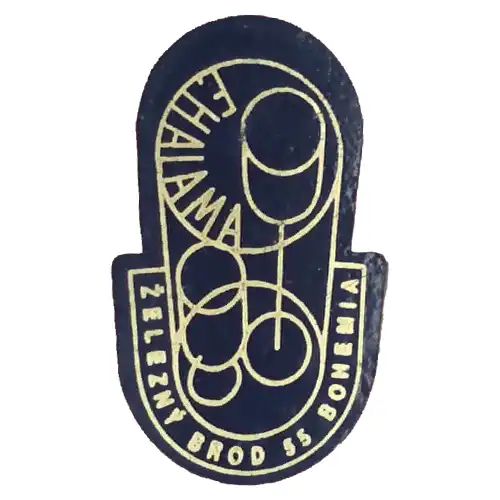
Undated
label · blue, gold · glass · Bohemia
" " blue & gold plastic label.
Undated
impressed · glass
………….. Franklin Industrial Company, Warwick / Clinton, Ohio. (c. 1906-1915). Seen on base of beer bottles. Franklin Industrial Co. was formed to control a number of related small industries in the Massillon, Ohio area, including sand and gravel companies and the operation of the Warwick Company, which was supposedly founded in 1901 by a Maria Warwick. How long this manufacturer actually lasted and whether any other marks were used on the bottles made there, especially in the 1901-1906 time frame, seems open to question. For a bit more info and links, please see the post from “Jim” and my response, dated March 3, 2020, in the Comments section of the WELCOME / Home page.
Undated
glass
………………..Fairmount Works/Company, Fairmount, Indiana (1889-1906) & Indianapolis, Indiana (c.1906-1968). For more info on the marks used by this company, please see this page: Fairmount Company.
Undated
glass
………… Fenton Art Company, Williamstown, West Virginia (1905-2011). Mark first used in 1983, seen on brightly colored handmade upscale glassware.
Undated
glass
………………..attributed to C. L. Flaccus Company, Pittsburgh, PA (1879-c. 1927). General offices in Pittsburgh, actual factory locations were at Tarentum, Leechburg, New Brighton, California, Charleroi and Beaver Falls, all in Pennsylvania. The period of usage of this particular mark is uncertain. Although the mark is listed in “ Milk Bottles: Their Makers and Marks ” by Jeffrey L. Giarde (1980) on page 22, and he dates it as “1900 – 1928”, Giarde might have been copying Julian Toulouse’s info in “ Bottle Makers and their Marks ” (1971). I have only heard about one milk bottle confirmed to have this mark – but on the heel, not the base. If you have seen ANY bottles bearing an “F in a keystone” mark, please write! Also, see “C.L.F.” and “C L F G CO” marks. Flaccus has a rather complicated and confusing history – here is an article by Bill Lockhart with more background information on this company: C.L. Flaccus Co.
Undated
glass
……………Frederick Lorenz & Co, Pittsburgh, Pennsylvania. This mark (and “F. L. & Co.”) was listed by Rhea Mansfield Knittle in Early American (1927:441;444). Some sources give the dates 1819-1840 for the use of one or both of these marks. Knittle notes that “ & CO.” appears on a Union-Clasped Hands pictorial flask, but McKearin & Wilson (1978:651) show that the mark as “L.F.& Co”. In any case that flask would certainly date from the 1860s or 1870s. See “F R L”.
Undated
glass
………………….see above entry.
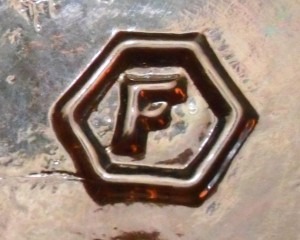
Undated
glass · Indianapolis, Indiana
The caption identifies in a hexagon on an amber bottle base as Fairmount Company, Indianapolis.
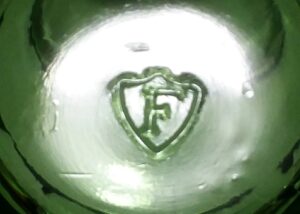
Undated
glass
The caption identifies Federal Company’s in a shield on the base of an avocado-green miniature mug.
Undated
label · glass
Federal Glass used the F-in-a-shield mark until the factory closed in 1979. Its output included Depression glass, milk glass and decorated commemorative mugs.
Undated
glass
………….Fahnstock, Albree & Company, Pittsburgh, PA. See entry above.
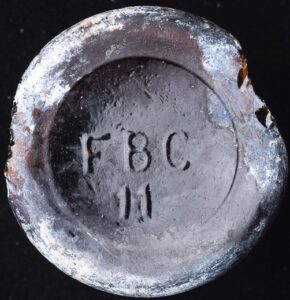
Undated
glass
The image caption identifies as Findlay Bottle Company on a beer-bottle base shard excavated from the San Antonio River.
Undated
glass
“ ”…………..phrase commonly seen on liquor bottles. For more information, please check out this article: .
Undated
glass
……………………….. Forster’s Co., Ltd., St. Helens, Lancashire, England (c. 1902-c.1966) . Toulouse illustrated this mark (page 205, Bottle Makers and their Marks ) and stated it is “modern”, likely dating no farther back than World War II. The two letter F’s are in cursive font and may be somewhat “tall” and “thin”, slightly more so than the letters in the very similar mark used by Foster-Forbes in the United States. These marks may be easily confused, but if the container was found in Great Britain it is much more likely to represent Forster’s Co., rather than Foster-Forbes. (See FGC mark).
Undated
glass
……………….. Foster-Forbes Company, Marion, Indiana and (later) several other plant locations. (1929-2000). This particular mark was first used in 1942 and is seen on the bottoms of many kinds of bottles including those made for soda, beer, food, medicine, cleaning products, etc. The exact ENDING year of use of this mark seems a bit uncertain, but I have seen emerald green soda bottles with date codes for 1986 and 1990. Foster-Forbes Co. was merged into National Can Company in 1969 and eventually National Can Company was merged with other interests to form American National Can Company in 1987 (see American National Can Company mark on Page One )- however at least some bottles made at some of the Foster-Forbes plants under this corporation “umbrella” continued to use the “FF in a circle” mark – at least as late as 1990 and possibly as late as 1995. Sometimes the mark is faint and very hard to discern and in some cases the cursive “FF” is interpreted as “33” with the numbers having a somewhat flat top, or as a “JJ connected, inside a circle” ! Some of the former Foster-Forbes plants are no longer in operation, and others are part of the present-day Ardagh Group (formerly owned by Saint Gobain, later Verallia). Saint-Gobain Containers products usually have an “SG” on the heel or base (see my page on the “ SG” mark used by Saint-Gobain ) . For an earlier mark used by Forbes ( 1929-c. 1942), see entry under “Z” (Backward Z with a slash through the center) on Page Five . For more background material on Foster Forbes and related companies, check out this web article by Bill Lockhart et al: Foster-Forbes Company. ALSO, please check next entry for a similar mark used in Great Britain!
Undated
glass
…………………………………….. Forsters Company, St. Helens, Lancashire, England (United Kingdom), 1902-1966. Forsters was acquired in 1966 by Rockware , and Rockware eventually became part of Ardagh in 2006. This mark is frequently seen on fishing net floats.
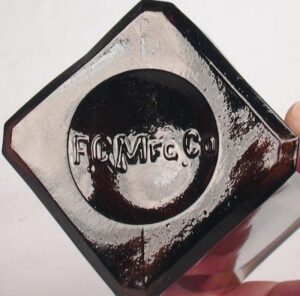
Undated
glass · Michigan City, Indiana
The image caption identifies as Farrall Manufacturing Company of , on an amber Primley’s Iron & Wahoo Tonic bottle.
Undated
glass
……………Fidelity Company, Tarentum, Pennsylvania (1895-1916).
Undated
glass
………………….Fidelity Company, Tarentum, Pennsylvania (1895-1916).
Undated
incised · glass
………………. Fire & Light, Arcata, California (1995-2019). Located in northern California (Humboldt County), this independent studio operation produced handmade glassware from recycled (mostly from crushed bottles), and has gained a devoted following among collectors. Many types of products were made including bowls, plates, tumblers, ashtrays, votive candleholders and other novelty items, in a wide range of colors. Many pieces seem “heavy” in weight for their size. Most (although not all) of the pieces, especially the bowls, plates and tumblers, feature a somewhat uneven surface (which might be described as “hammered”, bumpy, corrugated, irregular, or subtly crinkled or pebbly). Only a minority of pieces were signed, usually on the base or edge of the piece. Sadly, the operation ceased production and closed down permanently in April of 2019, evidently because of financial issues.
Undated
glass
………………………. Anchor-Hocking Corporation (1937-to date). This has been an extremely popular line of glassware since introduced in the 1940s. glassware has been made in semi-opaque or “translucent” colors, as well as fired-on colors over transparent or white milk . is made of a heat-resistant type of , and many patterns and styles of bowls, cake pans, and other items for oven use have been made, competing with Pyrex-brand cookware made by Corning Works . Large numbers of drinking mugs and cups have been made with the brand name logo on the bottom, and these are avidly collected today, especially by the so-called “baby boomers” growing up during the 1940s, 1950s and 1960s, when so many of these items were in popular use in most American homes. Many of the mugs and bowls have surface-applied color decoration, which sometimes begins to wear off, thus washing them in an automatic dishwasher is strongly discouraged. Vintage ware has great nostalgic value, and can be seen frequently for sale at antique malls, flea markets and garage sales. Please see “Anchor with an H superimposed” mark on this page: Anchor Hocking Corporation .
Undated
glass
………….. , Fislerville (now Clayton), New Jersey (1850- c.1863, although known under the name unofficially for years afterward). Became Moore Brothers & Company in 1863. Most famous for their Jenny Lind calabash liquor flask produced in the early 1850s. Note : Many reproduction “Jenny Lind” calabash bottles are known, in a range of colors, and are much more plentiful than the originals made by Fislerville . Most of the repro Jenny Lind bottles were made by Clevenger Brothers Works. For info on how to tell them apart, see this page: Have you been fooled by the Clevengers? – RealorRepro.com
Undated
glass
………. See this page: Fletcher’s Castoria .
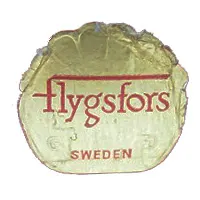
Undated
label · red, gold · glass · Sweden
" " red & gold shell shaped foil label.
Undated
glass
………..Food Manufacturers Federation. (See post submitted by Jeremy Kemp on 8/27/2017 in the “Comments” section). Seen on clear bottles in the United Kingdom.
Undated
glass
………………. unknown. Reported by Lee Taylor on base of handmade aqua export style beer bottle, probably circa 1900-1920. The initials might stand for a brewer or bottler?
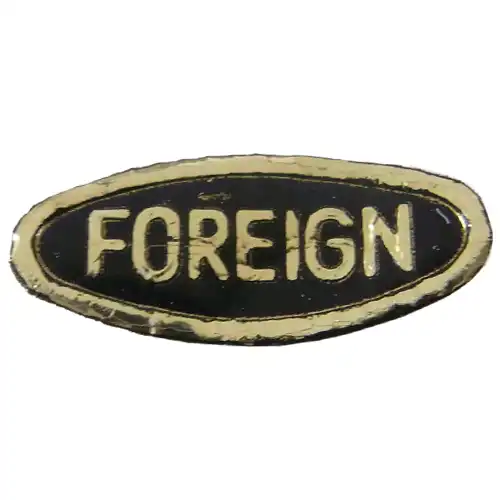
Undated
label · black, gold · glass · Japan
" " black & gold oval foil label found on Japanese .
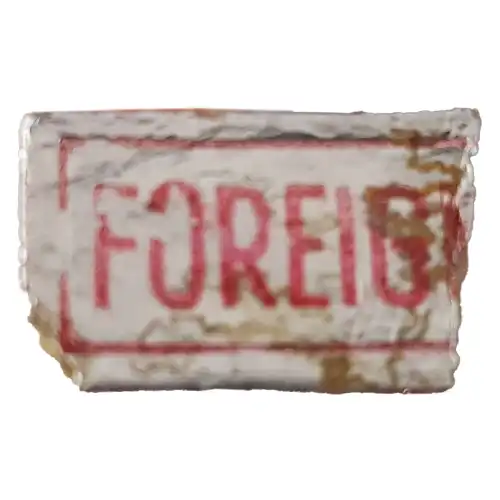
Undated
label · red, silver · glass · Japan
" " red & silver rectangular foil label found on Japanese .
Undated
label · red, white · glass · Japan
" " red & white oval paper label found on Japanese .
Undated
glass
………………………….See F.G.C. entry.
Undated
glass
………………………….Fort Trumbull Company, New London, Connecticut (1865-1868) . Mark is known on the base of cylinder whiskey bottle.
Undated
glass
……………. a popular type of shoe polish (“shoe dressing”), especially well-known during the late Victorian era, circa 1880s-1890s. For more information, please see this webpage about .
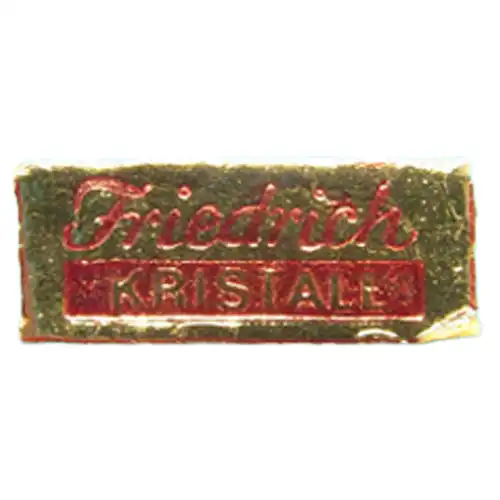
Undated
label · red, gold · glass · Germany
" " red & gold rectangular foil label.
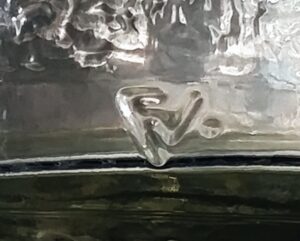
Undated
The source cites bottles with 2006 and 2023 date codes; these do not establish a complete use interval.
glass · Mexicali, Mexico
The connected logo is identified with FEVISA, Fábrica de Envases de Vidrio, , and other plants. The exact use span is unknown; it appears on Mexican Coke and Jarritos bottles.
Undated
glass
FWF (Capital letter W, joined with two capital “Fs” – the first one is backward)…………. Wilkerson , Moundsville, West Virginia (1975 – present). This mark was used after the FW mark listed above, beginning in 1989, and is sometimes called a “Flying W”,” Winged W” or “W with wings”. The mark appears on the bottom of pressed novelties such as open salts and miniature insulators, made in a variety of colors. Not all was marked. Wilkerson has made a wide variety of blown and pressed items and their website can be found at WilkersonGlass.com
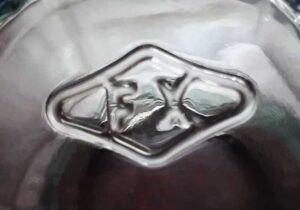
Undated
glass
in a diamond is unidentified, on a small clear six-sided jar or shaker described as of recent manufacture.
Undated
glass
…………………Glenshaw Company, Glenshaw, Pennsylvania (1895-2004) on some bottles. Also, see “ in a square” mark.
Undated
glass
…………………Gayner Works, Salem, New Jersey (on some bottles especially in the earlier years). See “ in a circle”.
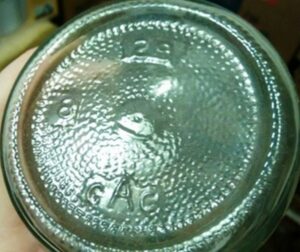
Undated
glass
The image caption identifies on a packer jar as Arkansas Container Corporation.
Undated
glass
g A c (capital A, with smaller, yet upper case, “G” and “C” placed on both sides, as shown) …………………… for several years I had this mark listed as “unknown manufacturer”, but recently (9/2023) have discovered this is an early mark (most likely the very earliest mark) used by Arkansas Container Corporation of Jonesboro, Arkansas (1956- to present). (Julian Toulouse listed a single capital “A” mark as the earliest mark they used, but I’ve not seen it on any containers). This gAc mark has been seen on a variety of utilitarian/packer jars of various sizes, as well as on a syrup dispenser jar. The mark also appears on the bottom of a large jug made for sun tea that came with a yellow plastic lid, probably from the late 1960s or early 1970s. In some cases the “A” is quite large and the “G” and “C” are like two small “footnote letters” positioned to the lower left and right of the “A”. (Thanks to Melissa Alonzo for her help with this mark! She sent me photos of an older cardboard shipping box containing jars that proved conclusively this mark was connected with Arkansas Container). For more information and a photo showing their current mark, please see the “A G C within an outline of the state of Arkansas” entry on Page One.
Undated
glass
………… On the base of some cobalt blue bottles, such as Phillips Milk of Magnesia Tablets, this “G” stands for Gulfport Company, Gulfport, Mississippi (1955-1970). Gulfport Co. made large quantities of the Phillips M.O.M. bottles. Gulfport was acquired by the Dorsey Corporation in 1968.
Undated
glass
…………… Gray & Hemingray, Cincinnati, Ohio / Covington, Kentucky (1848-1856). See Hemingray & H.G.CO. marks.
Undated
glass
G and W with three dots (lower case “g” with “W and three dots” placed above the “g”, seen on the bottom of kitchenware items such as salt and pepper shakers, sugar shakers, syrup pitchers, etc)………………. Gemco Ware, Inc., Freeport, New York, later at Hauppauge, New York (1948-2003). Gemco Ware was a distributor, not a manufacturer. This mark was registered on December 11, 1962, and the trademark number is #741,771. The “W” which floats above the letter “g” is often mistaken to stand for Westinghouse, but this is incorrect. Many item listings on ebay, etsy and other sites repeat this mistaken belief. Actually, the “capital W with dots” almost certainly represents a “Crown with jewels” and is merely part of the entire trademark as used by Gemco. It is not clear what company (or companies) actually manufactured the items marked “g W & 3 dots” and “GEMCO”. Please see the trademark information at this page: Gemco ware – from Justia trademark site . Also, see “Gemco” entry, above. (Thank you to J. T. S. for help with research on this mark!)
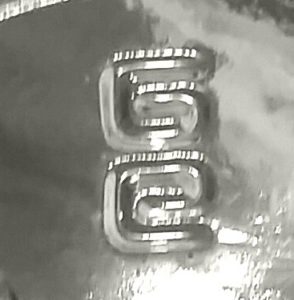
Undated
glass
G. C. CO (as seen on the bottom of machine-made clear food containers including a condiment bottle made for Barbeque sauce, and a 10-paneled shaker or mustard jar) ……………………….. Glaser-Crandell Company, Chicago, Illinois. For more information, please see the webpage here on the G. C. Co. mark.
Undated
glass
………………… George C. Ovens & Company, Red Bank, New Jersey (c. 1875- c. 1890). Initials seen on aqua condiment bottles. The bottles were made by an unidentified bottle manufacturer in the New Jersey / New York area.
Undated
glass
……………………. Graham Company, Evansville, Indiana (1912-1929). This mark was introduced circa 1913, ending date uncertain. (See photo of this mark under the “Bottle” entry near the bottom of the listings on Page One . ) Other marks used by Graham include just “GRAHAM” and (on many soda bottles) a series of letters and numbers along the heel including such letter combos as EG, EP, LP, OG, etc. For more info on Graham and their history, see Lockhart et al article here: Graham Company.
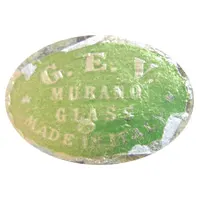
Undated
label · green, silver · glass · Italy
" " oval green and silver foil label.
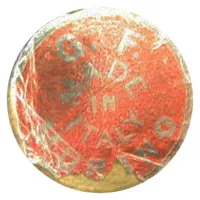
Undated
label · red, white, silver · glass · Italy
Previously attributed to Galliano Ferro, but the source reports that the furnace denies having used this label. Its user remains unresolved.
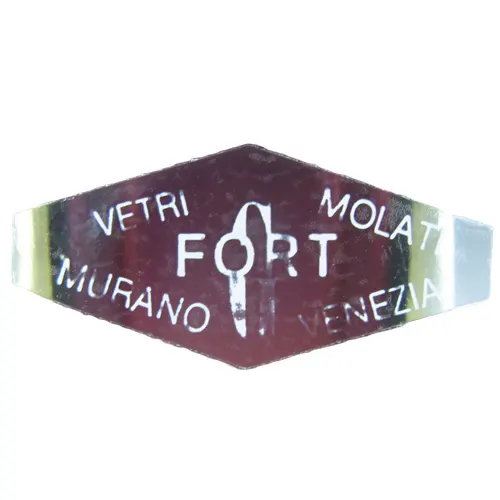
Undated
label · white, clear · glass · Italy
White and clear plastic Gino Fort label, reads " "
Undated
glass
……….. Graham Company, Evansville, Indiana (1912-1929). For more info, see page 435 of this extensive .PDF article on Graham, by Bill Lockhart and the BRG: Graham Company.
Undated
glass
G G W (monogram, with the second “G” somewhat larger and overlapping the first “G” and the “W”). Gayner Works, Salem, New Jersey (1898-1937), later Gayner Company (1937-1975 – but under National Bottle Corporation ownership 1957-1975). Monogram, accompanying this manufacturer’s name and city, seen on an advertising paperweight, reported to me by Bob Berkley, date of manufacture unknown. See “G in a circle” and “G inside outline of a jar or bottle” entries. For more background information on Gayner and their marks, please see this PDF article by Bill Lockhart and the Bottle Research Group: Gayner Works.
Undated
glass
G. H. R. (on base of Porter’s Pain King” bottles)…………………….. George H. Rundle Company, Piqua, Ohio (1871-1969). The “Porter’s Pain King” patent medicine was made until the early 1920s, when Prohibition began and the company switched to a liniment salve product. The company officially went out of business in 1969 but the rights and formula for the liniment were sold to Bill & Dave Toecker, of nearby Covington, Ohio. The “Porter’s Liniment Salve” is still being sold on the internet (as of 2022). The bottles with the mark “G H R” on the base could date from the late 1800s up to the early 1920s. One of these bottles is also marked with an “O inside a square” logo which indicates it was made by the Owens Bottle Company. (Thanks to David Weaver for calling my attention to this mark).
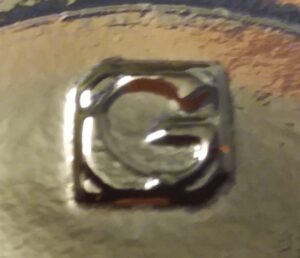
Undated
The illustrated bottle is captioned as made around 2010; this is an object date.
glass
The caption identifies Gamer Packaging’s on an amber Fentimans Ginger Beer bottle.
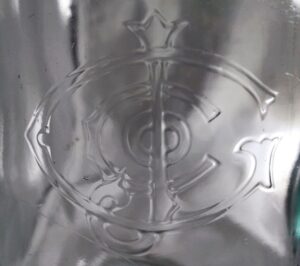
Undated
glass
The caption identifies a monogram on the face of a Gilchrist fruit jar.
Undated
glass
………………..Gayner Works (1898-1937), later Gayner Company, Salem, New Jersey (1937-1975). (The Gayner operation came under control of National Bottle Corporation in 1957 until the plant closed in 1975). It is unclear if Gayner used the “ ” mark between 1957 and 1975. This mark was reportedly used (re Julian Toulouse in Bottle Makers and their Marks ) in the c. 1920s on machine-made bottles. Also see “G inside the outline of a jar”. See next entry and “GGW”.
Undated
glass
…….in some cases, Gulfport Company, Gulfport, Mississippi (1955-1970). This information comes from Toulouse (Bottle Makers & Their Marks, page 210) although how to tell this apart from the “ ” mark used by Gayner (above) is not clear. Toulouse writes that Gulfport made blue and amber containers, and that Gulfport was acquired in 1968 by Dorsey Corporation of Chattanooga, TN although the operation was continued under the Gulfport name until 1970.
Undated
glass
……………….. Garston Bottle Company, Ltd., Garston, Liverpool, England.
Undated
glass
…………….. General Corporation, Winchester, IN (circa 1931-1937). This mark is confirmed to exist on the base of some “Old Mr. Boston” pint size liquor bottles. For more detailed information on this rather obscure mark, please see this webpage: Other G Marks – SHA.org
Undated
glass
……………… unknown. Seen on the base of clear and aqua cylindrical “packer style” laboratory / chemical / apothecary bottles (with custom-ground inner lip for ground stopper). Date range for these bottles – circa 1890 to 1940? I suspect this could represent a glassmaker from Europe, but I have no concrete evidence for that.
Undated
glass
…………….Gallo Company, Modesto, California (1958-to date). Gallo produces large quantities of wine bottles for their products. This “g” is written in a cursive script (with a rather large “gap” on the upper right portion of the letter), and on some of their bottles the mark might be mistaken for an odd-looking capital “S”, especially if the embossing is light. Most often seen on the bottom of heavy green bottles. Many of these bottles are made in a strong, bright green colored – the green shade having a slight yellowish tint.
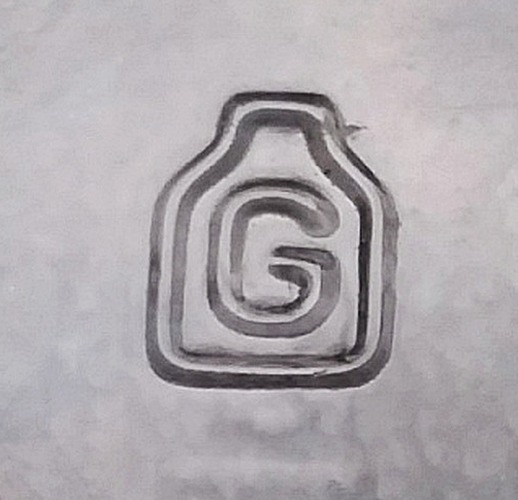
Undated
The illustrated clear wine-bottle shard is tentatively dated to the 1950s–1970s; this is an object estimate.
glass · Salem, New Jersey
The source identifies in a jar or bottle outline as Gayner Company, . Exact use dates are disputed: the author considers Toulouse’s circa-1920 date too early, citing later examples.
Undated
glass
……………….. Gilchrist Jar Company, Elmer, New Jersey (1898-c. 1901). Jars with this monogram were made by several firms including Elmer Works (S. M. Bassett Company at the “Upper Works”), Gilchrist Jar Company, and some jars were also evidently made by Atlas Company and later, Hazel-Atlas Company, up to about 1906. Other Gilchrist-related marks seen on fruit jars include the “R A G” monogram (for Ruth A. Gilchrist) and “Doolittle”. For more history and background information on this mark and others used by the Gilchrist firms, check out this extensive article by Bill Lockhart et al: Gilchrist Jar Company.
Undated
glass
………………. Gamer Packaging, Minneapolis, Minnesota (1987-to date). Gamer Packaging is a distributor/wholesaler of bottles as well as other types of packaging including plastic and metal containers. Some items are manufactured directly by them, others by arrangement with other companies. Gamer currently (2021) has an arrangement with Anchor Container Corporation and O-I (Owens-Illinois, Inc.) to supply many of the bottles they sell. They have also used Ardagh Group as a bottle supplier. Other unnamed firms might also supply some bottles sold by/through Gamer Packaging, including unidentified companies located in Asia. The bottle with this particular mark (shown) was sold by Fentimans – see The History of Fentimans – Fentimansusa.com .
Undated
glass
…………….. unknown meaning. Initials, arranged in a circular formation, seen on the base of black (very dark olive green or dark olive amber) ale or brandy bottles of British origin. The “G” may appear to be a “C”. Also, the order of the letters could also be construed as “W. & J. G.” From the general appearance of these bottles, (rather heavy, crude, with very dark color), I’m assuming they date from sometime in the 1850-1880s period.
Undated
glass
……………….. initials seen on the bottom of a few aqua and amber utilitarian bottles. The initials might stand for the G. W. Cole Company (later known as “3- in One Oil Company”). If this is the correct attribution, the bottles so marked would probably date from the 1899-1905 time period.
Undated
glass
…………………George W. Kearns & Company, Zanesville, Ohio (c.1860-1869). Seen on the front of a strap-side whiskey flask. See also “K” and “K H & G Z O” marks.
Undated
glass
……………….see Great Western Company, St. Louis, Missouri (1874-c.1887?) .
Undated
glass
…………….Gerresheimer Glas, Düsseldorf, Germany. This mark may have been first used in the 1937-1939 time period, but I don’t have information on how long it was used or when it was discontinued. This photo, shown above, shows the mark as seen on the bottom of a dark olive green “bladder” style wine bottle that looks somewhat similar to the Mateus Rose bottles. The “crown” may be rather difficult to discern, and may appear to look something like three “spikes” sticking upward from the capital G.
Undated
glass
G with a small S inside (this mark appears to be an upper-case “G” with a smaller “s” positioned within the upper part of the letter, see photo) …………….. Currently unidentified. This mark appears on a dark green hourglass-shaped bottle that may have held an alcoholic beverage, perhaps a product of a company from somewhere in Europe. The base of the bottle is marked with the number 348. Any info on accurate attribution is invited!
Undated
impressed · glass
The image caption identifies on a clambroth or white milk- custard cup.
Undated
glass
G with the letter “M” inside. (M inside a G)………………… Maryland Corporation, Baltimore, Maryland (1907-1980). Please see the “M inside a G” entry near the top of Page Four.
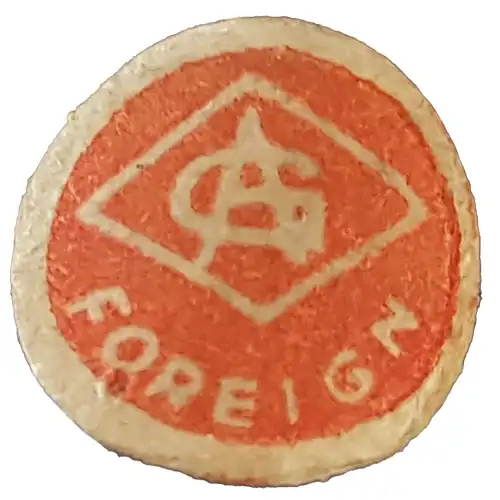
Undated
label · red, gold · glass · Japan
" " red & gold circular foil import label, found on Japanese lampwork.
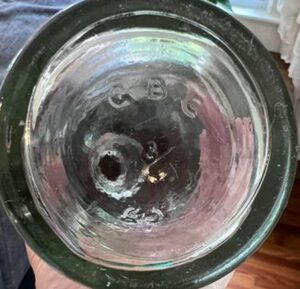
Undated
glass
The image caption identifies on a liquor-bottle base as Garston Bottle Company Ltd.
Undated
glass
…………………… Containers, Inc., Vernon, CA, later known as Containers Corporation, (1933-1983), main office (after 1959) in Fullerton, California. There were at least two variants of the “G over C” mark used over the years – in the first one the letters have a “sharp” or “angular” look and in the second one (shown above) the letters are more “rounded” and resemble a capital G above a lower-case “e”. Please see the Containers Corporation page for more details.
Undated
glass
…………… Containers Corporation, Fullerton, California and other plant locations. See Containers Corporation page.
Undated
glass
…………………. as seen on faces of the “FRUIT KEEPER” and some “MASON’S PATENT NOV 30TH 1858” fruit jars. ………………… Giles-Clough Company, Redkey, Indiana (1893-1897). This works was later known as Redkey Company. For more info and photos showing this particular monogram, please see this article by Bill Lockhart and the “Bottle Research Group”: Giles-Clough Co. and Related Companies
Undated
glass
" " signature on Gullaskruf bowl, for designer Hugo Gehlin.
Undated
impressed · glass
…………………… Ware, Inc., Freeport, New York, later [after 1999] at Hauppauge, New York (1948-2003), marketed a variety of kitchen-related items including salt and pepper shakers, sugar shakers, syrup pitchers, measuring cups, and other items of that nature. The company was acquired by Lifetime Hoan Corporation in 2003. The embossed name “ ” appears on the base of many of the items they distributed / sold. The actual manufacturer of the glassware marked “ ” is unclear. Some of the milk items bear a strong resemblance to the “Corelle Ware” line of kitchenware sold by Corning, but the items (of that particular line of ware, usually in milk ) were intended to “coordinate” with Corning Ware, and was, in effect, a competitor to Corning, and not a product of that company. Contrary to some information on the web (including info I have put on my site in the past), this is evidently unrelated to another “ ” brand name, a chain of department stores (in business from 1959 to 1986). If anyone knows for sure what manufacturer (or manufacturers) actually made the glassware marked “ ”, please write! Also, please see “G W with three dots” entry farther down on this page.
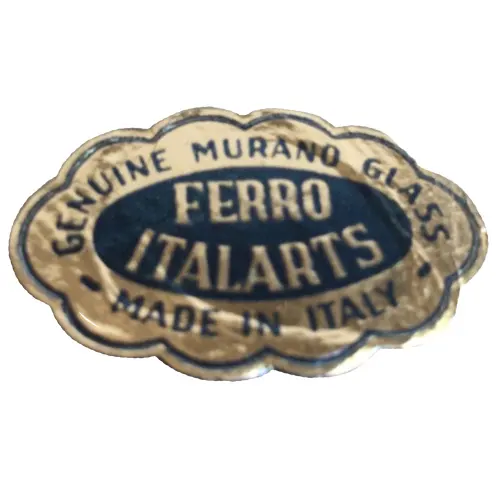
Undated
label · glass · Italy
Ferro Italarts may be a retailer; the source reports this label on some glassware that appears to be by Galliano Ferro, without confirming that attribution.
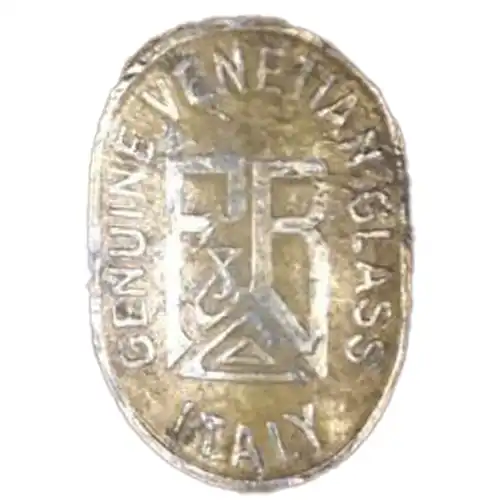
Undated
label · gold, silver · glass · Italy
" " oval gold & silver foil label.
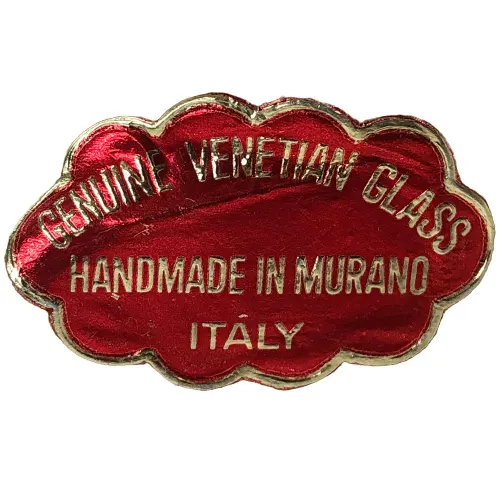
Undated
label · red, gold · glass · Italy
" " red & gold scalloped oval foil label.
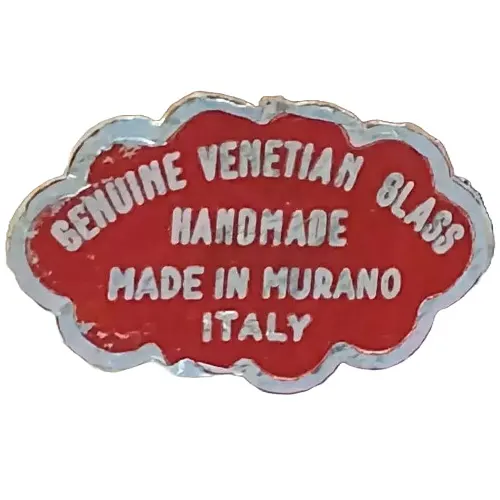
Undated
label · red, silver · glass · Italy
" " red & silver scalloped oval foil label.
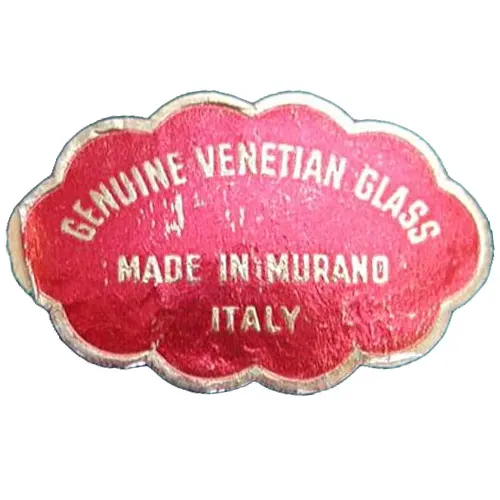
Undated
label · red, silver · glass · Italy
" " red & silver scalloped oval foil label.
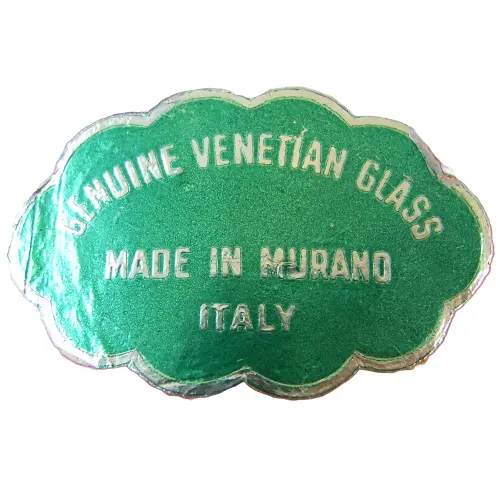
Undated
label · green, silver · glass · Italy
" " green & silver scalloped oval foil label.
Undated
label · black and gold · glass · Italy
Black and gold foil Galliano Ferro label, reads " " .
Undated
glass
GF or G F (Letters are connected by a downward arching underline which curves underneath them, somewhat creating the appearance that the letters are seated in a small boat). …………………. Gijón Fabril, La Calzada, Gijón, Asturias, España (Spain) —– (1915-2016). I’ve been told this mark has been used since 1915, although on earlier bottles the mark can be very indistinct. The beginnings of this enterprise date as far back as 1844. In 1900 Gijon Industrial was formed, which was superseded in 1915 by Gijon Fabril. Bottles and other glassware were made in large quantities until 1982 when the factory became a mold-making facility. The most well-known bottles made by this company, of green , were made for cider, a very popular beverage produced in Gijon. (This is an alcoholic apple cider, known as “hard cider” in the United States). The company finally went bankrupt in 2016. (Thank you Michelle Marie for info on this company).
Undated
glass
………………….. Garcia Group (Garcia Group, Inc.) based in Atlanta, Georgia. Vases for the floral industry appear to be products of the 1980s-2010s era?
Undated
label · black and gold · glass · Italy
" " black & gold rectangular foil label.
Undated
impressed · glass
………………………….. McKee Company , Jeannette, Pennsylvania. “ ” is a brand name embossed on the bottom of much glassware for household use. This was a popular name introduced and used by McKee for their high-quality, heat-resistant ovenware, serving bowls, and other kitchen ware. The line was introduced in 1917, and competed with Pyrex (made by Corning Works) and Fire-King (Anchor Hocking Corporation). The formula was changed (after a lawsuit was filed by Corning) and re-introduced in 1919. The brand was used more or less continuously throughout the succeeding years, under Thatcher ownership (1951-1961), and later by Jeannette Company until 1979. See McKee Company page for a little more general information on this operation.
Undated
label · black and gold · glass · United Kingdom
" " circular black & gold foil label.
Undated
label · black and clear · glass
" " black & clear square plastic label.
Undated
label · black and silver · glass · United Kingdom
Retail label found on Chinese .
Undated
glass
Glassblower design/logo (trademark showing the figure of a man holding a blowpipe upward, blowing into the pipe). In some instances, the design might be mistaken for a man blowing on a musical instrument …………. this trademark was used by MacBeth-Evans Company, Pittsburgh, PA; Charleroi, PA; Toledo, OH; Marion, IN – 1899-1936), and later by Corning Works, Corning, New York, which acquired MacBeth-Evans in 1936. According to “400 Trademarks on ” (Arthur G. Peterson, 1968), this mark was used as early as 1880 by predecessors of Macbeth-Evans. The mark has been seen on lamp chimneys as well as various tableware items.
Undated
glass
…………………………… , Seattle, Washington (2001- to present). The words “ ” are stamped (in lower case letters, in a circular formation) on the bottom of colorful art votive candle holders made for small tea lights. This company sells their votive candleholder “cups” in a wide variety of colors. The piece is typically made with the base section, perhaps 1/6th of the piece, showing clear (transparent, colorless) and a unique color in the upper portion. All “glassy babies” are handmade, produced by a team of professional artisans, and no two are exactly alike. The company donates some portion of the proceeds to a variety of charitable causes. These pieces are in popular demand by an enthusiast crowd of art collectors.
Undated
glass
………………….. Hemingray Company , Covington, KY & Muncie, IN. Trade name of their best-known fruit jar. Also, see H.G.CO. mark.
Undated
label · black and white · glass · United Kingdom
" " circular black & white paper label.
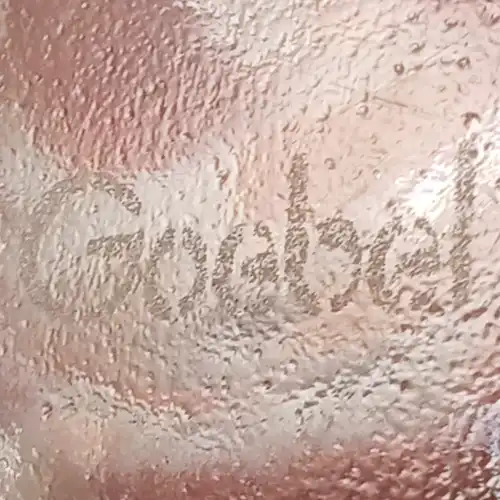
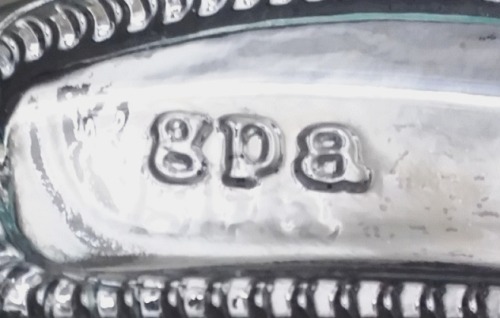
Undated
label · black and white · glass · Malta
" " " rectangular black & white paper label.
Undated
glass
……………….. Global, headquartered in Mansfield, Massachusetts (2007- to present). This is a packaging solutions company with manufacturing / distributing center locations on several continents. Mark as seen on the base of a spirits flask made for Jose Cuervo, probably made in Mexico.
Undated
impressed · glass
………………….. Products Division, Arrowhead Puritas Water Company, Los Angeles, California (c. 1956- 1987). Seen on the bases of 5-gallon water bottles (carboys) typically made of medium blue aqua . Year date codes from the 1950s- 1970s (possibly into the 1980s?) are usually embossed on the bottom. The Arrowhead plant was purchased by Nestle in 1987. These bottles were made at Gardena, California, at the former McLaughlin plant where these same types of large water bottles were handmade, but those earlier ones are marked “McL” on the base. For more information, see the reference “Dreams of : The Story of William McLaughlin and his Company” by Fred Padgett (1996), page 85. Also, Bill Lockhart and the Bottle Research Group includes some information on the Arrowhead water bottles here: Other A Marks.
Undated
glass
…………………. Company, Evansville, Indiana; Loogootee, Indiana; and Okmulgee, Oklahoma (1912-1929). Another plant location also was operated at Chekotah, Oklahoma until 1923. was owned by Owens Bottle Company after 1916, plants became part of Owens-Illinois in 1929. For more info, see this article by Bill Lockhart: Company.
Undated
impressed · glass
………………………. Granite Company, Stoddard, New Hampshire ( 1846-1862). Lettering is embossed across the face of whiskey flasks. One type features an eagle above an oval “frame” with the embossed lettering placed inside. More in-depth info on this glassworks in this peachridgeglass.com article: Stoddard . Also, Bill Lockhart et al has an article here with information on Granite Company and the New Granite Company, both of Stoddard: The Granite Companies – SHA.org.
Undated
label · white and red · glass
" " red & white teardrop shaped paper label.
Undated
glass
Group of three raised “bumps” or “dots” (seen on beverage and food containers made in Mexico and imported into the US)………….. Vitro Packaging, Monterrey, Mexico. For more information, please see the “stylized V” mark as used by Vitro, above on this webpage.
Undated
label · gold and yellow · glass
" " yellow & gold triangular foil label with underneath banner.
Undated
glass
………………..Westmoreland Company, Grapeville, Pennsylvania (1889-1984). Westmoreland made large quantities of white milk tableware and decorative ware including many of the older “hen on nest” dishes. Please see “W superimposed over a G” entry on page five.
Undated
glass
…………….. Hemingray Company , Muncie, Indiana (used c. 1924-1935). Information proven to be correct from Hemingray historian/researcher Bob Stahr. However, this doesn’t rule out the possibility that a mark similar to this one could be seen on products from other factories. Type of bottle, age, color, and other characteristics must be taken into account to decide if this would be a Hemingray product. NOTE: If the number consists of either one or three digits, it is not Hemingray. On Heinz bottles, a number (which may consist of one, two, or three digits) which accompanies an “H” on the base refers to a particular design or style of bottle made by Heinz, and is not Hemingray-related. See the other “H” entries above.
Undated
impressed, label · glass
……………… marked on the base of certain mouthblown bottles in shades of aqua (and similar in shape to “Jamaica Ginger” and oval generic bluing bottles of the late 1860s to the mid/late 1880s era, but with a square-band style lip)………….. those bottles shown to have been used for Reuben P. Hall’s “Hall’s Sicilian Hair Renewer” because of labels found intact. They are found with just a capital “ ” embossed on the base, and in these cases the “ ” almost certainly stands for “Reuben P. Hall”. The “ ” varies in appearance and may be offset, not positioned directly in the center of the bottom. Those bottles are found in both “applied lip” and “tooled lip” versions. The Hall’s company was based in Nashua, New Hampshire. From information relayed to me by collector, digger and researcher Mark Newton, most, if not all of these bottles were likely made for Hall by the Lyndeboro Company, South Lyndeborough, New Hampshire (1866-1888). Also, see next entry.
Undated
glass
………….Hazeltine & Perkins Drug Company, Grand Rapids, Michigan (c. 1890-1910). Info courtesy Bob Davidson.
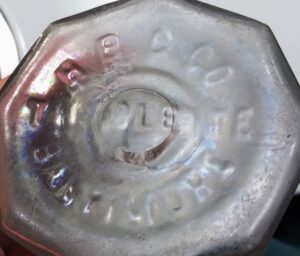
Undated
glass · Baltimore, Maryland
Caption identifies an eight-sided cosmetic jar associated with Henry B. Gilpin Company.
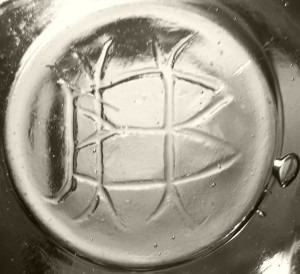
Undated
glass
………………..Unknown manufacturer. This mark (pictured above) occurs on the base of a clear/off-clear fish bowl or leech bowl. “Older” looking with bubbles, possibly 1890-1930 era? Hagerty Bros. & Company comes to mind, but this is only a possibility, not a definite attribution! Ideas from readers on correct ID of this mark are solicited!
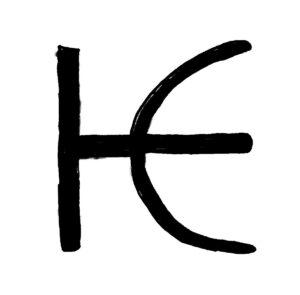
Undated
glass
………………. This mark appears on the base of an off-clear eye bath (eye cup) made for Health Enterprises, North Attleboro, Massachusetts (1975-2016), a distributor of health care-related supplies. In 2016 the company was acquired and became a division of “Apothecary Products” which is still in business currently (2023). The mark is a stylized monogram of the letters “H” and “E” and may be hard to decipher at a quick glance, resembling a Greek numeral or ancient hieroglyphic symbol. When turned to the left, it might be described as a highly simplified stick figure of a menorah. This mark is mentioned in the reference book “Eye Baths – An Illustrated Survey” by George Sturrock (2012) and the logo is also shown in a 2016 news article webpage on the site of Apothecary Products. According to Sturrock, the eye baths made for HE were produced by a company in Hong Kong. The Health Enterprises company sold eye baths beginning in 1990. (Many thanks to Lianne McNeil, Etsy seller MarchAir, for her kind assistance with research on this mark and photos of the eye bath).
Undated
glass
………………….. this letter was used by several companies, and the maker of many bottles with just an “ ” on the bottom is uncertain. On flint (clear) medicine bottles, usually indicates W. . Hamilton & Company, Pittsburgh, Pennsylvania (1863-1898) and Charleroi, Pennsylvania (1898-1918). An “ ” is shown on the base of bottles illustrated in their 1898 bottle catalog (cut shown on page 251, Glasshouses and Manufacturers of the Pittsburgh Region , Jay W. Hawkins, 2009). Other possibilities include Hemingray Company, Muncie, Indiana (See Hemingray) ; . J. Heinz Company, Sharpsburg, Pennsylvania (c.1893-1946); and Hagerty’s Works, Brooklyn, New York. Also, please see next several entries.
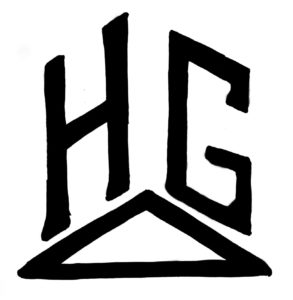
Undated
glass · Hillsboro, Illinois
Caption identifies the Hillsboro Company logo.
Undated
glass
……………………. Hemingray Company, Covington, KY & Muncie, IN (used on bottles c.1870-1895; insulators until about 1915). See more info on Hemingray Company.
Undated
glass
…………….Hemingray Company, Covington, Kentucky (monogram seen on reverse side of certain “MASON’S PATENT NOV 30TH 1858” fruit jars- most likely made circa 1870-1885).
Undated
glass
………………….Hillsboro Company, Hillsboro, Ilinois (1961-1997)……………… please see this page: Hillsboro Company.
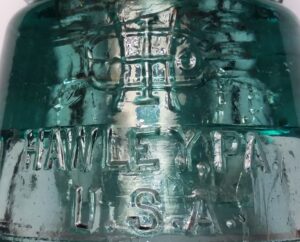
Undated
glass
Caption identifies a monogram on the skirt of an aqua Harloe Insulator Company insulator.
Undated
impressed · glass
…………………. this stands for “Harloe Insulator Company” based in Hawley, Pennsylvania (c.1902-1906?) with some production at Elmer, New Jersey (Mar 1903-Oct 1903) . The monogram, with “HAWLEY, PA. U.S.A.” placed below, appears on the skirt of a variety of electrical telephone and telegraph insulators made by Harloe. The most common type found is their version of the telegraph line “beehive”, classed as a CD 145 in the system of identification used by collectors. On some examples the “S” is embossed backwards. (Contrary to information that continues to be repeated online and in reference publications, these insulators were NOT made by Hawley Company, also of Hawley, Pennsylvania – Hawley produced fruit jars and bottles of various types but NOT insulators).
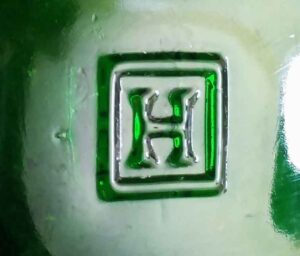
Undated
The caption dates the pictured Hemingray bottle to 1924–1935, rather than establishing exact mark-use limits.
glass · Muncie, Indiana
………… Hemingray Company , (mark used c.1924-1935). “ in a square” trademark as it appears on the base of an emerald green beer or soda bottle made by Hemingray Company, in the 1924-1935 period.
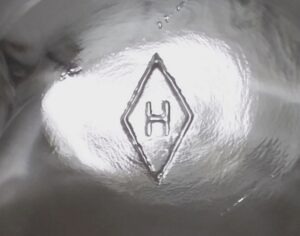
Undated
glass
………… Hemingray Company , Muncie, Indiana. The “H inside a square” mark was used on several styles of bottles made by Hemingray during the circa 1924 to 1935 period, according to collector and researcher Bob Stahr. The photo above shows the mark as it appears on the bottom of an emerald green (“seven-up green”) crown-lip style bottle that contained beer, mineral water or some type of lemon-lime or ginger ale soda. The bottle is unmarked except for the base.
Undated
glass
……….J.T.& A. Hamilton, Pittsburgh, Pennsylvania (1884-1943). Mark reportedly used approximately 1900-1943.
Undated
glass
………..See “C with an H inside it” mark.
Undated
impressed · glass
……………………………….. H. J. Heinz Company, Sharpsburg, Pennsylvania (c.1892-1946). Heinz (started by entrepreneur Henry J. Heinz) is best known in the United States (and worldwide) for their iconic brand of ketchup, as well as a wide variety of other condiments, sauces, soups and other food products. Bottles marked “Heinz” or “H. J. Heinz” and other variations were made for many years, possibly dating back to the first incarnation of Heinz’ company circa 1860. From c. 1860 to about 1892, bottles with those markings would have been manufactured by unidentified glassmakers. Heinz acquired a factory in Sharpsburg for his own products, evidently beginning production sometime in late 1892 or early 1893. Several years later he built a new, larger factory at Sharpsburg for producing bottles for his products. After 1946, many of Heinz’s bottles were again made by other manufacturers such as Hazel-Atlas (H over A) and Owens-Illinois Company. Please see “H” and “H-28” marks. Note : for a discussion on Heinz, with pictures of dozens of the older HEINZ-embossed food bottles that have been found, check out Betty Zumwalt’s ground-breaking reference work Ketchups, Pickles, Sauces (1980). For much more background information the complicated history of Heinz and various HEINZ markings found on containers, please see this article from Bill Lockhart and the Bottle Research Group: The H.J. Heinz Co. and the H.J. Heinz Co. – SHA.org.
Undated
glass
…………………Unknown. Initials seen on base of tooled-lip crown-top beer bottle (circa 1900-1920?) from Quandt Brewing Company of Troy, New York. Bottle reported by Jake Smith.
Undated
glass
……………..uncertain, but possibly Abramson-Heunisch Company. Most earlier researchers, copying info from Julian Toulouse’s Bottle Makers and their Marks (1971) credited Holt Works of Berkeley, California as the source of these bottles. That attribution is now under considerable doubt. More recently (2016), archeologist and historian Bill Lockhart has gathered evidence to indicate some of these bottles found in the western states, typically with a number (one, two, or three digits) accompanying the “H”, may have been manufactured by Abramson-Heunisch Company, San Francisco, CA (1893-1902 – and perhaps extending into bottle production during the early years of Illinois-Pacific Company, up to circa 1907, when Adam Heunisch was the president of I-P G CO) . See this link: The Great Holt Myth: A Study of Misidentification for more background explanation on Holt and Heunisch. In most cases, the number is placed above the “H”, although in some cases is may appear either below, or positioned to the right of the letter. Please keep in mind that positive attribution of a bottle with an “H” mark to any definite glasshouse is often very uncertain. Please see next two entries.
Undated
glass
…………………………. Hazel-Atlas Company , Wheeling, West Virginia; started operations at Washington, PA; later plants included Clarksburg, WV; Zanesville, OH; Ada, OK; Montgomery, AL; Oakland, CA; Pomona, CA and other locations (1902-1964). This trademark is often confused with the “H superimposed over an Anchor” mark used by Anchor Hocking Corporation. For more information on this mark, please see my Hazel-Atlas page.
Undated
impressed · glass
……………………….H.Ricketts & Company Works, Bristol, England. This embossing is seen, arranged in a circle, on the bottom of early blackglass ale and wine bottles. Bottles with this marking are believed to date from 1821 to about 1853. This is probably the earliest type of bottle carrying an embossed factory identification mark on the base.
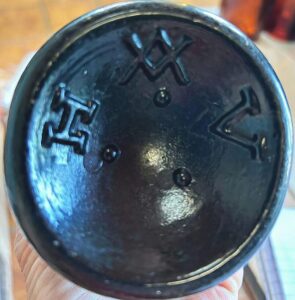
Undated
glass · Norway
Caption leaves the maker uncertain between Høvik, Hurdal and Hadeland glassworks.
Undated
glass
H superimposed over an Anchor (see “Anchor entwined with letter H”, on page one)……………. Anchor Hocking Corporation / Anchor Hocking Company , based in Lancaster, Ohio (1937 to date).
Undated
glass
…………….. Hart Manufacturing Company, Dunkirk, Indiana (1918-1938) . This particular “H” mark is infrequently seen, but within the context of machine-made liquor bottles with the “Federal Law Forbids Sale or Reuse of this Bottle” phrase on them, a few Old Quaker brand whiskey flasks have been confirmed that bear a base code including “ 70 H ” along with a date code of 7 [1937] or 8 [1938] placed to the right of the “H”. The “70” was the liquor bottle permit number assigned to Hart – that code was also used for a short time by Armstrong Cork Company (Hart’s Dunkirk facility was acquired by Armstrong in 1938), perhaps in the 1938-1940 time frame. Other Hart bottles may exist, but this is one example of a bottle bearing an “H” which can be strongly tied to Hart.
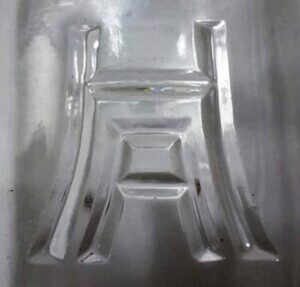
Undated
glass
Caption identifies the Hazel-Atlas H-over-A trademark on a clear Atlas Mason jar.
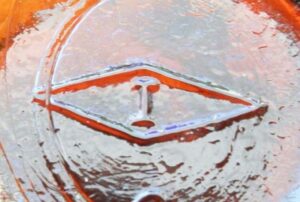
Undated
glass · Alton, Illinois
Caption identifies the Illinois Company mark on an amber chemical bottle.
Undated
glass
………………………………see Hazel-Atlas Company .
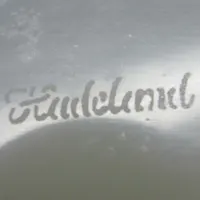
Undated
glass
…….. , Brooklyn, New York (c.1849-c.1900). factory name seen spelled out in a circle on the base of blob-top soda bottles. This factory was known as “ ” until at least 1875, later became “Hagerty Bros & Company”, with perhaps other slight variations on the name. Hagerty might have used some other marks, but if so, it is not certain what they were.
Undated
glass
…………………….actually the letter “L” in cursive script. For more information, see this page on the “ L” in cursive mark used by Libbey Company.
Undated
glass
…………………… Hamilton Works, New York City, New York (actually located in Brooklyn – 1851-c.1854) . This works evidently was the same location as the later “Brooklyn Green Works” and “Hagerty Works”. This marking appears on some blob top soda / mineral water bottles with an iron pontil mark on the base. (This “Hamilton Works” has no relation to the Canadian firm listed above). See this page from Tod Von Mechow that has some more info on Hamilton: Beer & Soda Bottle Manufacturers – Tod Von Mechow.
Undated
label · gold and red · glass
Found on Romanian .
Undated
label · black and white · glass · Italy
" " rectangular black & white paper label. [ 01 ]
Undated
label · gold and silver and red · glass · Italy
Probably an export label; foil is described as silver or worn gold.
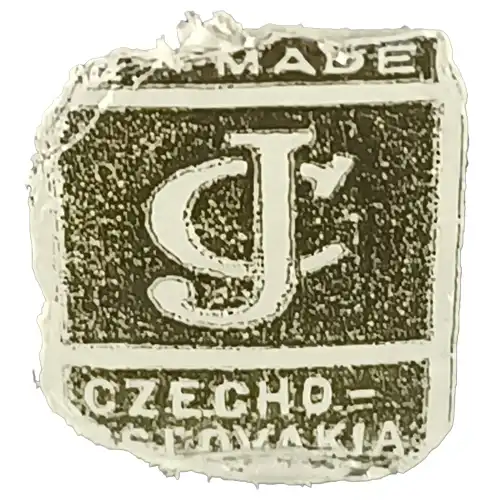
Undated
label · black and silver · glass · Czechoslovakia
Jones & Co import label.
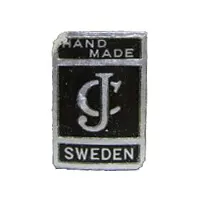
Undated
label · black and silver · glass · Sweden
Jones & Co import label.
Undated
label · black and white and red · glass · Belgium
Label for the De Rupel factory.
Undated
label · black and gold · glass · United Kingdom
" " curcular black & gold paper label.
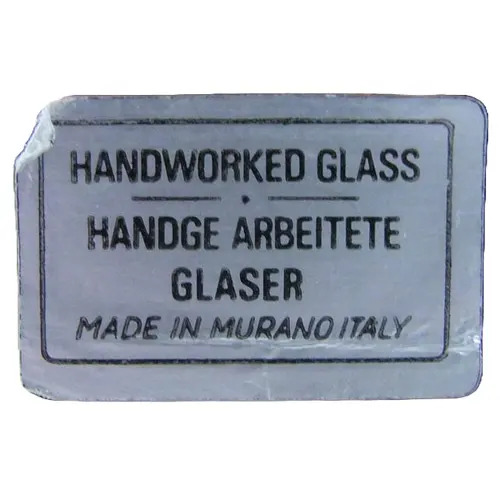
Undated
label · black and silver · glass · Murano, Italy
" " black & silver rectangular foil label. [ 01 ] [ 02 ]
Undated
glass
……………………Hawley Company, Hawley, Pennsylvania (1882- c. 1931) Seen on the base of fruit jars and a few soda bottles. This was not the same company as the Harloe Insulator Company (c.1902-c.1906) which produced electrical insulators marked with an “H I CO” monogram placed above “HAWLEY PA/ U.S.A.”. (See “H I CO” monogram, below on this page). Hawley Company produced a variety of containers but evidently did not make electrical insulators. For a brief rundown on the Hawley Company, including an old photograph of some of the factory glassworkers in the 1880s, see the article at this link (although please note that the info there about insulator production is likely incorrect): The Hawley Company – article on RiverReporter.com.
Undated
glass
………….this mark is actually supposed to be the letters V and M (entwined) inside a circle, and was one of the logos used by Mexican company Vidriera Monterrey, based in Monterrey, Mexico. Detailed information on this mark and others from Mexico are shown in this PDF file article written by Bill Lockhart: Mexican Marks – SHA.org.
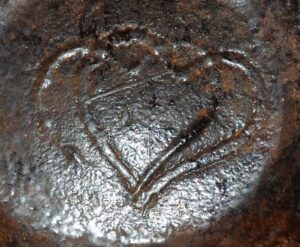
Undated
The source tentatively dates the pictured case gin bottle to the 1840s–1870s and suggests Holland.
glass
Slightly doubled heart embossing on a dark olive-green square-based case gin bottle; maker unidentified.
Undated
glass
………………………. please see H.J. Co., below on this page.
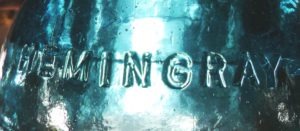
Undated
glass
………………… this marking is seen on the most commonly found insulator type ever made in the United States (and probably in the world) – by the Hemingray Company of Muncie, Indiana (and Owens-Illinois Company which acquired the Muncie plant in 1933). The “42” is a model / style number (not a year date). This insulator style was typically used for telegraph and long-distance telephone lines, and was introduced in 1921. The style was manufactured almost continuously for at least 41 years, as one example has recently been confirmed bearing a 1962 date code. Hemingray- 42 insulators have been found in clear, aqua, blue aqua, “Hemingray Blue”, true green and a few other much scarcer colors. For more information on this style, and the Hemingray company, see my webpage on Hemingray Company .
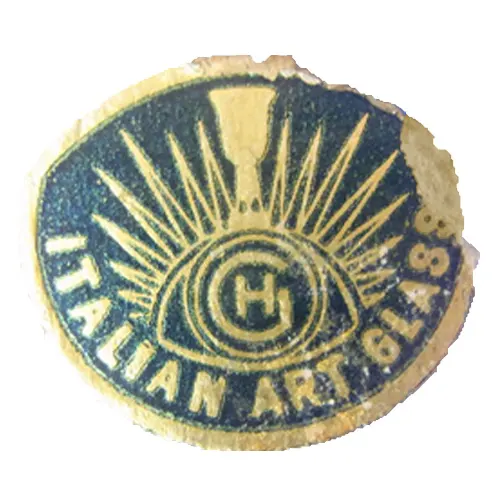
Undated
label · blue · glass · Italy
Hans Geismar Ltd importer label.
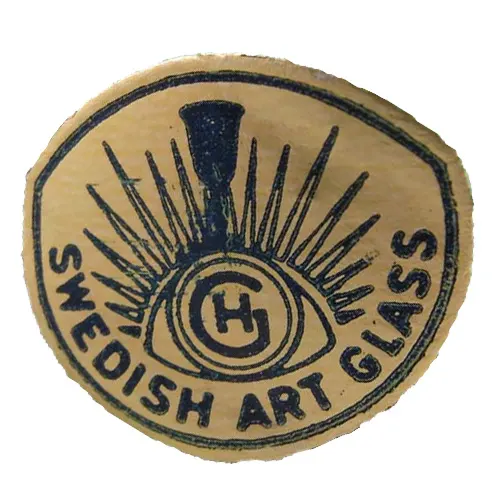
Undated
label · gold · glass
Hans Geismar Ltd UK importer label.
Undated
label · silver · glass
Hans Geismar Ltd UK importer label.
Undated
label · green · glass
Hans Geismar Ltd UK importer label.
Undated
label · red · glass · Italy
Hans Geismar Ltd importer label.
Undated
glass
…………On fruit jars with the “Mason’s Patent/ Nov 30 1858” embossing, this monogram stands for the Hero Works, Philadelphia, Pennsylvania (1869-1883) and Lockport, New York (1869-1872). The monogram may be difficult to decipher. HGW became Hero Fruit Jar Company in 1883 (see H.F.J.CO.)
Undated
label · silver and red and green and blue · glass · Germany
" " red, green, blue & silver rectangular foil label.
Undated
impressed · glass
……………… the lettering “ FROM F. FACTORY, LOCKPORT, N.Y.” is embossed in a circle on the base of spring water bottle made for Oak Orchard Acid Springs. Francis operated the Lockport Works of Lockport, New York from 1850 to 1866. See Lockport Works entry.
Undated
glass
……………. Unidentified mark, seen on some modern “decor bottles”. The mark probably indicates a glassmaker in China or elsewhere in Asia. Or it might stand for a housewares distribution company? The bottles appear to date within the last 20 years or less (possibly being made in the 2020s??) and typically have raised “crescent shaped knurling” or raised dashes around the perimeter of the base resting surface – very typical of modern, machine-made bottles. If you have information on exactly what this mark stands for, please contact us (see the Contact Information page) and we will be happy to update this entry!
Undated
glass
……………….. Holz, Clark & Taylor, Salem, New Jersey (c.1866-c.1872). Also, see “H.C. & T.” entry.
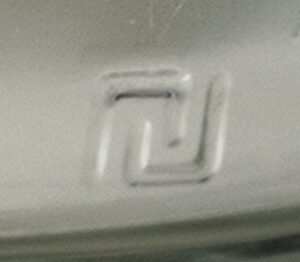
Undated
The caption tentatively dates the pictured Rockware milk bottle to the 1960s–1970s.
impressed · glass
Rockware Ltd rectangular emblem on the heel of a milk bottle.
Undated
glass
Hooks (a mark that might be likened to two interlocking squared “hooks” that form a horizontally-oriented rectangle) ……………. Rockware , Ltd, originally based in Greenford, Middlesex (London), England (1919-2006) . Julian Toulouse ( Bottle Makers and their Marks , 1971) illustrated this mark on page 434 and only notes “Modern”, with no date range shown. So, obviously we can be sure it was used at least as early as 1971, but not sure how long it had already been in use at the time he published his book. The photo at right shows the mark on the heel of a Canadian milk bottle of uncertain date, but possibly from the 1960s or 1970s. The Greenford works closed in 1973, but several other Rockware factories continued in production. Rockware was purchased by Ardagh Group in 2006. Some info on timeline is at this link: Rockware – Gracesguide.co.uk . Rockware also used the “R in a circle” trademark. In recent years [2020] the rectangle mark is still shown, accompanied by location code letters/numbers positioned to the left of the mark, as still in use at four Ardagh Group manufacturing locations in the United Kingdom, as shown in the Bucher Emhart punt marks database here: Emhart Punt Marks Guide – Emhartglass.com.
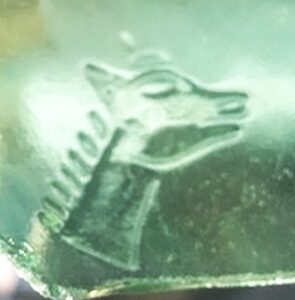
Undated
impressed · glass
Horse-head emblem on a Rolling Rock beer-bottle fragment.
Undated
impressed · glass
………….. embossed image as seen on light green “beach ” shard, found along the coast of North Carolina. This is a trademark design seen on green “Rolling Rock” brand beer bottles. Although Rolling Rock was introduced in 1939, I don’t know how long the horse head design has been embossed on their bottles.
Undated
glass
Horseshoe (logo on heel of modern bottles that resembles a horseshoe, the letter “U” or an upside down Greek letter “Omega”)………. Ardagh Group. Please see entry under “U” on page five for more info.
Undated
glass
House, or building (emblem resembling the outline of a house, with “W” or “V V” inside)………………….. logo used by Nienburger Glas GmbH, Nienburg / Weser, Niedersachsen (Lower Saxony), Germany. Nienburger Glas became part of Ardagh Group in 2007. Exact period of use of this mark is unclear. The mark is also illustrated in Toulouse (Bottle Makers and their Marks, 1971, page 580) and he attributed it to “Himly, Holscher & Co, Glasfabrik, Wilhelmschutte”, Germany, and stated in use as of 1965. The “W” inside the emblem presumably stands for Wilhelmschutte. The operation is now known under the name Ardagh Group GmbH – Nienburg. Note: if you have info on the meaning of the logo directly below the “house” logo ( in the “6 o’clock” position) on this bottle base, please let us know!
Undated
glass
…………..L. J. Houze Convex Company, Point Marion, Pennsylvania. Makers of lenses, art , rolled sheet , signal semaphores, perfume bottles, for lighting fixtures, mirror blanks, automotive , multi-colored slag ashtrays and lamps, etc. Website with more information on Houze: Houze Museum .
Undated
label · black and gold and purple · glass · Halsinborg, Sweden
" " purple, black & gold rectangular foil label.
Undated
glass
……..Indiana Bottle & Company, Cicero, Indiana (1905-1909)
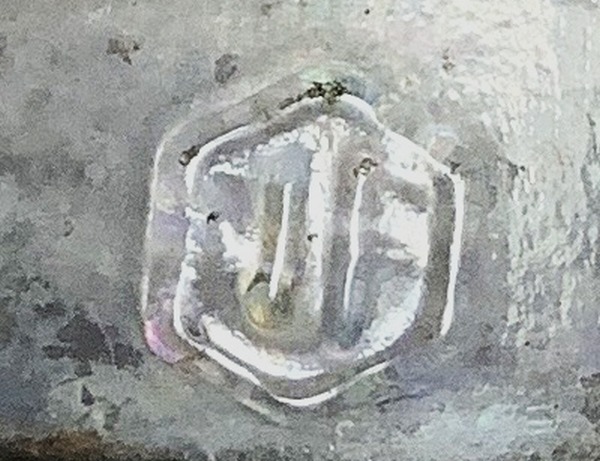
Undated
The caption suggests a possible 2004 bottle date code; the glassmaker is unidentified.
glass
…….. sometimes the “I and G entwined” mark used by Imperial Company of Bellaire, Ohio can be interpreted as “I and C entwined”. Please see the “I superimposed over a G” entry on this page. “ inside a hexagon” glassmaker mark on heel of colorless Corona Extra bottle with possible 2004 date code. Currently this logo is unidentified. (Photo courtesy of Mikhael Phelps).
Undated
glass
…………… Unidentified mark, possibly that of a bottle manufacturer in Mexico or another Central or South American country? This mark appears on the heel of a colorless Corona Extra beer bottle along with an apparent 2004 date code. Information on the correct identity of this mark is requested!
Undated
glass
……………….. Illinois Company, Alton, Illinois (1873-1929). This mark was used possibly as early as the mid-1870s to around 1900, and may appear on either the base or the heel of various bottles, and was also used for several years after 1900 primarily on the lower heels of their soda bottles (since the base would frequently be reserved for the logo or initials of the bottling company a bottle was made for). The “O” in “Co” may be either upper case or lower case. Use of the mark on certain soda bottles is known to have extended at least to 1909, perhaps 1911. Please see “ .L”, “IGCO within a diamond” and “ I within a diamond ” marks. Illinois Company merged with Owens Bottle Company in 1929 to form the Owens-Illinois Company . Also, please see next entry.
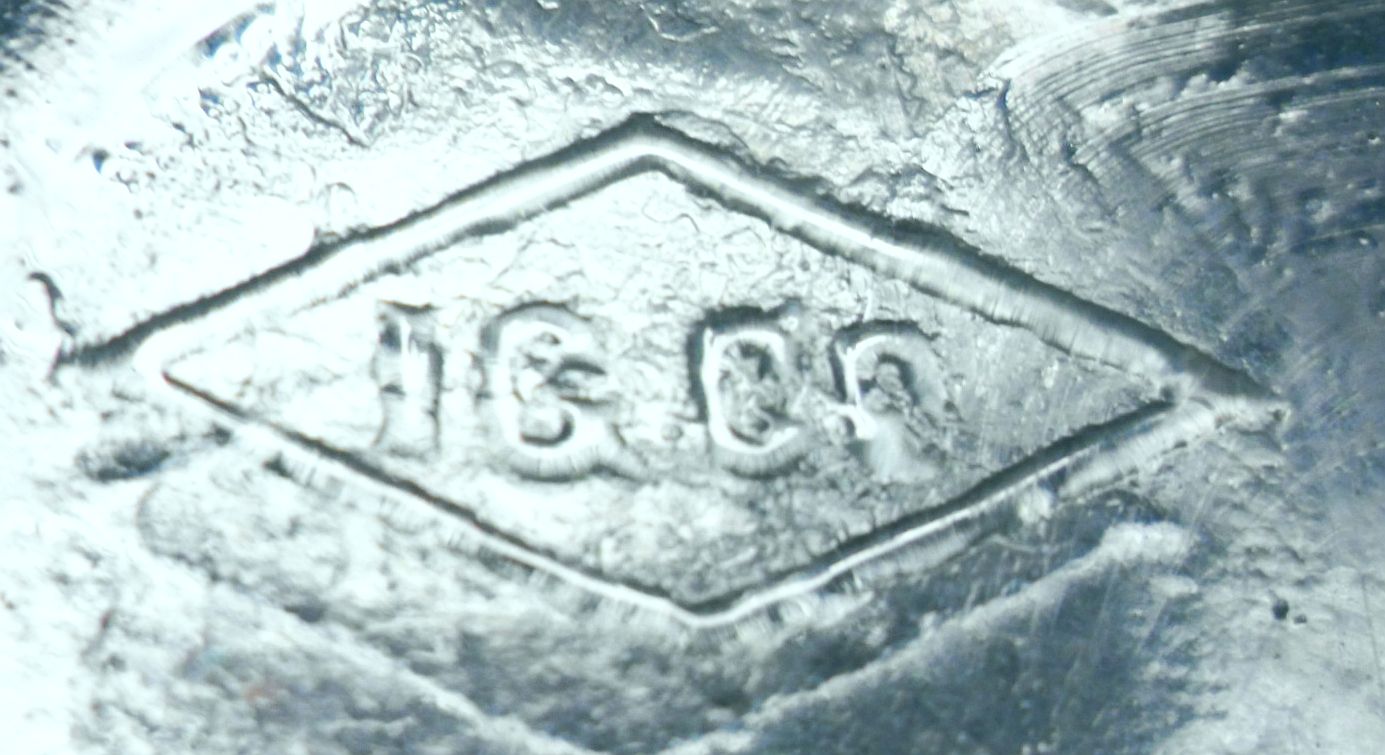
Undated
glass
inside a diamond on the base of a light aqua square pickle bottle.
Undated
impressed · glass
…………….. probably Indianapolis Works Company, Indianapolis, Indiana (1870-c.1876). This mark has been reported on an amber ale bottle from Dayton, Ohio. The word “Company” was part of the name of this factory as listed in city directories of the period, although fruit jars and flasks are found with just the wording “Indianapolis Works” embossed on them.
Undated
glass
…………………. I. M. Packaging, based in Montreal, Quebec, Canada. I.M. Packaging is a wholesaler/distributor/supplier of a wide variety of packaging products including metal, plastic and containers. The actual manufacturer(s) of the bottles and jars sold by I. M. P. is unknown, but presumably they are made by unnamed makers in China, Canada and/or the United States. This company was apparently incorporated in 2013. I have no information on when this mark was introduced on their container .
Undated
glass · San Francisco, California
Illinois-Pacific Company mark on a clear bottle; company activity is given as 1902–circa 1925.
Undated
glass
…………. Illinois-Pacific Company, San Francisco, CA (1902-c.1925). This mark is very rare, but confirmed to exist on the base of an amber beer bottle.
Undated
glass
……….. This mark has been recorded on the base of two beer bottle variants (from F. Bernhard, Canal Dover, Ohio; and Bruckman Brewing Company, Cincinnati, Ohio). Recently [10-2023], a reader informed me that the “I” is actually a “1” (one) and this is a case in which the mold number “1” was placed to the left of the glassmaker’s initials, instead of below, which is the ordinary placement. Thus, this mark is actually that of Reed & Company (R & CO) of Massillon, Ohio. Please see the “R & CO” entry on Page Four. (Thanks to Gregg Wilson for this correction!).
Undated
impressed · glass
……………….Imperial Company, Bellaire, Ohio (1902-1984). This particular “I and G, intertwined” mark was used from 1951-1977 on upscale tableware and novelties including milk , carnival , and other glassware of many patterns and in many shapes, forms and colors. For more information on Imperial and their history and marks that were used, please check out this site: Imperial Company history – Imperialglass.org . On many items, the mark is small, lightly embossed, and can be rather difficult to make out. At a quick glance it might resemble a “cents sign”, “dollar sign” or treble clef sign in sheet music. Sometimes the letter “I” looks somewhat like an ornately designed number “1”. The letter “G” is often mistaken for a “C”.
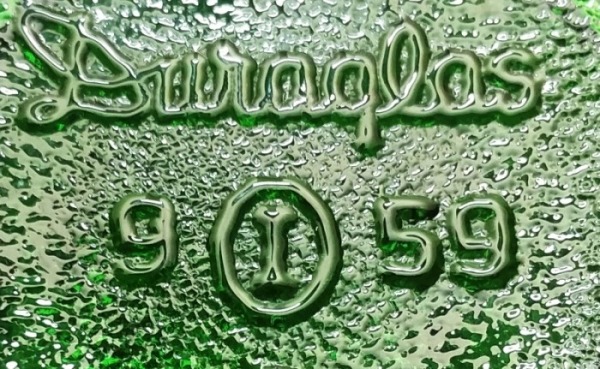
Undated
The caption identifies the pictured Seven-Up bottle as made in 1959 at plant 9.
glass · Streator, Illinois
………………….Illinois Company, Alton, Illinois (1873-1929). This mark is seen on the bases of millions of machine-made bottles of all types dating from the 1915-1929 period, and is one of the most common manufacturers’ marks seen on bottles found in early-20th century bottle dumps, landfills and other trash dumping areas in the United States. For more information, please see the “ within a diamond ” and LYRIC pages. “ inside an O” trademark used by Owens-Illinois, here on the base of a Seven-Up soda bottle, made in 1959 at their Streator, IL factory (plant #9).
Undated
impressed · glass
I within an “O” or oval (shown above) ……………………………………………………… see this page with more info: Owens-Illinois Company . Owens-Illinois, formerly headquartered at Toledo, OH, now Perrysburg, Ohio (1929 to present), has used three major trademarks over the last 90+ years. (“ Diamond and oval entwined with I in the center “; “ I inside an O “, and presently simply “ O-I “). Approximately 25 manufacturing factories are located in the US and Canada, with the most recently opened plant at Windsor, Colorado. This mark was used beginning in 1954, up to quite recently, being gradually replaced (over a period of several years) with the “ O-I ” mark (the current mark used by O-I) on most bottle molds. The diamond was removed from the “old” mark beginning in 1954, although a few bottle molds apparently didn’t have the diamond eliminated (i.e., the mold retooled) until years later, even as late as 1966. After c. 1958 the great majority of O-I bottles carried this simplified mark of just an “I inside an O”. On recent bottles, this mark may be small, faint, and not always easily discernible, usually seen embossed on the heel of the container. O-I is presently (2024) the largest making corporation in the world. A wide variety of containers are made, many especially for food and beverage products. For more information on this mark and several others used by Owens-Illinois over the years, see this page: Owens-Illinois Company .
Undated
glass
……………. Bottle Company, Inglewood, California (1921-1923)
Undated
glass
………………. stylized monogram used by Ball-Incon Packaging (1987-1994).
Undated
glass
………….. Ball-Incon Packaging (mark used 1987-1994). Seen on clear packer ware.
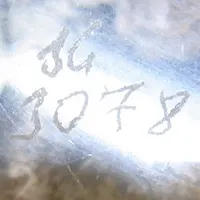
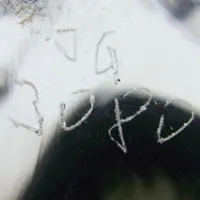
Undated
glass
……………….. See “I superimposed over a G” entry (Imperial Company), below.
Undated
glass
………Illinois Company, Alton, Illinois (1873-1929). This monogram which is seen most commonly on the “ MASON’s PATENT NOV 30TH 1858 ” fruit jars may also indicate, in some cases, other unidentified companies, but most of these jars are presumed to be products of Illinois . See the next 3 entries.
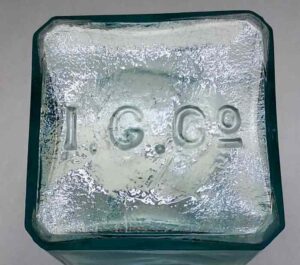
Undated
glass
Illinois Company mark on the base of a mouthblown square ink bottle.
Undated
glass
………….Illinois Company. Alton, Illinois (1873-1929). This mark was used from approximately 1895-1915. Please also see the “ I within a diamond ” and “ LYRIC ” pages.
Undated
glass
………….. see C. Ihmsen & Son, on page two.
Undated
impressed · glass
…………………… Company, Alton, (1873-1929) and its successor Owens- Company. The mark is typically seen embossed on the bottom of prescription / druggist bottles. The mark was a “brand name” assigned to a line of druggist bottles called “ Ovals”, evidently used c. 1910s-1929 by , but continued in production by Owens- until 1949. Many of those bottles made after 1940 also carry the DURAGLAS brand name on them. Also, see the I in a diamond page, and Owens- Company.
Undated
glass
Imperial (IM /PE /RI /AL), the letters inside 4 small squares arranged to form one larger square, or in 4 segments inside a Maltese cross or “plus sign”………………….. Imperial Company, Bellaire, Ohio (1902-1984). Found on tableware. This particular mark believed to date from approximately 1904-1951. Also, see “I superimposed over a G” entry, located farther down on this page.
Undated
glass
……………. Company, Dunkirk, Indiana & Sapulpa, Oklahoma (1907-2002). Producer of a huge variety of glassware … drinkware, all types of tableware, decorative , floral container , candle ware, Carnival , EAPG (Early American pattern /pressed ) etc for nearly a century. Almost all glassware is unmarked , although I have seen a candy dish marked on the base “ /Made in U.S.A.” with an “LCC” mark. ( Company was purchased by, and became a subsidiary of, the Lancaster Corporation, based in Lancaster, Ohio, in 1957. That company expanded to become Lancaster Colony Corporation [LCC] in 1961.) The Dunkirk, IN plant shut down production of in 2002, and for a time afterward served as a warehouse and/or mold repair facility. Some was continued to be made under the name at Sapulpa, Oklahoma (the former Bartlett-Collins Company facility) until that plant was purchased by Anchor Hocking Company who closed it down in June 2008. For more info on , try this website here . Also, check out this page discussing the “ Hen-on-Nest” covered dishes made by .
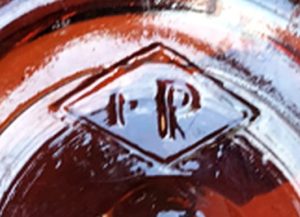
Undated
glass
………. (Company), Indianapolis, Indiana (1870-c.1876). Seen on the base of wax sealer fruit jars and across face of whiskey flasks, probably other types of bottles also exist with this marking. See “I.G.W.Co.” in a diamond (Photo courtesy of Garrett Trask)
Undated
impressed · glass
………………………Illinois-Pacific Corporation, San Francisco, California (c.1925-c.1930). (Name change of company above). plant locations at Los Angeles; Oakland, CA; Seattle, WA; & Portland, OR. Usually has a tiny triangle inside the larger triangle, squeezed in above the letters. The mark is sometimes poorly embossed and very difficult to make out. Illinois-Pacific – a West Coast Phenomenon Part II – Illinois-Pacific Corp.
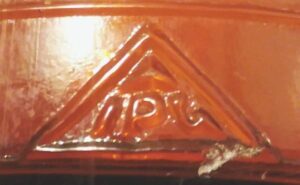
Undated
glass
Illinois-Pacific Corporation mark on the heel of an amber Clorox bottle.
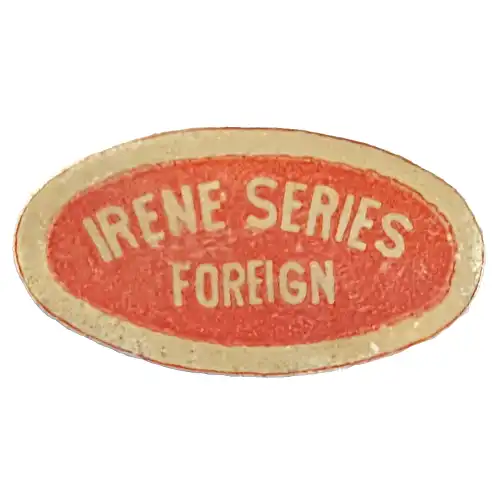
Undated
label · gold and red · glass · Japan
Export label found on Japanese lampwork.
Undated
glass
………………………………….. (also known as New Brooklyn Works), New Brooklyn, New Jersey (1848-c.1868). Pictorial flasks bearing this inscription along with an anchor on the front, and a representation of the factory on the reverse, are found which were made here. This glassworks is briefly discussed in Adeline Pepper’s reference work The Gaffers of New Jersey (1971) which I heartily recommend for anyone interested in early American making, and New Jersey glassware in particular.
Undated
label · glass
………… Capital letters, in cursive script (shown above)…………………… Johnson & Johnson, headquartered in New Brunswick, New Jersey (1886 to present). The “J&J in cursive” mark is seen on the bottom of jars and bottles that contained products marketed by Johnson & Johnson. In some cases the “&” symbol may vary in how clearly it is delineated. The mark is most commonly seen on the bases of white milk cosmetic-type jars made for Johnson & Johnson’s Baby Cream. The jar features five horizontal raised bars on two opposite sides, and is easily recognizable even with the label missing. The photo here shows the mark as it appears on one of those jars, of uncertain date but possibly from the 1940s or ’50s. According to the Justia trademark site, this particular mark was first used in 1913.
Undated
glass
………………… Bodine & Sons, Bridgeton, New Jersey (1846-1855).
Undated
glass
…………….See Johns Bros, below.
Undated
glass
J D S (letters arranged in a triangular formation, usually with a mold number placed between the “J” and the “D”, on the bottoms of Lea & Perrins bottles)…………………. John Duncan’s Sons, at first, distributors (later, makers) of Lea & Perrins Worcestershire Sauce that originated in England. The Salem Works, of Salem, New Jersey are believed to have made most, if not all, of the bottles marked “J D S”. These bottles are mouthblown (handmade) and were produced beginning sometime in the 1877-1880 time period (sources disagree on exact year) and were made in very large quantities until at least the 1910s, before a switch was made to machine-made bottles. Many mold numbers are seen, ranging from “1” to at least “105”, possibly higher. The bottles are nearly always in shades of light aqua or light green. Some more background information on Lea & Perrins is here: Lea & Perrins – Baybottles.com
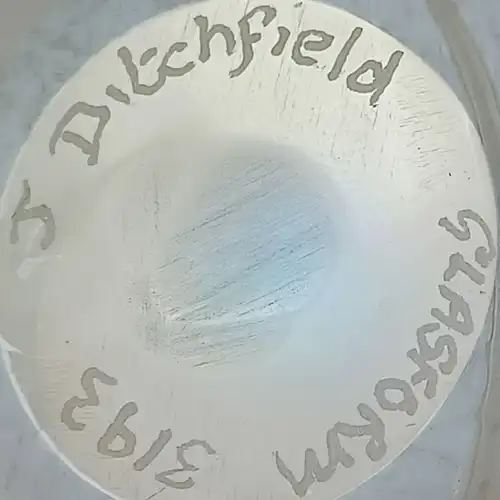
Undated
glass · United Kingdom
Signature accompanied by a pattern number.
Undated
glass
………………..Jeannette Company, Jeannette, PA. (1898-1983). These initials were seen on the base of a Curtice Brothers ketchup bottle, reported by Taylor McBurney.Jeannette Company made bottles and fruit jars earlier in their history. See “J in a square” entry on this page, also see this web page with more detailed info: Jeannette Company – SHA.org.
Undated
glass
………………… Knox Bottle Company, used on containers made at their Jackson, Mississippi factory location (1932-1953). See “K in a keystone” entry.
Undated
glass
………… Jeannette Company, Jeannette, Pennsylvania (1898-1983). Exact period of use of this mark is unclear …….. perhaps 1920s-1940s. Jeannette Company was the successor (purchaser of the factory) of the Jeannette Bottle Works (or Jeannette Bottle Company) that had began operation in about 1888.
Undated
glass
……………. probably Jeannette Company, Jeannette, Pennsylvania (1898-1983), although there is a possibility this mark was used by D. C. Jenkins Company of Kokomo, Indiana (1906-1933), a producer of pressed and blown tableware and novelties. Jay Hawkins, in his book on Pittsburgh region factories (2009), states that the mark was seen on a clear restaurant creamer.
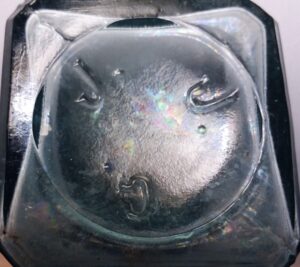
Undated
The source dates the bottle type approximately 1865–1895; the maker and order of initials are uncertain.
glass
…………………..Unknown. Initials appear, in a circular formation, on the base of a handmade aqua pickle bottle, 7 & 1/4th inches in height, distinctly American, of a type generally made circa 1865-1895. This might stand for a food/dry goods distributor instead of a company? The order of the letters may also be interpreted as “J. G. J.” or “G. J. J.” “ ” on base of aqua pickle bottle. Unknown glassmaker or distributor.
Undated
glass
…………………John Kilner & Company, Castleford, Yorkshire, England. Years of usage of this mark is uncertain. See next 2 entries.
Undated
glass
…………….John Kilner & Company, Castleford, Yorkshire, England. From Julian Toulouse’s “ Bottle Makers and their Marks “, confusion reigns as to the exact stretch of years this mark was actually used – if it even existed. He stated “1842-1844” which seems doubtful. The company evidently existed, in various incarnations, for many years after 1844. (The particular mark has evidently not yet been confirmed to exist).
Undated
glass
………………… John Kilner & Sons, Wakefield, Yorkshire, or Thornhill Lees, Yorkshire, England. Similar to the mark “J K & Co” (above) confusion on the actual dates of use continue. Toulouse (Bottle Makers and their Marks ) stated “1844 to 1857” but also related that this same firm name was applied to a manufacturer still in business as late as 1928. Dates of usage for this mark are unclear and I would propose a very wide possible date range extending from the 1860s into the late 1920s. (Most likely, perhaps 1880-1910). Also, see K.B.Ld. and K. B. Ltd. marks. For much more detailed research on this and other Kilner-related marks, please see this article by Bill Lockhart et al: The Kilner Companies .
Undated
glass
……………. John Kilner (Wakefield) ; John Kilner (Thornhill Lees)…………see entries above.
Undated
glass
…………………John Lumb & Co. (1870s-1905), name changed slightly to: John Lumb & Company, Limited. (1905-1937), Castleford, Yorkshire, England. Became part of United , Ltd, in 1937. After 1937 their mark was “U G B” positioned over an “L”.
Undated
glass
……………..Pitkin Works, Manchester, Connecticut (1783-1830). Appears on flask probably made circa 1815-1825. Initials presumably stand for Joseph P. Foster, manager at Pitkin.
Undated
glass
………………………… Please see page here for more information
Undated
glass
………………… seen on base of heavy, crude black ale, beer or wine bottle, sand pontil, probably British or possibly American, looks circa 1820s-1850s. Unknown maker. There is also a small “D” along base rim. Bottle posted on ebay in November of 2017.
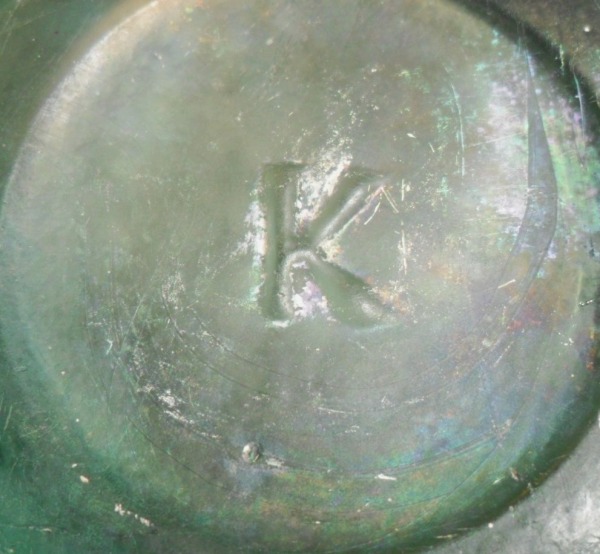
Undated
glass
Caption tentatively attributes the ringed pepper-sauce bottle to Kearns of Zanesville, Ohio.
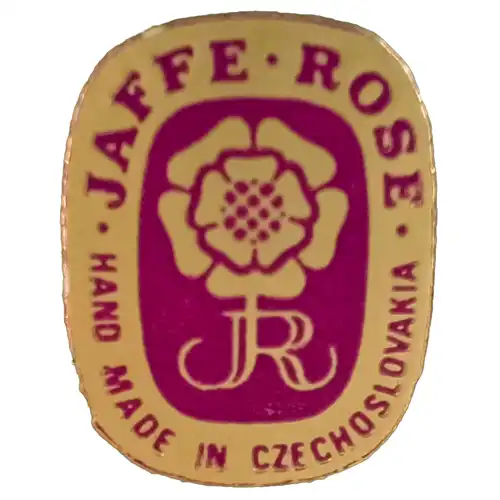
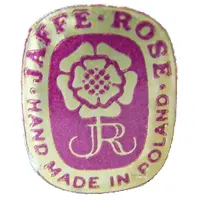
Undated
label · glass · Poland
Import label for Polish .
Undated
label · silver and red · glass · Japan
" " red & silver oval generic foil label.
Undated
label · silver and blue · glass · Japan
" " blue & silver rectangular generic foil label.
Undated
glass
………this mark is rather indistinct and appears to be a “B” with the lower loop of a “J” hanging down from underneath it. Probably Johns Bros, Fairmont, West Virginia (1893-1907). Seen on heel of amber slug-plate crown-top soda bottle made for H. Epping, Louisville, KY.
Undated
label · black and silver · glass · Sweden
Jones & Co import label.
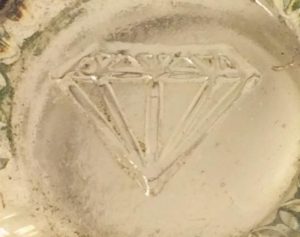
Undated
impressed · glass
Cut-jewel emblem on the base of a shot .
Undated
impressed, label · glass
………………unknown meaning. This embossed emblem appears on the base of a clear shot with green and white “Applied color label” type graphics, perhaps from sometime in the 1940s-1960s?? If anyone has information about this mark, please let us know!
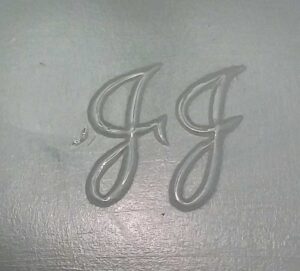
Undated
impressed · glass
Cursive mark on a white milk- Johnson & Johnson Baby Cream jar.
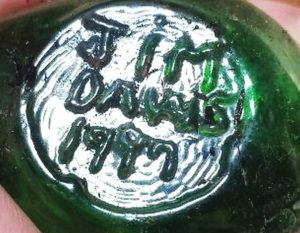
Undated
The caption dates the green bird paperweight to 1997.
glass
Green bird paperweight base with a signature and year.
Undated
glass
……….Johns Brothers, Fairmont, West Virginia (1893-1907). This company was a successor to the Fairmont Bottle & Fruit Jar Company which was incorporated in 1892. Johns Bros. operated up to about 1907, at which time it became known as the Fairmont Bottle Company (1907-1912). See JB.
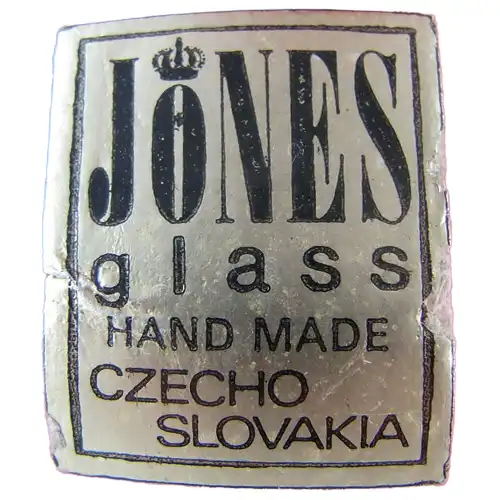
Undated
label · black and silver · glass · Czechoslovakia
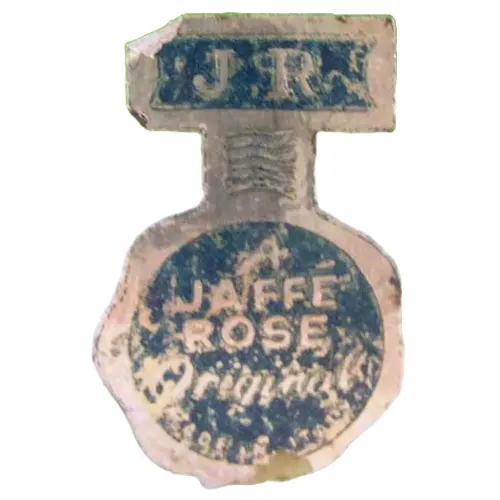
Undated
label · glass · Italy
British importer Jaffe Rose label, found on some Galliano Ferro items.
Undated
glass
capital letter with image of a baby / toddler or small child peering from behind the letter…………… as seen on the base of clear jars/canisters with baby-related motifs. (Supposedly, these were given away to newly adoptive parents by orphanages in Germany, to hold cotton, pins, etc.). Attributed to Kruger , Germany, circa 1930s-1950s? I don’t have detailed info on this company, but if you have information on this mark, the company and the products they made or distributed, please write and tell us!
Undated
glass
……………Kilner Bros. Limited, Thornhill Lees and/or Conisbrough, Yorkshire, England. (c. 1895-1937).
Undated
glass
……………Kilner Bros. Limited, Thornhill Lees and/or Conisbrough, Yorkshire, England, United Kingdom (c. 1895- 1937). For more detailed information on this and other Kilner-related firms, please see this article by Bill Lockhart et al: Kilner – SHA.org.
Undated
glass
…………………………..King City Works, Fairmount, Indiana (1890-1897).
Undated
glass
……………….Kearns-Gorsuch Bottle Company, Zanesville, Ohio (1886-1937). Years this mark was used are not completely certain, but perhaps circa 1910-1937. See next entry, also see “K” entry, above.
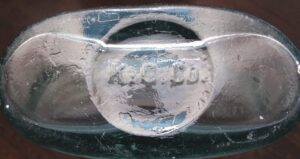
Undated
The caption dates the pictured aqua ammonia-type bottle to circa the 1890s.
impressed · glass
…………..Kearns-Gorsuch Bottle Company, Zanesville, Ohio (1886-1937). Monogram seen on fruit jar. Initials also appear spelled out and are known embossed on the base of a pickle bottle. A number of Hutchinson-style soda bottles are found with this mark, and they generally date in the 1890s-1910 period. This mark presumably dates before 1920, when Hazel-Atlas bought the plant. Also, see “K” and “K-G” marks. “ ” on base of aqua ammonia-type bottle, circa 1890s.
Undated
glass
………………… uncertain meaning, but possibly Kentucky Cooperative Company, Louisville, Kentucky (1897-1898). On some bottles, these initials may stand for another company. Kentucky Cooperative went into receivership in 1898 and was reorganized to become the “Louisville Company” (also called the Louisville Bottle Manufacturing Company), a short-lived venture that ceased by 1901 (and not to be confused with the much earlier Louisville Works (1855-1873). The “K. G. Co.” initials are seen on the reverse heel of a small number of mouthblown soda bottles (most of which are of the “hutch” style) including bottles marked “M. Bochart / Jeffersonville, Ind”; “F. & P. Bochart / New Albany, Ind”; “American Bottling Works / Louisville, KY”; J. I. Marsh / Portsmouth, O”; “H. C. Kunkel / Michigan City, Indiana” and Cartens Bros. / Cincinnati, Ohio”, all, except for the Michigan City bottler, are located on the Ohio River. Two “outliers” include “A. Weber / Union City, Conn” and “Enterprise Soda Works / S.F.” . Also – a light greenish-aqua “champagne blob top” style beer bottle is marked “H. Neiman / Bottler / Chicago” in a slug plate and “K. G. Co.” on the heel. The maker (in my opinion) of the bottles made for the bottling outfits located along the Ohio River is most likely Kentucky Cooperative Company, even though the extra “C” in the name does cast some doubt on that attribution. Louisville, New Albany and Jeffersonville are all located very close to each other. And all of those bottling firms were operating in the late 1890s. The bottles from Connecticut and California may be totally unrelated. A tall narrow “ammonia type” medicinal bottle in aqua (which also looks 1890s) is marked on the bottom with “K G CO” (see photo). Researcher Bill Lockhart writes that the K G CO mark was most likely used by Kanawha Co, of Cedar Grove, West Virginia – an obscure bottle company that operated circa 1913-1914 (no relation to the much later Kanawha Company that made tableware 1955-1989) – but I feel that company was too late to produce the hutch sodas that were more typical of late 1890s production. Perhaps more research will uncover what these initials stand for – for sure!
Undated
glass
……………… Kentucky Works Company , Louisville, Kentucky (1879-1887). Another minor variant of the “KY.G.W.CO.” mark. See KY.G.W. entry.
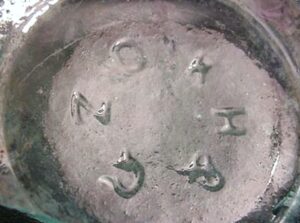
Undated
glass · Zanesville, Ohio
Kearns, Herdman & Gorsuch glasshouse mark.
Undated
glass
……………………….Kearns, Herdman & Gorsuch, Zanesville, Ohio (1869-1886). The lettering is usually arranged clockwise in a circle on the base of aqua-colored hand-blown fruit jars and bottles. On a few bottles the lettering has been reported with the “K H & G” clockwise, but the “Z O” counterclockwise. Sometimes the mark is misunderstood to be “Z. O. K. H. & G.” or “O. K. H. & G. Z.” or a similar string of letters – if the observer “starts off” with the wrong letter. Confirmed on the bottom of strap-sided and “coffin” or “shoofly” type whiskey flasks as well as “wax sealer” type fruit jars, and other utilitarian bottles of the period. Also, please see “K” mark. Much more background information on the confusing series of Kearns-related companies based in Zanesville can be found in this .PDF article by Bill Lockhart and the Bottle Research Group: The Kearns companies of Zanesville, Ohio.
Undated
glass
……….Karl Hutter, the inventor of the “Hutter porcelain stopper” patented in 1893 which was used on many beer bottles (and still is, using plastic instead of porcelain, on several modern bottles such as Grolsch), evidently had large numbers of bottles manufactured for him during the c. 1880s-1910 era. These bottles were made by one or several unidentified glasshouses in the New York/New Jersey area. A good possibility for one source would be Brookfield Company (Bushwick Works) .
Undated
glass
…………… As seen on lenses, lamp globes, airport runway light covers and other industrial glassware : Kopp , Inc., Pittsburgh, Pennsylvania (1926-to date).
Undated
glass
………..Seen on ornamental and reproduction glassware, novelties, tableware: John E. Kemple Works, East Palestine, Ohio (1945-1956) & Kenova, West Virginia (1956-1970). See next entry.
Undated
glass
……………. Kopp Company (Kopp , Incorporated), Pittsburgh, PA (1926-to date). I don’t know what years this particular mark was used. If you have info on date ranges for this mark and the “K in a circle” mark they used, please advise.
Undated
glass
K in a diamond (seen on the base of an amber blob lip beer bottle marked “Consumers Brewery Company, Erie, PA)…………..unknown meaning. That bottle likely dates from the 1890s, and the mark is not related to the one above attributed to Kopp.
Undated
glass
……………… Knox Bottle Company/Knox Associates, Knox, Pennsylvania and other plant locations (1917-1968). This mark was introduced in about 1932. Knox operated a number of manufacturing plants over many years during the 20th century, producing tremendous quantities of containers of many types during that time. Sometimes there is no discernible letter inside the keystone shape. Originally, the main Knox plant at Knox, PA used the “ ” (c. 1932) and most, if not all, of their other factory locations instead used a different letter inside the keystone at that time. However, most of the Knox factories are believed to have switched over to using the “ ” mark after about 1953, continuing on up to 1968 when Knox was bought out by Containers Corporation. For much more in-depth information on the Knox family of plants and the marks they used, please check out this article by Bill Lockhart et al: Knox Bottle Company.
Undated
glass
……………………. probably George W. Kearns & Company, Zanesville, Ohio (c.1860-1869) and/or Kearns, Herdman & Gorsuch, Zanesville, Ohio (1869-1886). Examples include wax sealer fruit jars and “ringed” pepper sauce bottles. (Also, see “K. H. & G. Z. O.” entry on this page). In the case of some black ale, beer or wine bottles of apparent British manufacture, which are sometimes marked with a single letter on the base, the “K” might stand for one of the Kilner companies. Julian Toulouse attributed the “K” on some British-made bottles to Kinghorn Bottle Company, Kinghorn, Fifeshire, Scotland (1907-1920).
Undated
glass
……………… Kimble Company, later Kimble-Kontes, later, Kimble Chase Inc. (part of the Gerresheimer Group), Vineland, New Jersey. Kimble-Chase was later acquired by DWK Life Sciences in 2016. Kimble produces borosilicate under the trade name KIMAX (similar to PYREX). See “K in a hexagon”, below. In some cases the “K” may be rather small and unobtrusive on the base of bottles, and accompanied by a group of raised dots. (The dots, in this case, are numeric mold codes that can be scanned or “read” by high speed electronic inspecting machines – to capture information that identifies the exact mold in which a particular bottle was made).
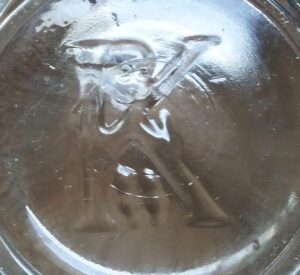
Undated
glass
K over a “W”…………………..Wheaton, mark appears on various items made by Wheaton, Millville, NJ, after they purchased the molds previously used by John E. Kemple Works. See next entry.
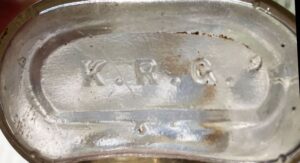
Undated
impressed · glass
K.R. (backward letters, embossed twice, crudely marked on base of aqua “strap-side” whiskey flask, circa 1860s-1880s era; an example was dug in the Louisville area)……………… unknown manufacturer. There is a chance the initials could have stood for Krack & Reed (1866-1868), one of the business firms that operated the Louisville Works, but there is no proof of this. The lettering is very crudely done, almost as if lightly “scratched” into the mold.
Undated
impressed · glass
…………….. Unknown meaning. These initials are embossed on the base of a bottle found in the Louisville area. The bottle is plain with no lettering on the front, and is similar to the “Philadelphia Oval” druggist bottle types especially popular in the 1875-1895 period.
Undated
glass
………………………seen on an amber jar base shard, circa 1960s or 1970s. No info on maker, though it might stand for one of the Knox Bottle company plants, or maybe it is just a mold letter (mold identifier).
Undated
glass
K Z (Letter “K” positioned above a larger “Z”, on the base of handmade paperweights)……………….. Zimmerman Art Company, Corydon, Indiana (1963 to present). This mark indicates a piece handmade by Kerry Zimmerman, one of two sons of company founder, owner and chief glassblower Joe Zimmerman. The KZ mark probably dates the piece to after 1983, the year that Kerry and his brother Bart joined his father in the family business. (See “Z” and “B Z” marks).
Undated
glass
……………………….Knox Bottle Company, originally based in Knox, PA. Mark seen on milk bottles. See “K in a keystone”.
Undated
glass
………..see “K H” mark.
Undated
impressed · glass
………………… Keene Works / Keene-Marlboro Street Works, Keene, New Hampshire (1815-1842). Keene is located in Cheshire County, in southwestern New Hampshire. This glassworks operated under a number of firm names (partnerships / business names) over the years, including Twitchell & Schoolcraft (1815-1816); Justus Perry (1817-1822); Perry & Wood (1822-1826); Perry & Wheeler (1826-1830); Perry, Wheeler & Company (1830-1835); and S. & Q. Wheeler (1835-c. 1842). Subsequent operation was sporadic and reportedly lasted until around 1850. There is a commemorative historical marker / plaque erected in the city of Keene that dates this particular works as “1815-1842”. (Another factory in Keene made mostly window , not bottles. It was located on Washington Street). Most of the output of the Keene Marlboro Street factory was not marked. It made a wide variety of bottles. However, a few Masonic flasks were marked, including GIV-17 (the McKearin figured flask classification number) which is embossed “KEENE”, and 3 variants of that general type that are lettered “KCCNC” – the mold engraver neglected (either accidentally or purposely) to place a central bar in the “E”s. The embossed letters are sometimes faint or indistinct and hard to discern. The three variants lettered “KCCNC” are catalogued as GIV-18, GIV-19 and GIV-20. Most of these bottles were made in shades of amber-colored . The front of the flasks feature Masonic symbols and the reverse bears a representation of an eagle, with the oval “frame” placed below the eagle. There is confusion and conflicting date ranges given for the years when the “KEENE” and “KCCNC” marked flasks were actually produced. The most likely date range (in my opinion, and you can take that with a grain of salt) is from circa 1822 to 1835. Several other flask variants, also believed to be products of this glassworks, include examples marked “IP”, “HS”, “H-P”, “P & W” and “J. K. B.” in an oval frame. The “I-P” is actually “J P” and stands for Justus Perry. For more details on this factory, check out this article from Bill Lockhart: Keene-Marlboro-Street Glassworks – SHA.org.
Undated
impressed · glass
………………… Kensington Works, Philadelphia, Pennsylvania (c.1816-1833) and (1842-1846). Full name seen embossed on a number of early figural / historical flasks. Flasks made at the Kensington works include GI-14, GI-16 and the GI-90 through GI-96 variants. researcher and author Helen McKearin dated those, in general, as having been made beginning around 1824 with production continuing for an undetermined stretch of years thereafter. Dr. Thomas W. Dyott was either part-owner or full owner and manager of this works by around 1821. This factory (or, more accurately, factories – by 1833 there were four or five separate factory buildings) was later known as the Dyottville Works (see “Dyottville Works” entry on page two) . Some of the early flasks made by the Kensington Works were marked “T.W.D” (for Thomas W. Dyott). T. W. Dyott went bankrupt in about 1839 and there would be a succession of other operating firms that ran the glassworks over several more decades, with some intervening periods of inactivity. NOTE: a number of pontiled soda bottles from the 1840s are also known with the marking “KENSINGTON WORKS” [no “PHILADELPHIA”] but these were made in the c. 1842-1846 time period after chemist Henry Sybert re-opened the idle Dyottville glassworks to make mineral water bottles for Eugene Roussel. The works were then sold in 1846 to Benner’s Smith & Campbell, who ran the plant as “Dyottville Works” (source: research by Tod Von Mechow). An overview of the Kensington Works and Dyottville Works (by Bill Lockhart et al) can be found here: Dyottville Works
Undated
glass
………………see webpage on Manufacturing Corporation.
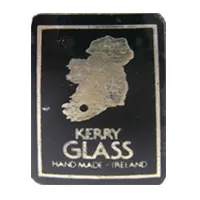
Undated
label · glass · Ireland
" " Irish paper label.
Undated
glass
………………… a type of mold associated with handmade (mouthblown) antique bottles, typically characterized by a “line-semicircle-line” mold mark on the base of the bottle. The mold mark may or may not be easily discernable, and sometimes may be partially obscured by a pontil mark. Although it is difficult to pin down a specific age to such bottles, in general, this type of mold was most often used with bottles made in the c. 1845 to c. 1875 time period in the US. For more in-depth information on this type of bottle mold (as well as others), check out this page on Bill Lindsey’s site: Bottle Bases – Historic Bottle Information Website.
Undated
glass
Key (outline / representation of a KEY, with the letters R E D superimposed over it) as seen on the face of certain MASON and MASON’S PATENT NOV 30TH 1858 fruit jars……….These jars were made by Redkey Company (1897-1902), of Redkey, Indiana. Redkey (originally named Giles-Clough Company ~ 1893-1897), was purchased by Ball Bros Manufacturing Company and some of the later jars with this marking were evidently made by Ball – perhaps in the 1900-1902 time period.
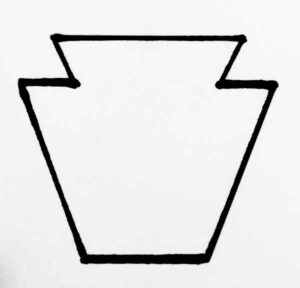
Undated
glass
Empty keystone outline; most such container marks are attributed to Knox, but not all.
Undated
glass
…………………… Kilner Brothers, London; Thornhill Lees; or Conisbrough, England. This marking and others have been seen on various food jars that could have been produced over a very long time span, theoretically from around 1857 to 1937. For more info on this series of confusing marks, see this article: Kilner – SHA.org .
Undated
glass
………………trade name for borosilicate bottles and laboratory ware manufactured by Kimble. See “K in a hexagon”.
Undated
glass
…………………. see “K in a hexagon”.
Undated
glass
……………………………… Bottle Company. See “K in a keystone”.
Undated
glass
………. , Wheeling, Virginia (now WV) (1824-1829). Full name seen on very rare historical flasks. Initials “K & M” were reported by Knittle, but are not confirmed to exist on any bottles.
Undated
glass
………………..brand name used by Knox Bottle Company for a line of druggist / pharmaceutical bottles. The “ ” brand name was trademarked by Knox in 1924, with “first use” said to have been in 1918 – according to the records published by the U.S. Patent & Trademark Office. See “K in a keystone”.
Undated
glass
……………… Kopp Company , (officially Kopp , Inc.) , Pittsburgh, Pennsylvania (1926-to date). Manufacturer of a wide variety of industrial items such as signal lenses, railroad lantern globes, colored light covers (airfield boundary lenses), etc. Also see “K in a circle”.
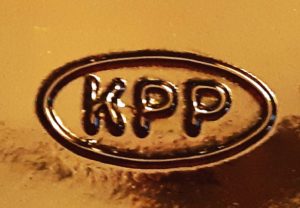
Undated
The caption identifies the pictured Budweiser bottle as date coded 1972.
incised, label · glass
Caption expands as Kerr Packaging Products Division of Kerr .
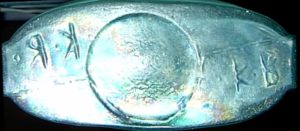
Undated
The caption dates the handblown strap-side flask approximately to the 1860s–1880s.
impressed · glass
is embossed backwards twice; maker unidentified.
Undated
The source identifies 2015 as the date accompanying Kathryn Roberts's initials.
glass · United Kingdom
" " signature (K is backwards) for Kathryn Roberts, with 2015 date.
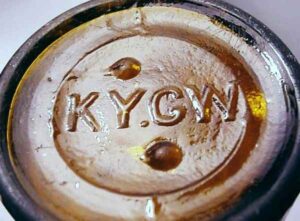
Undated
glass · Louisville, Kentucky
Kentucky Works Company mark on an amber beer bottle.
Undated
glass
………………. Kentucky Works Company, Louisville, Kentucky (1879-1887). Maker of many types of utilitarian containers, usually found in aqua or amber . Base photo of a beer bottle is shown above. For more info on this company, please check out this article: Kentucky Works Company, Louisville, KY.
Undated
glass
……………………… Kentucky Works Company, Louisville, Kentucky (1879-1887). Another variant of the above mark, seen on quite a few bottles and jars of various types.
Undated
glass
………………….Lamb Company, Mt. Vernon, Ohio (1921- c. 1971). This mark seems to be found only on milk bottles. On most containers the “52” is seated on the “lap” of the capital letter “L”. Lamb made many of the earlier “Babyface” milk bottles in clear , which are now being reproduced (usually in brightly colored such as cobalt blue) by factories in China & Taiwan. The Lamb Company factory was purchased by the Dorsey Corporation (owners of Chattanooga Company, Chattanooga, TN) in 1963. After 1963, the “L52″mark was evidently continued on milk bottles, but some other types of containers made at the Mt. Vernon plant bore the “C in a circle” mark used by Chattanooga Co. The L52 mark on milk bottles was probably continued in use until around 1971. The exact year of ending of the L52 mark is rather “fuzzy” as Lamb usually didn’t place date codes on their containers – or, at least, date codes that were easily interpreted as such. See “L” and “L G Co.” entries. See also L.G.CO. mark: Lindell, Lyndeboro, Lockport and Lamb Companies.
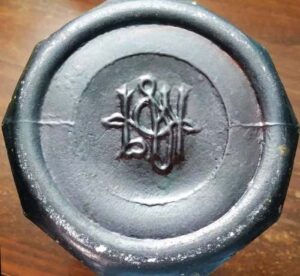
Undated
glass · Pittsburgh, Pennsylvania
Lorenz & Wightman monogram on an amber A. Templeton cream-ale bottle; source dating is disputed.
Undated
glass
…………. Lorenz and Wightman, Pittsburgh, PA (same as above). Although “L & W” is often seen on bottles with the letters very clear, distinct and obvious, this monogram has those letters closely intertwined and may be more difficult to interpret correctly.
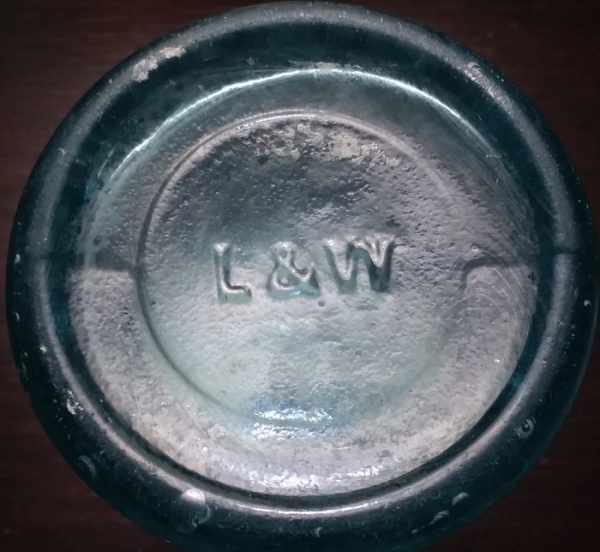
Undated
impressed · glass · Pittsburgh, Pennsylvania
Lorenz & Wightman mark on a blue-aqua H. Schuckman mineral-water bottle.
Undated
painted · glass
…………………. Lampton, Crane & Ramey Company, Louisville, KY (c.1894-c.1928). This firm was a dealer in paints, oils and varnishes. They apparently offered lettered bottles as part of their product line (many firms of this type offered window and bottles in addition to their other products), and since they were not an actual bottle manufacturer, the LC&RCo bottles were made by an unidentified glassworks. (Just a wild guess……….no proof!…… possibly Illinois Company??)
Undated
glass
L (capital L, in cursive script, sometimes resembling a cursive capital Q , fancy numeral “2” or in some cases, a short curly hair embedded on the surface of the )…………………………… Libbey , Inc., Toledo, Ohio (1888-to date). For more information, see this page: Libbey Company.
Undated
glass
………… unidentified manufacturer.
Undated
label · black and gold · glass · Venezia, Italy
Venice retailer label.
Undated
glass
…………………. Latchford Company, Los Angeles, California (this mark used c.1957-c.1989). Julian Toulouse, in Bottle Makers and their Marks , published 1971, on page 314 writes the plain was used “ Possibly 1925 to 1938, definitely 1957 to date”. I have doubts that the W. J. Latchford Company used the “plain ” in the earlier period, but perhaps they did so. Latchford eventually became part of Anchor . See also “ in a circle” and the next entry on the “ ” used by Laurens Company.
Undated
glass
…………. Lippincott, Fry & Company, Pittsburgh, PA (1866-c.1867). These initials appear on the front of a “Shield with Clasped Hands” pictorial whiskey flask. That glassworks was also known as “Crescent Flint Company”. This mark was identified by author and researcher Jay W. Hawkins in his groundbreaking reference work Glasshouses and Manufacturers of the Pittsburgh Region 1795-1910, published in 2009.
Undated
glass
…………………Unknown. Reported by Jimmy Bray, this mark appears on the base of a light aqua tooled-lip strap-side flask, probably dating from the 1885-1910 time period. There is almost certainly no connection between this and the following mark.
Undated
glass
………………..Liberty Company, Sapulpa, Oklahoma (1918-c.1995), mark used c.1934-c.1967. Note that mark includes a dash.
Undated
glass
………………Liberty Company, Sapulpa, Oklahoma (1918-c.1995), mark used c.1924-c.1936. Note that periods are used.
Undated
glass
L.G.CO. arranged around a star with the words “ACME/Trademark 1893″…………Lamont Company, Trenton & New Glasgow, Nova Scotia, Canada (1890-1898). Seen on the face of fruit jars. Also see the “ L.G.CO.” mark webpage.
Undated
glass
……………………Several factories used this marking, including Lindell Company, St. Louis, Missouri; Lyndeborough Company, South Lyndeborough, New Hampshire; Lamb Company, Mount Vernon, Ohio; and Lockport Company, Lockport, New York. Please click here for more information: L. G. Co. marks seen on bottles and jars .
Undated
glass
………………..Liberty Company, Sapulpa, Oklahoma (1918-c.1995), mark used c.1955- c.1995. Dash removed. (NOTE: There is a considerable overlap of the time periods during which these three mark variations were used (L.G. / L-G / ) so careful scrutiny for an accompanying date code is advised. This information on approximate dates of use courtesy of author/researcher Bill Lockhart.) The Liberty Company factory became part of the Ball-Foster Container Corporation in about 1995, Saint-Gobain Containers in 2000, now (after c. 2014) operating as part of the Ardagh Group. Also, check the L.G.CO. mark page for info on other factories that used a somewhat similar mark.
Undated
glass
………………Laurens Works, Laurens, South Carolina (1910-1996). Plants also operated in Henderson, North Carolina (opened 1957) and Ruston (Simsboro), Louisiana. The Henderson and Ruston plants were later to become part of Saint-Gobain Containers, currently (2020) under Ardagh Group. Laurens Works was a prolific manufacturer of soda bottles. The “ ” may appear on the heel of a bottle, but is often seen on the bases of soda bottles, along with mold , date, and/or style code numbers. Often, the LGW mark (as used by Laurens) is situated between numbers (date codes) such as: “6 1”. That would indicate a bottle made in 1961. Also, see the “L” mark entry on this page. NOTE: In some instances certain older (pre-1900) bottles or flasks with the marking “L & W” (indicating Lorenz and Wightman) are misunderstood to read “L. G. W.”, and because of an entry in Toulouse’s Bottle Makers and their Marks , this mark is believed to stand for Louisville Works. I do not believe Louisville Works ever marked ANY items with the initials “ ”. If you have information that might show otherwise, please feel free to contact me with details. Also, see the “L.G.CO.” mark webpage.
Undated
glass
…………………… probably Lockport Works, Lockport, New York (1843-1908). An example of this mark is seen on the lower heel of a blue “J. A. Lomax / 14 16 & 18 / Charles Place / Chicago” soda or mineral water bottle, probably dating from the early 1870s. There is a SLIGHT chance this could have stood for Lancaster Works, but Lockport is much more likely since Lomax had previously had other soda bottles made for them (marked “LOCKPORT NY”) that appear very similar in color, shape and embossing.
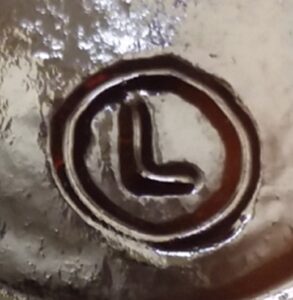
Undated
The source suggests manufacture in the 2010s or later for the sauce bottle; maker is unidentified.
glass
………………………………. unknown maker, possibly European and of recent manufacture (2010s or later). “ inside a circle” mark on base of dark amber sauce bottle.
Undated
glass
…………………….Lincoln Bottle Company, Lincoln, Illinois (1942-1952). Plant was sold to the Obear-Nester Co. in 1952.
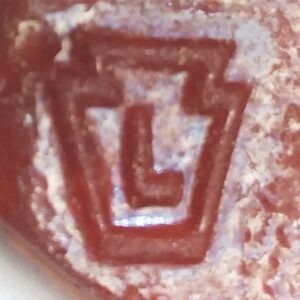
Undated
glass
Caption identifies the Lincoln Bottle Company mark, with company dates 1942–1952.

Undated
glass
…………… Lynchburg Corporation (1923-1925).
Undated
glass
……………….. Leone Industries, Bridgeton, New Jersey (1966-to date). Seen on the heel of modern generic packer jars and other food containers. Leone also purchased/controlled the former Reed Company, later Castle-Hanson Corporation factory at Rochester, New York for some period of time, exact dates unclear. (See “R in a triangle” mark, “C-H” marks). Leone was purchased in 2012 to become part of the Ardagh Group, but is apparently still using their own mark (as of 2015).
Undated
glass
……………………… W. J. Latchford Company, Los Angeles, California (1925-1938); this became the Latchford-Marble Company (1938-1956); and finally Latchford Company (1957-c.1989). Mark was first used approximately 1925, although during the “Latchford-Marble” era, the mark “LM in an oval” or “LM in a circle” was used instead. This mark tends to be seen more frequently on containers made for companies in the Western states of the US. See next entry. For more background on the marks used and the confusing series of changes in the Latchford operation, see this detailed article by Bill Lockhart and the Bottle Research Group: Latchford .
Undated
glass
………………Laurens Works, Laurens, South Carolina (1910-1996). Although Laurens more commonly used an “L G W” on many of their containers, in some instances they used the single letter “L” as their identification mark along with a mold number and/or date code. Notable examples are on Coca-Cola bottles of the 1934-1951 period, wherein the L appears on the side of the bottle, placed between a mold number and a date code. This “L” is also seen on the base of “Longlife Mason” jars. The “L” identification mark is also believed to have been used on many of their bottles after around 1970. For more information on Laurens and the marks they used, see this article by Bill Lockhart and the Bottle Research Group: Laurens Works.
Undated
glass
…………… Lamb Company (1921-c.1971). Lamb was acquired by Dorsey Corporation (owner of Chattanooga Company) in 1963.
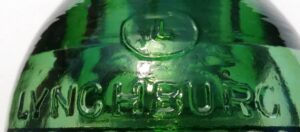
Undated
glass
Caption identifies a green CD 154 insulator made by Lynchburg Corporation.
Undated
glass
L (what appears to be a “cursive L” with a horizontal slash in center)…………….. on electrical insulators, this is the “Sterling” (British Pound) sign, and stands for Sterling Company, Elmer, New Jersey (1902-1903). Four different styles of insulators have been found with this marking on the skirt, with or without the actual word “STERLING”.
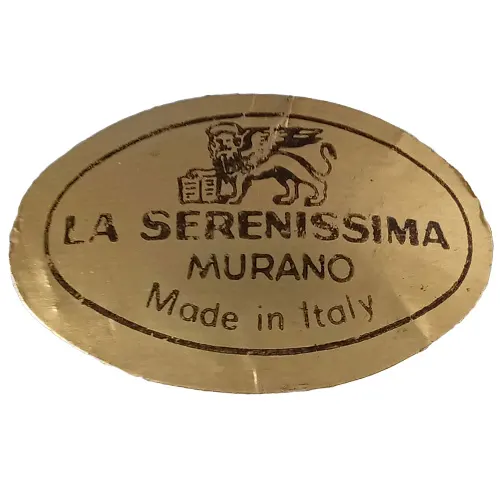
Undated
label · black and gold · glass · Murano, Italy
" " black & gold oval foil label. Appears to have been a factory [ link ]
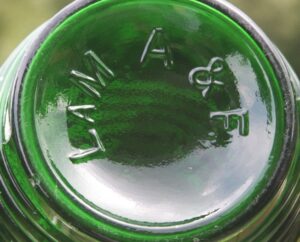
Undated
label · glass
……………these bottles were evidently imported to the US from France, although the exact meaning of the initials is not yet known as far as I can tell. For many years these bottles were considered to be a mystery, but recently an example was found with an original paper label, indicating the bottle contained “imported capers”. Though this one label doesn’t prove ALL of those bottles contained capers, we can be reasonably sure most, if not all, contained some kind of pickled food product. The bottles probably date from the 1880s to around 1910, although some examples, apparently older, are known with pontiled bases. They have been seen in a range of true green shades including olive green and emerald green. Possibly other colors exist. They are found in three different sizes. Note that many of the bottles are unmarked , so only a percentage of them bear these initials. These barrel-shaped bottles are mentioned in the classic reference book Ketchup, Pickles, Sauces – 19th Century Food in by Betty Zumwalt (published in 1980) on page 264. A very good web article, written by Eric Richter in 2013, with lots of beautiful photos, can be found here: LaM A & F bottles – Eric Richter
Undated
glass
…………… fruit jars made by Lamb Company, Mt. Vernon, Ohio (1921-c.1971). The jars may be marked with an “L” on the base. See “L-52” on this page for more info.
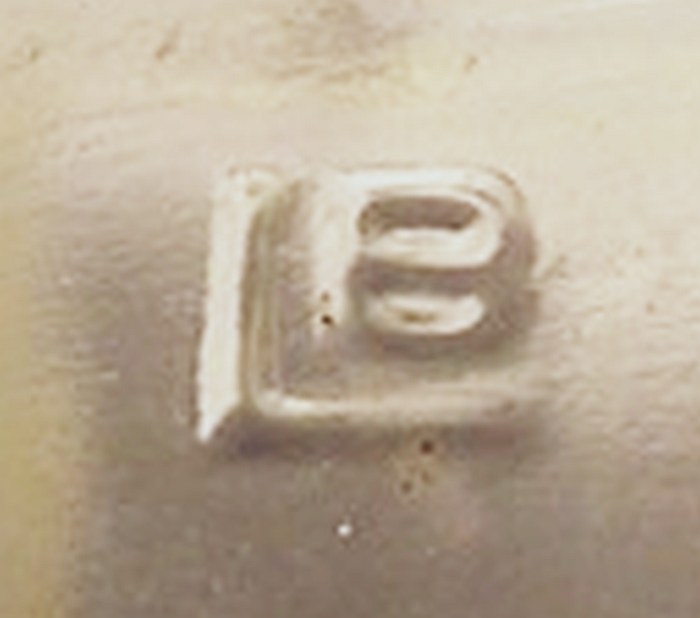
Undated
glass
Caption attributes the mark to Long Beach Company; image-alt text names Beach Company, Long Beach.
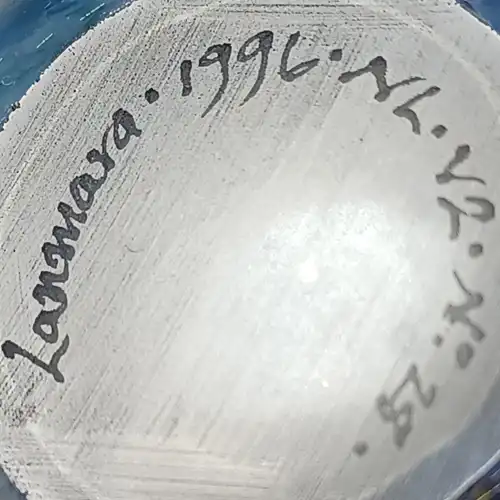
Undated
The source identifies 1996 as the signature's accompanying date and also mentions a pattern number.
glass · United Kingdom
" " signature, with 1996 date and pattern number.
Undated
glass
………………….Long Beach Company, Long Beach, California (1920-1933). This mark appears in the form of a large capital “L” with a smaller upper case “B” sitting in the “lap” of the L.
Undated
glass
…………….. Unidentified. The initials might stand for a company in France.
Undated
glass
………………….. Lynchburg Works, Lynchburg, Virginia (1919-1922). See Lynchburg Corporation page.
Undated
glass
…………………. Lancaster Colony Corporation, based in Lancaster, Ohio. Indiana Company was acquired by Lancaster Corporation in 1957, and with several other companies, Lancaster Colony Corporation was formed circa 1961. See “Indiana ” entry on this page. Also, see this page for information on the popular Indiana “hen on nest” dishes .
Undated
glass
…………….. this is one of the most common earlier handmade sauce bottles found in dumps and privies dating as early as the 1870s and before. The sauce originated in England and was probably sold as early as the very late 1830s, and by the 1840s it was being exported to America. Many of the Lea & Perrins bottles are marked “J D S” in a triangular formation, along with a mold number, on the base. Those initials stand for John Duncan’s Sons, originally a distributor, later an actual producer of the sauce. The bottles marked with those initials are believed to have been produced in the United States by Salem Works of Salem, New Jersey. Please check out my entry under “J D S”, above on this page.
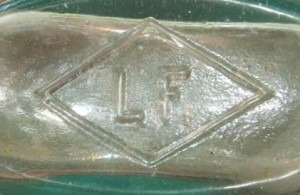
Undated
The caption identifies the pictured bird as signed Leo Ward 1994.
incised · glass
……………………………..Brand name embossed across the face of certain fruit jars, these were evidently made by John Gayner/Gayner Works, Salem, N.J. (1885-1898/1898-1937) and Cumberland Works (or Company) /Cumberland Manufacturing Co., Bridgeton, New Jersey (1882-1896/1896-1920). The trademark “ ” (#43288) was said to have been in use starting in September, 1903, according to trademark documents. (Info from Alice Creswick’s The Fruit Jar Works, Vol. 1, 1995). Handmade blue “Bluebird of Happiness” paperweight / figurine, this particular example signed (engraved) on base “ ”.
Undated
glass
………..Graham Company, Evansville, Indiana (this code indicates production from their Loogootee, Indiana plant). See Graham.
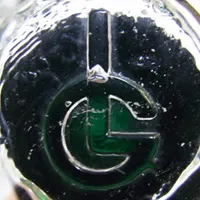
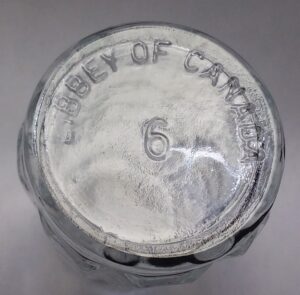
Undated
glass
On a Waffle Block salt-shaker base; 6 is a mould number.
Undated
glass
……………. mark seen on bases of salt & pepper shakers, bottles and other types of glassware. Information on the history of this company and the exact time period when this mark was used is confusing and incomplete, but evidently most (if not all) of the so marked was made at Wallacesburg, Ontario, Canada by Libbey Canada Inc. between 1993 and 1999, at which time LCI closed the Wallaceburg factory. Libbey St. Clair had operated there from 1978 to 1993, and was purchased by LCI in 1993. It is unclear if was made under the name Libbey Canada Inc. at other glassmaking plants after 1999. Please see the “OOOO” mark used by Libbey St. Clair on Page Four.
Undated
glass
…………………. This mark appears on the base of a clear whiskey or bitters sampler bottle, likely circa 1890-1910. Update 9/16/2024: Carol Serr realized this is actually the mold number “317” inside a diamond and we are viewing the mark upside down! Illinois Company produced many styles of bottles with mold numbers placed inside a diamond. This one is shown on page 152 of the 1906 Illinois Company catalog, shown here at Bill Lindsey’s website: Illinois Co. 1906 catalog – page 152 – SHA.org.
Undated
label · red · glass · Italy
Hans Geismar Ltd importer label.
Undated
label · gold and clear · lead crystal · United Kingdom
" " circular gold & clear plastic label.
Undated
glass
……………….this is a mark that appears in “ Bottle Makers and their Marks ” by Julian Toulouse (1971), purported to have been used by Kentucky Works. I don’t believe that it actually exists, as such, and I prefer to brand it as a “fantasy mark” (nonexistent). I think that someone communicated to him concerning a mark they saw, which they abbreviated within their correspondence, thus creating a misunderstanding of the exact appearance of the mark. If you have any info to show otherwise, (as I would actually like to be proven wrong :-), please contact me through this website! Also, please see these entries: LGW, L.G.CO. , Louisville Ky Works, KYGW, KYGWCO , and S.G.W. LOU. KY. Also, see webpage on the Kentucky Works Company .
Undated
glass
…………………Latchford-Marble Company, Los Angeles, California. See “L in an oval” mark.
Undated
glass
……….Latchford-Marble Company, Los Angeles, California. See “L in an oval” mark.
Undated
glass
……………….. , Lockport, New York (1843-c.1908). Factory name is found spelled out on the front of historical flasks and soda bottles. Most of the flasks probably date from the 1840s into the 1860s. The blob-type soda bottles most likely date from the 1850s-1870s period. The works was operated by several owners/firms over the years. Francis Hitchins operated the company circa 1850-1866, and some bottles made during that time period were marked “ From F. Hitchins Factory, Lockport, N.Y”. Alonzo Mansfield bought this factory in 1872 and it then became known as the Mansfield Works, although the factory may have unofficially been called the or Lockport Manufacturing Company for several years afterward, at least into the 1880s if not later. The works continued in operation until about 1908. Note: Another factory which may or may not have been related was “Lockport Company”, reportedly in business from c.1900 to 1919. Also, please see the “ L.G.CO.” page.
Undated
glass
……………………………….Lockport Works, Lockport, New York. Seen on heel of soda bottles probably dating from the late 1860s or the 1870s. One example would be a “J. A. Lomax” soda bottle in light cobalt blue from Chicago, Illinois.
Undated
incised · glass
…………………………… Johann Lötz (or ) Witwe, factory was located at Klášterský Mlýn, Czech Republic (formerly Klostermühle, Bohemia), (c.1836-1947)………….. celebrated maker of fine “Bohemian” glassware including “Art Nouveau” art very popular in the late 1800s and early 1900s. (The ö or “oe” sound is not used in typical English, but one way to describe the vowel sound is to pronounce the name as the English word “lets” but at the same time with the lips rounded into a circle as if you were saying “oo” in “look”). The majority of pieces made by were not marked. Some was engraved “ ” or “ Austria” on the bottom, usually in a cursive type script. There are a number of other authentic signatures and marks known. There is considerable confusion with this type of , as much of what is sold as was actually made by some other glassworks, either in the same region or in other countries. Many items, including older from other companies as well as more recent production from other firms, have fake etched or engraved signatures on them. There are many websites with more info for the interested collector, but for a basic introduction on this subject, check out this webpage: Is this really and should I buy it? – Article on .com .
Undated
label · black and silver and red · glass · China
Found on the Lotus Flower range by The Dalian Co.
Undated
impressed · glass
………………….. This embossed marking (interspersed with four crossed lines), is listed as appearing, in a circular formation, on the base of a wax sealer-type fruit jar, according to Dick Roller in The Standard Fruit Jar Reference (1983). He lists this jar as #693.5 which is described on page 195. However, that listing is in error . This jar is not a product of the Louisville Works, as the actual embossing is “S. G. W. LOU. KY.” Because of the placement of the crossed lines, the “S” is either invisible or partly obliterated on examples of the jar, creating confusion as to the exact order and interpretation of the letters. Actually made by Southern Works , Louisville, Kentucky (1877-c.1885), a factory in operation several years after the Louisville Works had ceased production. See “SOU G W”, “SOU G WS”, “S. G. CO.” and “S. G. W. LOU. KY.” and related marks.
Undated
impressed · glass
………………Louisville Works, Louisville, Kentucky (1855-1873). Factory name is seen embossed on several types of whiskey flasks, including plain, strap-sided, eagle, scroll (“violin”) flasks, and several vertically-ribbed types. A number of different operating companies ran the Louisville Works over the years. A very rare fruit jar, a type apparently made to be used with a cork closure, is also known with this marking. (Also see “ K. R. & Co .” mark on this page). Please see Louisville and my “Louisville Factories of the 19th Century, Part One” article link on that page; and the Insulator Factories information page. The Kentucky Works Company , Falls City Company and Southern Works pages also have some background info on those later bottle factories in Louisville.
Undated
glass · Sheffield and Wilcox, Pennsylvania
Caption attributes the mark to Pennsylvania Bottle Company; the image-alt text gives company dates 1940–1952.
Undated
glass
……………….. Pennsylvania Bottle Company, with plants at Sheffield, PA and Wilcox, PA. (PBC began in 1926 at Sheffield although this mark reportedly dates from 1940-1952, according to Toulouse). The “L” in the mark stands for Lummis Company, Inc. , a distributing company based in New York, NY that marketed the bottles made by the Pennsylvania Bottle Company. Also, see “V in a keystone” on Page Five.
Undated
glass
……… see entry “LP” above; see Graham.
Undated
glass
……………….. Lax & Shaw, Ltd, Leeds, Yorkshire, England (started c. 1891, incorporated in 1913). This bottle maker was involved with a series of acquisitions and mergers over the years and now [2025] is operating under the name Verallia UK (see link below). I don’t know the exact date range for the “LS in a circle” mark. If you know, contact us! About Us – uk.Verallia.com
Undated
glass
………embossing found on prism “vault lights” (triangularly shaped tiles) used in various construction/lighting applications, sold by Luxfer Prism Company. See Ian Mackey’s Glassian.org site with more info here: Glassian.org/Prism/Luxfer/ . Apparently these were manufactured by Jeannette Company, Jeannette, Pennsylvania.
Undated
impressed · glass
…………………… Lynchburg Corporation, Lynchburg, Virginia (1923-1925). For some basic info check out my page on Lynchburg Corporation . For a great site with lots of detailed background history and information on Lynchburg and their insulator production, check out this site by Dennis Bratcher: https://www.Lynchburgglass.info
Undated
glass
………………….. Illinois Company, Alton, Illinois, Gas City, Indiana and other locations. Trademark seen on the base of clear prescription/druggist bottles. Please see this page on the bottles.
Undated
glass
……………………… a plain “ ” is also seen on the base of certain mouth-blown amber, aqua and clear beer bottles (and a smooth-lip amber handmade salve or cold cream jar, photo below) that appear to date c. 1880-1910, and the glassmaker in those cases predates Maryland and to my knowledge has not been identified with absolute certainty . (For instance, some beer bottles marked “F. & P. BOCHART, NEW ALBANY, IND” are marked with a plain “ ” on the bottom, and those would date sometime between 1890 and 1907, judging from the years that bottler was in business). That unidentified manufacturer was probably located somewhere in the Midwest, i.e. IL, IN, OH or PA. There were a number of bottle factories just in those states with a name beginning with “ ”, which shows why it is so hard to know for certain who the maker of those bottles was. Researcher Bill Lockhart believes that Massillon Works, of Massillon, Ohio (1881-1904) could be the source of the “ ” mark on beer bottles. Some of the “ ” marks appear with numbers or letters (see my “ B” entry on this page). For in-depth information on the marks attributed to that glassmaker (also known as Reed & Company), see this .pdf article: Reed & Company and the Massillon Works . There is also a good possibility that this “plain ” indicates Modes Company of Cicero, Indiana (1894-c. 1902), since examples of “F. & P. Bochart, New Albany, Ind” beer bottles have been found with both (either) a “plain ” OR an “ G CO” marking which, in the latter case, almost certainly indicates Modes Company (see my page on .G.Co. bottles here) : .G.CO. marks on antique bottles & fruit jars (Mississippi, Missouri, Modes) . Thus I feel that the “ ” mark may indicate the very same manufacturer that made those “ G CO” bottles for Bochart. NOTE: In some cases a “plain ” may be the mark of the Mosser Company, Cambridge, Ohio (1971-to date) but in those cases it would appear on upscale, colorful decorative and novelty glassware, NOT utilitarian bottles or jars. See “ inside a circle “ and “ within a G” entries, as well as next entry.
Undated
impressed · glass
Maryland Corporation mark on a cobalt-blue Merrell's Milk of Magnesia bottle.
Undated
glass
Mark on a cobalt-blue Chemical Industrial Co., R. DeAngelis bottle.
Undated
glass
M (abstract representation), shown, consisting of one stroke, a narrow rectangle or horizontal line, positioned over three other narrow rectangles or vertical strokes (at right angles). This logo may have been intended as an abstract M, but also appears something like a capital “E” with a space between the vertical stroke and the three horizontal strokes. Looking at it upside down, the mark might resemble the Roman numeral “3” with an underline……………… Midland Company, Inc., Cliffwood, New Jersey; Terre Haute, Indiana, and Shakopee, Minnesota (1968-1984?) This mark is frequently seen on “stubby” non-returnable beer bottles of the 1970s.
Undated
impressed · glass · France
Caption identifies a Verreries de Masnières CD 642 insulator.
Undated
glass
…………Verreries de Masnieres (Masnieres Glassworks), Masnieres, France. This mark is seen on the skirt of French-made electrical insulators, such as the CD 642 style “Gingerbread Man”, typically seen in shades of dark olive and emerald green . There is apparently no connection between this factory and the Mexican factory (see above) which also made insulators, although both marks are nearly identical in appearance. The Masnieres glassworks dates back to 1818 with various name/firm changes over the years. The range of dates this mark was used is uncertain, but might be from the 1920s-1950s? If you have better info on the years this was used, please contact me!
Undated
glass
…………….. Massillon Bottle & Company, Massillon, Ohio (1900-1904). Photo above shows the mark on the bottom of a handblown, tooled lip quart size beer bottle in aqua. Also see “R & CO”.
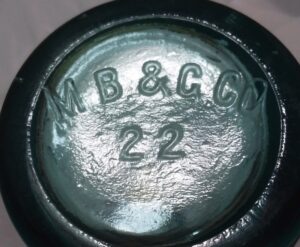
Undated
glass · Massillon, Ohio
Massillon Bottle & Company beer-bottle base; 22 is a mould number.
Undated
glass
………………Millville Bottle Works, Millville, New Jersey (1903-1926). Bought by T. C. Wheaton Company in 1926. MBW made chemical, druggist and laboratory bottles, tubing, funnels, etc. Exactly when the “M B W” was discontinued in actual practice is unclear, as bottle molds in use at the time of the buyout in 1926 might have continued to carry that mark for just a little while after 1926, before eventually being retooled. See T.C.W.& CO.
Undated
glass
…………… Uncertain meaning. This might be a case in which the “C” was intended to be a “G”. However there are jars known with mold numbers “3” as well as “4” and in both quart and half-gallon sizes. This would seem to indicate the “C” is intentional and deliberate and not meant to be a “G”. If the letter was supposed to be a “G” the jars would presumably be products of the Mississippi Company of St. Louis, Missouri. Alice Creswick (The Fruit Jar Works) wrote that W. McCully & Company of Pittsburgh might be a possibility. Researcher Dick Roller (The Standard Fruit Jar Reference) wrote “maker unknown”. Please see the “M. G. CO.” page.
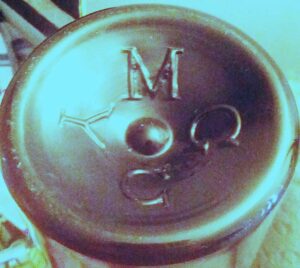
Undated
glass
Unidentified British bottle mark, read in the caption as MGCY or MCGY with a faint IA between letters.
Undated
glass
…………….Mallinckrodt Chemical Works, St. Louis, Missouri (1867-to date). I believe most, if not all, of the bottles found with this mark are hand-blown and date from approximately the 1880-1920 period. The actual factory where these bottles were made is unknown, but Illinois Company, Alton, IL, would be a likely source.
Undated
glass
……………………………………on the bottom of machine-made cobalt blue jars and bottles, usually Maryland Corporation, Baltimore, Maryland (1907-1980). Exact period of use is uncertain, but verified on the base of cobalt “Milk of Magnesia” bottle from circa 1940-1950. Most Maryland bottles, if they carry a mark, have the “circled ” on the base (see that entry). If a bottle with a “plain ” is a medicine bottle and was made in cobalt blue colored , it is almost certainly a product of Maryland . (Please see next entry).
Undated
glass
……… Marion Fruit Jar & Bottle Company, Marion, Indiana (1888-1904), Fairmount & Converse, Indiana (1894-1904). Plants bought out by Ball Bros. in 1904.
Undated
glass
……………probably variation of next entry, seen on base of wax sealer jars.
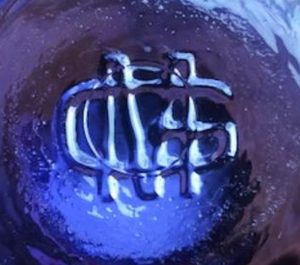
Undated
impressed · glass
Unidentified or GM monogram on an amethyst Mason's Patent jar, described as a likely modern reproduction.
Undated
glass
…………… Metro Bottle Company, Jersey City, New Jersey. Mark used c.1949 – c.1981. Also with plants at Washington, PA (since 1957); Carteret, NJ (1958) and Dolton, Illinois. Known as the Metro Division of National Dairy Products Corp. after 1956 (Kraftco after 1969). Later known as MetroPak Containers. MetroPak was bought by Ball Corporation in 1980. The Jersey City plant was closed on Nov. 13, 1981, but the other three plants continued in operation.
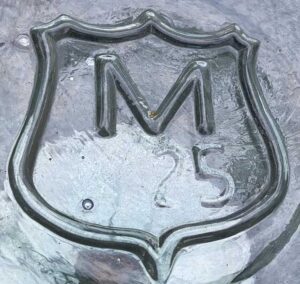
Undated
The caption reads 25 on the pictured Arrowhead bottle as a 1925 date code.
glass
………….Metro Bottle Company, Jersey City, New Jersey (Mark used c.1935-1949). See above entry. “ inside a shield” on the base of an Arrowhead brand water bottle. The “25” is a date code for 1925. (Photo courtesy of Peter Utas).
Undated
glass
………………. Monarch Company, Los Angeles, California (1924-c.1926). Seen on the bases of Puritas and Arrowhead brand 5-gallon water bottles, as well as blank slug plate (unbranded) water bottles. Thanks to Peter Utas for this information and for the photo at right.
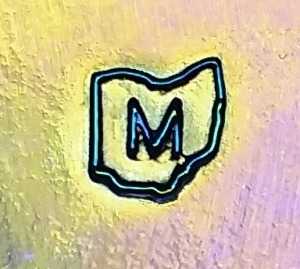
Undated
glass · Cambridge, Ohio
Mosser Company mark inside the base of a cobalt carnival- mug; source photograph was flipped.
Undated
glass
see more information about this mark on this webpage: Maryland Corporation, Baltimore, Maryland (1907-1980) . This “M in a circle” was used by Maryland beginning in about 1921, and is seen, nearly always, only on machine-made bottles and jars. Maryland also used a “plain M”, an “M inside an oval-shaped G” and a “Ma.G.C. inside a diamond” mark. Also, please see next two entries.
Undated
impressed · glass
………… currently unidentified manufacturer. A rather small number of bottles have been found that could not have been made by Maryland Corporation, as they are mouthblown and date from before Maryland started using their “M in a circle” trademark in 1921. They are American-made, are found in colorless , are not machine-made, and would date from the 1880s-1890s – no later than around 1910. Some examples of these bottles include: a “Sunburst” design whiskey flask with a ground screw-top lip; a “Honey Suckle” choke-neck style back bar bottle with swirled design on shoulder; “Taylor & Williams Whiskey, Louisville, KY” cylinder whiskey; “Geo. T. Stagg Co, Frankfort, KY” cylinder; “V. E. Shields & Co, Cincinnati, O” flask; and a prescription-lip clear druggist-style bottle embossed “H. D. Block / 245 E. Jefferson St./ Louisville, KY” (actually a liquor distiller/distributor) on the front. Since most of these bottles appear to be from the KY/OH area, it is most likely that the unidentified bottle-making company was located in that general area, and (of course) had a company name beginning with the letter “M”. If anyone has good info on what company this could be, please let us know!
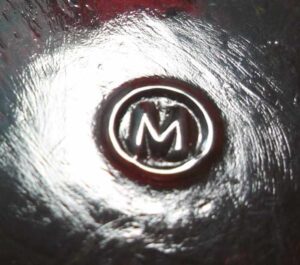
Undated
glass · Cambridge, Ohio
Mosser mark on a ruby-red toothpick holder or votive holder.
Undated
glass
M inside a diamond (on Mason-type zinc caps for fruit jars, and their corresponding milk “discs” or inserts)………………..Marion Fruit Jar & Bottle Company, Marion, Indiana – with plants also located at Fairmount, IN; Converse, IN and Coffeyville, KS (1888-1904). “The Marion Jar”, a fruit jar made circa 1890s to 1904, originally came with these lids. The “M” has slightly out-curved “legs” which make the mark appear as the letter “W” when viewed upside down.
Undated
glass
…………….. John M. Maris Company, wholesalers/jobbers of druggist ware, sundries, pharmacy “furniture”— this firm began in 1842 as Pleasants & Maris, name changed in 1846, business offices in Philadelphia and New York City. Still in business (2015) with offices currently based in Rockaway, New Jersey. John M. Maris Co. sold drugs wholesale until 1872 when they changed the focus somewhat and started selling a large line of druggist bottles and related ware (Pharmaceutical Era, Vol. 39, pge. 166, 1908). Apparently most (if not all) of the sold by Maris was actually manufactured by unnamed bottle companies, in early years almost certainly by Whitall Tatum & Company of Millville, New Jersey who specialized in druggist ware of all types. The “M in a diamond” mark is confirmed on several different items including a clear druggist bottle circa 1885; clear and cobalt blue eyewash cups; and a miniature clear mouth-blown lamp with a ground lip and metal screw-top wick assembly which was seen on ebay and said to have possibly been used for medical/laboratory purposes. Apothecary weights (tokens) are known with the “M inside a Diamond” logo. Also, confirmed as marked on the bottom of a milk cold cream jar, circa 1920s-1940s (but this item may or many not have any connection with Maris)? Also, please see next entry. (Thanks Nona H. for the eyecup, and thanks to George Sturrock for his help in researching this mark!)
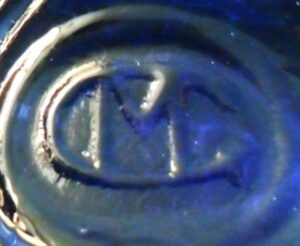
Undated
glass · Baltimore, Maryland
Maryland Corporation mark on a two-ounce rectangular iodine or poison bottle.
Undated
glass
…………….Unknown (Seen on base of wax sealer fruit jar).
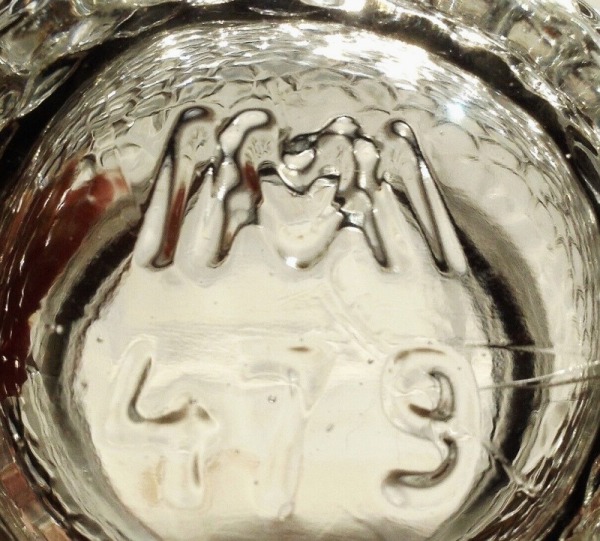
Undated
glass
arranged in a circular formation, shown above)……………………. Unknown. This mark appears on the base shard of an amber bottle (probably from a beer bottle). The base measures about 3 inches in diameter. The piece might date from sometime in the 1895-1920 time period?
Undated
glass
…………. almost certainly James J. Murray & Company (Murray Flint Works), Philadelphia, PA (c.1891 or earlier – c.1922 or later?). This maker, located on the corner of Culvert Street & Trenton Avenue south of Waterloo Street, specialized in lamp globes, shades and other lighting fixture-related glassware as well as novelty items. This company might have expanded to become a distributor of a wider variety of goods for department stores in later years.
Undated
glass
……………………. Unknown meaning.
Undated
glass
………………Thatcher Manufacturing Company, Kane, PA; Wharton, New Jersey and several other plant locations in later years (c.1904-1985). This particular variation is seen in the form of a large T with smaller “m” and “c” sheltered underneath the “roof” of the T, in rather plain “block” style lettering, as shown in photo. (There is another, more common variation which was used later, a large T with a smaller, angular M and C underneath, which I show under the “TMC” entry on page 5, and on the webpage about Thatcher ). For more information on this and other marks used by Thatcher, please see the Thatcher page .
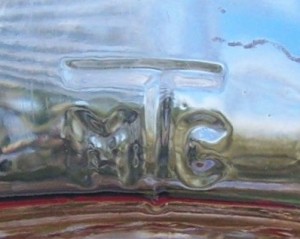
Undated
glass
………………See T/M mark.
Undated
glass
M with a line underneath (Underlined “M”)……………………on a few pressed items made by Mosser Company, Cambridge, Ohio (1971 to present). Mosser makes pattern tableware, decorative and novelties, usually in colorful . This mark is seen on the inside bottom of at least one example of the “ Robin in a Tree” mugs made by Mosser . Other examples of Mosser glassware may have an “M in a circle”, “plain M” or an “M inside the state of Ohio” mark.
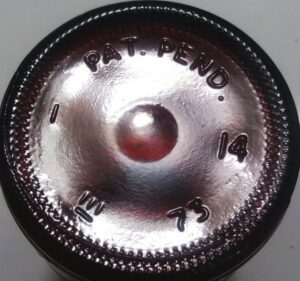
Undated
The caption dates the pictured Midland Glass stubby beer bottle to 1973.
glass
……………. Mosser Company, Cambridge, Ohio (1971-to present). Occasionally seen on colored tableware and upscale novelty glassware. Mosser has produced toothpick holders, salt cellars, mugs, small animal figurines and other “whimsies” as well as a lot of that replicates the “look” of Early American Pattern tableware. That has been made in new molds, and in many different colors that were not used in the original patterns. Also, see “ in a circle”, “ with a line underneath”, and “ ”. Check out the Mosser Company site here: Mosser Company – About Us . Midland “Stylized ” logo (lower left) on bottom of “Stubby” amber beer bottle made in 1973.
Undated
glass
…………………… Maryland Corporation (1907-1980) . This mark is rarely seen and the exact time period of use is unclear. The most common mark seen on bottles made by Maryland is their “M in a circle” (more info above).
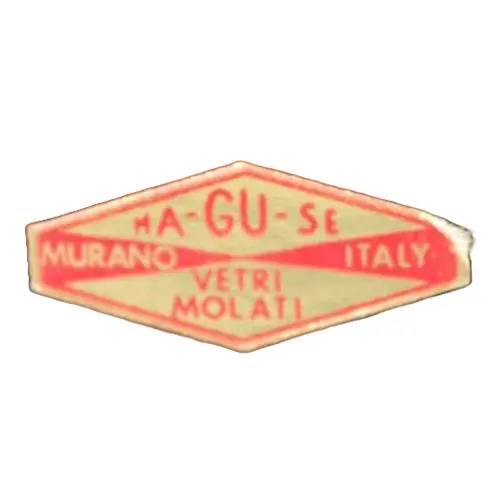
Undated
label · gold and red · glass · Murano, Italy
Possible connection to Daniele Maguse is suggested but unconfirmed.
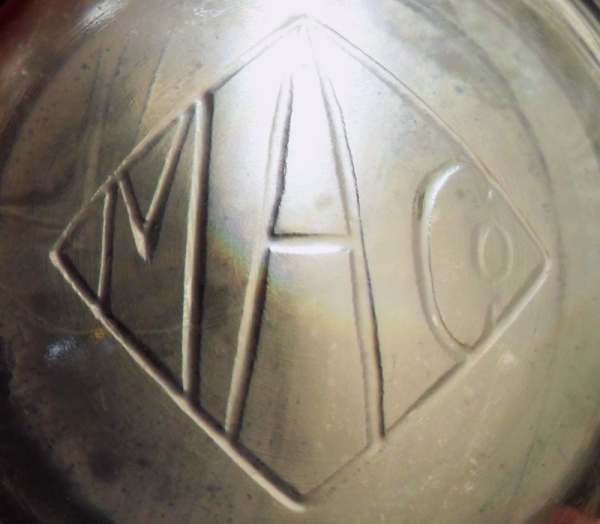
Undated
The caption tentatively dates the clear shaving mug to 1900–1930; maker unidentified.
glass
………………………………… Unknown. This appears, along with a “Crescent Moon” logo on the base of a clear pharmacy bottle lettered “Eugene Gosselin / 148 No. Champlain St. / Burlington / VT”. Info on this bottle was reported by Barry Conolly. (See “Crescent Moon” entry). within diamond (on base of clear shaving mug). This is of uncertain date, but possibly from the 1900-1930 era.
Undated
glass · Bohemia
Acid-stamped mark on a Mary Gregory-style tumbler.
Undated
label · black and clear · glass · China
" " generic black & clear oval plastic label.
Undated
label · black and white · glass · China
" " generic black & white oval paper label.
Undated
label · glass · Finland
Export label found on Riihimäen/Riihimäki glassware.
Undated
GDR wording refers to the German Democratic Republic, which existed from 1949 to 1990.
label · gold · glass · East Germany
Generic " " gold foil export label. GDR = German Democratic Republic (East ). The GDR existed between .
Undated
label · white and blue · glass · Germany
Generic " " blue & white circular paper export label.
Undated
label · silver and yellow · glass · Italy
Found on Murano sommerso vases.
Undated
label · white and red · glass · Italy
" " red and white circular paper label. [ 01 ]
Undated
label · gold and blue · glass · Murano, Italy
" " blue & gold circular foil label. [ 01 ] [ 02 ]
Undated
label · gold and yellow · glass · Japan
" " yellow & gold circular generic foil label.
Undated
label · silver and yellow · glass · Japan
" " yellow & silver circular generic foil label.
Undated
label · gold and silver and red · glass · Murano, Italy
Foil is described as silver or worn gold.
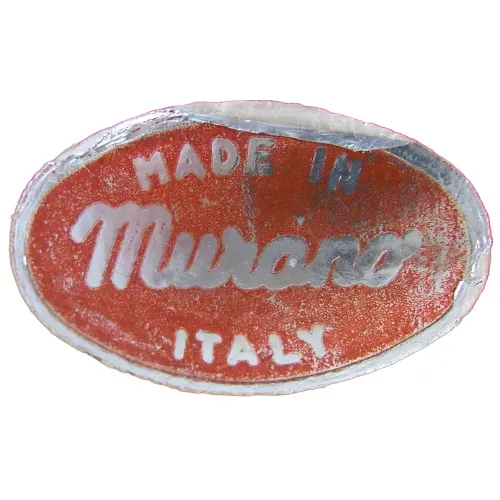
Undated
label · gold and silver and red · glass · Murano, Italy
Foil is described as silver or worn gold.
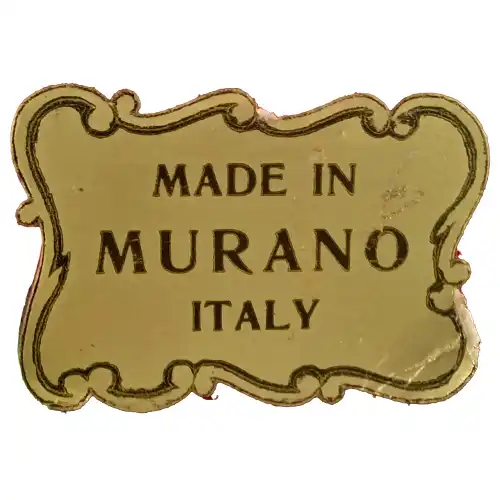
Undated
label · black and gold · glass · Murano, Italy
" " black & gold scalloped rectangular foil label. [ 01 ]
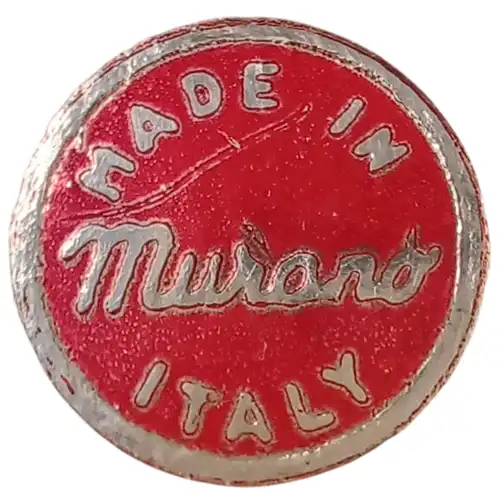
Undated
label · silver and red · glass · Murano, Italy
" " red and silver circular foil label. [ 01 ] [ 02 ] [ 03 ] [ 04 ] [ 05 ]
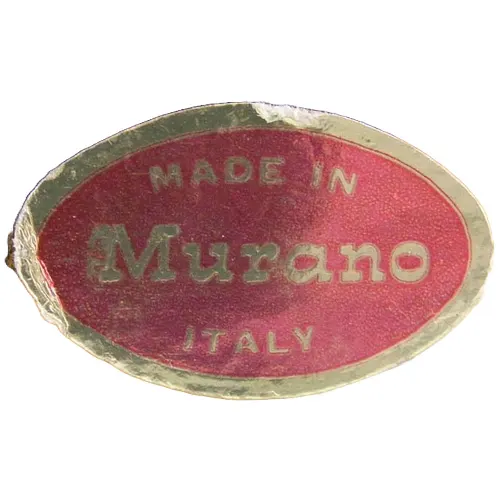
Undated
label · gold and red · glass · Murano, Italy
" " red & gold oval foil label. [ 01 ] [ 02 ]
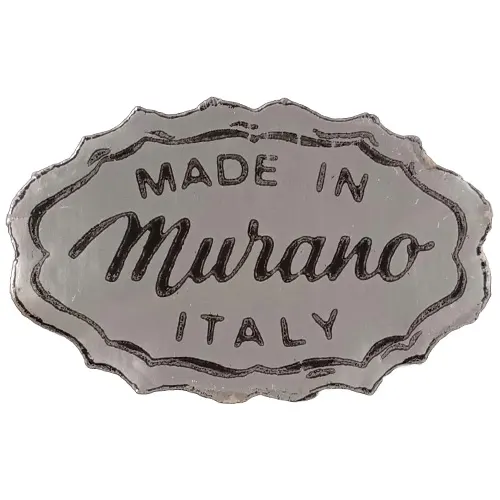
Undated
label · black and silver · glass · Murano, Italy
" " black & silver scalloped oval foil label. [ 01 ] [ 02 ] [ 03 ]
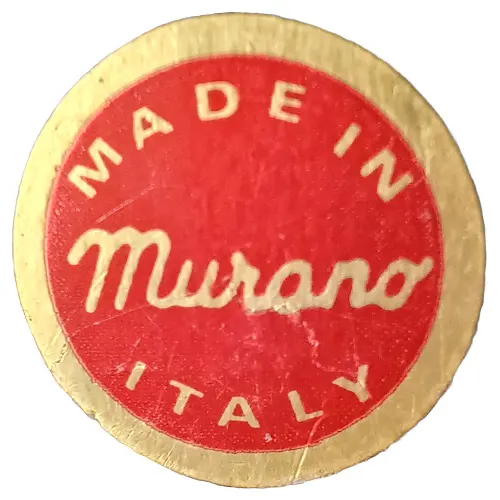
Undated
label · gold and red · glass · Murano, Italy
" " red and gold circular foil label.
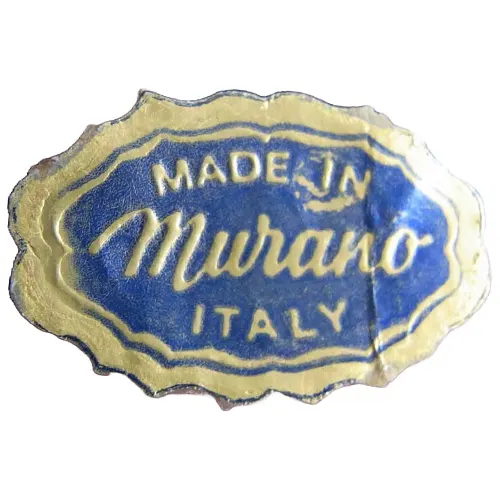
Undated
label · silver and blue · glass · Murano, Italy
" " blue & silver scalloped oval foil label. [ 01 ]
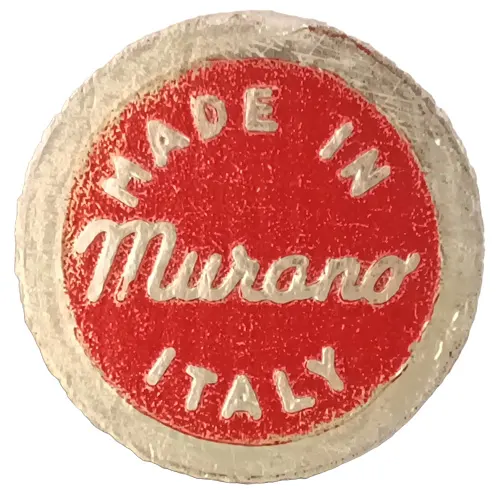
Undated
label · gold and red · glass · Murano, Italy
" " red and gold circular foil label. [ 01 ] [ 02 ] [ 03 ] [ 04 ]
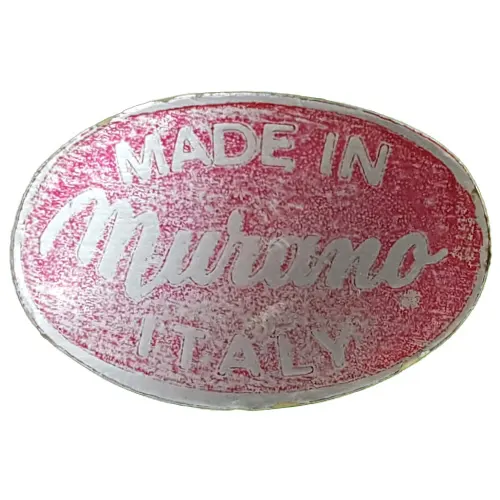
Undated
label · gold and silver and red · glass · Murano, Italy
Foil is described as silver or worn gold.
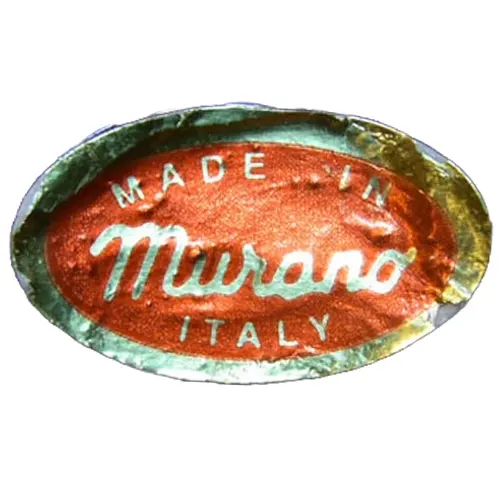
Undated
label · gold and red · glass · Murano, Italy
" " red & gold oval foil label. [ 01 ]
Undated
label · white and red · glass · Sweden
Generic " " red & white circular paper label.
Undated
label · white and blue · glass · Sweden
Generic " " blue & white circular paper label.
Undated
label · gold and yellow · glass · Sweden
Generic " " yellow & gold circular foil label.
Undated
label · silver and blue · glass · Sweden
Generic " " blue & silver circular foil label.
Undated
label · silver and blue · glass · Sweden
Generic " " blue & silver circular foil label.
Undated
glass · Taiwan
Embossed mark found on Empoli-style genie bottles.
Undated
label · white and blue · glass · West Germany
Generic " " blue & white circular paper export label.
Undated
glass
MAINE, with number and/or letters & the word “SEAL”, on milk bottles ) ………………. a number of manufacturers made milk bottles with this type of marking, required by state law, for bottles used within the state of Maine. See list at this milk bottle site (archived snapshot): Milk Bottle Marks – from the Dairy Antiques site
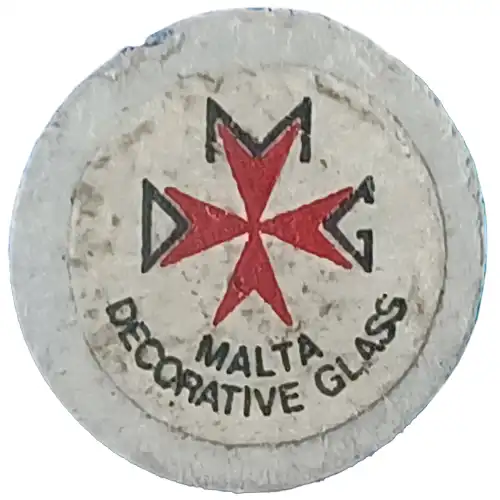
Undated
label · black and white and red · glass · Malta
" " " circular red, black & white paper label.
Undated
glass
………. , Lockport, New York (1872-c.1909). See Lockport Works entry.
Undated
label · black and gold · glass · Sweden
" " black & gold rectangular foil label.
Undated
label · glass · Bordighera, Italy
Retailer label.
Undated
impressed · glass
MARION (“The Marion Jar”) – phrase embossed on some “Mason’s Patent Nov 30TH 1858” type fruit jars…………………… made by Marion Fruit Jar & Bottle Company (see “M.F.J.& B. CO” on this page).
Undated
glass
Keystone shape with a letter inside (such as K, L, J, M, T, etc). Most, although not all, of the “letter inside a keystone” marks were used by container factories owned/controlled by the Knox Bottle Company. Please check entries under the individual letter, such as “J in a keystone” or “K inside a keystone” on this page.
Undated
glass
Gemstone (representation of a cut diamond or other jewel/gem). See “Jewel” listing, farther down on this page.
Undated
label · gold and black · glass
Clear plastic label with gold letters over a black compass.
Undated
glass
***Seattle Company, Renton, Washington (1905-1907), known for producing amber beer bottles. These are primarily found in the northwestern US.
Undated
glass
W. & J. G. (see “G.W. & J” entry on page three).
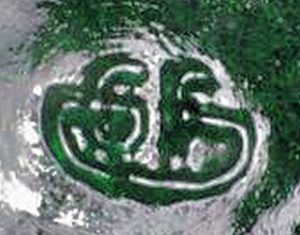
Undated
glass
jP monogram (see “vP” monogram listed on Page Five. This mark appears on a modern packer jar and was made in Germany.
Undated
glass
OS (same as above). See Graham.
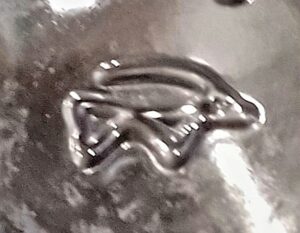
Undated
glass
Unidentified maker's emblem on a clear vase or bottle; source interpretations vary.
Undated
glass
HOMCO (Home Interiors and Gifts, Inc), based in Carrollton, Texas (1957-2008). Mary C. Crowley, a struggling single mother with two small children, scraped up all her savings, and along with some other borrowed money started up her own small business in 1957, selling a selection of home decor items. The business model was somewhat similar to others such as Mary Kay, Tupperware and Amway, with much of the merchandise sold at “house parties”. Total sales grew rapidly and had reached into the millions of dollars by the 1970s. A wide variety of home decor items were sold including porcelain Victorian Lady figurines, candle holders and other home decor. Much of the merchandise sold by HOMCO was manufactured in Asia, although apparently at least some percentage of the glassware sold by Homco was made here in the United States- by Indiana Company of Dunkirk, Indiana (in business 1907-2002). The mark shown at right appears on the inside bottom of a clear votive candle holder or toothpick holder also marked “MADE IN USA”, and probably dates from the 1980s or 1990s.
Undated
glass
Oil Well (see Oil Derrick logo, above).
Undated
glass
American National Can Company (1987-2000) emblem. This particular logo was used from 1988 to 1995. The mark (shown in pic) is hard to classify, so I’ve pictured it on this page under the company name. The mark might be loosely described as two highly stylized capital “Ds” facing each other, or perhaps separated halves of a tin can in a curved orientation. The mark was photographed here as it appears on the base of a typical emerald green non-returnable 16-ounce soda bottle with a 1990 date code. That type of bottle often contained a lemon-lime soda or ginger ale. Please also see a related mark, the “triangular logo” (which might be construed as a highly abstract “sailboat” representation) used by National Can Company shown on Page Five .
Undated
glass · United Kingdom
Decorative daisy prunt sometimes placed over the pontil on Midsummer Glassmakers .
Undated
glass · Philippines
Caption identifies Arcya Corporation; exact mark-use dates are uncertain.
Undated
glass
XXX in vertical formation on machine-made bottles (see “Oil Derrick logo” on Page Four).
Undated
glass
TRIUMPH M S (marking on base of light blue Seltzer style soda water bottle, found in Hungary, probably made in Europe. Unknown meaning. (For more info, please see photographs of the bottle and mark on the “ Unknown/Unidentified Marks on ” webpage ).

Undated
label · orange · glass
Label on an acid-cameo vase with an orange background.
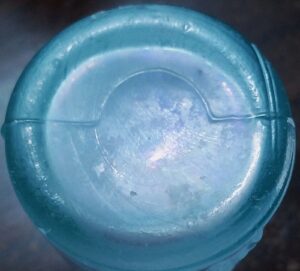
Undated
The caption dates the Nerve and Bone Linament bottle approximately to the 1860s.
glass
Key-mould base construction on an aqua bottle; this is not a castle-and-key maker's emblem.
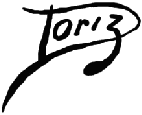
Undated
painted, overglaze · glass
Enamelled signature on a hand-enamelled Art Deco vase.
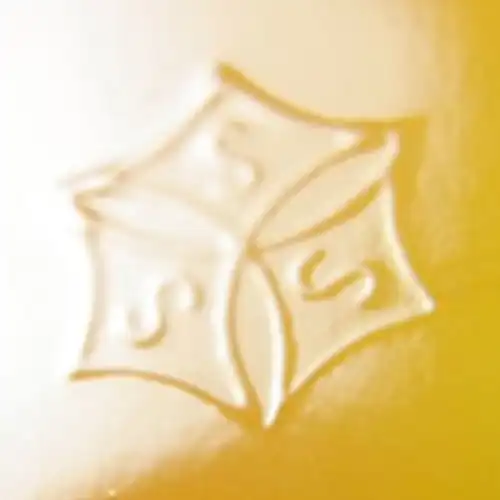
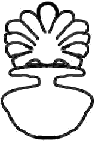
Undated
glass
T (double-lined letter, shown at right). This was the very last logo used by Thatcher Manufacturing Company .
Undated
glass
***Southern Company, Vernon, California (1919-1930). Mostly machine-made bottles, including clear prescription druggist types, mainly found in the western states of the US. This factory also used several other marks including “S in a circle”, “S in a horizontal diamond” and “S in a star”, on various types of bottles.
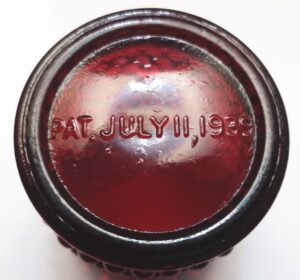
Undated
The wording is a patent date, not a mark-use date.
glass
On the base of a Crescent Company votive.
Undated
glass
Prescut (note this is one word , not separated by a dash, as above entry) more accurately called “Early American Prescut”, this is an unrelated, later tableware pattern made by Anchor Hocking Corporation , beginning in 1960, and still in production as late as 1999. It is extremely common and many pieces are very inexpensive. They are usually not marked . A very similar pattern is called “Oatmeal”. Much of this ware was originally distributed as free giveaways as part of sales product promotions, especially in the 1960s and 1970s. For more information on this pattern see this article on NDGA.net: Anchor Hocking’s Early American Prescut by Cathy Linehan . author/researcher Gene Florence discusses and pictures many of the pieces in this pattern in his reference book Collectible Glassware from the ’40s, ’50s and ’60s . Note: this line is unrelated to the much earlier “PRES-CUT” line (two words) produced by McKee Company , discussed in the above entry.
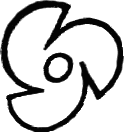

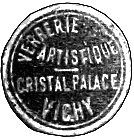
Undated
label · blue on white · glass · Vichy
Probably a retailer's paper label.
Undated
glass
Lancaster Colony Corporation, based in Columbus, OH (1961-to date). Holding company, “umbrella” corporation over a number of manufacturers of various products. See Indiana , LCC mark.
Undated
glass
Derrick (see “Oil Derrick” logo on page four).
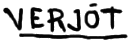
Undated
painted, overglaze · white · glass
Enamelled signature on a hand-enamelled white opaline vase.
Undated
glass
Co, inside abstract letter “O” or circle, perhaps a monogram for “O Co”? Unidentified/unknown. This mark appears on the base of a small, clear handmade bottle, c. 1890-1920, perhaps used for a perfume or cosmetic product. The general appearance of the mark vaguely reminds me of the cross-sectional diagram of an eye.
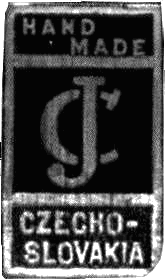
Undated
label · glass
Jones & Co metallic paper importer's label.
Undated
glass
vP (see logo illustrated here). This mark, presumably a monogram composed of V and P joined together, was shown in Julian Toulouse’s Bottle Makers and their Marks (1971) on page 582. He stated that the mark was in use by Weck Glassworks (Germany) in 1969. He also wrote that the mark was used by Von Poncet Glashüttenwerke GmbH, Oflingen, Germany, in 1965. The same mark is seen on a recent packer jar that contained fruit preserves, for sale on store shelves in the US in early 2024 (the jar was probably made in 2023). More info is invited on the current name of this manufacturer!
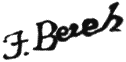
Undated
incised · glass
Wheel-engraved signature on an elaborately engraved cranberry-cased vase.

Undated
impressed · glass
Mouse-head-like on a silver frame over a coralene-decorated vase.
Undated
glass
Wheaton Fine Glassware (see entries on “Wheaton”, “W” stylized letter).
Undated
glass
S in a diamond (vertically or horizontally oriented), on mouth-blown (handmade) bottles, at least in some instances, possibly Swindell Bros, Baltimore, Maryland (1869-1959). Some strap-side type flasks (most commonly found in the Eastern states) bear an “S inside a diamond” mark on the bottom and these are suspected to be products of Swindell Bros. They are typically found in shades of amber, olive green and occasionally citron. Swindell Bros. catalog pages indicate they made several types of liquor flasks in the 1880s-1890s period. HOWEVER , from the collection of papers held at the Winterthur Library pertaining to the career of Chas. Yockel and his mold manufacturing firm, there is a letter proving that the Chicago Manufacturing Co., of Chicago, IL, ordered bottle molds with an “S inside a diamond” on November 17, 1887. Evidently both Chicago and Swindell Bros. made large quantities of colorless prescription / druggist type bottles so this presents a problem for accurate attribution! Perhaps more enlightening information will be uncovered as time goes on.
Undated
glass · China
Caption identifies Qinhuangdao Fangyuan Company on a green mineral-water bottle.
Undated
glass
Horseshoe and Star, as seen on the bottoms of small jelly glasses and tumblers. Please see this page with more information: Horseshoe & Star.
Undated
label · pink on silver · glass · Alassio, Italy
Probably a retailer's metallic label.
Undated
glass
*** Southern Company/Works , Louisville, Kentucky (1877-c.1885) Frequently seen on the base of “JOHN J. SMITH / LOUISVILLE KY” tonic bottles.

Undated
glass
Acid-etched on a decanter; source cautions that the orientation may be reversed.
Undated
glass
*** Severn Company, Annapolis, Maryland (c.1897-1901). Appears on certain bottles (usually flasks or beer bottles in amber or aqua) found in the Baltimore, Maryland and surrounding area. The mark appears on the heel or the base, and in some cases is accompanied by an anchor. Information uncovered by researcher Tod Von Mechow indicate that ths little-known firm is virtually certain to have been the user of S.G.CO. on these bottles. Several dozen different beer bottle variants from Baltimore and surrounding area are known with this mark.
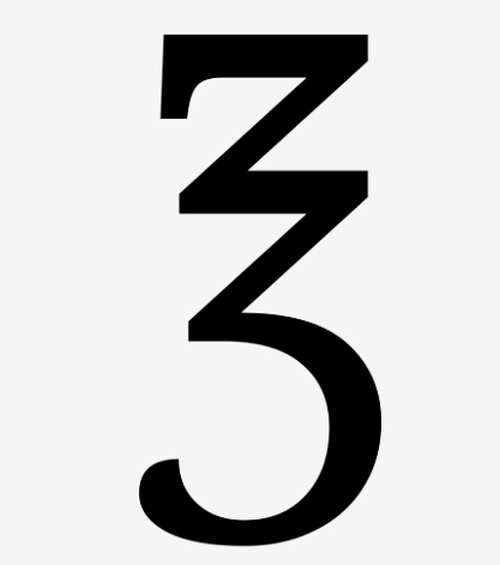
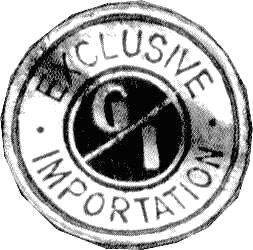
Undated
glass
Hamilton Works, Hamilton, Ontario, Canada (c. 1864-c.1898). Hamilton Works was purchased/absorbed by Diamond in 1893 or 1894. Hamilton made fruit jars as well as electrical insulators. Many of the fruit jars are marked across the front “HAMILTON / No 1 / WORKS” (and other numbers such as No. 2, No. 3 or No 4). Some jars were made for a cork closure, others are to be fitted with a lid and metal clamp-style closure.
Undated
glass
Boyd’s Crystal Art , Cambridge, Ohio . (B in a diamond mark on upscale glassware indicates that company.)
Undated
glass
R. Lalique (see Lalique).
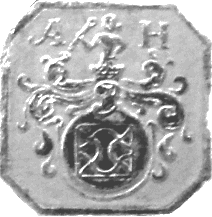
Undated
glass
Shear mark (minor defect / imperfection on the base of articles, created during the manufacturing process). The shear mark is typically “C” or crescent shaped and has been described as resembling a false eyelash, centipede, fern leaf, or feather. Shear marks are commonly seen on the bottom of machine-made bottles, jars, vases, mugs, drinking glasses, etc. Sometimes they are mistakenly believed to be emblems or logos of a specific company.
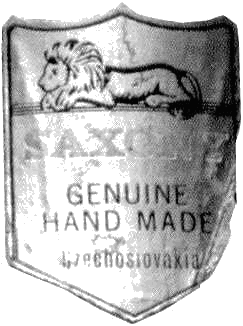
Undated
glass
DD (stylized characters that look vaguely similar to two curved capital Ds facing each other, or two halves of a metal can in a curved formation) please see my entry on “American National Can Company”, on page one. This mark is seen on modern (1980s-1990s) soda bottles.
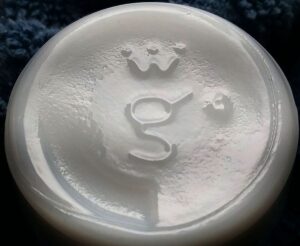
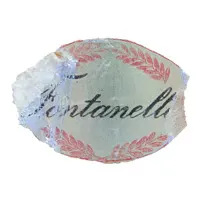
Undated
label · glass
Source gives the name as or Fontanella and questions Italian origin.
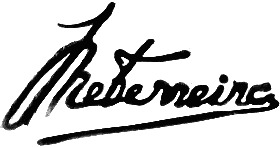
Undated
glass
Ardagh Group (see U symbol, shown on page 5)
Undated
glass
Eyelash (mark on base of articles that may resemble a false eyelash, centipede, feather or fern leaf) . This is a minor defect created during the manufacturing process, called a shear mark. Please see the “Shear mark” entry on Page Five.
Undated
glass
Star or “snowflake” design comprised of thin crossed lines (as shown) . This particular photo shows a base shard from a handblown dark olive green rectangular, square-based “Case Gin” type bottle imported to the US from Europe, likely Holland (Netherlands). Many different “crossed lines” designs have been seen on the bottoms of these kinds of bottles. Most of them date, in general, from the 1860 to 1920 period (although that general type of bottle was made as early as the 1620s). Although no one is 100 percent sure of the original purpose of these emblems, they are more likely to have been intended as mere decorative devices, and not glassmakers’ identification marks. See next “star” entry, also see my entry on “X” near the bottom of this page.
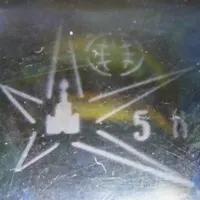
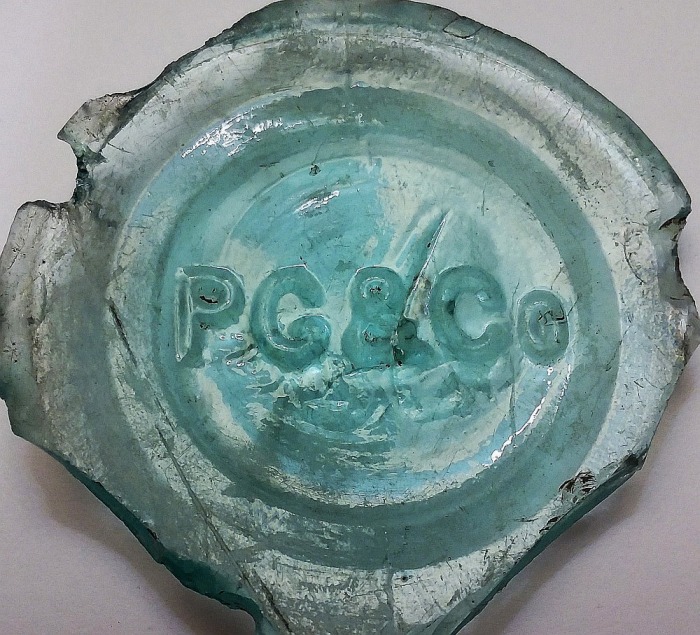
Undated
glass · Louisville, Kentucky
Caption identifies a bottle or jar sold by Peaslee Gaulbert & Company.
Undated
glass
N in a rectangle (see above entry, and “N in a square”).
Undated
impressed · glass
G 23, G 24, G 25, or similar configuration, embossed along the lower heel area of soda bottles (usually seen in light aqua or light green ), this number is normally found within a string of several other letters and/or numbers. Graham Company, Evansville, Indiana. See next entry, and also see “Graham”.
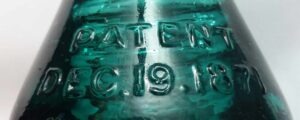
Undated
The inscription gives a patent date, not a production or mark-use date.
glass
On a Hemingray CD 132 telegraph insulator.

Undated
label · silver on black · glass
025 metallic label (silver on black ground)
Undated
glass
P (what appears to be a thin, narrow “P” with a short stroke on lower end of letter that juts toward the upper left. It also resembles a “jP” monogram). This mark is actually supposed to be a “vP” and the jar was made in Germany. Please see entry for vP (with photo of the mark) on Page Five.
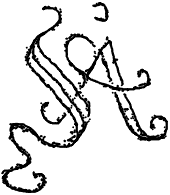
Undated
label · blue on silver · glass
Partial label; upper name is read uncertainly as Flco or Jlco.

Undated
glass
ADVERTISEMENT
Undated
label · glass
Metallic paper importer's label on iridescent glassware.
Undated
glass
………………………………Unknown. Reported on base of clear pharmaceutical/drugstore bottle. Probably a brand name used by a particular manufacturer for their line of prescription bottles (such as “LYRIC” by Illinois ).
Undated
glass
………………… Please click here for a general summary on this marking, as seen on the front of many fruit jars (canning or preserve jars). Jars with this phrase on the front were actually made over a very long period of time, and by many bottle factories: Fruit Jars .
Undated
label · gold and red · glass · Murano, Italy
Found on a faceted sommerso vase.
Undated
glass
…………….Massachusetts Company, Somerville, Massachusetts (c.1867-1871?) . This manufacturer is believed to have produced unmarked insulators, apparently none of which have been yet positively identified (See my page on Insulator Manufacturers ). This rare mark, which is assumed to be linked to that same company, has been reported observed on the base of a very, very small number of bottles.
Undated
glass
MASS (with number and/or letters & the word “SEAL”, on milk bottles ) ………………………………… a large number of manufacturers made milk bottles with this type of marking, required by state law, for bottles used/distributed within the state of Massachusetts. See this site for a list of similar marks: Milk Bottle Marks – Dairyantiques.com
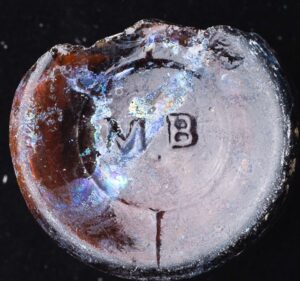
Undated
glass
……………….. William McCully & Company, Pittsburgh, Pennsylvania (c. 1833-c.1909). Please see “W. . & Co” entry on Page 5.
Undated
glass
……………William McCully and Company, Pittsburgh, Pennsylvania (c. 1833-c. 1909). See W. McC. & Co. entry on Page 5.
Undated
glass
……………………..Unidentified with certainty. These initials appear on the base of an American-made aqua 12-sided “umbrella ink” bottle (shown above) which appears to date from the 1860s into the early 1870s. The base is a “key mold” type without a pontil mark. This is only one of two reports of this bottle (and mark) that I am aware of. One possibility, although tenuous: To my knowledge there is only one brief instance of the firm name “Wm McCully & Son” – evidently from the 1850-1852 timeline as seems to be implied on page 187 of “Allegheny County’s Hundred Years” (1888) by George Henry Thurston. However, the bottle on which this mark appears seems to post-date the early 1850s, so at this time I can’t say if that would be the correct attribution?! If anyone else has seen this mark on any bottles, please contact me!
Undated
impressed · glass
………………….. Name neatly embossed (vertically) on an antique cylindrical frosted (matte finish) vase or container of uncertain purpose and origin. No other markings. This was found in a dumpsite in the Louisville, Kentucky area, with items mostly dating from before 1900. No information found. Possibly a funerary / cemetery florist vase?
Undated
glass
……………………………….. William McCully & Company, Pittsburgh, PA (c. 1833- c. 1909). One of many marks variations found on bottles. Please see “W. McC. & Co.” entry on Page 5.
Undated
glass
……………….. William & Company, Pittsburgh, PA (c. 1833- c. 1909). For more info, see “W. McC. & Co.” entry on page five.
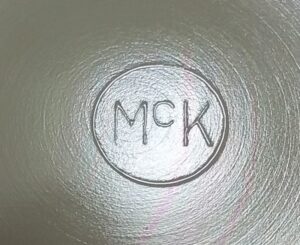
Undated
The caption tentatively dates the pictured Tom & Jerry child's mug to the 1930s.
glass
……………………..Unknown. This mark appears on the base of a black ale or beer bottle probably from Great Britain, and likely dating from sometime in the 1860s-1890s. Similar to the dark olive green “black ” ale bottles marked “C. W. & CO.”. The order of the letters is assumed to be as stated, but it is possible the first letter may not be the “M”. Also, it is not absolutely clear if the letters “C” and “G” are correctly identified, as they appear very similar, so the actual abbreviation could be “M G G Y”, “M C G Y” or “M G C Y”. If anyone in the UK knows the identity of this early company, please advise! “ in circle” mark, as it appears on the base of an ivory (custard ) child’s mug lettered “Tom & Jerry” on the front. This probably dates from the 1930s.
Undated
glass
…………. McKee Company, Jeannette, Pennsylvania. Seen on the base of syrup dispenser, circa 1951. See the McKee Company page, link above.
Undated
glass
………….. McKee Company , Jeannette, Pennsylvania (1888-1951). Seen on various items such as black salt shakers and other opaque tableware, this mark was perhaps used mostly in the 1930s and ’40s. McKee became a subsidiary of Thatcher Manufacturing Company in 1951, and eventually the factory was purchased by Jeannette Company in 1961. For some more information on McKee, click here: McKee Company.
Undated
glass
…………..see McKee Company .
Undated
glass
…………………. McLaughlin Company , Vernon, California (1920-1935). Especially well known by collectors for their electrical insulators, McLaughlin also produced a wide variety of bottles and other glassware. Most McLaughlin products are found in the Western states of the US. For more information see this page: McLaughlin Company. Note: Some water bottles (and possibly other types of bottles) marked with “ ” on the base also date somewhat later, from the 1940s and 1950s, when William McLaughlin operated other, smaller factories in Vernon and Gardena, California.
Undated
glass
……………….McLaughlin Company, Vernon, California (1920-1935)
Undated
glass
……………..Mechanic Works, Philadelphia, Pennsylvania. Exact dates of operation currently uncertain, but a very scarce flask which bears this inscription appears to date from sometime in the 1845-1865 period.
Undated
glass
………………………. Middle East Manufacturing Company, Nasr City, Cairo, Egypt (1979 to present). Initials seen on the heel of a packer jar that contained a brand of strawberry preserves. MEG has three manufacturing locations – at Nasr City, Sadat City, and Mostorod, Egypt.
Undated
glass
………………….. Maywood Company, Compton, California (1930-1959). For more information, please see the Maywood Company page.
Undated
glass
………………… Madera Company, Madera, California (1970-c. 2000?). Found on wine bottles. This factory is still operating (2024) and is now part of Ardagh Group (since 2014). The plant was acquired by Saint-Gobain Containers, later Verallia, before becoming part of Ardagh Group. If anyone knows what year this MG mark was actually discontinued and when the later marks were phased in at this factory, please contact me!
Undated
glass
………………. in rare instances, Maywood Company, Compton, CA (1930-1959). Mark has been confirmed on the bottom of an amber beer bottle. Please see next entry.
Undated
glass
……………….. , Milford, New Jersey (1838-c.1860). This factory operated under several firm names, beginning under the name “Pendleton Works” in 1838 (according to Adeline Pepper in her book on NJ factories). Some “Louis Kossuth / S. Huffsey” historical calabash flasks are thought to have been made here in the early or mid-1850s. Several scarce ale bottles with the embossing “ ” (in an arch) are known and probably date from the 1850s. There were two different small towns known as Milford (or Millford) in the state of New Jersey during that time period. The one in question is now known as Kresson and is located in Camden County. The other town (evidently NOT connected with this glassworks) is still called Milford and is located in Hunterdon County.
Undated
glass
…………. lettering on reproduction (fantasy) bottle manufactured by T.C. Wheaton Company circa 1970s. (Please see discussion in “Comments” section below, starting with query posted by Robin on 8/1/2017.)
Undated
glass
………………………………… a number of manufacturers made milk bottles with this type of marking (required, for a time, by state law for bottles to be used within the state of Minnesota). Seen on the heel or the shoulder. See this site (archived, but no longer live) for more information: Milk Bottle Marks – from the Dairy Antiques site
Undated
impressed · glass
……………… this particular jar was evidently actually made by Newark Star Works, Newark, Ohio (Shields, King & Company, proprietors at the time, FOR Missouri Company). Please see this page: M G CO. marks on bottles and jars .
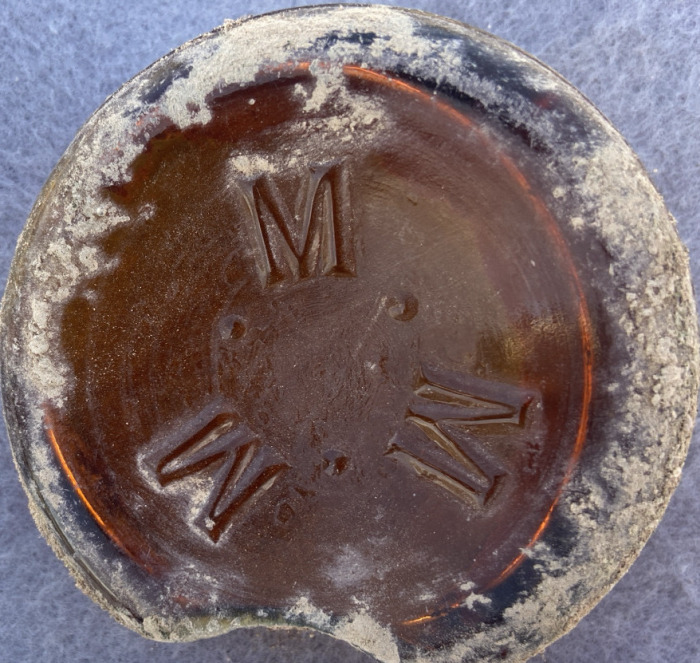
Undated
glass
Three letters in a circle on an amber bottle base found in Arizona; meaning uncertain.
Undated
glass
…………….Missouri Company, St. Louis, Missouri (c.1859-1911). Seen on face of rare wax sealer fruit jar, probably dating from the 1860s or ’70s. This particular jar may or may not have actually been made by Missouri Co – possibly made for them by a Pittsburgh, PA glassmaker. Please See M. G. CO.
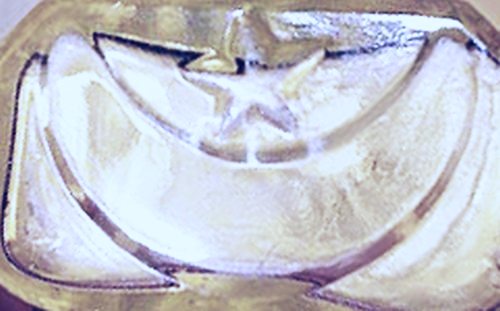
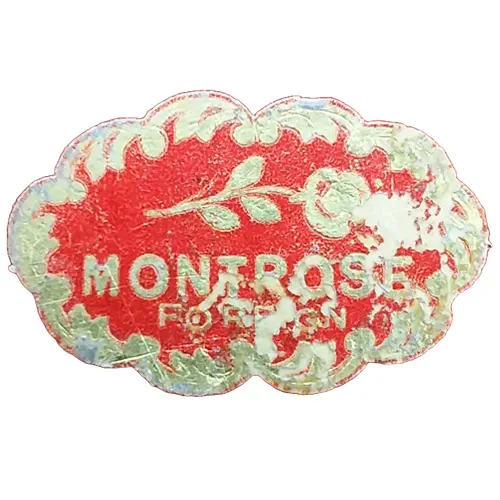
Undated
glass
……….. Manufacturer not identified with absolute certainty, but this is probably another mark used by Crescent Bottle Company, McDonald, Pennsylvania. The moon and star is actually “Debossed” (sunken) into the base of the bottle. Please see my entry under “Crescent Moon logo” on page two.
Undated
glass
…….see “Crescent Moon” entry.
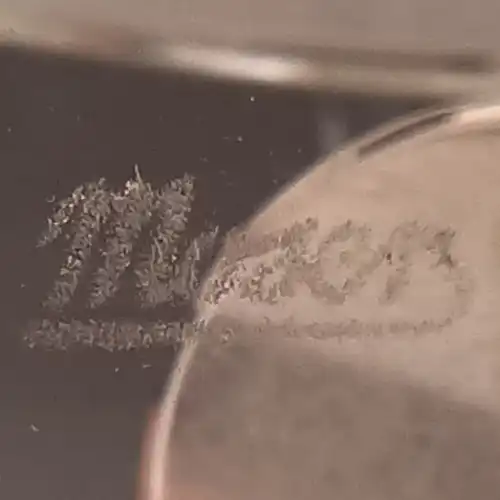
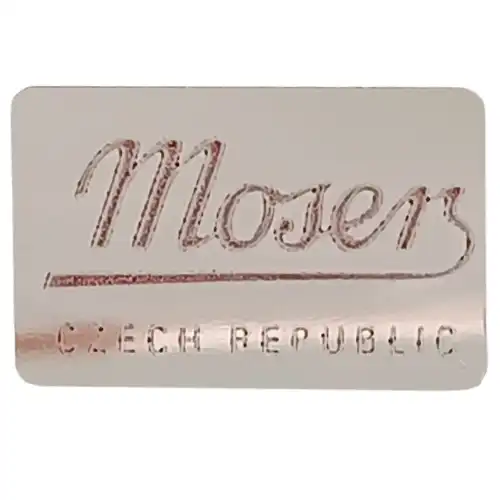
Undated
label · black and clear · glass · Czech Republic
" " black & clear rectangular plastic label.
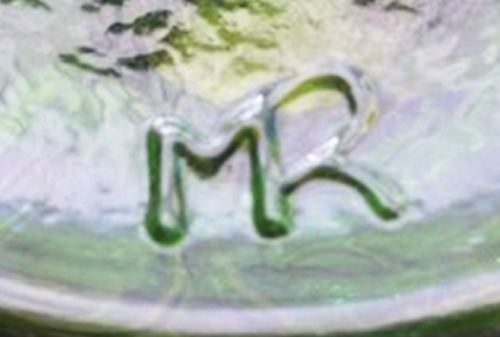
Undated
impressed · glass
Joined on an olive-green oil-lamp base; origin is tentatively Mexican or European.
Undated
impressed · glass
…………………… as seen on the base of a dark olive green oil lamp. The time period when this oil lamp was made is unknown, but perhaps mid- to late 20th century? Two examples have been seen in olive green, as well as one in clear . Both olive green examples surfaced in Great Britain (UK). One of the olive green examples has the green shading into a rich cobalt or “Bristol” blue color toward the base. The design of the lamp consists of large embossed ovals or “eggs” covering most of the surface of the . I was told in a Facebook lamp collecting discussion group that this lamp may be a product of Mexico. I thought it might be European or Asian? If you have info on this mark, help with accurate identification is requested!
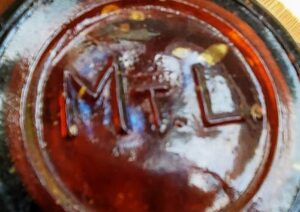
Undated
The source estimates the pictured beer or soda bottle to 1910–1930; maker and meaning are unknown.
glass
……………………. unidentified/unknown meaning. Mark seen on base of amber machine-made beer bottle with no markings on sides, but with unusual “hobbleskirt” type profile, that appears to be from the 1910-1930 period. This mark may stand for either a company OR a brewer or bottling company, perhaps meaning “Mount L______” ? mark on base of amber beer or soda bottle. (Photo courtesy of Seth Miller)
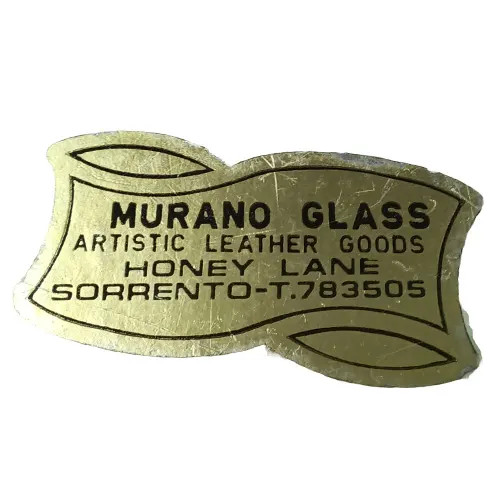
Undated
label · glass · Sorrento, Italy
Retailer label found on a Barovier & Toso bowl.
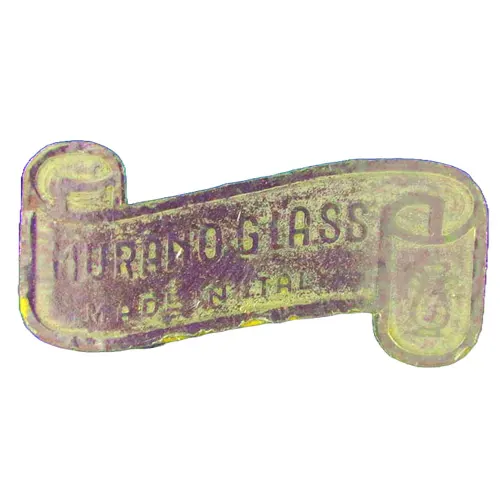
Undated
label · gold and yellow · glass · Italy
" " yellow & gold scroll shaped foil label.
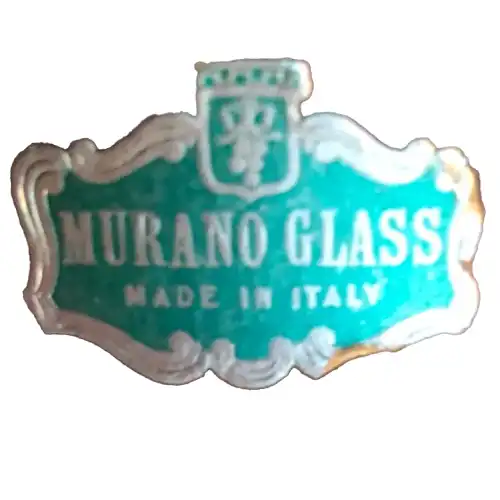
Undated
label · silver and green · glass · Italy
" " green & silver foil label.
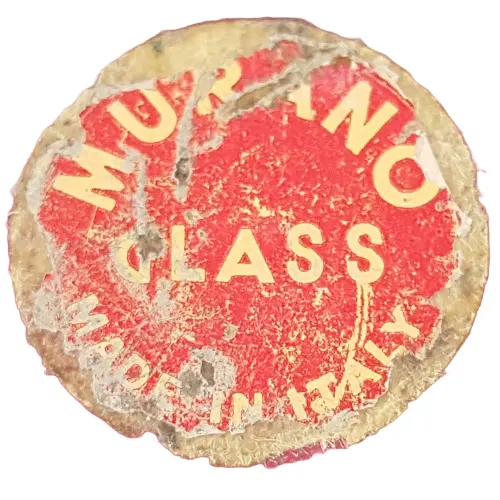
Undated
label · white and red · glass · Italy
" " red & white circular paper label. [ 01 ]
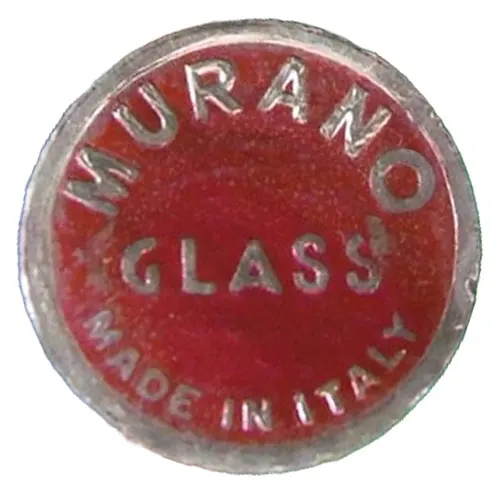
Undated
label · silver and red · glass · Italy
" " red & silver circular foil label. [ 01 ]
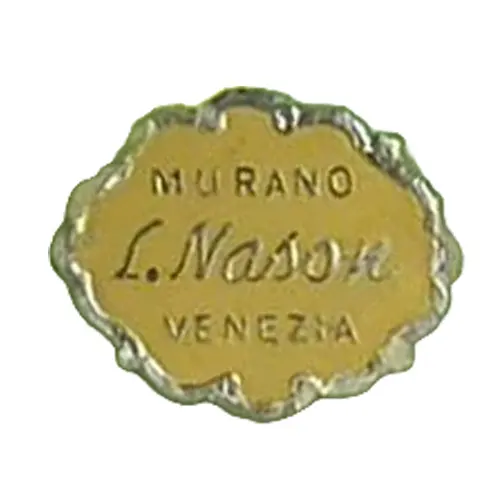
Undated
label · glass · Italy
Possibly a retailer label, reported on attributed to AVEM, Arte Nuova and others.
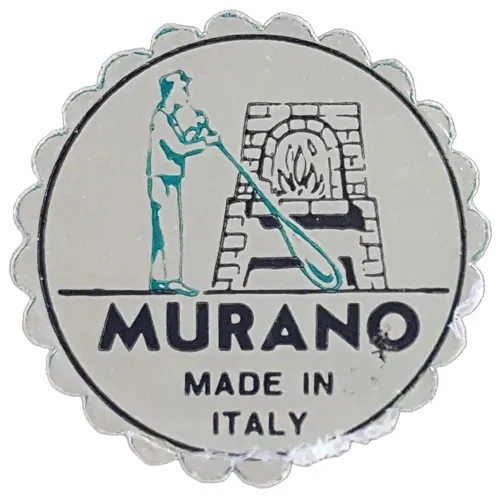
Undated
label · black and gold and blue · glass · Italy
Black, blue and gold scalloped foil label, reads " " . [ 01 ]
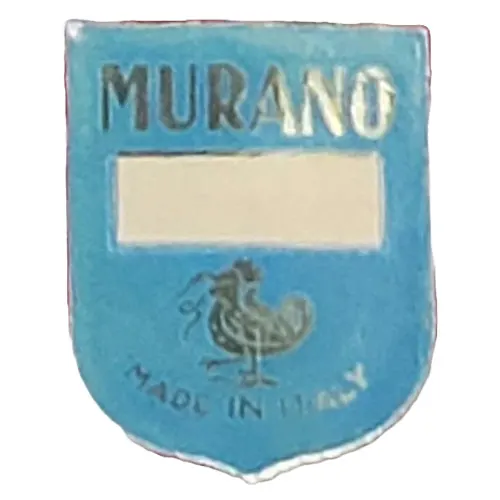
Undated
label · white and blue · glass · Italy
Blue and white shield shaped paper label with rooster emblem, reads " " . [ 01 ] [ 02 ]
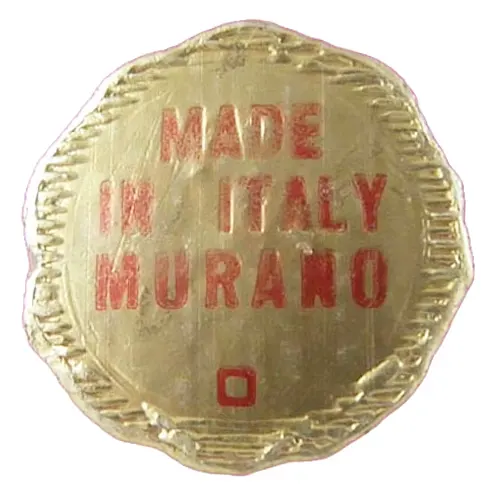
Undated
label · gold and red · glass · Italy
" " gold and red circular foil label. [ 01 ] [ 02 ] [ 03 ] [ 04 ] [ 05 ] [ 06 ] [ 07 ] [ 08 ] [ 09 ]
Undated
impressed · glass
………………..Mutual Company, Pittsburgh, Pennsylvania (c.1869-c.1888). Name embossed on base of a wax sealer fruit jar. This rather obscure concern made tableware as well as oil lamps, chimneys, chandeliers, fruit jars, bottles and flasks. Also known as Gallinger and Company. Date information courtesy of Jay W. Hawkins’ Glasshouses and Manufacturers of the Pittsburgh Region 1795-1910 (2009) with more detailed info in that reference book.
Undated
glass
…………………………………..Obear-Nester Company, East St. Louis, Illinois (1894-1978). Although the most common mark used (by far) was their “ inside a square” logo (see that entry below on this page), some bottles made by Obear-Nester are seen with just a plain “ ”, such as here on the base of an amber, rectangular “ Winstead’s Lax-Fos ” laxative remedy bottle. The bottle in question, although a cork-closure type, is machine-made , and likely dates from sometime in the 1910s -1930s. See Obear-Nester Company, East St. Louis – “ in a square” mark .
Undated
glass
………………………. Nuttall & Company, St. Helens, Lancashire, England, Great Britain (United Kingdom). Nuttall made many types of bottles that were exported to the United States. Probably the most common are the cylindrical mineral water, beer and ale bottles, typically in shades of dark green. Many of the N&Co bottle bases also bear a “pointer”, “needle” or “minute hand on a clock” along with the mark. This mark dates from about 1871 to 1913, when Nuttall merged with several other plants to form United . More info here: Nuttall & Company – Bill Lockhart et al – SHA.org
Undated
glass
………………..Nelson Baker & Company, Detroit, Michigan (1890-1950). Nelson Baker was a pharmaceutical / drug manufacturing company. N B & CO combined with Penslar Chemical Company in 1950. Mark (as shown) appears on base shard of a square amber medicine bottle, possibly circa 1900-1920, photo submitted by Jon McCormack. Thanks Jon!
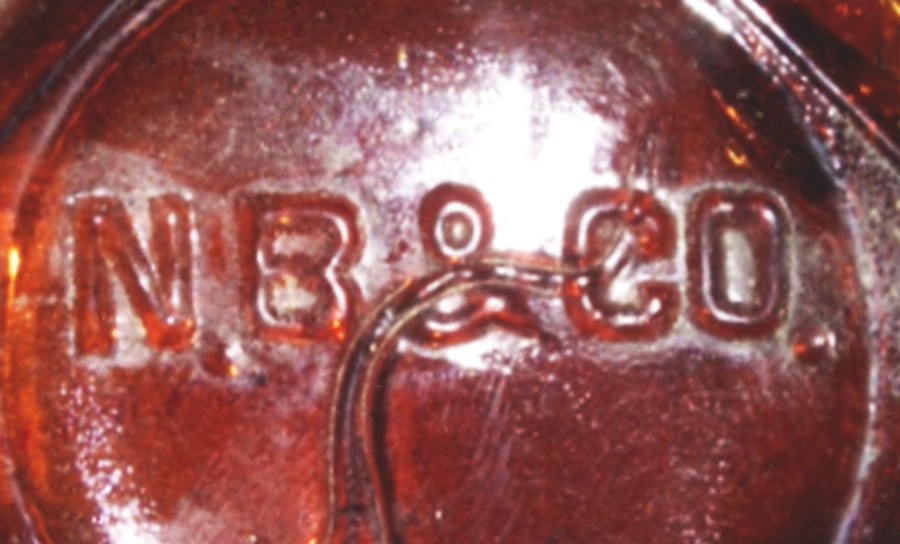
Undated
glass
……………Nail City Lantern Company, Wheeling, West Virginia (1877-1897). This firm was re-organized as Wheeling Stamping Company in 1897.
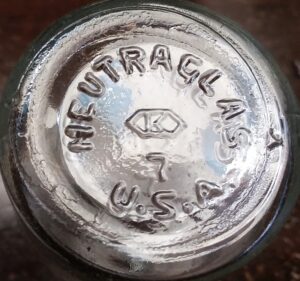
Undated
impressed · glass
Kimble Company mark on a small clear vial.
Undated
glass
…………………… National Fruit Product Company, Winchester, Virginia. The mark was likely used sometime in the mid- late 1920s? (Thank you to Cullen Dunham for calling my attention to this mark).
Undated
glass
…………………… Northern Company, Milwaukee, Wisconsin (1892-1893). This mark is very uncommon, but has been confirmed to exist by author/researcher Roger Peters.
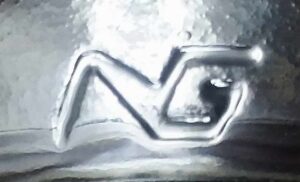
Undated
glass · Sharkia, Egypt
Caption identifies National Company for and Crystal.
Undated
glass
………………Northern Works, Milwaukee, Wisconsin (c. 1896-1900). Continuation of above factory. Mark is uncommon, but does exist. W.F.& S. mark (William Franzen & Son) might have been the actual mark used on much of the product from this factory during the 1896-1900 period.
Undated
glass
…………… Unidentified. This mark appears on the bottom of a clear narrow, cylindrical food bottle of the type often used for products such as olives and capers. This also bears a “48” to the right of the monogram which is presumed to be a date code for 1948.
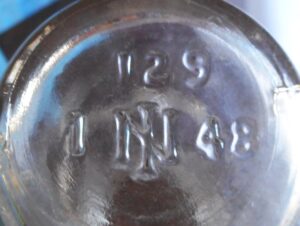
Undated
glass
……………National Works (York), Limited, Fishergate, York, Yorkshire, United Kingdom (c.1930-1967). Known as York Flint Company, founded circa 1837. Incorporated as National Works in 1930. National merged with Redfearn Works in 1967. York factory closed c. 1984?? Exact stretch of years of usage of the N-Diamond mark is unclear, but it was surely in use at least during the 1950s and 1960s. Additional info on dates of usage of the mark is sought from readers!
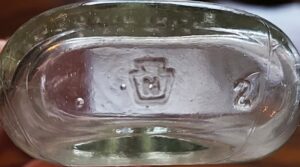
Undated
The source tentatively suggests circa 1920–1925 for this mark, while stating its introduction is uncertain.
glass · Royersford, Pennsylvania
Newborn Company mark on an Edison Battery Oil bottle.
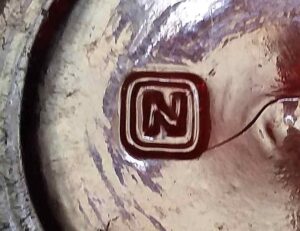
Undated
glass · East Saint Louis, Illinois
Caption identifies an Obear-Nester mark on an amber beer bottle.
Undated
glass
N in a square or “box” (shown above)………………… Obear-Nester Company, East St. Louis, Illinois (1894-1978). The square typically has somewhat rounded corners. Obear-Nester made huge quantities of bottles of many types over several decades, much of it in amber-colored . They produced some of the amber Orange Crush soda bottles, Purex bleach bottles and many others. Some sources imply that this “Box N” mark (and/or an “N in a rectangle) was first used as early as 1895, but Toulouse ( Bottle Makers and their Marks – 1971) states the “N inside a square” was first used on machine-made bottles circa 1915. For more info, see “ N in a square “ page.
Undated
glass
…………Obear-Nester Company, East St. Louis, Illinois (1894-1978). This mark was supposedly used concurrently with “N in a circle” and “N in an oval”, on handblown ware from c. 1894 or 1895, up to about 1915. After 1915, on machine-made ware, the “N in a square” was instituted as their standard mark. On some bottles it’s hard to say if the “box” is better described as a “rectangle” or a “square”, as the whim of the mold engraver resulted in some variations in exact appearance – so any particular mark could lean in one direction or the other. See “ N in a square “ page.
Undated
glass
………see Newark Star Works, Newark, Ohio (1871-1904) .
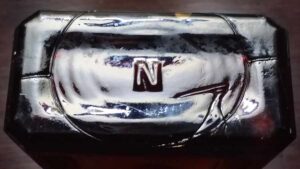
Undated
glass
Caption identifies an Obear-Nester mark on a Winstead's LAX-FOS bottle.
Undated
glass
N over a somewhat “flattened” V, inside a circle, shown (upside down, this mark resembles an N under a “roof”) ………………. Previously unidentified, Lou Bisiecki has kindly informed me by email that this mark is used by Vetri Speciali S.p.A., Italy, at its Pergine Valsugana container plant.
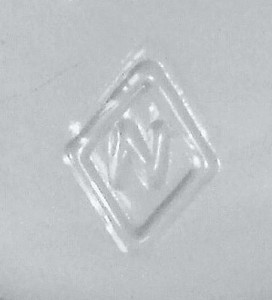
Undated
impressed · glass
……………………. (confirmed on base of clear “shoofly” or coffin flask) …………….. North Wheeling Company, Wheeling, West Virginia (1878-1899) and Wellsburg, West Virginia (1899-1900 / 1904-1922). This flask would probably date from the 1880s or early 1890s. The “N” is embossed backwards. Evidently this glassworks did not mark the great majority of their bottles. More info on North Wheeling can be found in this article by Bill Lockhart and the Bottle Research Group: Other N Marks .
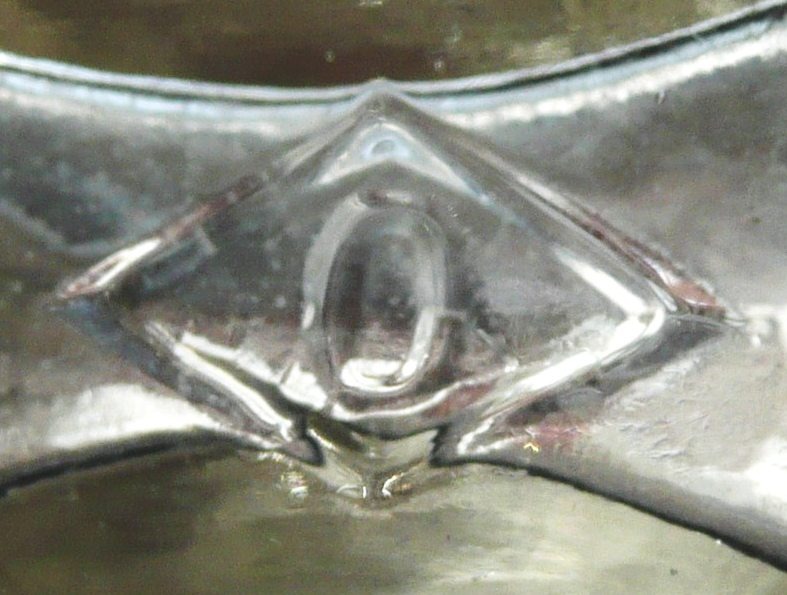
Undated
glass
On an H.E. Bills Magic Relief bottle from Bay City, Michigan; maker unidentified.
Undated
label · gold and red · glass · Japan
National Potteries Corporation import label.
Undated
glass
…………………… as seen on base of clear bottle/shaker with eight fluted sides and ground lip. Nathan & Wight (Henry C. Nathan and George R. Wight) was a manufacturer and seller of mucilage (glue), based in New York City, and, judging from advertisements in period trade magazines and newspapers, operated in the 1880s and early 1890s. This glue bottle with an “octagon” base can easily pass as a salt shaker, and could certainly serve as one with a fitting perforated lid. The manufacturer that made these containers is unidentified.
Undated
glass
……………………. Noelle & von Campe Glashütte (Glassworks), Boffzen, Lower Saxony, Germany (Deutschland)………… (1866-to date). I saw this mark on the base of an 8-ounce clear packer jar (containing instant coffee) in October, 2012, and a packer jar (containing raspberry fruit spread from Poland) in March of 2019, both imported to the United States. I don’t know when this mark was introduced or if it has been in use for a long time. The letters inside the triangle may appear somewhat indistinct, smeared or “muddy” and might be misinterpreted as MC, MG, NG, etc.
Undated
impressed · glass
……………………..Kimble Company, Vineland, New Jersey (1905-to date). This trademark was used by Kimble beginning in 1941, according to trademark information on the Justia website. The trademark is listed as “cancelled” as of 2003, although as far as actual use it may not have been embossed on bottles for many years before that time. (Bill Lockhart wrote that it was probably discontinued around 1955, being supplanted by the trademark “KIMAX”). “ ” was the name used for their borosilicate for scientific, pharmaceutical & industrial applications. It appears on the base of bottles and may be accompanied by the “K in a hexagon” mark used by Kimble (see “K in a hexagon”). Company later known as Kimble/Kontes, and recently (2016) Kimble became part of DWK Life Sciences based in Baden-Wurttemberg, Germany.
Undated
glass
………….New Albany Works, New Albany, Indiana (1867- c.1872). There is also an ale bottle known with the embossing error “New Albany Glas Works” on the bottom. For more information see this webpage on New Albany Works.
Undated
glass
………….New England Bottle Company, Cambridge, Massachusetts (1827-1845) . Embossing is arranged in a circular formation along the outer base rim of a “blackglass” (very dark olive green or olive amber) ale, porter or wine bottle. (This firm is not to be confused with the New England Company, also of Cambridge). This mark was suggested to be, by author & historian/researcher Helen McKearin, the probable earliest glassworks identification mark known on the base of an American-made bottle, possibly dating from the 1830s. However, no one really knows what year the mark was first used. I believe that another mark (but from the Pittsburgh region) might actually be a contender for “1st place”! See “W. I. & P” entry.
Undated
glass
…………………. New Granite Works, Stoddard, New Hampshire (c.1861-1871). Full name and location appears on the face of a type of flask with a flag design on the reverse. This glassworks evidently made a good variety of bottles and flasks of various types, but the vast majority of their production was not marked – excepting a few flasks. (See Granite Co.) For more info on Stoddard , see Stoddard – Updated Information from Michael George
Undated
impressed · glass · Suzano, São Paulo, Brazil
Nadir Figueiredo mark on an avocado-green tumbler.
Undated
glass
……………Newburgh Company, Newburgh (New Windsor), New York (c.1867- c.1872). Also known as the “New Windsor Works” in at least one source ( The Telegrapher , trade newspaper, 1867). Embossing confirmed on the base of a very scarce ale bottle. Newburgh also manufactured telegraph insulators, including at least some, if not many, of the insulators marketed by L.G. Tillotson in the late 1860s.
Undated
glass
NF. (Upper case “N” joined with horizontal stroke (upside-down L, or simplified “F”, lower case R?) and raised dot, see picture of mark as shown, above)……………………………… Nadir Figueiredo S.A., Suzano, São Paulo, Brazil, South America (1912-present). Producer of tableware including drinking glasses, wine glasses, tumblers, bowls, cookware and other items. Although the roots of the company extend back to 1912, the first year glassware was manufactured may have been about 1933. Illustration is showing the mark as seen on the base of an avocado green tumbler or “Rocks” style bar . A few CD 106 style telephone insulators (in various shades of green) have been found with the lettering “NADIR” enclosed within a diamond shape. Their website is here: Nadir.com
Undated
glass
…………………….The National Company for & Crystal, S.A.E., Sharkia, Egypt (1984 to present). This mark (shown above) as it appears on the heel of a clear packer jar exported to the US.
Undated
label · black and clear · glass
" " black & clear circular plastic label.
Undated
impressed · glass
NT (as seen embossed lightly on center of base on light aqua beverage (sake?) bottle found washed up along the Oregon coast -this also bears a “67”, probably a date code for 1967)………………. Toulouse ( Bottle Makers and their Marks, 1971) lists this mark as being used by Nippon Taisanbin Co., Ltd. in Ogaki City, Japan. No info on entire date range.
Undated
glass
……………Imperial Company, Bellaire, Ohio (1902-1984). For a website illustrating some of the marks used by Imperial, check out his page: Imperial – glassencyclopedia.com
Undated
glass
…………….Imperial Company, Bellaire, OH. Mark used circa 1911-1932, on a small percentage of their pressed glassware. (Note: all with the “Nucut” mark, and certain similar marks used by other companies including “Near Cut” or “Pres Cut” are not actually cut , they are properly termed “pressed ”. Pressed tableware was made by forcing molten under pressure, by either hand or machine methods, into an iron or steel mold). Also, see link in above entry.
Undated
glass
……………….. many bottles and jars have only numbers marked on the base. Single digits (1, 2, 3, 4, 5, 6, 7, 8, 9, as well as double digits, sometimes ranging up into the 80s, and on recent bottles often underlined ) on most machine-made bottles are usually ( but not always! ) mold numbers or “mold cavity numbers”. These numbers merely identified a particular mold (or its placement) on an automatic bottle-making machine. (However, numbers also served a variety of other uses on bottles). For more background information, please check out this webpage: Numbers on the bottoms of Bottles and Jars .
Undated
glass · Auburn, New York
Caption identifies Central New York Bottle Company.
Undated
glass
…………………Central New York Bottle Company, Auburn, NY (1978-1994). Made Miller brand beer bottles. From information submitted by John Kuzma, this factory was sold by Miller to Owens-Illinois Inc. in 1994, to become their plant #35, which was still in operation as of 2016.
Undated
label · black and clear · glass · Sweden
" " black & clear rectangular plastic label.
Undated
glass
………….. Unknown meaning. An amber bottle in the form of a cannon and marked “O.B.& Co.” on the base is recorded by Stephen Van Rensselaer on page 301 of “Early American Bottles and Flasks, Revised Edition” published in 1926. He stated the bottle held a pint and measured 10.5 inches tall. I haven’t found mention of this particular bottle anywhere else.
Undated
glass
……………..Ohio Bottle Company, Newark, Ohio (1904-1905). Short-lived merger of 3 factories. Later merged with several other plants to form the American Bottle Company.
Undated
glass
………………..see O G CO monogram, below, used by Ottawa Company, Ottawa, Illinois. On some bottles the “G” may look more like a “C” although there is usually a small “tail” on the lower right of the letter that can be hard to discern.
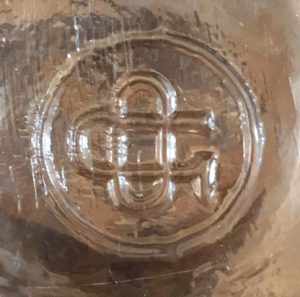
Undated
glass
O G Co (as a monogram, with a larger “O” in the center, superimposed/entwined with a smaller “G” on the left and “Co” on the right). The “G” may be easily mistaken for a “C”. Ottawa Company, Ottawa, Illinois (1868-c. 1889). The city of Ottawa is located north of Streator (another “ factory town”) and west of Chicago, in northern Illinois. This mark (as seen on older, handmade bottles) was long unidentified with certainty, and was often attributed to the first Olean Company of Olean, New York. Information uncovered in recent years points to the mark as having been used by Ottawa instead of Olean. For more information on the Ottawa Company, check out this article by Bill Lockhart: Ottawa Company – SHA.org
Undated
glass
…………. probably Olean Company/Works, Olean, New York (1883-1913). There were two different companies known as Olean . This mark was evidently used by the first Olean Company, but only on a very small number of containers. (See the “OG in a circle” entry above.) It has been seen on the heel of Hutchinson style soda bottles. For more information on both companies that used this name, please check out the extensive article by Bill Lockhart and other researchers, at this link: The Olean Company . Olean also had a second factory located at Port Allegany, Pennsylvania (1896-1912), which in later years was successively occupied by Wightman Co-Operative Company (1915-1917) and then Pierce Company (1917-1987), currently (2021) being operated by Ardagh Group.
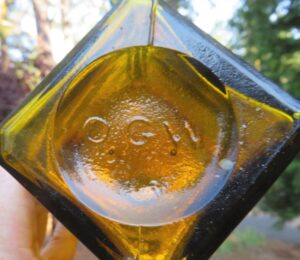
Undated
impressed · glass · Oakland, California
Oakland Works mark on an amber bottle base.
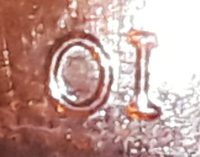
Undated
glass
Owens-Illinois variant without a dash on a beer-bottle heel; introduction date uncertain.
Undated
glass
…………………….. Owens-Illinois Company (see O-I). A few soda bottles have been reported with this mark on the base. From research by Bill Lockhart, these would most likely date only from the 1929-1931 period.
Undated
impressed · glass
……………. Owens-Illinois Company (Owens-Illinois, Inc. since 1965; in business from 1929-to date, now usually known simply as “O-I”). This is the current trademark (as of 2020) used by Owens-Illinois on their containers, registered March 20, 2007, with “first use” claimed to have been on December 17, 1997. Please see the Owens-Illinois Company page for more background info on this and their other marks. On some bottles this mark is very small, or lightly embossed, and may be hard to make out clearly. At a casual glance, and viewing sideways, the mark might be perceived as part of a simple stick figure or a logo somewhat similar to the “female symbol” when turned on its side!
Undated
glass
…………………Oil City Bottle Company, Oil City, Pennsylvania (1930-1952). Also, see the “Oil Derrick logo” entry farther down on this page, which was the mark used by their successor, the Oil City Company (1952-1984).
Undated
glass
……………… Owens Bottle Company , Toledo Ohio (1911-1929), also Fairmont, WV; Clarksburg, WV, Charleston, WV and other plant locations. Also called the “Box O”. See the Owens Bottle Company page .
Undated
glass
O inside a circle or oval (small “o” inside a larger O or circle, shown above)………………………Saint Gobain Oberland AG (now Verallia Germany / Verallia Deutschland AG), main factory at Bad Wurzach, Germany. There are four slight variations in the mark: One small dot or period placed to the lower right of the mark indicates production at their Neuburg factory; two dots indicates made at Essen; three dots indicates Wirges and no dot indicates the main plant at Bad Wurzach. The dots may be indistinct and thus hard to make out on some bottles. I don’t have info on exact date range for this mark, perhaps early 2000s?
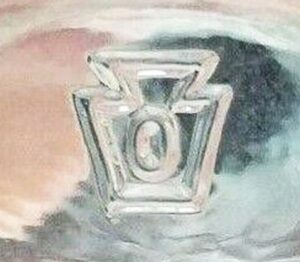
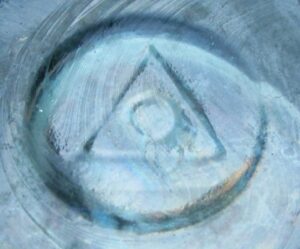
Undated
The source dates the pictured Providence soda bottle approximately 1895–1901; maker unknown.
impressed · glass
………………….Unknown meaning. This mark reported on the base of a soda bottle from Providence, Rhode Island, dating circa 1895-1901. inside a triangle, unknown meaning, embossed on the base of a soda bottle from Providence, Rhode Island, dating circa 1895-1901.(Photo courtesy of Taylor McBurney)
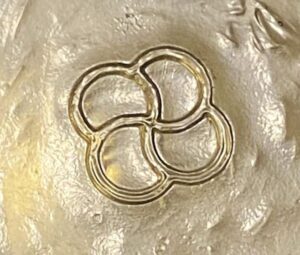
Undated
glass · Ontario, Canada
Caption identifies Libbey-St. Clair's four-circle trademark.
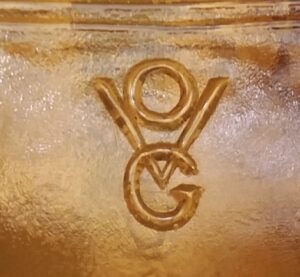
Undated
glass
Olde Virginia monogram on a Daisy & Button shoe-shaped toothpick holder by Fenton.
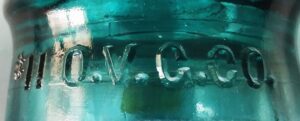
Undated
glass · Pleasant City, Ohio
Mark on a number 11 CD 112 telephone insulator made by Ohio Valley Company.
Undated
glass
……………. Owens-Illinois Company (now Owens-Illinois, Inc.), Toledo, Ohio and other plant locations. This “I inside an oval or O” mark was phased in beginning in the year 1954 (according to Julian Toulouse), although apparently it was several years before ALL of their bottle molds in use carried the “new” mark, which was basically the same as the “old” mark but with the diamond removed. (See the Owens-Illinois Company page where this and several other marks are discussed in more detail).
Undated
glass
………………please see “ Obear Nester Company – “N inside a square” mark “.
Undated
label · black and gold · glass · Germany
" " black & gold rectangular foil label.
Undated
glass · Ottawa, Illinois
Ottawa Company monogram on an aqua coffin- or shoofly-type flask.
Undated
glass
……………Olean Company, Olean, New York (1929-1942). This mark was used by the second company that used the name “Olean Company”. The mark may be somewhat indistinct on some containers, with the “G” looking more like a “C” or a sideways “U”. Also reported as being found both with and without the circle. This mark (in the photograph shown) as it appears on the bottom of a clear “generic” type of wide-mouth packer jar used likely for such items as applesauce, coffee or other food products. See “O G CO” entry also.
Undated
glass
………………. Oil City Company, Oil City, Pennsylvania (1952-1984). This factory started production in 1930 under the name “Oil City Bottle Company”, which used an “O inside a keystone” logo on their bottles. In 1952 the factory was acquired by the Pyramid Rubber Company and evidently started using the new oil derrick trademark around that same time. This particular logo, a representation of an oil derrick or “oil drilling rig”, is seen on the bottom of a variety of bottles, and is sometimes misinterpreted as an electrical tower or some other type of “grid” structure. On some bottles the mark is small, distorted or faint and hard to make out. Two types of bottles frequently seen with this mark on the bottom include the “EVENFLO” brand baby bottles, and battery oil bottles (often found along railroad tracks) made for National Carbon Company. Salt shakers were also made in a characteristic “oil derrick” shape and marked on the base with the logo. (The shakers were made sporadically, over some time, and back-stocks were kept in the storage room and gradually sold over a period of time, perhaps even years after actually being made). Julian Toulouse ( Bottle Makers and their Marks , 1971) wrote that this mark was used from 1952 to 1969 . However, I have seen a clear flat liquor flask with the derrick mark and a 1970 date code. The Oil City Company was purchased by the Questor Corporation [what year?] , and the Questor Corporation sold the factory to National Can Corporation in 1969. After 1969, the factory operated under the Foster-Forbes Division of National Can Corporation, although the plant was often referred to by locals as the Oil City Co. factory for many years afterward. The last bottles made at the Oil City factory were produced on April 13, 1984, according to information posted about a commemorative bottle listed on ebay (that listing later placed in the Worthopedia database). Evidently the oil derrick logo was phased out in the 1969-1970 time frame, although it might have taken a little while before all the bottle molds (mold base plates) in use were retooled with the “FF in a circle” logo used by Foster-Forbes. Also, please see “O in a keystone” entry, above on this page. (Also, thank you to former factory moldmaker John Pochran – I had a nice conversation with him by phone on 8/17/2022).
Undated
The source identifies 1983 as the date accompanying the signature and a pattern number.
glass · United Kingdom
" " signature, with 1983 date and pattern number.
Undated
glass
……………… Company/Works, , New York (1883-1913)
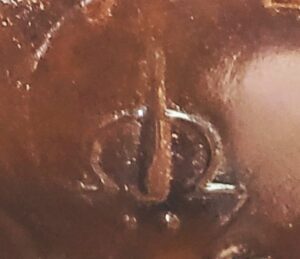
Undated
glass · Brussels, Belgium
Bouteilleries Belges Réunies mark; proposed 1950s–1970s dating is explicitly uncertain.
Undated
glass
OOOO (monogram that appears to be four connected “Os”, zeros or circles, or a group of closely connected rings, almost a cloverleaf, somewhat similar to the Olympics logo but with four instead of five “rings”). Some have described it as a flower bloom with four petals…………………….. trademark used by Libbey-St. Clair Inc., company headquarters in Mississauga, Ontario, Canada, factory located in Wallaceburg, Ontario, Canada (1978-c.1993). Several years ago, this mark (above) was reported to me as having been seen on the bases of restaurant glassware (such as mugs, tumblers) purchased in Canada. Sometime later I received information from reader Lisa Wallis that this mark was used by Libbey-St Clair, Inc. Currently, there seems to be relatively little detailed information online about that firm, but evidently it was formed in 1978. The site itself was originally that of Sydenham Company, dating from 1895, later Dominion Company, later DomGlas. From this page: Diamond Flint/Dominion /Domglas – 11th in Canadiana Series – Mandicrafts.blogspot.com , we read “In 1978 Dominion’s Wallaceburg Ontario factory was taken over by CB Pak and the plant became Libbey-St. Clair. It was renamed Libbey Canada when Libbey Inc purchased its assets in 1993.” On another site (on an Instagram post) someone wrote: ” In 1978, the glassworks in Wallaceburg, Ontario, Canada came under the ownership of the Owens-Illinois Company of Toledo, Ohio (Libbey was a subsidiary of OI at the time) and the works became known as Libbey-St. Clair.” By all accounts, the plant was closed in 1999 under the name “Libbey Canada Incorporated”.
Undated
glass
…………. Graham Company, Evansville, Indiana, this code used at their Okmulgee, Oklahoma plant. See Graham.
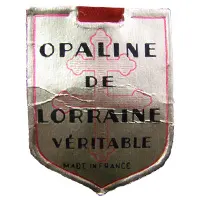
Undated
label · glass · France
Portieux label.
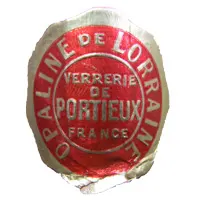
Undated
glass
………………. Vetri Speciali, formerly known as Vetrerie Venete S.p.A., Ormelle, Treviso, Veneto, Italy. Dates of use for this mark are unclear, but this appears to be a mark used in recent years. For a picture of the mark, please see the “V O” entry on Page 5.
Undated
glass
…………Western Manufacturing Company, Valverde (Denver), Colorado (c.1900-1909)
Undated
glass
…….. see OVG (below).
Undated
impressed · glass
………….. this mark stands for “Olde Virginia ” which was a line of colored decorative glassware sold by Fenton Art Company of Williamstown, West Virginia (1905-2011) . That particular line of glassware included such items as compotes, vases, bowls, salt shakers, candy dishes, decorative booties, shoes and hat-shaped toothpick holders. Most of the glassware sold as OVG are pieces in the “Daisy & Button” and “Fine Cut and Block” patterns. OVG was evidently sold as a slightly lower-cost alternative to their regular line, and was distributed in department stores such as K-Mart and sold in exchange for redeemed books of S & H green trading stamps. Information found online about the exact time period that Olde Virginia was produced seems contradictory in some cases. Some sites/webpages report the line was introduced as early as 1960. I think that is probably incorrect. Other sources indicate it was not instituted until 1969. In any case, the OVG trademark was apparently not actually embossed on the bottom of any of this glassware until 1970 or 1971, continuing in use until 1979. I invite readers who have more definitive information on this mark and it’s exact period of use to contact me with more details.
Undated
glass
…………….. Bottle Company, Toledo, Ohio (1919-1929) and its successor [after the merger with Illinois Company], -Illinois Company (1929-to date). Mark is confirmed on a clear druggist bottle with date code “7.” (presumed to indicate 1947). Sometimes just the “O” of “ ” is enclosed within a square. I don’t know when this mark was first used during the OBC years, so will have to go with “1919-1929” until further info is uncovered. I believe the mark was used up into the 1950s or ’60s by -Illinois , but have no definite info on ending date. See “O in a square” .
Undated
glass
“ ”…………… many bottles manufactured on Owens-type automatic bottle-forming machines bear the so-called “ ” on the base that was created during manufacture. The circular Owens scars are most frequently seen on machine-made bottles from 1904 and into the 1930s, although also on later bottles. The earlier bottles tended to have scars that were more heavily “feathered” and not quite as “neat” and “cleanly formed” as on later bottles made on Owens machines. There is some confusion on what those scars look like. For more info and a few pictures that illustrate Owens scars, please check out this page: Owens Scars on bottles- What are they?
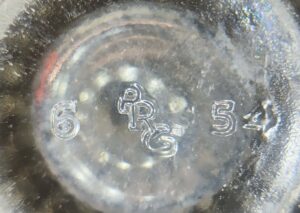
Undated
The caption dates the pictured crown-lip soda bottle to 1954.
glass
…………… Powell & Ricketts, Bristol, South West England, UK (c. 1856-1923). This particular mark may date from the 1850s into the 1880s or later. This company was just one incarnation in a series of firms based in Bristol, the earliest dating from the late 18th century. For more background info on these companies, see this article by Bill Lockhart et al : The Ricketts Family Firms – SHA.org mark on base of 1954 crown lip soda bottle (Photo courtesy of Carlos A. de Jesus-Rosario)
Undated
glass
…………………….Powers & Weightman, Manufacturing Chemists, Philadelphia, PA (c.1847-c.1907), firm operated under several other business partnership names before and after those years. “P&W”, accompanied by mold numbers, seen on the bottom of small cobalt blue medicine bottle, handmade, similar in appearance to Bromo Seltzer bottle, likely circa 1890-1915 era.
Undated
glass
………………Point Bottle Works Company, Rochester, Pennsylvania and Beaver Falls, PA (at second location 1899-1906). Originally known as Rochester Flint Vial and Bottle Works (1879-c.1882), later, Rochester Point Bottle Works Limited (c.1882-1906). The PBW mark appears on the base of clear coffin flasks. For more detailed information on this firm, as well as many other companies, many highly obscure, please refer to Glasshouses & Manufacturers of the Pittsburgh Region 1795-1910 (2009) by author/researcher Jay W. Hawkins.
Undated
glass
……… see “P.G.C.” mark, below.
Undated
glass
………………..Pacific Coast Works (1902-1925) and its successor Pacific Coast Company, San Francisco, CA (1925-1930). The PC mark probably dates from either 1919, or 1925, and on up to 1930.
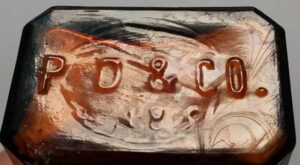
Undated
glass
On a mouthblown rectangular amber Parke Davis medicine bottle.
Undated
glass
……..Pacific Coast Works (1902-1925) and Pacific Coast Company, San Francisco, California (1925-1930). This mark was used possibly as early as 1919, but was definitely in use by 1925. See other “P.C.” entries.
Undated
glass
……….Pacific Coast Works (1902-1925) and Pacific Coast Company, San Francisco, CA (1925-1930). Mark was first used in either 1919 or 1925.
Undated
glass
……….Pacific Coast Works (1902-1925) and Pacific Coast Company, San Francisco, California (1925-1930). This mark was introduced in 1919, and used on ware until about 1930. Source on 1919 date: Peterson (1968:49).
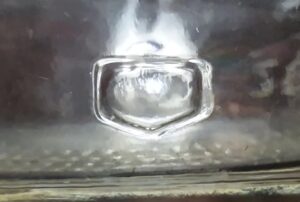
Undated
glass
Unidentified pentagonal trademark on a clear baby-food jar heel.
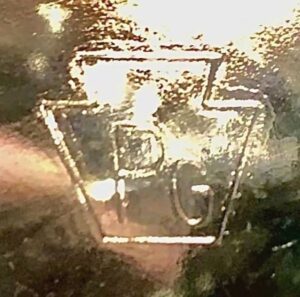
Undated
impressed · glass
…………………. almost certainly Peerless Company, Long Island City, New York (c.1920-1933). Seen occasionally on soda bottles, but evidently quite rarely on milk bottles. Steve Caldas informed me that he had found an example of a clear quart Borden’s Store milk bottle with the letters “ ” embossed along the lower heel along with “REG. U.S. PAT. OFF.” That bottle bears vertical ribbing. At first glance the marking appears to be “P.C.C.” but the second letter is actually intended to be a “G”. There is a number “32” on the base which is probably a date code for 1932. I also heard from Chris Carrara (4-2024), who had found a SHEFFIELD dairy bottle with this mark along the lower heel but with “33” on the base. For more background info on Peerless , please see this article by Bill Lockhart et al: Peerless Company
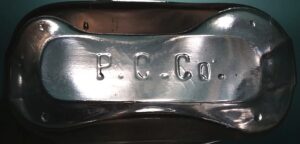
Undated
The caption tentatively dates this mouthblown druggist bottle to 1890–1910 and leaves its maker uncertain.
glass
…………..Peerless Company, Long Island City, New York (c. 1920-1933). The mark “P. G. Co” is illustrated, in a circular orientation on the “northwest” corner (10:00 to 12:00 position) of bottle bases, in a catalog page from an Owens-Illinois Company bottle catalog / circular, undated but evidently from the early 1930s. Also, see next entry. mark on base of clear mouthblown druggist bottle, probably made circa 1890-1910. Maker uncertain – possibly Pennsylvania Company, Anderson, Indiana.
Undated
glass
……………….. Uncertain. (Seen on base of colorless handblown druggist flask, above). Some bottles might be products of the Pennsylvania Company, Anderson, Indiana (1888-1915). They were heavy producers of flint (clear) prescription/druggist bottles. That company moved to Dunbar, West Virginia and operated there from 1915-1922. Also, “ .” was probably used by Poughkeepsie Company, Poughkeepsie, New York (1880-c.1913) on some of their bottles, including “Union Made” flasks from the early 1900s.
Undated
glass
………………………………… probably either Pioneer Works, Birmingham, Alabama (1888-c. 1891) or Piedmont Works, Tallapoosa, Georgia (1891-1892). Although Toulouse wrote that a “P G W” mark was used by Pacific Works of San Francisco, this is now considered very doubtful because fruit jars made by that company are marked with name of the company spelled out. If Pacific did make any bottles marked “ .”, which is highly unlikely because none have been confirmed to date, they would almost certainly be found only in the western US.
Undated
glass
………………………… Poughkeepsie Works / Company, Poughkeepsie, New York (1880-c. 1913)
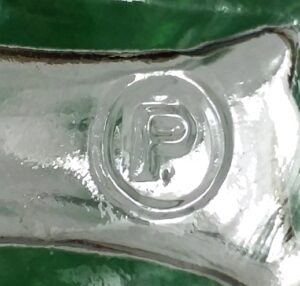
Undated
glass
……….Pierce Company, St. Mary’s, Pennsylvania (1905-1912); Hamburg, New York (1912-1917); Port Allegany, Pennsylvania (1917-1987). This last factory was eventually acquired by Indianhead Container Corporation which merged into Ball-InCon in 1987, and at that time lost its individual identity as “Pierce ”. This plant was later operated under Saint-Gobain, then Verallia, currently (2020) part of Ardagh Group. The “P in a circle” mark appears on some commonly-produced medicine bottles of the early through mid-20th century, including many of the Pitcher’s Castoria, Fletcher’s Castoria , Dr. W. B. Caldwell’s bottles and others which are found quite often in dumps of that time period. For more detailed background info on this company, check out this article written by Bill Lockhart and the Bottle Research Group: Pierce Company
Undated
impressed, incised, label · glass
…………….. Pairpoint Works, Sagemore, Massachusetts. Most of the glassware made over the years by Pairpoint was not marked, or bore paper labels, but some items have been marked on the base with the letter P inside a vertically oriented diamond. (This mark evidently has no connection with the “P in a diamond” embossed on some electrical insulators, specifically certain CD 134 styles. That mark is still unidentified with certainty but may have referred to James Pennycuick, who was issued a patent concerning insulator manufacture in the 1880s). For some more background info on Pairpoint, here is a brief article written in 1975: Pairpoint Company – Orva Heissenbuttel – Rainbow Review Journal – NDGA.net
Undated
glass
………….Pennsylvania Products Company, Pittsburgh, PA……….. (Note added 12/8/2016): There had been some speculation this mark might indicate the Pfizer pharmaceutical company, but that is incorrect. The “P in a flag” mark has now been positively identified as having been used by the Pennsylvania Products Company of Pittsburgh. This information has come to me from Lynor Lisi, who sent photos showing lettering on a cardboard carton of unused “NOS” emerald green bottles bearing the “P in flag” mark on their bases. The carton appeared to have been manufactured (or packed) in June of 1971. The bottles were actually manufactured by Owens-Illinois at their Fairmont, West Virginia plant. Apparently Pennsylvania Products Co. distributed vials, medicinal and laboratory bottles at the wholesale level, selling products actually made by O-I. There are listings on the web that indicate PGPC is still in business, but the exact timeline of business activity between 1932 and the present is rather murky, and the total period of use of this mark on bottles is unclear. PGPC was evidently in business (to some capacity) as early as 1932, the president of the company (Tunis J. Dykema) receiving a patent for his invention of a combination bottle stopper/rubber dropper in that year. The original patent number is 1843812, the “Re-issue” number is #19520 which can be found on “Google Patents” as RE19520. That patent number is usually, if not always, marked on the base of the bottles along with the P marking.
Undated
glass
…………….Wightman Bottle & Co, Parker’s Landing, Pennsylvania [in Knox Bottle Company group] (1932-1951)
Undated
glass
……….Pine Company, Okmulgee, Oklahoma (1927-1929). Maker of “Pine Mason” jars. Factory purchased by Ball Bros Company in 1929, later one of their most important plants.
Undated
glass
……………….. Petrolagar Laboratories, Chicago, Illinois (c.1930s-1950s). This mark appears on the base of squarish machine-made jars of several sizes, most of which are marked either “PHYSICIANS’ SAMPLE” or “HOSPITAL DISPENSING UNIT” across the front. The jars have been seen in clear, amber, and light green (possibly other colors). Some (or most?) of the jars contained a remedy to help treat constipation (a stool softener). Here, the pic sent to me by Richard Shepard shows the mark as seen on a colorless base shard. Petrolagar was evidently a pharmaceutical-related supplies distributor, not a glassmaker, so the actual manufacturer of these jars remains unidentified. Please see comments left by Mary Starr, from July of 2019, and Chris A, posted March 3, 2021, in the Comments section at the bottom of this webpage. The mark may date from sometime in the 1930s to the 1950s. Some brief information on Petrolagar Laboratories is related in this article on various “P” marks by Bill Lockhart, at this URL: Other P Marks – Sha.org
Undated
glass
P (on the base of water tumblers, wine glasses and other household / bar drinkware, may appear backward so the letter is oriented correctly by looking down into the )…………………….. Paşabahçe (Pasabahce), brand used by Şişecam, Istanbul, Turkey. (1935-to date). Şişecam has production facilities in Turkey as well as I believe, Romania, Bulgaria, Egypt and Russia. I don’t have information on the earliest year of usage of this P mark. Also, please see the “Drops/droplets” mark (also used on Paşabahçe glassware) on Page Two .
Undated
glass
P R G (letters typically “stair-stepped” downward from left to right)…………….. Puerto Rico Corporation, San Juan, Puerto Rico (1945-c.1980 or later). Some brief info here: Other P Marks – SHA.org
Undated
glass
P (seen on the base of an aqua mouthblown tooled-lip “Allen’s Lung Balsam” bottle, circa 1890-1910)…………… uncertain. The letter is quite small and easily missed. This might be merely a mold identifier, and not a glassmaker mark.
Undated
The source dates the Alsterfors vase bearing Per-Olof Strom's signature to 1970.
glass
" " (Per-Olof Strom) signature on Alsterfors vase, dated 1970.
Undated
impressed · glass
……………………. Pacific Works, San Francisco, California (1862-1876). Embossed in a circle on the face of fruit jars. A rare jar has the mark on the base. A rare variation is embossed “Pacific Work”. Most of those jars probably date from the 1870s. A few blob top soda bottles are also known with the mark “Pacific Works”. Contrary to information presented by Julian Toulouse in Bottle Makers and their Marks (1971), the mark “P. G. W.” is no longer believed to have been used by Pacific – see that entry below on this page. More info on the Pacific jars and slight variants can be found in Bill Lockhart’s exhaustive article here: Pacific Works – SHA.org
Undated
glass
Wording is supplied by the caption; the photograph shows the whole votive holder.
Undated
impressed · glass
…………… this lettering appears (rather lightly embossed) on the base of a frosted “satin” blue candle cup (votive candle holder) which might also be identified by collectors as a toothpick holder. The design is somewhat similar to a toothpick holder in the EAPG pattern “Kanawha” made by Riverside Company, Wellsburg, WV in the very early 1900s. Another toothpick holder with a very similar, but not identical, design was made by L. E. Smith Company, known under the pattern name “Dominion”. The upper rim has nine “scallops” or “petals”. These pieces were evidently produced for the Paragon Products Corporation based in Oshkosh, WI. A very similar piece, if not identical (seen in several frosted colors) is found marked only “No. 737” on the base and it matches up with a toothpick (designated as mold number 737) shown in a Brooke Company (of Wellsburg, WV) catalog. See catalog pages showing votives made by Brooke on this page from the Fairylampclub.com Aug 2001 newsletter, pages 8-9: Fairylampclub Aug 2001 Newsletter . The “Paragon” candle holders were probably made in the 1970s or 1980s. Another “tulip” style with four “petals” is marked “No. 239”. There is little information available but Paragon Candles seems to have been a maker and distributor of wax candles and candle-related items for quite some time, beginning in the late 1930s or early 1940s. This company was apparently a parent company (or affiliated firm) with Victrylite Candle Company of Oshkosh. Some other items sold by Victrylite were marked “Made in Italy” so it is possible some of these votive candle holders were also made by an unidentified company in Italy.
Undated
glass
…………..brand name seen on bottom of druggist bottles, assumed to be the name assigned to a line of such bottles made by an unidentified glassmaker.
Undated
glass
……………………. Pastorius, Schulz & Company, Pittsburgh, Pennsylvania (1864). This was the first of three firms that operated the Iron City Works, located on Twenty-Seventh Street near Jane Street in what was then known as East Birmingham. The glassworks operated until about 1868. (This “Iron City Works” is not to be confused with a second, unrelated factory with the same name in Fayette City, PA which started c. 1874). The marking, arranged in a circular formation on the base, has been found on black (very dark olive green) cylinder whiskey bottles. (Information from Jay Hawkins in his 2009 book on Pittsburgh-area companies).
Undated
glass
…………………….Crescent Company, Wellsburg, West Virginia (1908-19??, later renamed Brooke Company, dates of operation uncertain but prolific in the 1980s and 1990s, out of business before 2016). Please see the Hobnail Votive Candle Cups webpage.
Undated
glass
……………… as seen on electrical insulators . This marking positively identifies the insulator as a product of the Hemingray Company . Most insulators with this marking were made between 1871 and the early 1890s.
Undated
glass
………………..marking frequently seen on insulators. This patent date positively identifies the insulator as a product of the Hemingray Company, Muncie, Indiana. The patent was referring to the invention of “drip points” (“teeth” or “beading”) added to the base of most Hemingray insulators. Millions of insulators were marked with this patent date, primarily as a marketing ploy.
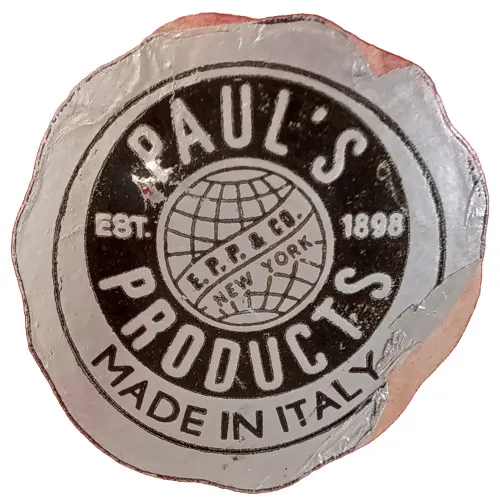
Undated
Est. 1898 is establishment wording on the label, not a mark-use date.
label · black and silver · glass · Italy
" " black & silver scalloped circular foil label. [ 01 ]
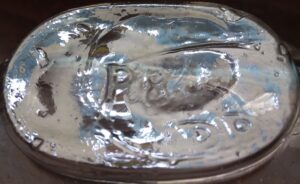
Undated
glass
………………… uncertain meaning. Seen on the base of a clear mouthblown picnic (“pumpkinseed”) flask, probably from the 1890-1910 period. Two possibilities include Point Bottle Works Company (below) and Parker Bros. Manufacturing Company, Bridgeton, New Jersey (1885-1916). More background info on this and other “P” marks is in this article from Bill Lockhart et al: Other P Marks – SHA.org
Undated
glass
……………… see “IPGCo inside diamond” entry on Page Three. Often the “I” and the “o” are barely discernable and the mark may be hard to identify.
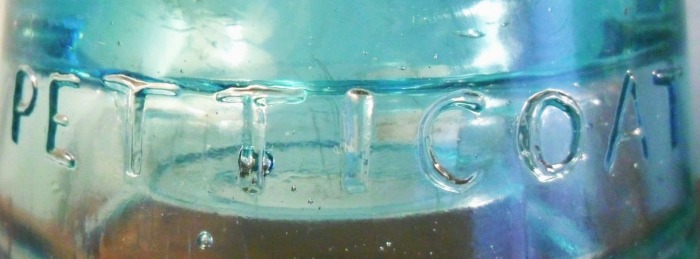
Undated
glass
Embossing on the skirt of an H.G.CO. CD 145 beehive-style insulator.
Undated
label · black and white · glass · Crieff, Scotland
" " rectangular black & white paper label.
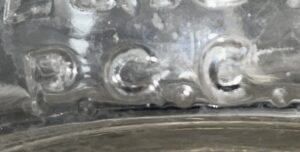
Undated
glass
……………….. meaning unknown. If you have information on this mark, please contact us!
Undated
glass
…………… Plum Company, Plum, Pennsylvania (1985-2002?). (The city of Plum is a community in the eastern part of the Pittsburgh metropolitan area). Plum produced a variety of handmade pattern tableware, novelties and art in many different colors. Plum was formed not long after Westmoreland Company closed down operations in 1984. John J. Biondich, an employee of Westmoreland for 28 years, along with a brother and three of his sisters, established the new firm, using molds acquired from Westmoreland. After 18 years of production as owner of the firm, sadly, Mr. Biondich passed away on June 27, 2002. I believe the glassworks closed permanently that year, but haven’t found definite confirmation for that information. Most of the produced by Plum is marked with the “PG in a keystone” along with the Westmoreland mark, but some pieces may carry only the PG keystone mark.
Undated
glass
………………Philadelphia Works, Philadelphia, Pennsylvania (1844-1910). Operated under more than one proprietorship, this factory started as Burgin & Pearsall in 1844 and became Burgin and Sons in 1853. Most commonly encountered bottles with this marking are the blob top soda and mineral water bottles that appear to date from the circa 1855-1875 period.
Undated
glass
……………. mark seen on bottles made in Germany. See “Anchor inside triangle” symbol on Page One.
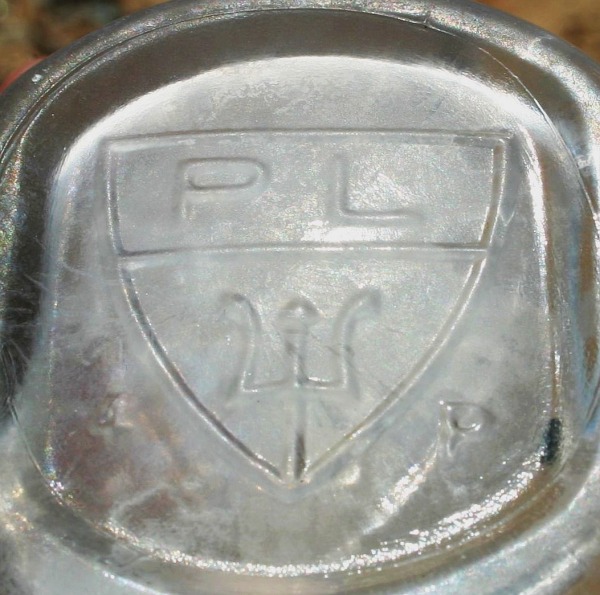
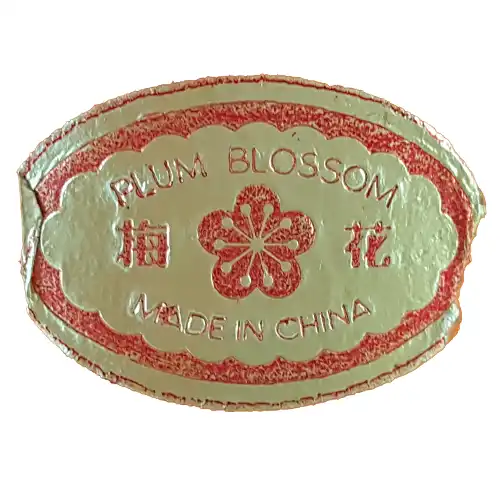
Undated
label · gold and red · glass · China
" " red & gold oval foil label.
Undated
glass
………………. Water was the name given to a natural mineral spring water bottled at French Lick, Indiana between 1913 and 1971. The water was sold primarily as a laxative because of the mineral salts dissolved in the water. Although the spring water in that area had been known and drank by European settlers as early as the mid-1800s, if not before, it wasn’t until 1913 that a modern bottling plant was built in the vicinity, and soon after the water was being bottled in tremendous quantity. Many of the earlier “ Water” bottles were made in a characteristic light green colored and are products of Root Company of Terre Haute, IN , but some of the later ones were made by Owens-Illinois. Other companies probably also made some of these bottles over the years. There are several different sizes of bottles found. The base of the bottle pictures the representation of “ ”, the Roman mythological god of the underworld. The picture is often interpreted as a “devil” with horns and a forked tail. Typically the word “ ” is placed below the graphic. There is some variability in the exact design of the image, as many different molds were made for this type of bottle.
Undated
glass
……………….. Poughkeepsie Company, Poughkeepsie, New York (1880-c. 1913)
Undated
glass
Pontil Marks (“Open Pontil” or “Iron Pontil” marks)………….. for a very basic page with illustrations of “Open Pontil” and “Iron Pontil” marks or scars seen on the bottoms of some antique bottles made in the US, please see this page: Pontil Marks on Antique Bottles.
Undated
glass
………………. Company, Muncie, Indiana (1890-1902); Belleville, Illinois (1902-1904). Plants bought by Ball Brothers Manufacturing Company in 1904, closed in 1910. Many fruit jars were made at this factory.
Undated
glass
……….most of these were made by Brookfield Company for the Postal Telegraph Company (1886-1945) and typically date from the 1895-1920 period.
Undated
glass
………………. , Bridgeton, New Jersey (c.1855-1863). This was one of the firm names under which the Bridgeton Works operated. Later became known as the Cohansey Works. “ ” mark is seen on fruit jars and on the base of cylinder whiskey bottles.
Undated
glass
…………………Trademark / Brand name assigned to a line of upscale glassware patterns produced by McKee Company , Jeannette, Pennsylvania. This marking appears on the base of many of these pieces, generally, most of it made during the period of c.1903-1920 . The patterns, known collectively as the “Tec” patterns, made use of elaborate “imitation cut ” designs, similar in general appearance to the finely-crafted cut that was very popular during that time frame. The 18 pattern names for this line include: Aztec, Bontec, Carltec, Doltec, Fentec, Glentec, Martec, Nortec, Plutec, Plytec, Quintec, Rotec, Sextec, Startec, Toltec, Valtec, Wiltec, and Yutec. They are very ornate, and often confused with each other. Also, please see next entry. Also see “Nucut”.
Undated
impressed · glass
“Prism” (a raised embossed mark that is often listed as a “prism” in insulator-collecting related literature, but actually was supposed to represent a typical rectangular cut emerald gemstone)……………… this mark appears on the skirt of some Knowles brand (C. S. Knowles, Boston, MA) electrical power line insulators, and these pieces are believed to have been made by Novelty Company of Elmer, New Jersey in the very early 1900s.
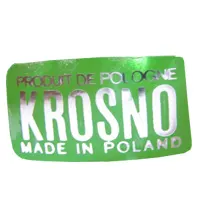
Undated
label · glass · Krosno, Poland
" " Polish plastic label.
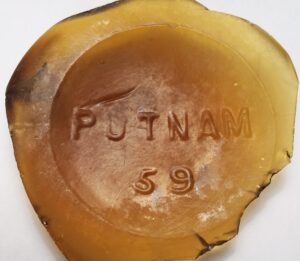
Undated
The caption tentatively dates the pictured jar fragment to the 1880s–1890s.
impressed · glass
59 is a mould number; the marking was used by several companies.
Undated
glass
……………….Putnam [Flint] Works, Zanesville, Ohio (c.1852-c.1871). Marking is arranged in a circle, and appears on the base of a wax sealer fruit jar. This factory went through many business name/owner changes and the exact period when these jars were made is uncertain.
Undated
glass
…………………….brand name used by Corning Works on a wide variety of glassware including bakeware, dinnerware, laboratory, medicinal and chemical bottles, and industrial including electrical insulators. For more info, please see webpage on Corning Company/Works, Corning, New York (1875-to date).
Undated
glass
……………..Unknown. Reported on base of drugstore bottles, principally from northern Illinois area.
Undated
impressed · glass
………………….. (on handmade bottles) probably Rochester Works, Rochester, New York (1862-1908). A “Doyle’s Hop Bitters” bottle is seen with a lone letter “ ” embossed on the bottom. Since the maker of Doyle’s was based in Rochester and was sold beginning about 1872, this seems like the most likely meaning. Also see “Rochester Wks”, “Reed” and “ in a triangle” entries.
Undated
glass
……………….. Reed & Company, Massillon, Ohio (1881-1904). See this page for more info: R & Co. mark on bottles.
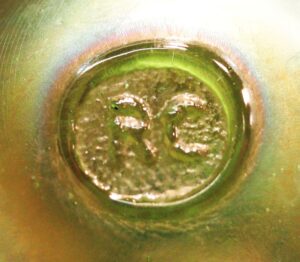
Undated
glass
…………….. Richard Cooper & Company, Portobello, Scotland (c. 1866- c. 1885). Seen on the bases of mouthblown black ale and wine bottles. For more information on this and related firms (including Cooper & Wood, a predecessor of R. Cooper & Co., and the later firm known as Richard Cooper & CO. Ltd.), please see this detailed article from Bill Lockhart et al: Cooper & Wood – SHA.org
Undated
glass
…………. See entry under “Key” on page three.
Undated
glass
……………………Rhodes & Bottle Company, Massillon, Ohio (1901-c.1920). This mark and the following variation is seen rather frequently on bases of amber and aqua beer bottles from cities in OH, PA, IN, MI, WI, and MD that I am aware of, and probably other states as well. An obscure company which was virtually unknown to most bottle collectors, nevertheless quite a number of bottles were manufactured over a period of almost two decades. The name of the company seems to have changed slightly at some unknown time during its history, with the “&” being omitted. Or, perhaps a few bottle molds were lettered “R.G.B.CO” either by accident or for some unknown reason.
Undated
glass
……………..Same as above. Presumably a variation of the above mark.
Undated
glass
………… Root Company, Terre Haute, Indiana (1901-1932). Mark used by Root in the early years (1901-c.1909). Toulouse (Bottle Makers and their Marks, 1971) stated these initials stood for Renton Company, Renton, Washington (1907-1911). However, the “R.G.CO.” mark which was used by Renton likely appears only on certain bottles from the West Coast. I do not believe any of the many Midwestern-origin soda and beer bottles seen with the “R.G.CO.” marking originate from Renton. See Root Company page .
Undated
glass
………..seen on base of druggist bottles made in Canada. Richards Company, Ltd. (later Richards Packaging), Toronto, Ontario, Canada. (1912- to date). Richards was/is a jobber/distributor and did not manufacture their own bottles, but had container ware made for them by Dominion Company (D in a diamond) and later by other unidentified glassmakers. See also RIGO, R (with bottle-shaped notch), and RP entries. For more detailed information on the Richards’ marks, see this thread at the Antique-Bottles.net site: Antique-bottles.net discussion thread: Have any of you Canadian collectors seen this mark? (Thanks to Glen Phillips and Eric Kloff for their help and research!)
Undated
glass
…………….. Probably Ravenna Works, Ravenna, Ohio (1857-1866). Seen on base of wax sealer fruit jars . (Dates courtesy of research by Brian Gray).
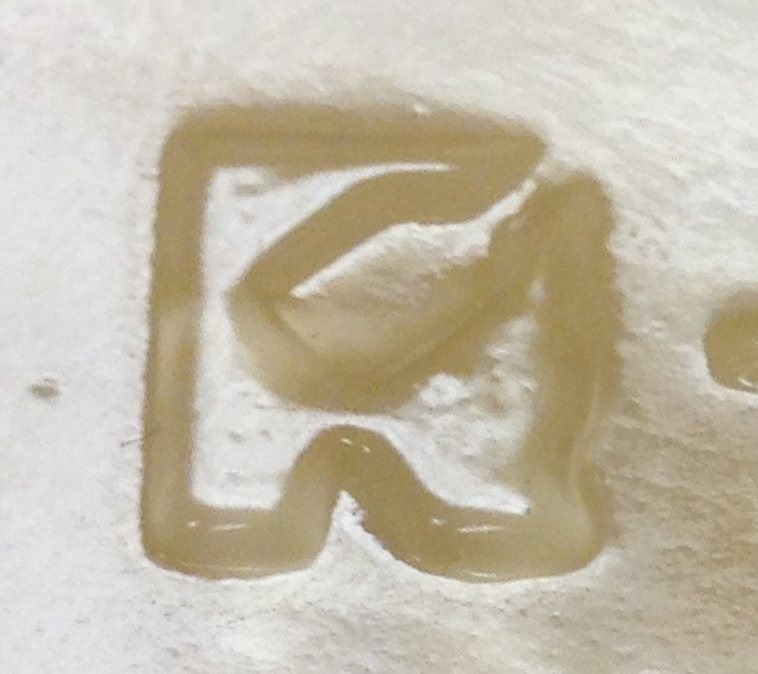
Undated
glass
…………….. Rock Island Brewing Company, Rock Island, Illinois. This mark probably dates in the years before prohibition, circa 1905-1920.
Undated
glass
R.I. (with number or letter and the word “SEAL” on milk bottles ) ………………… several manufacturers made milk bottles with this type of marking, required by law for bottle used / distributed within the state of Rhode Island. See list at this milk bottle site (archived and no longer live on the internet): Milk Bottle Marks – from the Dairy Antiques site
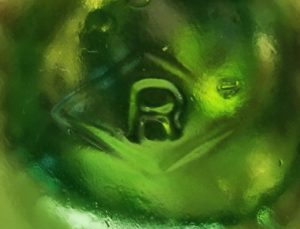
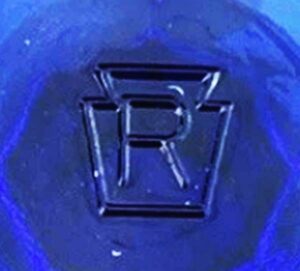
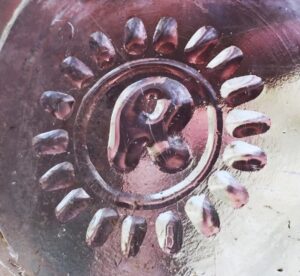
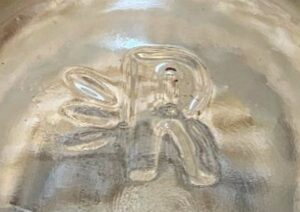
Undated
glass
with three feathers or leaves to its left on a packer jar; image-alt text attributes Armstrong Cork Company.
Undated
glass
R inside a capital letter “C”………….. unidentified meaning. The mark appears in the center of a clear stippled bottle base that looks to be from the early or mid-1970s.
Undated
glass
R (odd-looking trademark, sometimes may look like either an R or a K, with a bottle-shaped “notch” extending downward from the upper right side, shown)……………….. Richards Packaging, Mississauga, Ontario, Canada (originally operating under the name Richards Co. Ltd, formed in 1912). Richards is a distributor of and plastic containers, and has a number of distributing locations scattered throughout Canada and the United States. Most of their containers with this mark were made in China, and to some extent, some other Asian countries. This particular mark is often (but not always) accompanied by a four-digit number, and dates after 2005. Earlier containers, with their earlier trademark, an “RP” (see RP mark) date after 1982, and were made in Taiwan. Their website can be found at Richards Packaging . For even earlier marks, please see “R.G.Co.T” and “RIGO” entries on this page.
Undated
glass
………………….. unidentified trademark. This appears on the base of a generic packer jar made by Armstrong Cork Company, perhaps circa 1950s or ’60s. The mark is likely that of a food processing or distributing company. If anyone knows the identity of this mark, please let us know!
Undated
glass
R within a “Sun” or Sunburst……………. This mark is seen on the base of several styles of bottles, including cylindrical bottles that, judging from the style, probably contained floor wax, furniture polish or a similar product. The mark is also seen on bottles with the accompanying markings “DES PAT” and “94,231”, referring to a bottle design patent that was issued to Glenn A. Mengle on January 1, 1935, and assigned to Wizard, Inc, of Chicago, Illinois. Some later bottles indicated they had contained products made / sold by Midway Chemical Company of Chicago. A rectangular bottle containing a brand of multi-purpose oil (“Radiant Machine Oil”) has been recorded, made by Midway Chemical. The bottle package shows the design of the word “Radiant” placed within a sunburst. These bottles have been made by Owens-Illinois Company and possibly Brockway Company, and presumably date from the 1935 to mid-1950s era. Although the Mengle connection is referring to a “ patent ” of a bottle design, this “R in a sunburst” logo would assumedly be classed as a “ trademark “, of which specific detailed information has not been found as yet, at least to my knowledge. It seems that the “R in a sun” has been used as a trademark on a number of different household/cleaning-related products sold through both Wizard and Midway over the years.
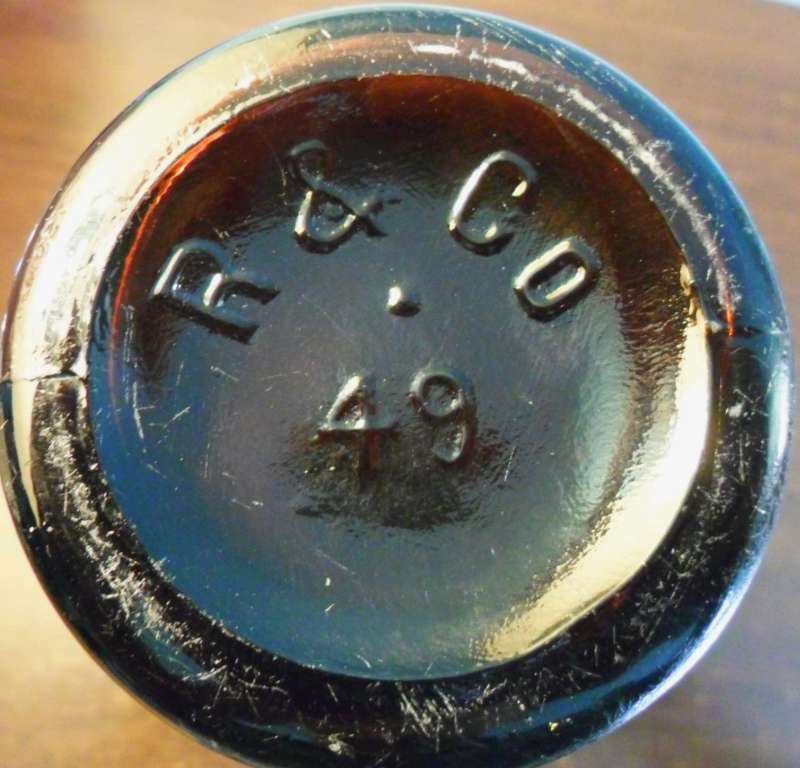
Undated
glass · Massillon, Ohio
Reed & Company beer-bottle base with 49 below.
Undated
glass
……………… Ravenna Works/Company, Ravenna, Ohio. There were actually several different business firms using the name “Ravenna Works” or “Ravenna Company” that operated for stretches of time between 1857 and about 1866. For more background information see this article by Bill Lockhart: Ravenna Company – SHA.org
Undated
glass
……………. Ravenna Works/Company, Ravenna, Ohio (1857-1866). These may have been made later within that time period.
Undated
impressed · glass
………………. , Ravenna, Ohio (1857-1866). Full name is found embossed on the face of fruit jars and whiskey flasks. Info on exact dates of operation courtesy of Brian Gray.
Undated
glass
…………………. bottles with his marking are quite frequently found throughout the United States. Please see this page for more information: Rawleigh’s – Freeport, Illinois .
Undated
glass
…………….Robert Coleman, independent artist who specializes in handblown iridescent (carnival ) pieces, some with an “art deco” influence. Vases, bottles, bowls, etc are found with this mark on the bottom. I’m not sure about years of production, but perhaps 1990s to present. If you have more info, please contact me!
Undated
glass
…………… same as above.
Undated
glass
Rectangle (two interlocking squared “hooks” that form a horizontally-oriented rectangle….. see “Hooks” entry on Page Three .
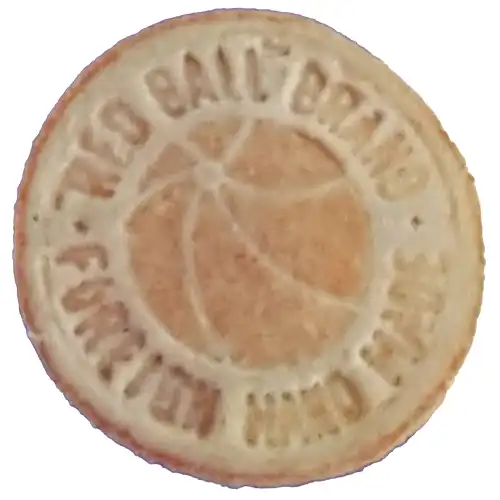
Undated
label · white and red · glass · Japan
Export label found on Japanese lampwork.
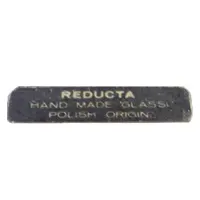
Undated
label · glass · Poland
British import label.
Undated
glass
…………. F. E. Company (or Company), Rochester, New York (c.1899-1956). See Rochester Works.
Undated
glass
………………as seen on base of crown-top blue-aqua tooled lip “export beer” style bottle, probably made circa 1895-1915. Unknown. (Reported by Lee Taylor). Could be either initials, or an actual surname for a brewer or bottling company?
Undated
glass
…………..Obear Nester Company, East St.Louis, Illinois (1894-1978). Mark used from 1896 to circa 1910? Trademark used by Obear-Nester, occasionally seen on base of clear prescription bottles. Please see “ N in a square ” page.
Undated
glass
………………another variation of “R. Cooper & Co.” (above).
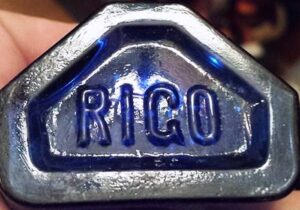
Undated
glass
…………. Richards Company Ltd., later Richards Packaging, Toronto, Ontario, Canada. (1912- to date) . As seen on cobalt blue poison bottles. Bottles actually made by Dominion Company. The “ ” mark apparently dates from 1912 to (at least) the 1970s. (Also, please see “R.G.Co. T” entry).
Undated
glass
………..Unknown. Reported to me as seen on beer or soda bottle base shard.
Undated
impressed · glass
……………………embossed marking on face of strapside flask. Made at the North Wheeling Works (dba Geo. W. Robinson), Wheeling, West Virginia (c. 1860s- c.1910). Exact time frame when these flasks were made is open to question, but they may date from sometime during the 1865-1875 period. Some sources (i.e. McKearin) indicate the works were in business as early as 1860. But in the earlier years window was the predominate product; later on they switched to making primarily bottles. George W. Robinson was the owner/manager of the works sometime in the 1860s/1870s. An 1879 reference ( History of the Pan-Handle , published by J. A. Caldwell) mentions “Mr. Robinson” was involved in early years, but indicates the works had just recently began operating with a new company (group of owners) under the name “North Wheeling Company”, for a “short time”, meaning perhaps since 1877 or 1878(?). The last mention I can find of this operation is from c. 1910 when young boys were striking at the factory.
Undated
impressed · glass
…………….. Rochester Works, Rochester, New York (1862-1908). Alice Creswick in The Fruit Jar Works (1995:273) shows this chronology for the Rochester Works and succeeding firms, evidently from city directory listings researched by either herself or Dick Roller: Rochester Works (1862-1881); Kelley & Co. (1882-1885); Kelley, Reed & Co. (1886-1887); Eugene Reed & Co. (1888-1889); E. P. Reed & Co. (1890-1894); Rochester Works (1895-1898); F. E. Reed Company/Works (1899-1900); Rochester Works (1901-1908); F. E. Reed & Co. (or F. E. Reed Co.) (1909-1927); Reed Co. (1927-1946); and Reed Co., Inc. (1947-1956). Several marks were used at various times by this factory, and the exact period of time that each mark was used is not entirely certain. Known marks include “Reed”, “F.E.R.”, “F. E. R. G. Co.”, “R in a triangle”, and “ ”. Some blob beer bottles are known with the marking “Rochester NY Works” embossed in a circle on the base. The full factory name could conceivably have been embossed on bottles dating from anytime within the 1862-1908 time frame. After a time of inactivity, the Reed Company plant at Rochester was purchased by Castle-Hanson Corporation in 1959, and the “C-H” mark was used for some period of time thereafter. Later, Leone Industries, based in Bridgeton, New Jersey, purchased the plant and their “L in an unconnected square” mark was used on ware produced at Rochester as well as Bridgeton. Exact dates of later operations of this factory are unclear. (See “R in a triangle”, “C-H”, and “L in an unconnected square” marks).
Undated
glass
………………… see next entry.
Undated
glass
……………. see “Anchor” (inside triangle) entry on Page One .
Undated
incised · glass
…………… Phoenix Studios, Fayetteville, Arkansas. These birds, usually in blue , but occasionally in other colors, are similar to the pieces made by Terra Studios, also of Fayetteville. (All birds marked “Leo Ward” on the base are products of Terra Studios.)
Undated
glass
……………….for more information please see this page: Root Company, Terre Haute, Indiana (1901-1932).
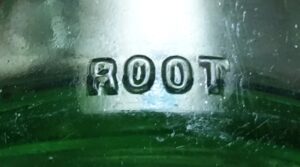
Undated
The caption dates the John G. Epping soda bottle approximately to the 1920s.
glass
……………..Richards Packaging, Mississauga, Ontario, Canada. This”RP” mark dates after 1982, and indicates production in Taiwan by unidentified factory(s) for Richards. Richards instituted their later “odd-looking R” mark in 2005 (as shown, above on this page). Also see “R”, “RIGO” and “R.G.CO.T.” marks. “ ” on lower heel of light green John G. Epping, Louisville, KY soda bottle, circa 1920s.
Undated
glass
……………American Bottle Company, Streator, Illinois plant (1905-1916). Mark was probably used only for a brief time. Not often encountered, usually the mark is “A.B.CO”. See also “16S” mark.
Undated
impressed · glass
………………….in most cases, those initials stand for Sharp & Dohme, Baltimore, a pharmaceutical company founded in 1860 that merged with Merck in 1953. The exact period of use of those letters, as embossed on the bases of various medicine bottles, is unclear – possibly during the 1900-1930 era? Also, collector Steve Hale reports a handmade blob-top beverage bottle, evidently made for soda or beer, marked / 112″ on the base. That bottle may have no connection whatsoever with Sharp & Dohme.
Undated
glass
S & L C (could be either “C S & L” or “S & C L”) ……………… unidentified mark seen on base of handmade black ale bottles that are almost certainly products of Great Britain. The exact order of the letters is unclear, although I presume the letters are to be read in a clockwise direction, beginning with “S”. There is a raised bump or dot (mamelon) in the center of the base, often seen on these types of bottles. This mark probably dates from sometime in the 1860s-1890s. I know of only two reports of this mark (so far), so presumably the factory was rather obscure or short-lived, or else they didn’t mark most of their bottle production. Other black ale bottles made in Great Britain (and exported to other countries including the US) that are somewhat similar in general “look” would include those marked “C W & Co”, “G W & J”, “Dixon & Co.”, “M C G Y” and “Woolfall Manchester”. The great majority of British black ale, stout and wine bottles of this general type are unmarked. The “black ” is in most cases a very dark olive amber or olive green color, but appears nearly black in reflected light. The bottles were typically made in a three-piece mold, and often have a rather crudely applied lip.
Undated
glass
…………………………. Southwick & Reed (one of the many proprietorship firms that operated the Clyde Works, Clyde, New York (c. 1864-c. 1868?).
Undated
impressed · glass
………….. Unknown. Embossed on the base of a Bludwine Bottling Co. bottle, handblown, slug plate, probably circa 1906-1915 era.
Undated
glass
………………….Swindell Bros, Baltimore, MD (1869-1959).
Undated
glass
…………………….Streator Bottle & Company, Streator, Illinois (1881-1905). The Streator plant eventually became part of the American Bottle Company, later Owens Bottle Company, and finally part of the Owens Illinois Company (Plant #9). “ .” is one of the most commonly seen marks on handblown beer bottles from the late 1800s and early 1900s. Many, many private brewers and bottlers from the Midwest and eastern United States had bottles specially made for them by Streator. The mark is also seen on other typical utilitarian bottles of the period, including pickle bottles, soda and mineral water bottles and other containers.
Undated
glass
………………. unknown/unidentified meaning. See photo above. Reported on the base of a flask and also on a cylindrical, mouthblown, tooled lip “fifth” liquor bottle with “brandy” style lip, both in very light sun-colored amethyst. The bottles appears to date from the 1890-1920 period. This mark might stand for either a distiller or a maker. All known bottles with this marking have been found in the Western US states.
Undated
glass
……………… Saltsburg Bottle Works Company, Limited, Saltsburg, Pennsylvania (c.1890-1903), also plants at Avonmore, PA (c. 1893-1904) and McDonald, PA (1900-1904). Best known as a manufacturer of clear (“flint”) druggist bottles. The McDonald plant later became the Warner Company (1904-1911) and then Crescent Bottle Company (see “Crescent Moon” logo entry). The mark “S B W CO” was also used, see next entry. For more detailed background info, see this article by Bill Lockhart & the Bottle Research Group: Saltsburg Bottle Works Company.
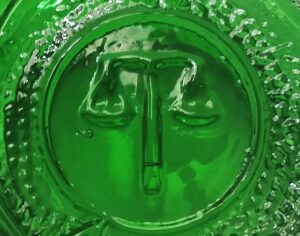
Undated
glass
Scales emblem on a small green jar made for McKesson & Robbins, possibly an ointment jar.
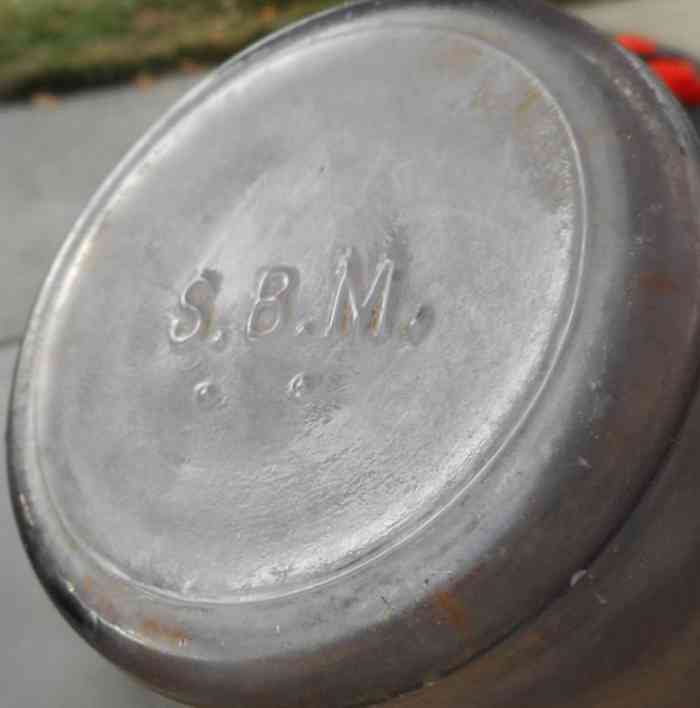
Undated
glass
Mark on a light-amethyst mouthblown cylindrical liquor bottle.
Undated
glass
S C R (or possibly “S G R”), as seen on the base of clear one-pint strap side flask, double ring finish, marked “HONEST MEASURE” and “FULL PINT” on front………………………… Unknown meaning, possibly a distiller? (Thanks to David Weaver for submitting info on this bottle).
Undated
glass
S (either a “plain capital S” or a graceful cursive script “S” that looks very similar to a treble clef symbol as used in written music)………………………… as seen on the base of upscale tableware and ornamental / decorative glassware including iridescent (Carnival) : L. E. Smith Company, Mount Pleasant, Pennsylvania (1907-2007). The cursive S mark was introduced in the 1960s and evidently was used on only a very small percentage of their output. The L.E. Smith factory was closed in June, 2004. Scottish-born Pittsburgh businessman William Kelman purchased the property in 2005 and hoped to revitalize the works, and the factory was apparently able to continue making some more for a while, but evidently shut down permanently sometime in 2007 (online sources are contradictory or unclear – can you tell me when the last was ACTUALLY manufactured there?).
Undated
glass
S. F. & Co. W. W. VA. (on base of aqua “wax sealer” style fruit jar, lettering is arranged in a circle) ……………… attributed to Stoetzer, Frank & Company, Wellsburg, West Virginia. This was evidently a firm name (business partnership name) used for at least a short period of time for the Frank Works/Company (1896-1903). Those initials have not been documented on any other type of bottle or jar.
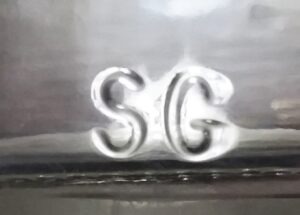
Undated
glass
Saint Gobain Containers / Verallia North America mark on a clear packer-jar heel.
Undated
glass
…………………….Sheldon-Foster Company, Gas City, Indiana (1894-c. 1902+) and Chicago Heights, Illinois (c. 1901-1912). This company made many druggist bottles that were sold by jobbers including A. M. Foster & Co and Dean, Foster & Company. More info on this page by Bill Lockhart et al: The Sheldon-Foster Co. and Related Companies
Undated
glass
S. F. (on skirt of CD 102 and CD 112 style “pony” telephone insulators)…………………….. unknown meaning. There has been much discussion over the years among insulator collectors as to the correct meaning of these initials, but to date no one has proven what they stand for. These insulators appear to date (from their style and “look”) from sometime in the 1900-1915 period, and are found in shades of aqua and green. Many have been found in the western parts of the United States. The most plausible theory points to Fobes Supply Company, an electrical supply company operating in the Western states in the early 1900s. But if that were the case, why isn’t the embossing “F. S.” rather than “S. F.”? Here’s a good article written by the late collector and researcher Frank Swies: “S F” article from Crown Jewels Magazine – April 2006.
Undated
glass
………………………. Several factories used this mark (at least four, probably more) . One fairly strong probable user of the mark was Scranton Company, Scranton, Pennsylvania (1881-c.1895) as there are a number of known types of bottles with embossings of local Scranton businesses which carry . , usually on the reverse heel. No proof that Scranton was involved, but perhaps time will tell. Nevertheless, here are listed four companies that I am certain actually did use this mark, at least on some items they produced
Undated
glass
……………Sydenham Company, Wallaceburg, Ontario, Canada (1894-1913)
Undated
glass
………probably Severn Company, Annapolis, Maryland (c.1897-c.1901). Severn Company was a successor to Annapolis Works, originally incorporated May 12, 1885 in Annapolis. (Per information found by Tod von Mechow).
Undated
glass
…………probably Southern Company, Vernon, California (1919-1930)
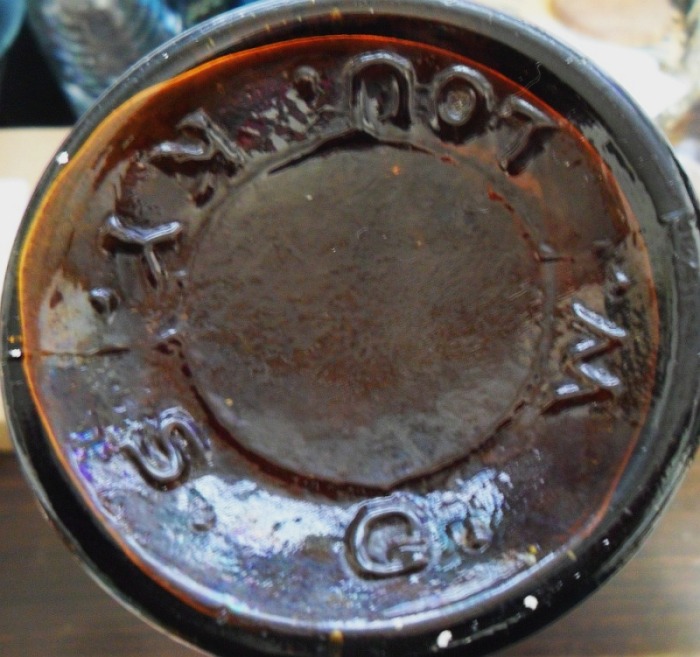
Undated
glass · Louisville, Kentucky
Southern Works mark on an amber cylindrical whiskey bottle.
Undated
glass
…………………. Southern Works, Louisville, Kentucky (1877-c.1885). For more information on this works, please see my page on Southern Works . For info on some other nearby glassworks, see Kentucky Works Company and Falls City Company , both of which were also located in Louisville and operated during much of the same general time period. Also, see the Star Company which made across the Ohio River in New Albany, Indiana.
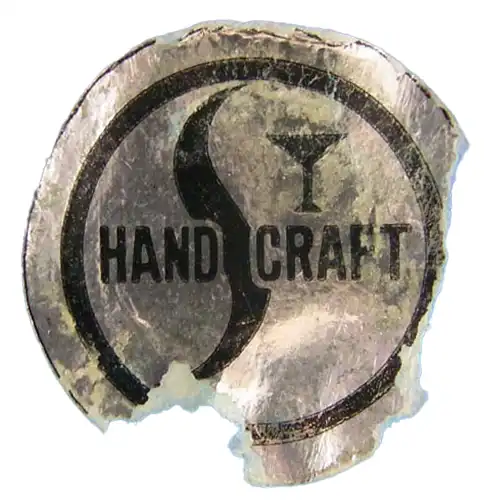
Undated
glass
…………….Southern Indiana Works, Loogootee, Indiana (1907-1912). Southern Indiana Works became Graham Company in about 1912, with a factory at Evansville, Indiana. See “Graham”. For more background info on this company, see this article by Bill Lockhart et al: Graham Company .
Undated
impressed · glass
………………………..this mark was used by at least FOUR different companies (within the United States) over the years: * Swindell Bros, Baltimore, Maryland (1869-1959). This was a bottle manufacturer. Reportedly used on machine-made bottles after c. 1920, per Julian Toulouse in “ Bottle Makers and their Marks “, 1971. * Sterling Company, Lapel, Indiana (1914-1950). Hand-blown bottles were produced from 1914 to 1918, at which time semi-automatic production was introduced. Sterling operated as the “Sterling Division” of the Warfield Company of Chicago from about 1940 until 1950. Brockway Company bought the Sterling factory in 1950. * Southern Company (seen on base of crown-lip soda bottle embossed “Crystal Bottling Works, Tucson, Ariz.)……………………. the meaning of this particular “ ” is open to question, but researcher Bill Lockhart believes it may have been used by Southern Company, Vernon, CA, on a few soda bottles. (Also see “S in a diamond”, below). For more information, see this article from Bill Lockhart et al: The Mysterious Letter S – SHA.org. * Sneath Company, Tiffin, Ohio (1892-1894) and Hartford City, Indiana (1894-1952). This particular “ ” mark is most often seen on certain types of glassware including kitchen canisters (storage jars). Sneath operated for a short time in Tiffin but a new plant was built and started production in September of 1894. Sneath made a wide variety of types of glassware, including kerosene lamp globes, semaphore signal globes and “Hoosier cabinet” jars such as spice jars, coffee and tea jars, salt and pepper sets, etc. The “Hoosier cabinet” jars were especially popular in the 1920s and 1930s. For a much more comprehensive article on Sneath, see the Wikipedia article here: Sneath Company – Wikipedia article * ALSO: An “S inside a circle” mark has been seen on the bottom of a white milk wide-mouth jar/bottle, possibly connected with the “TANG” brand orange flavored powdered drink mix, and dating from the early 1970s. This piece features a daisy motif encircling the shoulder area of the bottle. The S mark in this case has not been identified with certainty, and was used long after the other companies listed above were out of business.
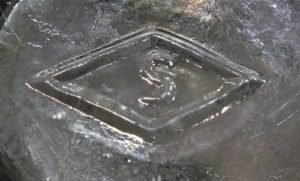
Undated
The caption dates the pictured Southern Glass Orange Crush bottle approximately to the 1920s.
incised · glass · Vernon, California
………………. Uncertain. Seen on the base of a handblown light aqua blob lip “champagne beer” bottle, c.1890-1920. It is possible (or probable) this mark could be an “ in a circle” and the raised dots are merely the effect of four air vent holes positioned in the engraved circle portion of the mold. Also, see above “ in a circle” entry. “ in a diamond” on base of 1920s-era Orange Crush soda bottle, Southern Company, Vernon, CA. (Photo courtesy of Tom K.)
Undated
glass
……………… said to be one of the marks used by L. E. Smith Company, Mount Pleasant, Pennsylvania (1907-2007). Reportedly, this is a more recent mark used in the 1990s (?). Please see “S” entry at top of this page.
Undated
glass
……………………. On machine-made bottles , Southern Company, Vernon, California (1919-1930). Please also see the next entry. (For more information on Southern Company, see this article by Bill Lockhart et al): Southern Co., Vernon, California – SHA.org
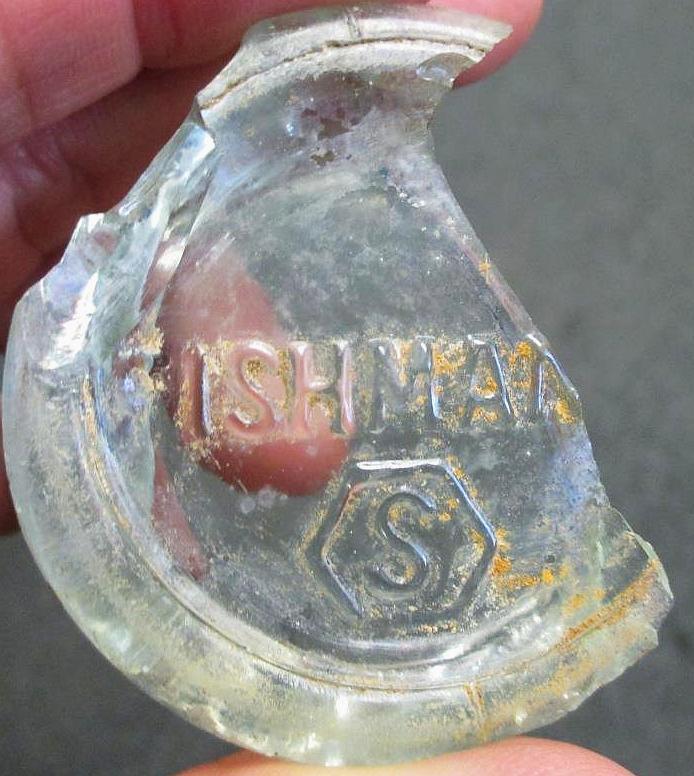
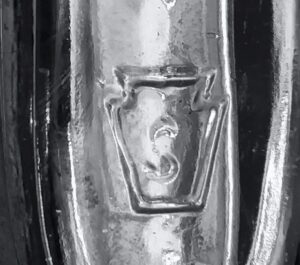
Undated
glass
……………. Seaboard Bottle Company, Pittsburgh, Pennsylvania (1943-1947)
Undated
label · glass
S in a rectangle (confirmed on base of dark olive green “case gin” bottle)………. Unknown meaning. One of these bottles was found with a partial paper label still attached for a gin brand from Rotterdam, in the Netherlands. The bottle is definitely machine made, as the vertical side seams extend up onto the very lip. This mark likely stood for an unidentified glassmaker in Western Europe. The bottle probably dates from sometime in the 1910-1940 time period.
Undated
glass
………………….Unidentified with certainty, but probably H. W. Streeter (Harry Winton Streeter) of Greenfield, Indiana (c.1896-1900). The factory was evidently known as the “Streeter Jar & Bottle Works”, as well as “Streeter Company” depending on source of info. (Not to be confused with Streator Bottle & Company of Streator, Illinois, an unrelated bottle manufacturer that used the mark S.B & G.CO. ). H. W. Streeter moved to Terre Haute, IN in 1900 and (under the name Terre Haute Mfg Co.) operated until about 1903. The firm made fruit jars and bottles. This mark is not common but has been seen on the bottom of a few bottles, such as an amber beer bottle marked “A HASS / HOUGHTON MICH / BREWING CO.”. That blob top lip bottle is of the “champagne” or Apollinaris style – one of the bottles shown on this page: Beer Bottle Library – Bruce Mobley – A HASS Brewing Company, Houghton Mich. Some more info on bottles found with the “ ” mark is here, pages 288-289: Other S Marks – Bill Lockhart & the BRG – SHA.org
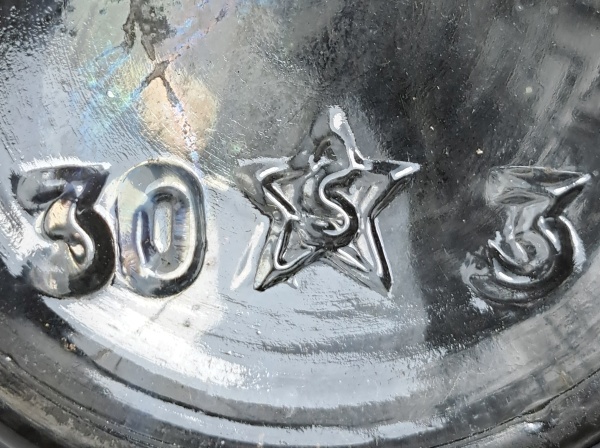
Undated
The caption interprets 30 on the Southern Glass bottle as a 1930 date code.
glass · Los Angeles, California
……………..Unknown. “ in a star” – Southern Company, Los Angeles, CA. Here on the base of colorless crown top General Foods bottle – “30” is a date code for 1930. (Photo courtesy of Tom K).
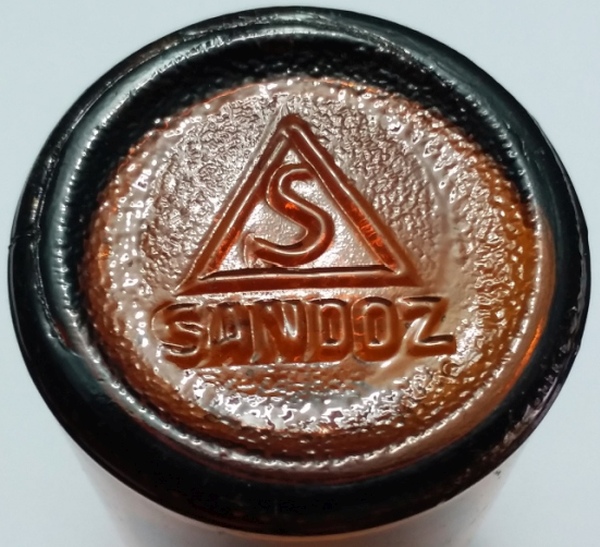
Undated
impressed, label · glass
……………… as seen on the base of small amber pharmaceutical bottle. The Sandoz company was founded at Basel, Switzerland in 1886 by Alfred Kern and Edouard Sandoz, at first producing color dyes but by 1895 their first pharmaceutical products were being sold. The company produced many pharmaceutical products during the 20th century, including those made to treat migraine headaches. Their most well-known product was probably the drug LSD, first made in 1938 but sold by Sandoz from 1947 to 1965 under the brand name DELYSID. The company merged with Ciba-Geigy in 1996 to become Novartis. By 2023 Sandoz again became a “standalone” company, operating under its former name. The brand name Sandoz is now used for a variety of “generic” drugs. Some more basic info is here – SANDOZ – Wikipedia article. The photo above shows the mark embossed on the base of an amber bottle about 2 and 3/4ths inches in height. The “S in a triangle” trademark was used for many years on their bottle bases and lids. I don’t have info on the exact time period of use for the mark. This particular bottle was found in a dumpsite that was closed in 1952, and the bottle likely dates from the 1930s- early 1950s. The actual glassmaker is unknown, presumably made in Switzerland or another country in Western Europe. With no label, the former contents are unknown but it may have held a product such as Scilleren or Gynergen.
Undated
glass
…………….Sotancro, Embalagem de Vidro, S.A., Lisbon (Lisboa), Portugal . Seen on the base of a miniature green bottle, probably a liqueur, imported to the USA (photo below).
Undated
glass
…………..See “G in an oval”. Gallo Company mark might be mistaken for an odd-looking “S”.
Undated
glass
……….Shields, King & Company (Proprietors of the Newark Star Works, Newark, Ohio (1871-c. 1880). Also, see “ N next to or within a star “ and “E.H.E.CO.” entries.
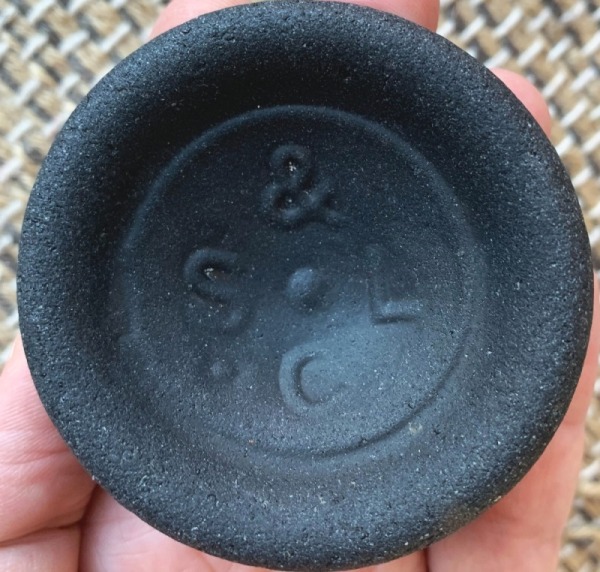
Undated
impressed · glass
Caption reads the initials as S & L C or C S & L on a black- base fragment.
Undated
glass
………………… Smith, Kline & French Co. (see next entry).
Undated
glass
……………..Standard Milk Bottle Manufacturing Company, Parkersburg, West Virginia (1911-1912). Seen on milk bottles.
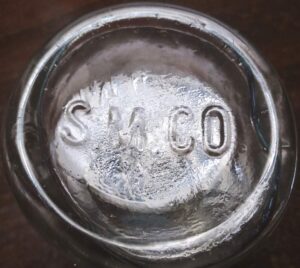
Undated
glass
…………………….seen on the bottom of many small ink bottles…………….. Sanford Manufacturing Company, later Sanford Ink Company. I suspect most of the bottles marked with these initials date from the 1880-1920 period.
Undated
glass
……………. S. McKee and Company .
Undated
glass
…………. same as above.
Undated
glass
……………See next entry.
Undated
glass
……. S. McKee and Company , Pittsburgh, PA (c.1834-1908).
Undated
impressed · glass
………………….In some cases this mark was used by Lyndeboro Company, South Lyndeborough, New Hampshire (1866-1888). The “S” is seen on the bottom of some hand-blown strap-side liquor flasks (usually in amber or blue-aqua) and certain other bottles which are found in the eastern states. (Thanks to Mark Newton for this info). If the “S” is on a clear bottle, or on a machine-made bottle, that would indicate another maker. Note : as with the great majority of cases involving soda bottles of the late 19th and early twentieth century, if the bottle base has just a large letter, such as S (or any letter, or initials comprised of 2 or more letters) and this corresponds to the initials of the bottling company name embossed on the front of the bottle, that would serve as a self-explanatory meaning, and nearly always does not indicate the manufacturer. Many such bottles with an initial on the base were purposely made with no manufacturer identification.
Undated
glass
…………………….. unknown meaning.
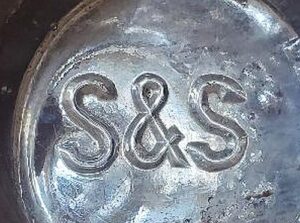
Undated
glass
…………… Unidentified. This might stand for a distributor or housewares company? I suspect this dates from sometime in the 1960s or 1970s. Any info from readers is invited!
Undated
glass
…………………………. Seen on the base of a clear tooled-lip mouthblown prescription/druggist bottle. From recently uncovered information, the initials most likely stand for the Saginaw Valley Drug Company of Saginaw, Michigan, a wholesale drug manufacturer and jobber. They made and/or sold a wide variety of drugs, chemicals, and such products as lemon and vanilla extracts. They were in business at least as early as 1899, in business until c. 1915 or later.
Undated
glass
S. W. G. Co (initials seen on heels or bases of aqua mouthblown bottles including “Codd” style mineral water / soda bottles)……………South Wales Company, Newport, Wales, United Kingdom (1886-circa early 1920s?). This operation was also known as South Wales Manufacturing Company, Crindau Works, and Newport Works. This webpage includes some excerpts of period newspaper articles on the glassworks: Crindau Glassworks – Newportpast.com
Undated
glass
S (with smaller letters “G” and “C” inserted within the upper and lower spaces/curves of the “S”)………………seen mostly on carnival tableware and novelties…….. L. E. Smith Company, Mount Pleasant, Pennsylvania (1907-2007). See entry above.
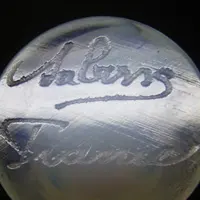
Undated
glass
………………triangular logo vaguely resembling a with sails unfurled. Please look farther down on this page for the “Triangular Logo” entry: a mark used by American National Can Company.
Undated
glass
………………. several varieties of “Mason” style fruit jars are known with the brand name, including the Genuine Mason , the Super Jar , and the Super Mason . In The Fruit Jar Works, Volume 2 (Alice Creswick, 1987) she credits these jars to date from circa 1930 to 1940. A trademark for the name “ ” was issued on November 1, 1931 to the Samuel Mallinger Company of Pittsburgh, PA. The company claimed actual use since August 1, 1931. According to Creswick, the Knox Bottle Company, Inc, of Marienville, PA was the primary manufacturer of these jars, but other possible makers included Glenshaw Company, Glenshaw, PA. and the Ball Bros Company , Muncie, IN. (The “ Genuine Mason” jars are virtually identical to “Knox Genuine Mason” jars with the word “ ” [inside the circle] substituted for “Knox”). Some of the jars came with a metal screw band with milk insert marked .
Undated
glass
……………………… , San Francisco, California (c.1865-1876). Full name is seen spelled out on the front of some “squat” soda bottles, circa mid-1870s. Originally started by Carlton Newman, and known as San Francisco Flint Works, but after a serious fire in 1868 the works were rebuilt and the name was changed to . Operated until 1876 when this company merged with Pacific Works to form San Francisco & Pacific Works. A photograph from the 1870s (courtesy of Alexander Kerr) is shown on page 289 of “The Fruit Jar Works” by Alice Creswick (1995), and the photo shows a large display of wares made by this company including fruit jars, wine bottles, beer, ale, whiskey, soda bottles, pickle jars, medicine bottles, and many demijohns and carboys with & without wicker coverings. Most of these bottles probably were not marked, or marked with the user instead of the maker. Some are believed to be identified by a characteristic star marking on the base (See “Star” entries on this page).
Undated
label · black and gold · glass · Japan
" " black & gold circular foil label.
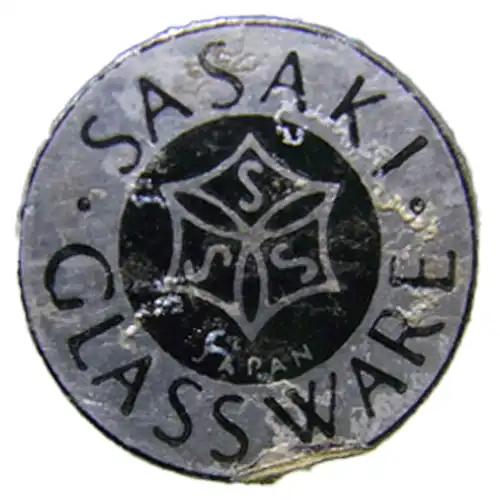
Undated
label · black and silver · glass · Japan
" " black & silver circular foil label.
Undated
glass
…………………….Occasionally the “Diamond/O/I” mark used by Owens-Illinois Company has been compared to a vague representation of the planet , or as a cat’s eye. Please check the Owens-Illinois summary page for some pics that show variations of this commonly seen mark.
Undated
impressed, label · glass
SB (S B), as seen on base of dark teal green wine bottle embossed “Real Vinicola” on front……………… Santos Barosa & Co, Marinha Grande, Portugal. Of course, this mark has no connection whatsoever with Swindell Bros in the United States. Julian Toulouse ( Bottle Makers & their Marks , 1971, page 596) lists this manufacturer mark but doesn’t supply a date range for its use. The wine bottle I’ve seen with this mark also bears a label for “Lagosta” Rose table wine, and was imported to the US by Austin, Nichols & Company of New York City, NY. and it looks like it could date from the 1950s or 1960s. The Santos Barosa factory is evidently now part of Vidrala, a large container manufacturing company with factories in several western European countries.
Undated
glass
…………..Uncertain, but perhaps Swindell Bros.
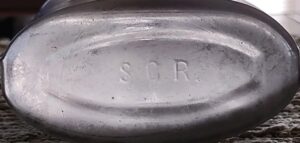
Undated
impressed · glass
Caption reads SCR or possibly SGR on an Honest Measure one-pint flask.
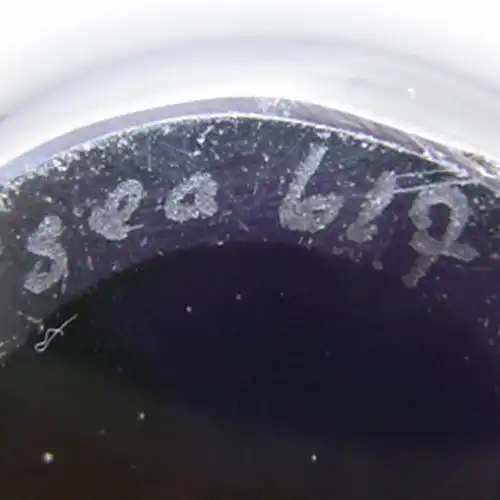
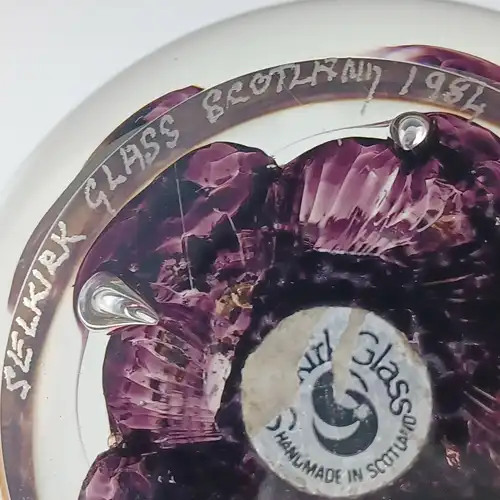
Undated
The source identifies 1984 as the accompanying signature date.
glass · Scotland
" " signature, with 1984 date.
Undated
incised · glass
………….. Seneca Company, Morgantown, West Virginia (1896-1983). Seneca started at Fostoria, Ohio in 1891 and moved operations to a new factory at Morgantown in 1896, starting production there in early 1897. This mark on tumblers probably dates from the 1970s-1983 period. If you have information that narrows down this mark more precisely, please contact me!
Undated
glass
……………………………Saint-Gobain Containers, Muncie, IN [head office], known (2010-2014) as Verallia North America, (mark dates 2000- to mid/late 2010s). Many typical modern “packer” jars and bottles found on grocery store shelves here in the United States, such as for jelly, jam, applesauce, etc, bear this mark, usually on the heel of the container, sometimes the base. Verallia North America was bought by Ardagh Group in 2014. For a little more info, see the “U” mark used by Ardagh Group, pictured farther down on this page, and the individual webpages SG mark , and Ball Bros Company.
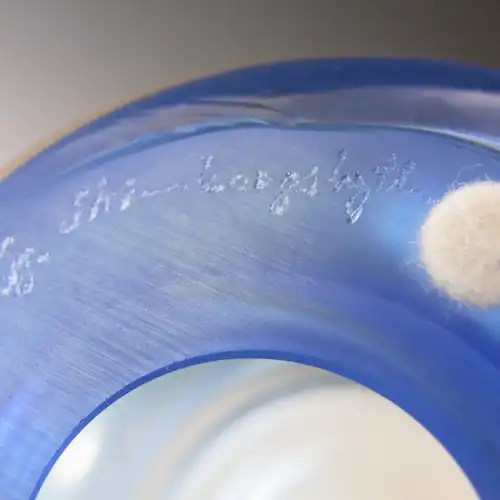
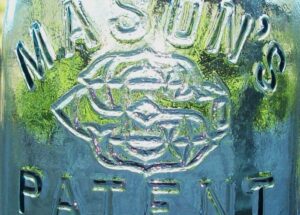
Undated
glass
Swayzee Company monogram on a Mason's Patent jar; the patent year is not a production date.
Undated
impressed · glass
…………………. Swayzee Company, Swayzee, Indiana (1895-1906). This “S G Co” monogram is seen embossed on the front of certain “Mason’s Patent Nov 30 1858” type fruit jars. The emblem is placed between the words “MASON’S” and “PATENT”. The variant usually found is listed as jar #1974 in the “Red Book” price guide used by antique fruit jar collectors. The jars are typically marked on the bottom with a three-digit number (a mold identifier). The letters comprising the monogram may be difficult to identify and are often misunderstood by collectors. This marking was attributed to Safe Company, Bowling Green, Ohio; Redkey, Indiana; later, Upland, Indiana, by author Julian Toulouse. Since the publication of his books (1968, 1971), wooden shipping crates have been found with illustrations of a Mason Patent style jar with the SGCO monogram – identifying it beyond doubt to have actually been used by Swayzee. (Although the monogram on the shipping crates is not absolutely identical to the monogram on the jars, it is very similar, and I don’t think the jars should be attributed, because of that difference, to any other company such as Safe Co. Artists doing work for packing crates, letterheads, patent records, etc., in the 1800s often took some liberties with the exact appearance of a design or trademark for a business). All “SGCO monogram” Mason’s Patent NOV 30TH 1858″ jars are handmade with ground lips, which would identify them as early Swayzee production, circa 1895-1898. Since the “Swayzee Improved Mason” jars (all machine-made) were produced beginning around 1899, that jar was promoted as an “improvement” on a previously made jar by Swayzee. And the SGCO monogrammed Mason jars fit that bill quite well.
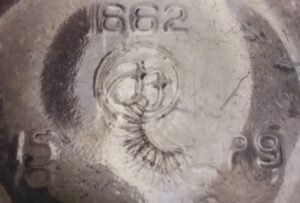
Undated
glass
Shear-mark imperfection resembling an eyelash on a Foster Forbes packer-jar base.
Undated
impressed · glass
…………………. , Philadelphia, Pennsylvania. (c. 1845- c. 1874). “SHEETS & DUFFY” was embossed on a few historical / figural type flasks including “calabash” type flasks. The flasks with that marking might have been made mostly in the 1860s, although no one seems to be very sure just when they were blown. The operation was evidently one of the earlier factories associated with Dyottville. (See Dyottville Works).
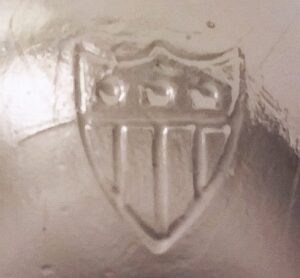
Undated
glass
Unidentified shield emblem on a clear jelly or tumbler; image-alt text suggests circa 1900–1930.
Undated
glass
……………Unknown meaning. The accompanying photo shows the mark as it appears on the base of a clear jelly , packer or small tumbler (which might have originally been sold filled with mustard, soft cheese, peanut butter or some other food product), probably circa 1900-1930 period.
Undated
impressed · glass
……………..Chicago Heights Bottle Company, Chicago Heights, Illinois (1912-1913). Trademark reportedly seen embossed on the base of bottles from this short-lived company. Became part of Illinois Co in 1913.
Undated
glass
…………………….. black cylindrical utility “wine” or spirits bottle marked “A. SINCLAIR / LIVERPOOL” in a circle on the base was posted on antique-bottles.net by collector Harry Pristis. Evidently “Archibald Sinclair” and later “Archibald Sinclair & Company” operated as a bottle maker in the c.1823- c.1828 period, possibly later, in Liverpool, England.
Undated
impressed · glass
★ (Small five-pointed star embossed on skirt of electrical insulators). These insulators were marketed by General Electric and are believed to have been made by at least 4 companies, three of them located in Elmer, New Jersey. Those companies included Sterling, Harloe, and Novelty. Some were also made by Brookfield Company of Brooklyn, NY and Old Bridge, NJ. (According to researcher Bob Stahr, there is no evidence to show that any Star insulators were ever made by Hemingray Company). Some more basic information on these insulators can be found in Brent Burger’s article here: A History of the Star Insulators – Brent Burger – Insulators.info
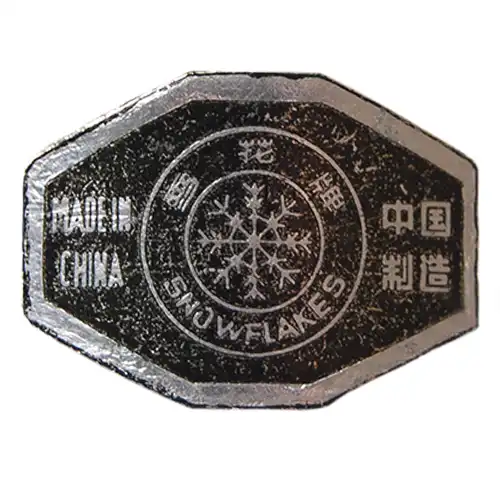
Undated
label · black and silver · glass · China
Found on the Snowflakes range by The Dalian Co.
Undated
glass
…………….see Weeks & Gilson entry.
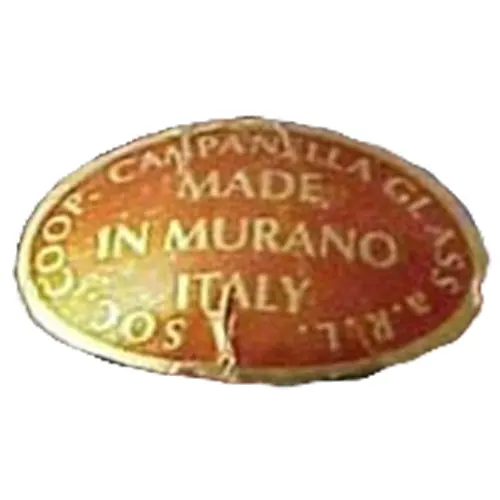
Undated
label · gold and red · glass · Murano, Italy
" " oval red & gold foil label.
Undated
impressed · glass
………………. embossed marking on the rim of small “forest green” colored automobile tail light………………. No information.
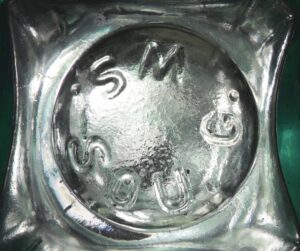
Undated
glass · Louisville, Kentucky
Southern Works marking on a pickle-bottle base.
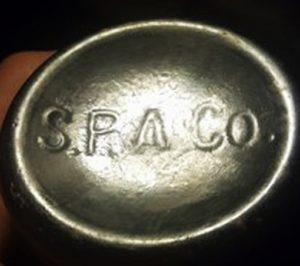
Undated
glass
……………………..embossing seen on early historical / pictorial flasks. This was one of the two factory sites in Baltimore, MD that also operated under the name “Baltimore Works”. (See Baltimore Works entry). There is conflicting information concerning the exact stretch of time the factory was designated with this name, but the flasks with the embossing (sometimes the lettering looks more like one word, “Glassworks”) were likely blown sometime during the 1850 to 1870 period. Some flasks from this works bear Anchor and Log Cabin designs.
Undated
glass
………….Silver Spur Corporation, Cerritos, California (1978-to date). All bottles are actually manufactured in Taiwan and China. Business offices and warehouse is located in Cerritos.
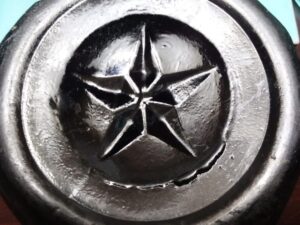
Undated
label · glass · Louisville, Kentucky
Star Works mark on an A. Templeton cream-ale bottle.
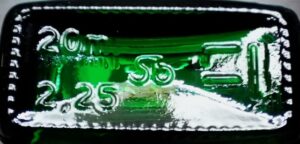
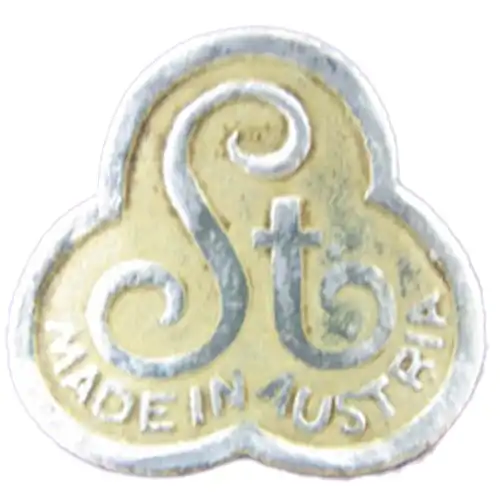
Undated
label · yellow and silver or worn gold · glass · Germany
" " yellow & dilver (or worn gold) foil label.
Undated
glass
……… (on the front of “WARRANTED FLASK / UNION MADE” flasks)………………… this bottle (made in a range of sizes) is attributed to the Star Company of Medford, New Jersey (also known as Medford Works), and is fairly commonly seen in the Eastern states of the US. According to Adeline Pepper in her reference book The Gaffers of New Jersey (1971), page 175 , the Star Company operated (under that name) from 1894 to 1923 and made a variety of bottles. Glassworks on the site of Star evidently operated as far back as 1825, at first making window . This historical plaque/marker (link below) gives “1850-1923” as the years for Star. I presume that covers the operation of the bottle works under other names. Local NJ area collectors and researchers of these bottles may have more precise information on the name changes and date ranges. Star Works – Medford, NJ – historical marker .
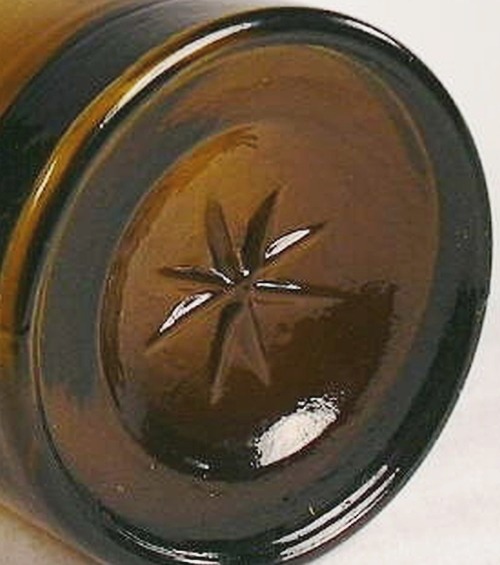
Undated
glass
Star on an olive-amber cylindrical whiskey bottle attributed to a Western US glasshouse.
Undated
label · glass · China
Stamped mark beside a Made in label on controlled-bubble sommerso sold at Debenhams.
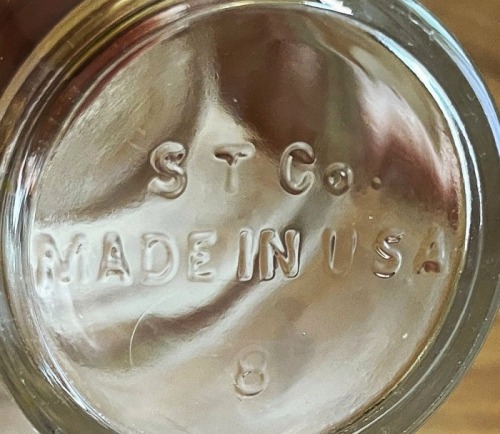
Undated
impressed · glass · United States
Mark on a small clear spice jar.
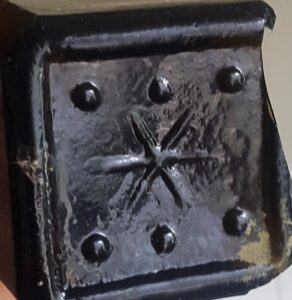
Undated
glass
Star or snowflake emblem on an olive-green case-gin bottle base.
Undated
impressed · glass
…………………….. Star Company (Star Works, New Albany, IN ). “ ” marking embossed across the face of wax sealer style fruit jars . These jars have been found in several colors including shades of aqua, green, citron and amber. See above entry.
Undated
glass
…………..made by an unidentified company. The style (profile) of the jar is reminiscent of some wax sealers made by factories in St. Louis.
Undated
glass
Sterling (“£” – Sterling or “British Pound” sign, as seen on electrical insulators) …………………. Sterling Company, Elmer, New Jersey (1902-1903).
Undated
glass
……………. screw-lid type fruit jar made by Sterling Company, Lapel, Indiana, and later by the Brockway Company after they acquired the factory at Lapel in 1950. See “Sterlinglass” and “S in a circle” entries.
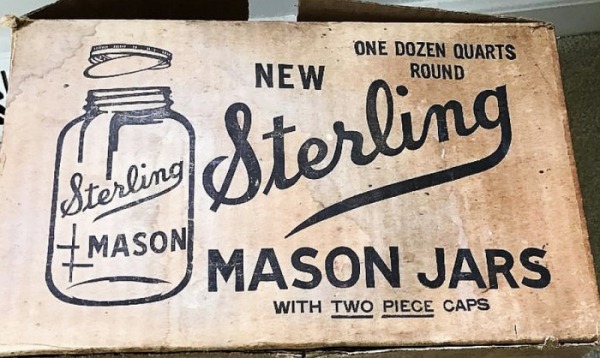
Undated
The caption dates the original Sterling Mason jar shipping box to before 1950.
Photograph shows cardboard packaging rather than a glass mark.
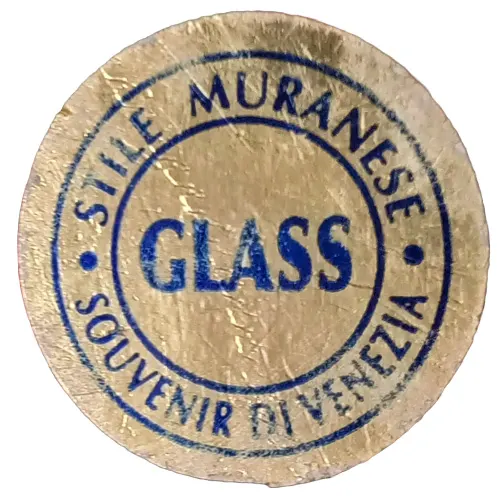
Undated
label · gold and blue · glass · Italy
" " circular blue & gold foil label. [ 01 ]
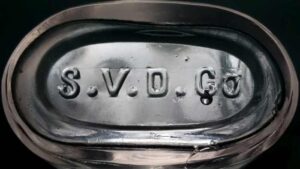
Undated
glass
Caption probably identifies Saginaw Valley Drug Company of Saginaw, Michigan; the quoted dates describe the firm.
Undated
label · gold and blue · glass · Skansen, Stockholm
" " blue & gold crown shaped foil label.
Undated
label · black and white · glass · Sweden
" " black & white paper label.
Undated
glass
Foster-Forbes mark on a clear Halitosine bottle; 3 is a mould number and 614 a mould-design number.
Undated
label · glass · Jesolo Lido, Italy
Probably a retailer label; found on a Carlo Moretti vase.
Undated
impressed · glass
…………………. Swayzee Company, Swayzee, Indiana (1895-1906). Factory bought by Ball Bros. in 1906. Lettering embossed across the face of machine-made (smooth lip) Mason-type fruit jars. These would have been made sometime during the 1899-1906 period. Earlier jars made by Swayzee (presumably hand made, with “ground lips”) are almost certainly the “MASON’S / PATENT / NOV 30TH / 1858” types found with the “S G CO monogram” on the front – that emblem placed between the words “MASON’S” and “PATENT”. (See S.G.CO. monogram, above on this page).
Undated
glass
………………………… Thomas A. Evans & Company, Pittsburgh, PA (c. 1860-c.1869). A slight reorganization of the previous firm. For more info see this article by Bill Lockhart et al: Other T Marks – SHA.org
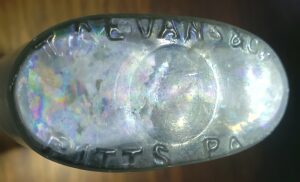
Undated
glass · Pittsburgh, Pennsylvania
Mark on a light-aqua liquor flask.
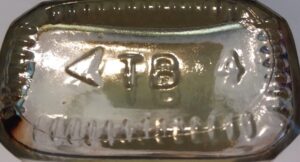
Undated
label · glass
Triangle/arrow and on a Watkins Vanilla Extract bottle base.
Undated
glass
……………….. T. C. Wheaton & Company, Millville, New Jersey (mark dates from 1888-c.1901 (see above entry).
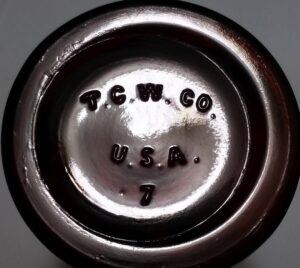
Undated
glass · Millville, New Jersey
T. C. Wheaton laboratory chemical bottle; 7 is a mould number.
Undated
glass
…………. T. C. Wheaton Company, later Wheaton Company , Wheaton Industries, Millville, New Jersey (1888-to date). This mark used after about 1901 and on up to circa 1946, their previous mark being “T.C.W.& CO.” for “T.C. Wheaton & Company”. The ampersand was removed in about 1901 after a slight name change. These initials are frequently seen on the bases of clear and amber laboratory, chemical, scientific and drug bottles that appear to date from the very early through mid-20th century, although Julian Toulouse listed the mark as dating from 1888. Many of these bottles were sold with a stopper, carefully ground to fit the bottle. See “W in a circle” and “Wheaton” entries.
Undated
glass
…………….Unidentified, but possibly Toledo Bottle Company, Toledo, Ohio (1916-1920). Seen on base of aqua rectangular paneled prescription bottle, machine-made, c. 1910-1930. The “circle”, (or, more accurately, two circles, one of which may be off-center in the case of this particular “T” mark), is evidently a diagnostic “signature” mark caused by the O’Neill semi-automatic type of bottle-making machine used by Toledo Bottle. See also the “T” entries.
Undated
impressed, label · glass
on base of small “Hen on Nest” candy dishes)……………….. uncertain meaning, but possibly the “T” stands for “Taiwan”? Seen on several hen dishes imported from Taiwan -probably from the 1960s-1980s period. Some examples are also embossed “MADE IN TAIWAN” on the base, others are not. Some hens were sold through Enesco (as shown by foil stickers still attached), and others were sold via AA Importing Company based in St. Louis, MO. Several colors are known including purple “marble” or slag , transparent medium pink, amber, and pastel opaque blue, probably others as well. Some of the hens from Asia are also marked with an “H inside a horizontal diamond” – assumed to be products of Taiwan. Please see “H in diamond” entry.
Undated
glass
……..Knox Bottle Company, Palestine, Texas plant location (1941-c.1953).
Undated
glass
………….. Anchor Hocking mark “Anchor in a rectangle” somewhat resembles a capital T when viewed upside down.
Undated
glass
…………..Turner Brothers Company / Turner Company, Terre Haute, Indiana (c.1910-c.1929). This Triangle-T mark was seen on the bottom of a clear handled jug, of a type frequently used for vinegar and apple cider. Also seen on a variety of packer bottles such as for ammonia and other chemicals. The mark is seen on some Edison Battery Oil bottles. (Travis Company also used a similar mark, but only used it on milk bottles – see next entry). Successor to Modes-Turner Company. This mark was trademarked with the US Patent & Trademark Office, as No. 205,166 , claiming first use in January of 1920. Turner Bros. was apparently briefly reorganized as Turner Bros. Corporation (c. 1930-1932), later bought by General Corporation (headquartered at Lancaster, OH) with bottle manufacturing plants at both Terre Haute and Winchester, Indiana. General Corporation lasted until around 1937 (some info from Indiana Factories Notes , Dick Roller, 1994, page 103) and used a “G inside a diamond” mark on its ware. For more background info, see this article: The Turner Brothers and William F. Modes – SHA.org
Undated
glass
………….Travis Company, Clarksburg, West Virginia, as seen on milk bottles , circa 1913-1919. Any bottles with this mark that are NOT milk bottles can be attributed to Turner Bros (above).
Undated
glass
…………… see above entry.
Undated
glass
…………………….. Uncertain meaning – these initials are found on amber and clear anesthesia (ether, chloroform) bottles – possibly originating from Germany, and probably dating from the early to mid-20th century. If you have solid information on the meaning of these initials, please advise!
Undated
glass
……………… Thatcher Manufacturing Company , Kane, PA; Elmira, NY; other locations (1904-1985). Mark used circa 1910s-1920s.
Undated
glass
……………… Modes-Turner Company, Cicero & Terre Haute, Indiana (c.1902-1905). Earlier known as Modes Company (1894-c.1902) although both company names may have been used somewhat interchangeably for a time. Terre Haute operation later known as Turner Bros. Company (c.1905-1930) and the Cicero plant became known as Indiana Bottle and Company (c.1905-1909).
Undated
glass
…………. Thatcher Manufacturing Company , Kane, PA; Elmira, NY; other locations (1904-1985). Mark used circa 1904-c.1920.
Undated
glass
…………… Thatcher Manufacturing Company , Kane, PA; Elmira, NY; other locations (1904-1985). Mark used circa 1910s-1920s.
Undated
glass
…………………………….almost certainly Tibby Brothers, Pittsburgh, PA (1866-1880) and Sharpsburg, PA (1872-c. 1915). Seen on the base of a small, clear, handmade, otherwise unmarked bottle (a bit heavy for its size), possibly 1890s or early 1900s. This bottle closely resembles the perfume bottles marked “Lubin” and “Hoyt’s”. Many other colorless bottles of various types have also been recorded, including small “generic” druggist bottles, and the most likely manufacturer appears to be Tibby Brothers. However, virtually all confirmed bottles made by Tibby were produced in colorless (or nearly so) . The Tibby Bros. factory called itself a “flint ” company which, for the most part, typically meant an operation that produced clear . However there are a few known mouthblown amber bottles with a “T” mark on the base, and the maker in those cases is uncertain. One example is a cylindrical amber medicine/packer style bottle with tooled lip, measuring 5 & 1/8th inches tall. For more background info, see the article by Bill Lockhart and the BRG (linked to in the “T” entry, below). Also, see “T. B.” mark.
Undated
impressed · glass
…………….Thomas Wightman & Company, Pittsburgh, PA (c. 1873-1893). This mark is seen on fruit jars and a variety of other bottles. One example would be an aqua bottle embossed “W. M. Sowders / Kentucky Sauce” which is very similar in appearance to the commonly-seen older style “Lea & Perrins Worcestershire Sauce” bottles. Another type of bottle made by is marked “Louis Weber & Co. / Louisville, KY”, a “squat” ale variant. This company was a successor to Lorenz and Wightman (also please see L & W, W.G.CO, and W marks). For more background information on Thomas Wightman and related companies, see this article by Bill Lockhart et al: The Thomas Wightman Companies – SHA.org
Undated
glass
…………………. Kensington Works, Philadelphia, Pennsylvania (1816-c.1833). These initials (standing for Dr. Thomas W. Dyott, part or full owner of the works by around 1821) appeared on a few early historical flasks produced by Kensington in the early 1820s. Helen McKearin ( American Bottles and Flasks and their Ancestry , 1978) believed they dated from around 1824 – 1826. See “Kensington Works” and “Dyottville Works” entries.
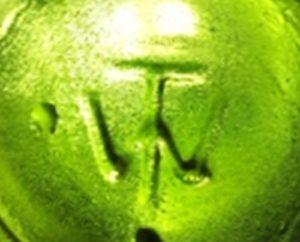
Undated
glass
Unidentified T-over-W monogram on a dark-green crown-top bottle found in Puget Sound.
Undated
label · glass
…………………. unidentified bottle manufacturer, possibly located in Egypt or that region of the world.
Undated
impressed · glass
TB (placed to right of embossed triangle or “left-pointing arrow” logo)……..seen on base of clear machine-made WATKINS / TRIAL MARK extract/flavoring bottle, probably circa 1990s-2000s. Uncertain meaning.
Undated
glass
Teardrops (logo consisting of two teardrops or water droplets, placed alongside each other in the orientation reminiscent of “69” or two “commas”, as seen on the base of drinking glasses / tumblers)……………………. trademark indicating the brand Paşabahçe, made / sold by Şişecam, Istanbul, Turkey. Please see “Drops / droplets” entry on Page Two .
Undated
glass
………………… Brand name used by Brockway Company, usually seen on the bottoms of jars and bottles. The exact time period of use is uncertain but seems to be from the 1950s-1970s. This brand was probably Brockway’s answer to Owens-Illinois’ “ DURAGLAS “. Please see “B in a circle” entry on “ Page One “. For more info on Brockway check out this .pdf article by Bill Lockhart and the Bottle Research Group at link below. ( is mentioned on page 332) : Brockway Company – SHA.org
Undated
impressed · glass
……………… embossed on the bottom of “Tropical Canners” jars made by Florida Mnfg. Company, Jacksonville, Florida (1926-1947) and/or its successor, Tropical & Box Company (1949-1957). The exact meaning of the initials TF is unclear. For more info see this article: Florida Manufacturing Company – SHA.org
Undated
glass
…………………… Company, , Texas (1922-1937)
Undated
glass
….See “T B”.
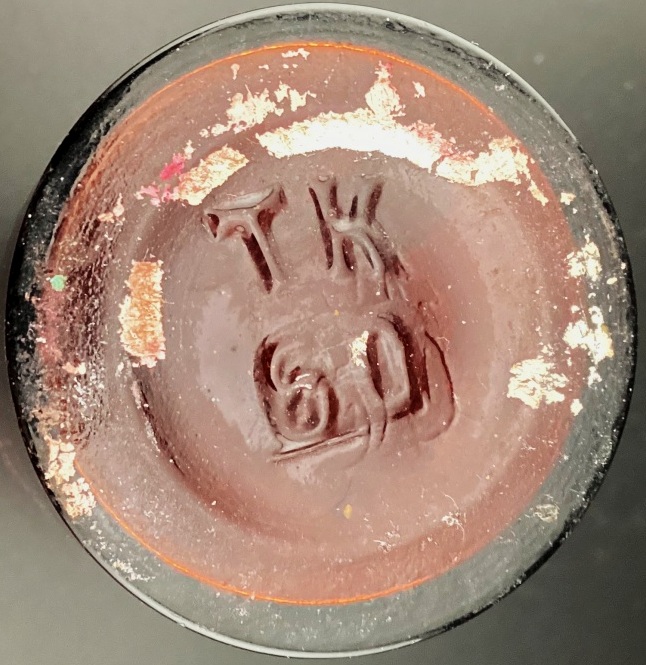
Undated
glass
On an amber anaesthesia bottle; 60 probably indicates capacity in millilitres.
Undated
label · gold and green · glass · Alassio, Italy
" " green & gold oval foil label. [ 01 ]
Undated
glass
TMC or MTC (large letter T, vaguely resembling an anchor with horizontal upper stroke, with smaller, angular M and C nestled underneath to the left and right, arranged in a somewhat triangular formation, as shown above, this mark used 1944- c.1983)……………………. Thatcher Manufacturing Company. This mark appears on huge numbers of containers of all types. For more information on this and other marks used by Thatcher, please see Thatcher Manufacturing Company/Thatcher Mnfg. Company .
Undated
glass
………. Elk Flint Bottle Company, Shinglehouse, Pennsylvania (1904-1912 or 1919), see E.F.B.Co mark.
Undated
glass
………………..see this page with more information: Fruit Jars .
Undated
impressed · glass · Lerma, Mexico
Caption identifies Vidrio Formas.
Undated
glass
Triangle inside a circle (as seen on the heel of a light blue “Clearly Canadian” flavored soda water bottle, bearing a 2019 date code)…………….. Unidentified at the present time. If you have information on the identity of this bottle maker, please help! I am assuming it is the mark of a company located in Canada.
Undated
glass
………………….. Vidrio Formas, S A de C V, Lerma, Mexico (1990-to date). Photo shows mark as it appears on the base of a Jose Cuervo tequila bottle.
Undated
glass
Triangles (two concentric triangles or “double triangle”) ……………………..emblem seen on the base of small cobalt blue ointment jars, in several sizes. These jars contained Vicks Vaporub, a salve packed in jars up until 1983. Please see this webpage: Cobalt Blue Vicks Vaporub jars.
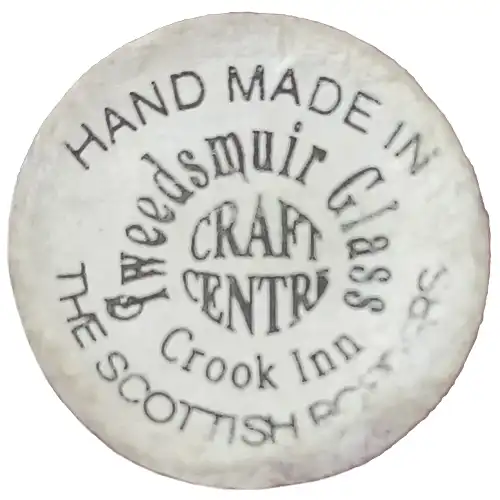
Undated
label · black and white · glass · Scottish Borders
" " circular black & white paper label.
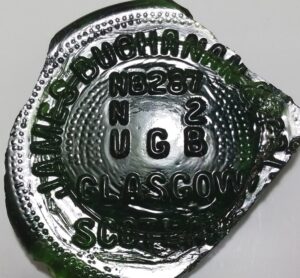
Undated
The caption dates the James Buchanan whisky-bottle fragment approximately to the 1950s.
glass · United Kingdom
………….United Drug Company, headquartered in Boston, MA (1902-1944), renamed Rexall Drug Company. Various medicine bottles with this mark on the bottom are known, with possibly the majority of them dating from the first two or three decades of the company’s existence. I don’t know what company/companies actually manufactured the bottles for United Drug, but Whitall Tatum Co., and other large bottle makers on the East Coast would be possibilities. “ ” on dark olive green base shard from “James Buchanan & Co” scotch whiskey bottle, circa 1950s.
Undated
glass
……………………………… United Bottle Manufacturers, Limited (large conglomerate of many factories in the United Kingdom). This mark dates from 1913 to about 1968 and is found on the bases of innumerable bottles of many styles and sizes that were made in Great Britain. UGB included factories located at Ravenhead, St. Helens; Sherdley, St. Helens; Portobello, Scotland; Charlton, London; Shettleston, Scotland; Castleford, Yorkshire; Harlow, Essex; New Cross, London; Brimsdown, London; Kinghorn, Scotland; Alloa, Scotland and Peasely, St. Helens. The history is confusing and some factory locations operated for a very long time but others were relatively short-lived. For more detailed background information and history on the factories involved and other marks used, please see this article written by Bill Lockhart et al: United Bottle Manufacturers, Ltd.
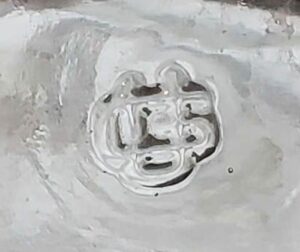
Undated
glass
……………. Universal Products (see next entry).
Undated
glass
……………… Universal Products, Parkersburg, West Virginia (1919-c.1979). Known for producing clear milk bottles for various dairies, especially in the 1920s-1950s. The “ ” mark is typically followed by a “51” and this usually appears on the heel of bottles. National Bottle Corporation acquired the plant in 1960. Julian Toulouse ( Bottle Makers and their Marks , 1971) also shows a “U G” monogram (U and G entwined) on page 515, with no info on dates used. Bill Lockhart indicates the UG monogram probably dates from 1960-1979, presumably after the company was acquired by National Bottle Corp. For more detailed information, and other minor marks attributed to UGP, see this article by Bill Lockhart et al: Universal Products Co.
Undated
glass
……………….. Universal Products, Parkersburg, WV (see above).
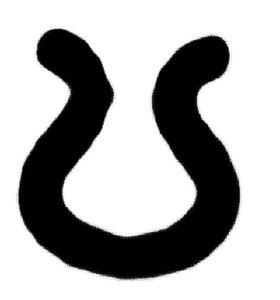
Undated
glass
U (symbol which vaguely resembles the letter “U” , a horseshoe, or an upside-down version of the Greek letter “Omega”…………………… Ardagh Group (pronounced AHR -DAW), originally based in Dublin, Ireland, with headquarters now based in Luxembourg, with many bottle manufacturing plants across Europe including Germany, Denmark, United Kingdom, Poland, Netherlands, Italy and Sweden. On most bottles, a number is placed to the immediate right, and that number denotes the factory that produced the . (For instance “U 31” seen on the heel of a Heineken green beer bottle indicates production at Ardagh’s bottle factory at Moerdijk, Netherlands). Ardagh began as the Irish Bottle Company, Ltd in 1932, changing the name to Ardagh PLC in 1989. NOTE: In the year 2014, Ardagh Group acquired the former Saint Gobain / Verallia factories in the United States, and this mark has since come into use on jars and bottles made at those plants. Thirteen container plants in the US are currently (as of 2021) under Ardagh Group ownership and it is my understanding they are all using this logo on their container glassware. (See the list of those 13 plant locations on the Ball Bros. Manufacturing Company page ). The logo design is an abstract representation of a chalice, loosely patterned after the celebrated ancient Ardagh Chalice found in Ireland. The mark usually appears on the lower “heel” area of containers but sometimes on the base. According to trademarkia.com, this logo was officially registered as of November 11, 2014. Also, please see the S G / Saint Gobain page.
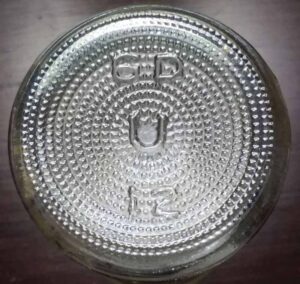
Undated
glass · New Orleans, Louisiana
Underwood Company mark on a Baumer Foods Crystal Hot Sauce bottle.
Undated
glass
…………………. if a machine-made bottle marked with a “U” ( no serifs ) on the base was made for an end user company based in or around the New Orleans area, the mark would almost certainly stand for the Underwood Company, with factories at New Orleans (Harahan), Louisiana (1956- Oct. 1979?) and Mineral Wells, Mississippi (Nov. 1969- late 1974 or early 1975??). (Mineral Wells is an unincorporated community in the southern part of the metro Memphis, Tennessee area). Two clear machine-made bottle types confirmed to be from this maker include certain examples of the Brer Rabbit brand molasses bottles, and some Baumer Foods, Inc. bottles that contained their Crystal Hot Sauce brand (see base photo above). A bottle style that typically held Karo brand syrup – probably dating no earlier than the late 1950s or ’60s – was seen on ebay with this mark on the base. This mark is quite scarce and not commonly seen – probably because most bottles made by Underwood were “generic” utility types, and usually discarded soon after use. There are surely many of them to be found in refuse dumps of that time period, probably most commonly in the south-central US. If anyone has more exact information concerning the last day of bottle production at either the Harahan or the Mineral Wells factory locations, please contact me and I will edit this entry. (Also, see the “U” entry concerning Upland , above). For more background info on Underwood, check out this article (esp. pages 189-191) by Bill Lockhart and the BRG: Other “U” marks – SHA.org
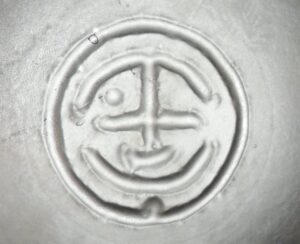
Undated
glass
Unidentified emblem on a matte frosted decorative bottle; origin uncertain.
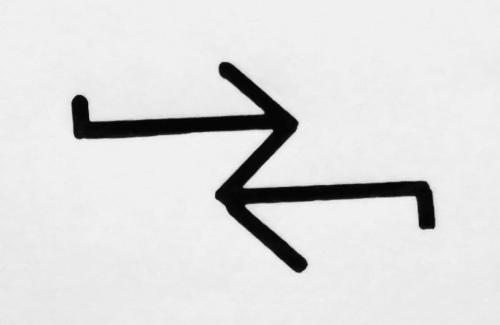
Undated
glass · Rotherham, England
Caption identifies Beatson Clark & Company double-arrow trademark.
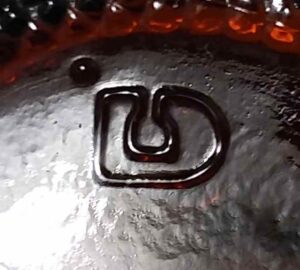
Undated
glass
………….. Union Works, Philadelphia, PA (c.1845-c.1876). There were a number of unrelated companies known under the name “Union Works”, located in several cities during the 19th century, but this particular firm is best known for having made many blob or “squat” type soda bottles for quite a number of soda bottling companies. Many of those bottles were made in a vibrant cobalt blue color and appear to be typical of the 1850s-1860s era. I have found conflicting info on the timeline this company was in business. Note- also, this particular works is the most likely producer of the “MASON’S PATENT NOV 30TH 1858” jars with “U.G.CO.” on the lower reverse heel.
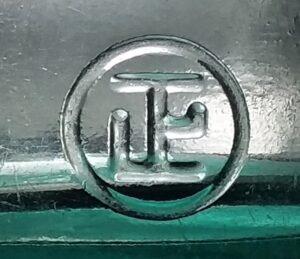
Undated
glass · Japan
Unidentified emblem on a Nippon Taisanbin beverage bottle.
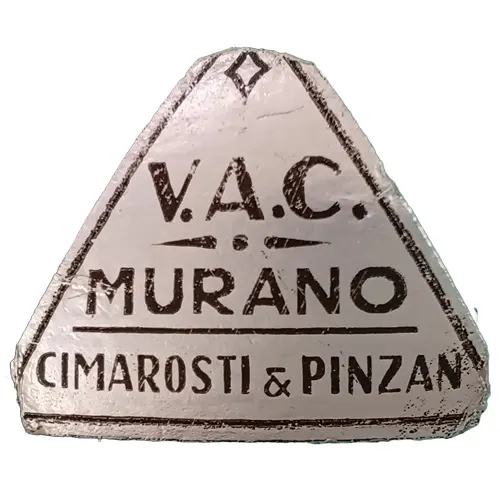
Undated
label · black and silver · glass · Murano, Italy
" " black & silver triangular foil label.
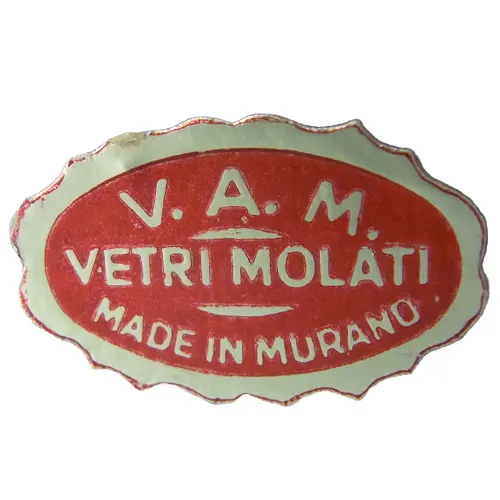
Undated
label · gold and red · glass · Murano, Italy
" " red & gold foil label. [ 01 ]
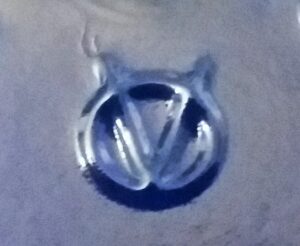
Undated
glass · Ormelle, Treviso, Italy
Vetri Speciali, formerly Vetrerie Venete, mark on an Acqua della Madonna water bottle.
Undated
glass
……………..Vidriera Monterrey, Monterrey, Mexico (1909-to date). See “M and V entwined inside circle” entry on Page Four.
Undated
glass
…………………………….. unidentified meaning. This mark has been recorded on several styles of emerald green bottles from Europe – presumably made in Great Britain. They are food bottles, and likely date from the 1880s-1900s time period.
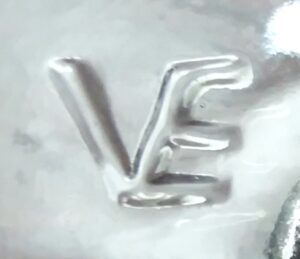
Undated
glass
usually found in shades of green or aqua, in this case, probably stands for Vichy Etat, a brand of mineral water popular in France).
Undated
glass
………… currently unidentified. This mark appears on the base of a clear Coca Cola bottle found along the north coast of Cuba. Presumably this mark was used by an unidentified manufacturer located in Mexico or, perhaps, in one of the countries in Central or South America. If anyone recognizes this mark, please contact me and I will add the information to this entry.
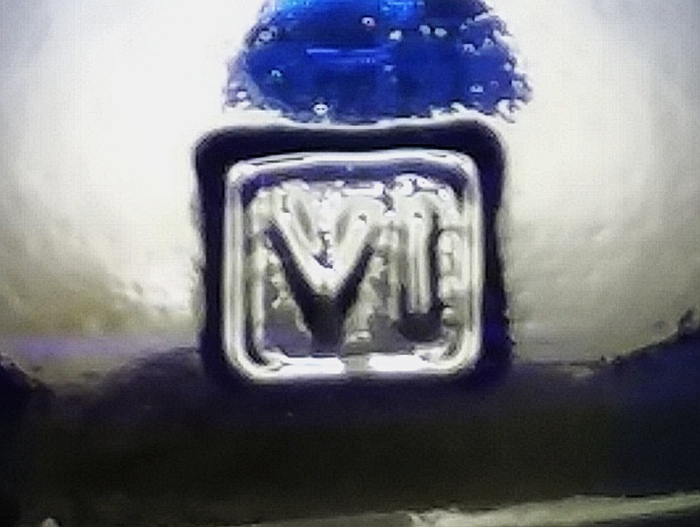
Undated
glass · Italy
Verallia Italia mark on a cobalt-blue beverage bottle heel.
Undated
glass
………………… Vidriera Oriental, Mexico City, Mexico (1980 – 1999). More info on Mexican marks at this article: Mexican Marks – SHA.org . Photo shows the base of a “Sioux City” brand soda bottle, and the “92” is a date code for the year 1992. Please see next two entries.
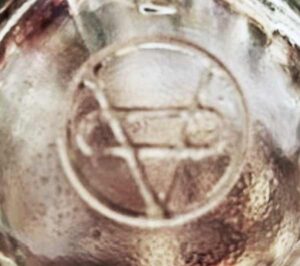
Undated
glass
and a thin oval inside a circle on a Coca-Cola bottle found in Cuba; maker not established.
Undated
glass
……………… Diamond Vienna Inc., Vienna, West Virginia (1981- c.1986) . Confirmed on the base of a clear liquor flask with a 1981 date code. This firm was one of the subsidiaries of Diamond-Bathurst, the other container subsidiary (in the US) being Diamond Company of Royersford, Pennsylvania .
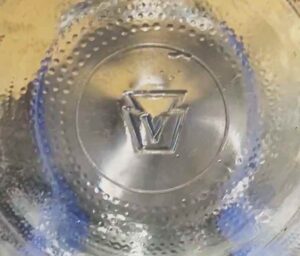
Undated
printed · glass
Keystone mark on a clear gallon jug; attribution to Pennsylvania Bottle Company is tentative.
Undated
glass
………….Vidroporto S.A., Sao Paulo, Brazil (1981-to date). This mark is listed in the Emhart database of worldwide manufacturers’ punt marks, but I don’t know when this “ ” was first used by Vidroporto. There is apparently no connection with the first “V in a circle” mark (used by Vidriera Oriental) from Mexico as shown above.
Undated
glass
…………….. Verallia Group introduced this mark for all their container plants worldwide in 2019- factories located in Europe, Asia and South America……………. please see “U inside a square” entry on this page.
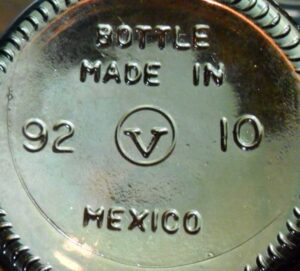
Undated
glass · Mexico
Circled-V mark on a Sioux City Wildberry soda bottle.
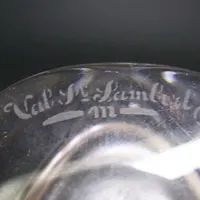
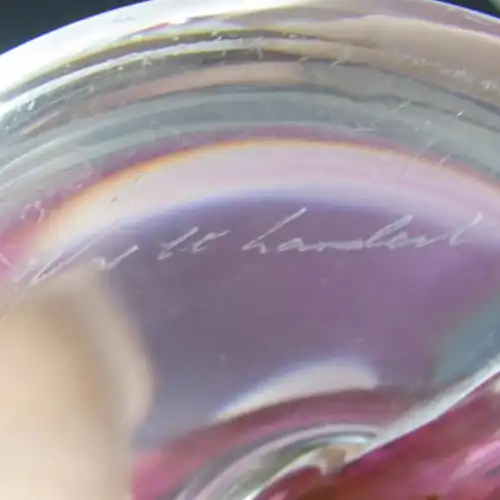
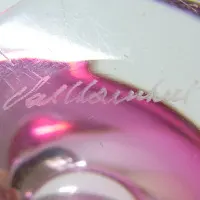
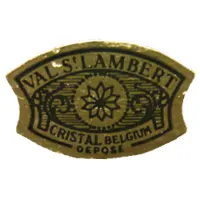
Undated
label · crystal · Belgium
" " Belgian foil label.
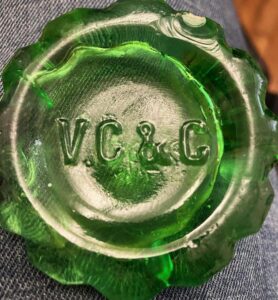
Undated
glass
……………………….. Vetreria Etrusca, business offices in Montelupo Fiorentino, near Florence, Italy ( manufacturing plant located in Altare, Savona, Italy). (1920-to date). I don’t have information on exactly when this company started using their VE-connected logo, or what other marks (if any) may have been used in previous years. Most of the containers bearing this mark seem to be relatively recent production, probably from the 1970s-1980s and thereafter. Many types of items have been made including olive oil and vinegar cruets, kitchen canisters, candle holders, “fish” bottles, and other kinds of decorative and household bottles. Many items are found in a characteristic very light greenish-aqua colored similar to the older Coke bottles. If you have information on exactly when this mark was introduced, and what (if any) other marks were previously used by this glassmaker, please let us know! Some information on the company can be found on their website here: Vetreria Etrusca .
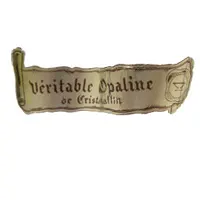
Undated
label · glass · France
French foil scroll label, reads " " .
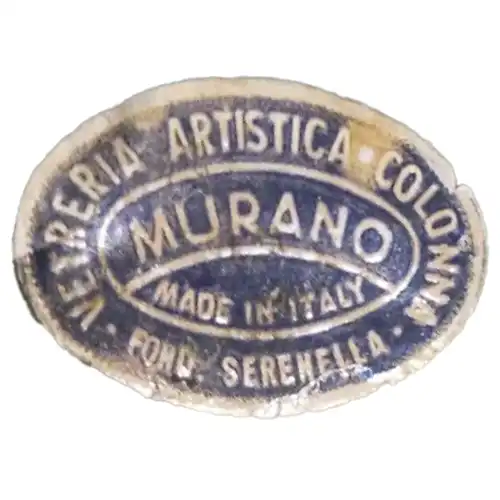
Undated
label · silver and blue · glass · Murano, Italy
Retailer founded by the Sent family in 1973; this is not a mark-use date.
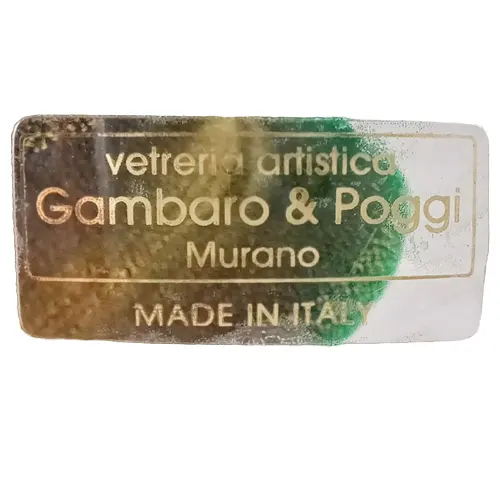
Undated
label · gold and clear · glass · Murano, Italy
" " gold & clear rectangular plastic label.
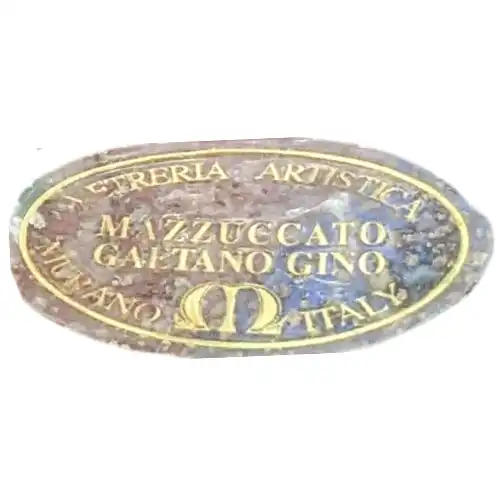
Undated
label · gold and clear · glass · Murano, Italy
" " clear & plastic label.
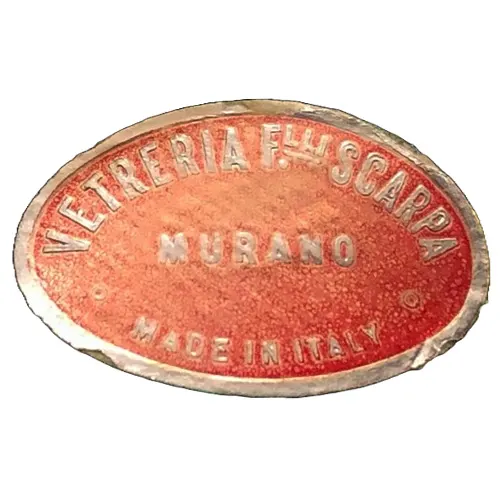
Undated
label · gold and red · glass · Murano, Italy
F.lli abbreviates Fratelli, meaning brothers.
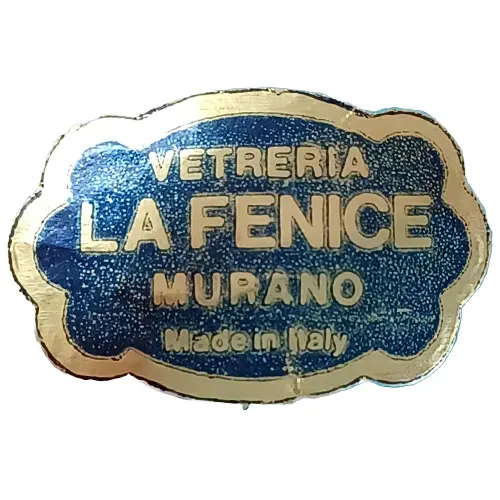
Undated
label · gold and blue · glass · Murano, Italy
" " blue & gold foil label.
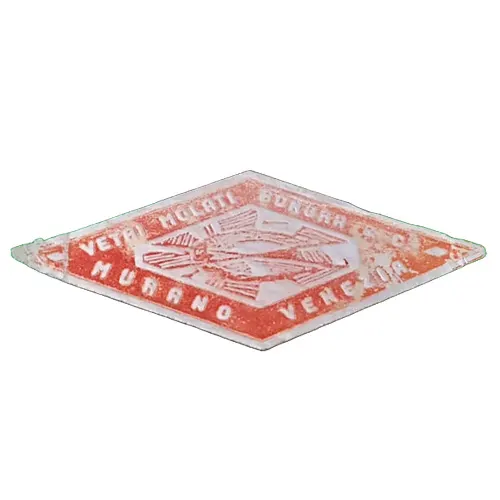
Undated
label · white and red · glass · Murano, Venezia, Italy
Factory founded by Sergio Bonora, later joined by his son Ivano.
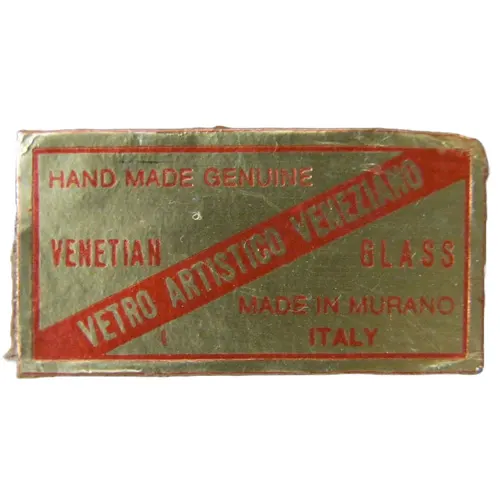
Undated
label · gold and red · glass · Murano, Italy
Probably an export label.
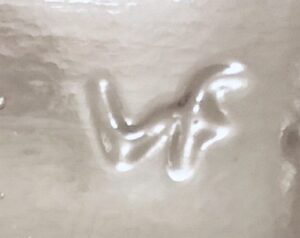
Undated
glass
………………. Verallia Italia (Verallia Italy) – (formerly part of Saint Gobain). This mark is seen on bottles produced at several plants located within the country of Italy (c.2013-2019). The mark may be accompanied by a period (dot) and the relative position of the dot identifies the plant where the bottle was made. See this file and the VI marks under “Verallia Italy”: Emhart Punt Marks – List of Worldwide Glassmaker Marks . Bottles made by Verallia Italy (2019 to present) are marked with the “V inside a square” – see that entry on this page.
Undated
glass
…………………see this webpage about the cobalt blue jars and the four base types seen, including the “Double Triangle” here: Jars .
Undated
label · glass
……… trademark for line of pharmaceutical bottles, used by Obear-Nester Company, East St. Louis, Illinois, circa 1902-1920 (History of Drug Containers & their Labels, Griffenhagen & Bogard, 1999, page 129).
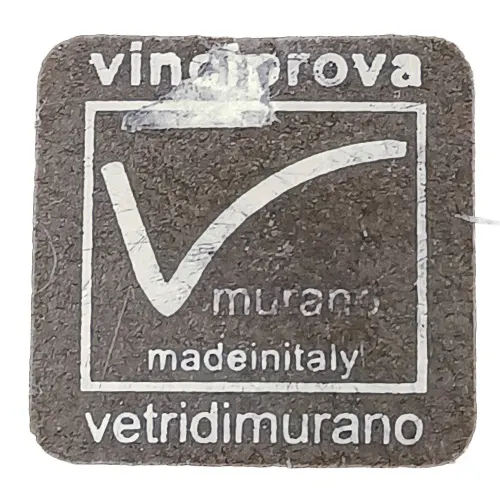
Undated
label · white and clear · glass · Murano, Italy
" " white & clear plastic label.
Undated
glass
………………………….. as seen on the base of some Italian-origin containers imported into the United States, such as bottles containing Lucini brand olive oil and Acqua della Madonna spring water………………… Vetri Speciali, formerly known as Vetrerie Venete S.p.A., this mark used at their factory location at Ormelle, Treviso, Veneto, Italy.
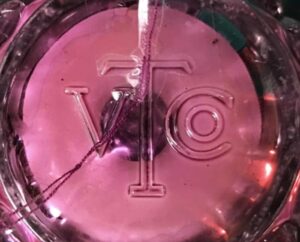
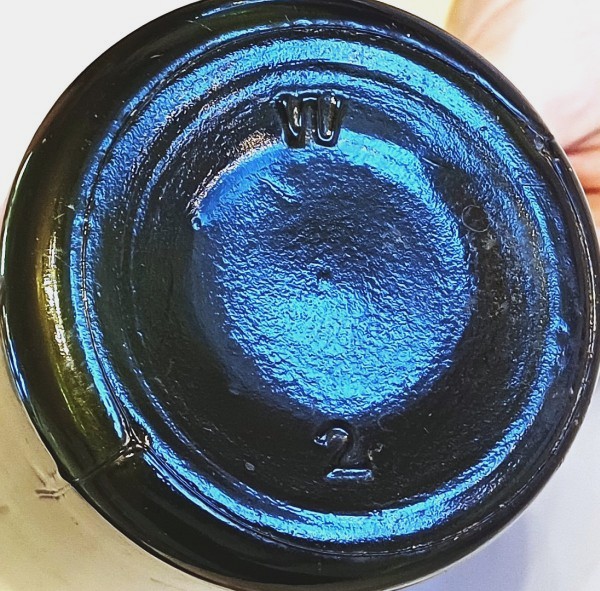
Undated
glass
Joined on a dark-green ale or whisky bottle; origin possibly English or Western European.
Undated
glass
VU (What appears to be the letters “VU” connected,shown above)……………… seen on base of dark olive green ale or whiskey bottle, machine-made, unknown age or origin but possibly early 20th century, from Great Britain or another country in Western Europe. If you have information on the identity of this mark, please contact us!
Undated
glass
………….. please see this webpage on Vicks VapoRub jars . This is one of the four base variations seen on cobalt blue Vicks Vaporub jars.
Undated
glass
…………………..Whitall Tatum Company, Millville, New Jersey (this particular mark used c. 1924-1938, perhaps as late as 1949 in some cases). This mark is seen on the base of many types of bottles and jars as well as on electrical insulators. For more information, please see my Whitall Tatum Company webpage.
Undated
glass
W (actually FWF, sometimes called “Winged W” or “Flying W”)………………… Wilkerson , Moundsville, West Virginia (1975 to present). This mark was used after 1989 when Fred Wilkerson, Jr. joined his father in the business. See entry under FWF on page three.
Undated
glass
…………..Unknown
Undated
glass
………….Thomas Wightman & Company, Pittsburgh, PA (c.1874-1895+). See “T.W.& Co.” and “L&W” marks.
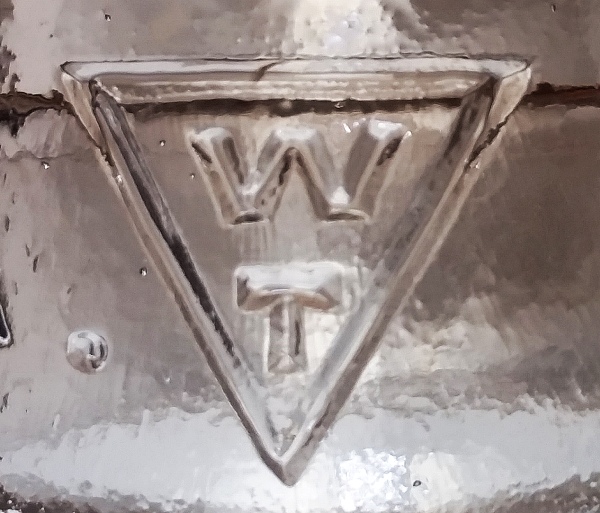
Undated
The caption dates the Whitall Tatum CD 154 insulator approximately to the 1920s.
glass
……………… unidentified. Seen on the base of clear, handmade druggist bottle made for “DRS. REID AND STRANAHAN” of Rome, NY. “ inside Triangle” mark, as seen on pinkish peach CD 154 electrical insulator made by Whitall Tatum Company, circa 1920s.
Undated
glass
……………please see “Dr. ” webpage .
Undated
glass
………………Western Bottle Manufacturing Company, Chicago, Illinois (1901- c. 1931). Maker/distributor of druggist bottles and other drug/health related items including toothbrushes, nursing bottles, etc. May have been a bottle jobber (not actual manufacturer) in later years? Some published sources on the web indicate they did business as “The Western Company”, at least for some period of time. More info requested! Possible user of the mark “W superimposed over B” listed above, which is found on the base of druggist/prescription bottles.
Undated
glass
……………marking used by Brookfield Company at their first plant located in Brooklyn, New York. The “W” in this case actually stands for “William”, although the letter is often misinterpreted as meaning “West”. Most insulators that bear this marking were made in the late 1860s up to around 1905. Their later insulators were marked with BROOKFIELD with the letter “W” having been removed. For more info on this glassmaker, please see my webpage on Brookfield Company (Bushwick Works) .
Undated
impressed · glass
……………… W.C.DePauw Works (fruit jar/window division of the DePauw’s American Plate Works), New Albany, Indiana (1879-c.1893). Initials are embossed in a semi-circle on the base of “MASON’S PATENT NOV 30th 1858 ” type fruit jars, along with a mold number such as “44”. This factory was known as Star Works (or Star Company) from c.1869 to about 1879, although the former name continued to be used casually for years after the “official” title of the works was changed. See “Star” mark, and Star Company webpage.
Undated
glass
……………………. West Coast Company, Los Angeles, California (1918-1930). According to Julian Toulouse ( Bottle Makers & Their Marks , 1971, page 536) this company primarily made milk bottles, some being found with this mark on the bottom. (Jelly glasses and tumblers were made before 1921). Toulouse doesn’t mention any other types of bottles that were made. Presumably most of the milk bottles made by West Coast were distributed in CA and the western states of the U.S. However, a tooled-lip, handmade (mouthblown) rectangular prescription bottle in clear (with slight grayish tint) marked “3 OUNCES” on the front was found in the east (Virginia) that bears this mark on the base. (Although the “o” is lower case). Another type of generic druggist bottle of the same basic shape and with the same marking was dug in the Rome, NY area. If another bottle manufacturing company used these initials, which certainly appears likely, it was probably located somewhere in the Eastern part of the United States. One possibility would be a short-lived venture, the Wightman Co-operative Company, Port Allegany, Pennsylvania (1915-1917). At this time, I consider the initials on those prescription bottles to be that of a glassmaker that has not been identified with absolute certainty, but Wightman sounds like it would be a likely candidate. For more info on West Coast Company, see this article from Pete Schulz, Bill Lockhart and the Bottle Research Group: West Coast Company – SHA.org
Undated
glass
………………Unknown, seen on the bottom of an amber strap-side flask, perhaps circa 1885-1915 (shown below right).
Undated
glass
……………..see next entry.
Undated
glass
…………….this monogram (and the above mark) apparently stands for the West Disinfecting Company, New York, NY (E. Taussig & Co., Proprietors), circa 1890s. Thanks to Jim Novak for info. For more information, see this page: West Disinfecting Company, New York – Baybottles.com.
Undated
impressed · glass
……………….Western Electric Manufacturing Company, based in Chicago, IL, in business beginning c. 1869. This insulator type was made by Hemingray Company for an unknown length of time beginning in about 1872. CD 126.4 style – Insulator overview – Hemingray.info site
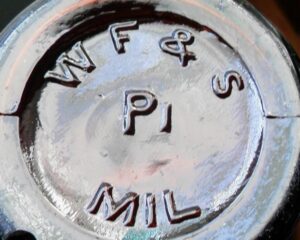
Undated
glass · Milwaukee, Wisconsin
William Franzen & Sons mark on an amber beer bottle.
Undated
glass
……. See next entry.
Undated
glass
……………… William Franzen & Sons Company, Milwaukee, Wisconsin (1893-1920). This and the mark listed above are commonly seen on many beer bottles from breweries located throughout the U.S. Midwest. For more info and pics of a few bottles, see this page: William Franzen & Sons Co. bottles – MrBottles.com
Undated
glass
………..William Frank & Sons, Pittsburgh, Pennsylvania (1866-1876). Earlier known as Wm. Frank & Company (1846-1866), although actual manufacturing didn’t begin until 1858 as during the period 1846 to 1858 the firm was only a dry goods/mercantile establishment. After 1858, when the glasshouse was built, it was also called the “Frankstown Works”.
Undated
glass
……………..Aetna Works (William F. Modes, Proprietor), Pittsburgh, Pennsylvania (c. 1867-c. 1869). The Aetna Works was also known, for a time, as “Arsenal Works”. Mark seen on the base of certain “Mason’s Patent Nov 30 1858” fruit jars. William Modes was also involved in several other, later companies, including Beaver Falls Company, Beaver Falls, Pennsylvania, and Modes Company of Cicero, Indiana (see M. G. Co. page ) .
Undated
glass
……………………… on handmade antique bottles made in the United States, uncertain – this could stand for any of several firms, possibly Wormser Company, Pittsburgh, PA (c. 1875-c.1927) or Thomas Wightman & Company, Pittsburgh, Pennsylvania (1872-1893), later Thos. Wightman Company (1893-1917) / Wightman Bottle & Company (1917-1921). There is also a possibility that some bottles marked with just a “ ” on the bottom are products of Whitney Works, Glassboro, NJ (c. 1875-1918), but that is only a guess! A square, handmade applied-lip aqua pickle bottle that bears a “ ” on the base looks to date from the 1880s or 1890s. Fruit jars with “ ” on the side, and and “L &” faintly visible (removed from the mold) are believed to be Thomas Wightman & Co. products. A detailed timeline of that company and its various incarnations can be found in Jay . Hawkins’ Glasshouses and Manufacturers of Pittsburgh Region 1795-1910 (2009).
Undated
glass
………………………(recorded as seen on base of wax sealer fruit jar, in The Fruit Jar Works , Volume 1, Alice Creswick, page 220). Unknown, possibly a mold engraver error for “W G. Co.”
Undated
glass
………………Wear Bottle Company, Deptford, Sunderland, Durham, United Kingdom (c. 1820s-c. 1890). A bottle with this mark appears to date from the late 1850s or 1860s. Catherine Ross, in “The Development of the Industry on the Rivers Tyne and Wear – 1700-1900” (thesis, 1982, page 260), writes that a bottle works in Deptford (which was in existence by 1816 and probably before) was known as the Wear Bottle Company by the 1820s. The firm was also known simply as the “Deptford Bottle Works” for some time during its operation.
Undated
glass
……………..Used by at least 2 or 3 companies (or more). Wisconsin Company, Milwaukee, Wisconsin (1881-1886) produced beer bottles with these initials on the base. Those beer bottles are usually found in some shade of amber . A “W G CO” mark is also confirmed on a clear, rectangular mouth-blown druggist bottle, circa 1900. A possibility for the source of the mark in that particular case might be the Wagner Company, Ingalls, Indiana (1895-1908). Company info on Wagner can be found in Dick Roller’s Indiana Factories Notes , page 49. Julian Toulouse states (Thos.) Wightman Company, Parkers Landing, Pennsylvania (he wrote “1900-1930”, but more recent info indicates c. 1893-c. 1921) as the user of “ .” (See “W”). I also suspect that some bottles made by Wormser Company, Pittsburgh, might have carried this mark. Woodbury Company (1893-1920) with three plants located in Indiana (at Parker, Winchester and Shirley) made some machine-made milk bottles with “ ” on them, typically on the heel, according to research by Bill Lockhart. Note: In the case of Wisconsin Company, the embossing “MILW” is usually included, but some bottles do exhibit the lone “ .” marking. See next entry, as well as “WIS.G.CO.” and related marks.
Undated
glass
…………….Wisconsin Company, Milwaukee, Wisconsin (1881-1886). Noted on blob-top beer bottles. Also, see “WIS. G. CO.”
Undated
glass
……………Western Manufacturing Company, Valverde, Colorado (1900-1909). insulators are known with these initials on the “skirt”. Many of those insulators are found in several shades of amethyst/purple. A number of bottles, usually beer or liquor bottles, were also made bearing these initials on the base. WGMCo also used what is termed a “belt buckle” logo, as well as a variety of numerical code marks on their bottles, and this article by Bill Lockhart (and the BRG) has more details on those marks: Western Mfg. Co – SHA.org
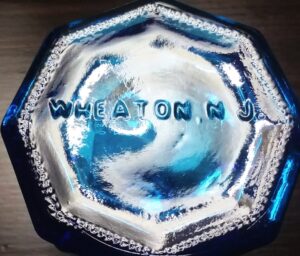
Undated
glass · Millville, New Jersey
Decorative octagonal Carter ink bottle made by Wheaton Company.
Undated
impressed · glass
……………………William H. Rorer, Inc., based in Fort Washington, Pennsylvania, pharmaceutical company that produced a number of drugs, including their most well known products, Maalox and Quaalude. Those initials are seen embossed on the bases of some of their rectangular medicine bottles in amber and clear . These were probably containers for such drugs as Maalox and Camalox, possibly others. The bottle bases I’ve seen bear date codes in the 1960s and 1970s and were made by Owens-Illinois (“I inside an O” trademark).
Undated
glass
…………………Whitehead, Ihmsen & Phillips, Pittsburgh, Pennsylvania (1836-1838). Co-proprietors of several factories in Pittsburgh (located in Birmingham, now called “South Side”), including the Pennsylvania Black Works. Mark is confirmed on the base of three bottle variants, all dark olive green “black ” or dark forest green porter or ale types. See article by Jay W. Hawkins in All About magazine, April 2011 issue.
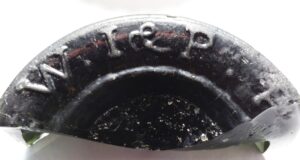
Undated
The caption dates the dark-green ale or wine-bottle fragment approximately 1836–1838.
glass
…………….. West India Manufacturing Company. Mark as seen on base of amber “West India Stomach Bitters” bottle. These bottles were made sometime in the 1873 to 1902 period. The glassmaker is unidentified, but likely from a bottle manufacturer in the St. Louis area, such as Mississippi Company or Illinois Company. This article by researcher and collector Ferdinand Meyer V has some good background information about this product: West India Stomach Bitters from St. Louis, Missouri Partial Base Shard of “ ” ale or wine bottle in very dark green, circa 1836-1838.
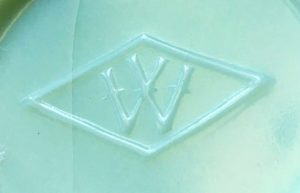
Undated
glass
……………. Westite Company, Weston, West Virginia (1930-1936). Maker of unusually-colored slag novelties such as planters, vases, ashtrays, etc, similar to the appearance of Akro-Agate glassware. The “W” could be seen as two overlapping capital letter ‘V’s, which would separate it from the appearance of the mark used by Whitney, above.
Undated
glass
…………………Westmoreland Company, Grapeville, Pennsylvania (1889-1984). This mark was used from 1910 to 1929. See “W superimposed over a G” entry.
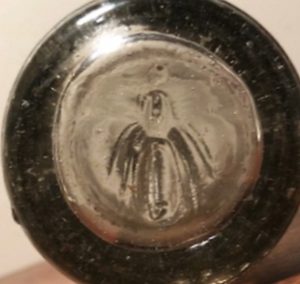
Undated
glass
Wasp emblem on a Booth Bros, Philadelphia, Hutchinson soda bottle.
Undated
glass
…………………. T. C. Wheaton Company, later, Wheaton Company, and later, Wheaton Industries, based in Millville, New Jersey (1888-to date). Now known as DWK Life Sciences (since 2017). This mark is seen on the bottoms of many laboratory, chemical & drug bottles including very small vials, and has been in use since about 1946. Previously (c. 1901-1946) their typical mark on laboratory bottles was “T.C.W.CO”. (Uncertain on the last year the “W in a circle” mark was used.) In recent decades, Wheaton has expanded with a large line of products catering to the medical / pharmaceutical / scientific world. As far as bottle production, the company produced large quantities of colorful commemorative and decorative bottles, especially in the 1960s, ’70s and ’80s. (See “Wheaton” entry on this page). They manufacture a good percentage of the small “serum bottles” or “vaccine bottles” and sterile injection vials (the small vials used to contain vaccines, etc.) sold in the United States and other countries. Update: Wheaton has gone through a confusing series of reorganizations/mergers and company takeovers within the last few years. As of 2015 Wheaton came under the control of DURAN Group GmbH, later (2017) renamed DWK Life Sciences, of Germany. For a good overview and general outline on Wheaton and its history (primarily up into the 1990s), check out this article: Wheaton Industries – Encyclopedia.com . Also, please see “T. C. W. Co.”, “Wheaton” and the the other “W inside a circle” entries on this page! NOTE: although most marked “W inside a circle” found in the United States is from Wheaton, this may not be the case outside the US. Many containers found in Europe are products of Wiegand-Glas of Germany, NOT Wheaton (see next entry).
Undated
glass
………………… container manufacturer Wiegand Glas, with factory locations at Steinbach am Wald (Bavaria); Großbreitenbach, Ernstthal, and Schleusingen (those three in Thuringia), Germany. The company name was listed as “Bayerische Flaschen-Glashüttenwerke Wiegan & Sohne GmbH” in Toulouse’s Bottle Makers and their Marks (1971, page 579. Toulouse indicated the mark was already in use at least by 1965, but not sure when first introduced.
Undated
glass
W inside a “house” or “building” outline / emblem………………… Nienburger Glas GmbH, Nieburg, Germany. See “House” entry on page three for a photo of this mark.
Undated
label · glass
……………………… White’s Laboratories, Newark, New Jersey (c. 1940s?) Mark is on the base of a small amber medicine bottle with black dropper lid and original label which is lettered in part “White’s Cod Liver Oil”.
Undated
glass
……………….. William McCully & Company, Pittsburgh, Pennsylvania. See entries below.
Undated
glass
…………………… William McCully & Company, Pittsburgh, Pennsylvania (c. 1833- c.1909). Firm operated a number of different glasshouses in the Pittsburgh area over a very long period of time. There were changes over the years concerning the exact persons involved in running operations. The McCully-run bottle-making factories included Phoenix Works, Mastodon Works, and Pittsburgh Works. Several other factories (Sligo Works, Empire Works and perhaps others) apparently made mostly window . The very last McCully-associated factory (Sligo – a window house) closed in about 1909. The history of the McCully operations is very complex, confusing, and discrepancies abound concerning the exact years of operation of the various McCully-owned and/or operated factories. Most bottles marked “Wm. McCully & Co.”, ”, “Wm. McC. & Co”, “Mc.C. & Co”, “McC” and other minor variations probably date sometime between 1860 and 1895 . For some more background info, with lots of base mark configuration examples shown, check out this article from Bill Lockhart and the BRG: William McCully and Company – SHA.org
Undated
glass
………………….. same as above.
Undated
glass
…………….. error embossing, see entries below.
Undated
glass
………… see below.
Undated
glass
……………….. see “W. McC. & Co.”, below.
Undated
glass
W (on the bases of modern clear and amber serum or “vaccine” bottles)……………….. Wheaton / Wheaton Industries, now part of DWK Life Sciences (since 2017). Often the “W” will be accompanied by a number, such as “W-1”. See “W in a circle” and “Wheaton”.
Undated
glass
…………….. West Penn Company, Blairsville, Pennsylvania (1890-c.1894). Seen on a picnic (“pumpkinseed”) whiskey flask, and on the base of a clear 1/4th pint shoofly flask (seen as listed on ebay by seller “hwbottles”). Also appears on the base of a Massachusetts milk bottle. Identification of this mark from research by Bill Lockhart.
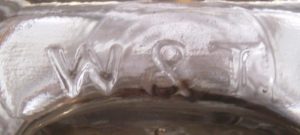
Undated
glass
Mark on a druggist bottle from Rome, New York; maker unidentified.
Undated
incised · glass
W (somewhat flattened “W” trademark, seen on the base of miniature sampler liquor bottle in amber, shown above)………………… Wisthoff & Co. Glashütten, Essen, Germany. A drawing of this mark is shown in Bottle Makers and their Marks (Toulouse, 1971) on page 583. At a quick glance it might resemble a simplified bird with wings outstretched during flight. Please see photo of the mark here. (The “20” is a mold number, and the “M” is a mold mark of uncertain meaning – the M does not stand for a company – as is the case with certain bottles made by other companies such as Maryland Corp.). According to Toulouse, Wisthoff was using this mark in 1965. The mini sampler bottle shown (sometimes called a “nip” or “airplane bottle”) is of uncertain date, possibly from the 1960s-1980s. Wisthoff is now (2023) part of the huge corporation Gerresheimer Glas. The container factory at Essen is shown as “Gerresheimer Essen GmbH” on their website. Not sure when this mark was discontinued (assuming it is no longer in use). If someone knows, please contact us!
Undated
glass
W (stylized representation of letter “W” consisting of three vertical “segments”, the one on the right resembling a wineglass or goblet, see photo above), often accompanied by the notation “Not for Canning” , as seen on the base of milk canister sets and other items ………….. Wheaton Fine Glassware, division / brand of Wheaton Industries (mark presumably used c. 1980-1984, according to information presented in article linked below). This particular jar or canister is also marked “1 L” indicating the capacity of the container is one liter. (See “Wheaton”, “T. C. W. Co” and “W in a circle” entries).
Undated
glass
………….Westmoreland Company, Grapeville, Pennsylvania (1889-1984). To be more accurate, this maker was known as Westmoreland Specialty Company from 1889 to 1924, being officially renamed in 1924 or early in 1925. The “W over G” monogram is seen most commonly on high-quality colored and opaque pressed and pattern , including tableware, novelties, hen-on-nest covered dishes, etc. Westmoreland produced huge quantities of white milk tableware during the 1940s and 1950s, much of it avidly collected today. A lot of their earlier ware was not marked. This particular mark reportedly dates from 1949 to 1984 . (See also “W in a keystone”, an earlier mark used by Westmoreland). Caution: This mark is also seen on some more recent items, such as hen-on-nest dishes, that were made after 1984 but produced from older molds which have since been sold to other making companies. For more information on Westmoreland, try visiting this page on the Westmoreland Club site (indexed into the Wayback Machine web archive database) here: Westmoreland Club – Brief history of Westmoreland Company.
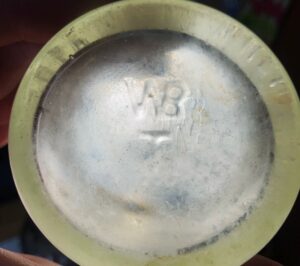
Undated
glass
Joined on a Cassidy & Co. Rochester beer bottle; image-alt text identifies Wittemann Bros.
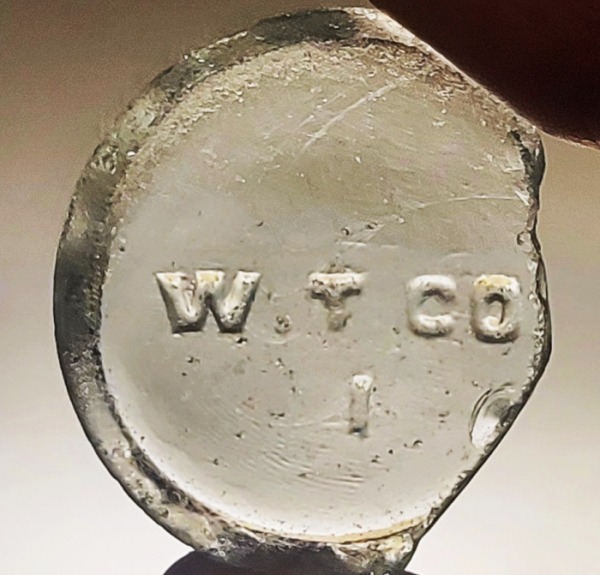
Undated
glass
……………..Whitall Tatum Company, Millville, New Jersey (mark used c.1901-c. 1924, possibly later on some bottles). See below.
Undated
glass
……………….for more information, please click here for a webpage on W. T. Rawleigh’s, Freeport, Illinois .
Undated
impressed · glass
…………. Western Union Telegraph Company. The insulators were made by Hemingray Company (CD 125 type) and Brookfield Company (CD 127 type).
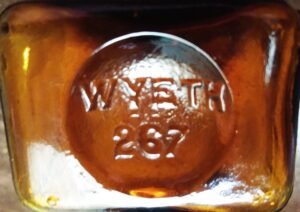
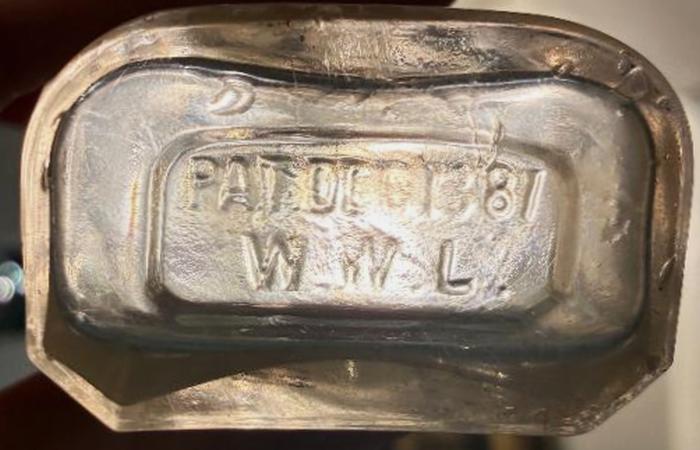
Undated
The inscription gives a patent date, not a mark-use date.
incised · glass
On the base of a Newman, 5th & Walnut druggist bottle.
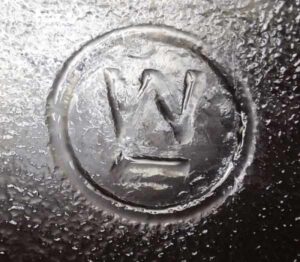
Undated
impressed · glass
Westinghouse trademark on a refrigerator dish or loaf pan.
Undated
glass
…………………….. unknown meaning, but probably that of an unidentified bottle manufacturer. This image is seen on the base of some “hutch” style soda bottles, probably dating from the late 1890s or very early 1900s. In particular, appears on the bottom of a Booth Bros, Philadelphia bottle, as reported by Ray Buch.
Undated
glass
……………… Paşabahçe, Turkey. See “Drops/Droplets” entry on Page Two .
Undated
incised, label · glass
……………… Crystal, City, Ireland (1783-1853 and 1947-to the present) ………………… The original factory opened in 1783, founded by entrepreneurs William and George Penrose. The glassworks specialized in producing extremely high quality handmade blown and cut crystal (leaded ) including wine glasses, goblets, tumblers, bowls, decanters and other items. The company gained a reputation for extremely well-made, intricately cut glassware. The company continued for about 70 years until it closed down after undergoing financial problems in 1853. Then, for nearly one hundred years no was produced, but the name was resurrected in 1947 when two Czech immigrants (Kael Bacik and Miroslav Havel) started a new operation at . They strived to create new handmade with the look and quality of the original cut glassware from the 17th and 18th centuries. The “new” Crystal glassworks is still operating as of 2026, although the great majority of is now no longer made in Ireland, but in other countries including Slovenia, Czech Republic, Hungary, and Germany. Most of the crystal made by before the 1980s was not permanently marked. Marking commenced sometime in the 1980s and the name appears (often rather hard to see) etched underneath on the base. However, some of the newer is also not marked. Most of the more recent production carries a sticker and/or permanent mark incorporating a seahorse motif. “ ” is considered (by some) almost as a “generic” name for very high quality cut crystal. For more info on including details on the 2009 bankruptcy and subsequent events, see the Wikipedia article here: Crystal – Wikipedia. An excellent article about Crystal from the antiquesarena site can be found at this URL: The Ultimate Guide to Crystal: History, Value, Identification and More
Undated
glass
……………….see the J. R. Watkins Co . webpage.
Undated
glass
………………… see entry in the “Unidentified” marks at bottom of the listings on this page.
Undated
glass
…………………….. Wittemann Bros, New York City, NY (c. 1885-c.1920), later at Buffalo, NY (c. 1920-c. 1928). Wittemann Bros. was a wholesaler/distributor of supplies for the beer and soda bottling industry, and also sold other products such as postcards. They were not a manufacturer, so would have had contracts with bottle makers to supply bottles marked with their initials. The manufacturer(s) of the WB-monogram bottles is unidentified, but likely a firm in the NY/NJ area. More info on Wittemann can be found here: Other W Marks – SHA.org
Undated
impressed · glass
…………………..O. J. Company, Los Angeles, California. Mark seen on bases of a number of milk bottles from California. The O.J. Co. was a supply house for dairy equipment, in business by 1906 and continuing until 1936 or somewhat later. They apparently contracted with more than one glasshouse over the years to have milk bottles made with their name embossed on the bottles. (Information from Bill Lockhart & Carol Serr).
Undated
impressed · glass
………………….Weeks & Gilson, South Stoddard Manufacturing Company (c. 1851-1873). This marking appears embossed in a circle on the base of cylindrical whiskey/wine bottles, usually in dark shades of amber or green. A nice article with illustrations of various bottles and shards, some of which were found at the South Stoddard site can be found on pages 52-55 of the August, 1933 issue of Magazine Antiques , written by Lura Woodside Watkins. Also, an article on Stoddard history, written by Michael George, can be found here: Stoddard – Updated Information from Michael George – Peachridgeglass.com
Undated
glass
…………… lettering arranged in a circular formation, as seen on the bases of a few cylinder whiskey bottles, this mark was evidently used on some bottles produced by Weeks & Gilson, South Stoddard Manufacturing Company (above). The bottles with this marking presumably date from sometime between 1851 and 1873.
Undated
impressed · glass
Boar-head emblem on a Gordon's Gin bottle base.
Undated
impressed · glass
…………Westford Company, Westford, Connecticut (1857-1869). Embossed wording seen on several figural / pictorial whiskey flasks, including the “Sheaf of Grain” flasks, GXIII-36 and GXIII-37 variants.
Undated
glass
……….. please see “W inside a Keystone” and “W superimposed over a G” entries on this page.
Undated
glass
………………………Wheaton Company / Wheaton Industries, Millville, New Jersey (1888- to present). (Now known under DWK Life Sciences – since 2017). Producer of many reproduction bottles, Avon cosmetic, cologne, decorator bottles and a wide variety of other glassware. Also please see “W” (stylized), “W in a circle” and “T.C.W. Co.”. entries. The Wheaton enterprises have had a rather complex history since 1888. After several restructurings, buyouts and renamings, Wheaton Industries (DWK Life Sciences) has diversified and is primarily a manufacturer of many lines of pharmaceutical/scientific products, including their “old standbys”- serum bottles, used to contain vaccines and other pharmaceutical products. Many if not most of the reproduction bottles, “fantasy” bottles, decorative figural flasks and containers marked “WHEATON” or “WHEATON NJ” on the bottom were made during the 1960s – 1980s. The “Cape Cod” ruby red line of tableware produced for Avon was manufactured over a period of many years: 1975-1993. (See the page on Avon bottles for a picture of these Cape Cod style goblets). Some items are marked “Nuline”, and many of the repro/fantasy bottles have an “imitation” pontil mark on the bottom, which looks like a depressed area in the , sometimes vaguely shaped like the outline of a state such as Iowa or Ohio! Some items such as canister sets are marked with a “stylized W” (see entry above on this page) and those were issued under the name “Wheaton Fine Glassware” in the 1980-1984 period. For some more background information on Wheaton, please see this article: Wheaton Industries – Encyclopedia.com
Undated
impressed · glass
…………….. , Glassboro, New Jersey (c. 1836-1918). Claiming an “ancestry” dating back to the late 1770s, as early as 1836 this firm operated under the name “Whitney Brothers”, although in later years (by 1875, if not before) it was known as “ ”. The “official” name of the firm became “ ” in 1887 (according to Adeline Pepper, The Gaffers of New Jersey – 1971, page 42), although ads dating from 1875 show both versions of the factory name within the same ad. This works made many types of bottles, including the famous original “BOOZ” bottles shaped like a cabin, the Drake bitters bottles, and many others. Various bottles are marked “ ” in a circle on the base, and these may date after 1887, although I feel that some might date before that year, since the timeline as to when the name was first actually embossed on their bottles seems rather “fuzzy”. In 1918 this factory became a part of the Owens Bottle Company. In 1929, after the forming of Owens-Illinois Co, the plant became O-I plant #8.
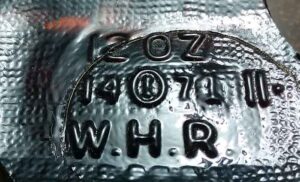
Undated
The caption interprets 71 as a 1971 date code and 14 as the Owens-Illinois plant number.
glass · Bridgeton, New Jersey
Probably a Maalox bottle base; WHR refers to William H. Rorer.
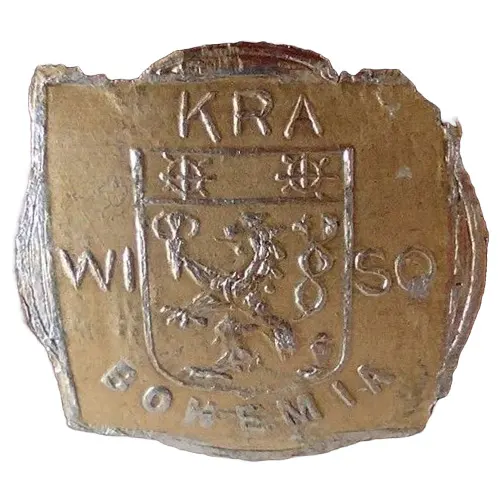
Undated
label · gold and silver · glass · Bohemia
Wilhelm Kralik Söhne foil label.
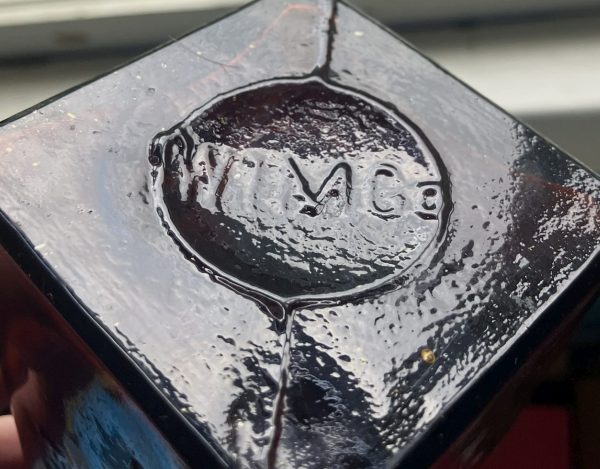
Undated
glass
West India Manufacturing Company mark on a West India Stomach Bitters bottle.
Undated
impressed · glass
……………… Willington Company/Willington Works, West Willington, Connecticut (1814-1872). Full name seen on several figured flasks, as well as embossed in a circle (as “Willington Works”) on the base of cylinder whiskey bottles. The flasks might date from the late 1840s into the 1850s or 1860s. The Willington glassworks is also famous for their much-hyped “Gothic cathedral” pickle jars (pickle bottles). However, many, if not most, bottle manufacturers along the US East coast and some in the Midwest made similar ornately designed square pickle bottles, of a variety of designs, so sometimes a particular bottle may be presented as “possibly Willington” without positive confirmation of its provenance. No Willington Cathedral pickle jars were actually marked with that glasshouse identification.
Undated
glass
………….Wisconsin Company, Milwaukee, Wisconsin (1881-1886) . [Note: For general information on antique bottles from WI, you might try browsing this collectors’ site. This link points to one page on the site concerning bottles made by Wisconsin Company: Wisconsin Company – MrBottles.com . ]
Undated
glass
……….Same as above.
Undated
glass
………Same as above.
Undated
glass
………..Same as above.
Undated
glass
…..Another variation on the above marks. This one is noted on a pickle bottle. (This mark can be misinterpreted to read “Milw Wis Co”, implying the name was “Milwaukee Company”, which would be in error. The company was known as Wisconsin Company).
Undated
glass
………… William Frank & Sons, Pittsburgh, Pennsylvania (1866-1876). See “W.F.& Sons” mark.
Undated
glass
………………………………………………. same as above.
Undated
glass
………………. same as above.
Undated
glass
……………. another variation.
Undated
glass
……………… another variation of the mark.
Undated
glass
…………yet another variation used by McCully, seen on base of cylinder whiskey.
Undated
label · black and clear · glass · Germany
" " black & clear rectangular plastic label.
Undated
glass
………….. Wood’s Bottle Works, Portobello, Scotland (c. 1866-1920). This mark recorded on the base of a black bottle, probably dating from 1866 to the early 1880s. For more info on this and related firms, please see this article: Cooper & Wood – SHA.org.
Undated
impressed · glass
……………brand name seen on the base of many cold cream containers. This indicates Soap Company, begun in 1870, originally from Albany, New York, and later based in Cincinnati, Ohio, manufacturer of a variety of personal care / cosmetics products. Most of the typical white milk cold cream jars with the marking on the base seem to date from the 1920s-1950s era, but I don’t know exactly when they were first made, or how late they were produced. I have also seen “ ” embossed on a “beach ” bottle base accompanied by the makers mark “BALL” in cursive lettering (standing for Ball Bros Company). Many of the milk jars were made by Hazel-Atlas Company , as their “H over a smaller A” is seen on some of them. There were probably other companies involved in their production over the years. This “ ” has nothing to do with the older Works, , NJ, that made fruit jars in the late 1800s.
Undated
glass
Manchester………….. John , Manufacturers, Manchester, England (Manchester Bottle Works) c.1833-c.1861. Base markings seen on several heavy, crude black ale/stout/wine bottles made in Great Britain. Seen are “ / MANCHESTER” ; “ / MANC’R”; and “(arc) (straight line) MANCHESTER (arc)PERCIVAL”. There may be other unrecorded variations. Factory name was “Manchester Bottle Works”, but the exact business / firm name changed several times, including “John , Manufacturer” (c.1836-c.1838), “Jackson, & Percival, Manufacturers” (c.1838-c. 1850), and “John & Company (c. 1850-c.1861). Information gleaned from posts on antique-bottles.net (email from genealogy researcher Richard J. , Essex, England), newspaper archives on Genes Reunited website, and bottle base photos posted on ebay. Some additional info from genealogy page: Maria Webb (1794-1871)
Undated
glass
……………. Company, , Ohio (c.1900-1904). This plant became part of the Ohio Bottle Company in 1904.
Undated
impressed · glass
……………………………………….. large pharmaceutical firm that operated under the name “John and Brother” from 1861 to about 1943, thereafter (having been under the ownership of American Home Products since 1931) known as “ , Inc.”. The business was eventually acquired by Pfizer in 2009. A variety of handmade medicine bottles are embossed “ ” on their bases, and most of those may date, in general, from the 1880s into the 1910s. see “J W & B” entry on page three.
Undated
impressed · glass
……………………. As a solitary mark, often embossed rather crudely in large bold strokes, seenon the bases of many older hand blown bottles and jars, most from the 1850s-1910 period. I believe this is an example of a mold identifying mark. It might have served the purpose of identifying a particular mold in use at the factory (especially when a number of virtually identical molds were being used simultaneously) in place of a number. In some cases it may be equivalent to a “shop number” or “shop letter”, identifying the output of a specific “shop” (group of glassworkers within the factory) assigned to produce a certain item. In such cases the worker was paid according to the output of a particular shop. There are many other marks known, including geometric shapes (triangle, diamond, heart, square), star, hash mark/tic-tac-toe mark/pound sign/number sign, spade, clover, Maltese cross, etc,) seen especially on the bases of 1870s-1890s era fruit jars, that might have served a similar purpose: equivalent to a mold number or a shop number. In some cases a mark may have been meant only as a decorative design added to the mold. At this late date, it’s difficult to know with 100% certainty the purpose of any particular mark or emblem of this type. Also, please see my entries on “Star” markings.
Undated
glass
…………………….. please see my “Dr. W. B. Caldwell’s “ page.
Undated
glass
Unidentified animal-like emblem on a bottle-base fragment found in Chile.
Undated
glass
……………………..Foster-Forbes Company, Marion, Indiana (1929-c.2000). (Also, see “FF” entry). This mark is actually a logo composed of 2 capital “F”s connected back to back, the first one upside down, but at a casual glance it somewhat resembles a backward Z with a slash through the center. Mark evidently dates from the 1930s-1940s period; exact time of use is uncertain. If you have more information on this mark, please contact me.
Undated
glass
………………………… , Zanesville, Ohio (c.1860s-early 1870s?).
Undated
glass · Germany
Sandblasted mark; 1872 is included in the inscription.