
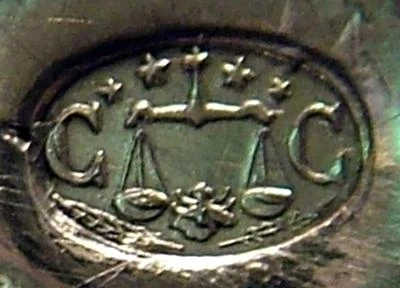
1844–1862
C C
Unboxed oval with CC, bee and balance; compare the later oval enclosed in a square.
stamped · Silver-plated metal · France
Silver
Christofle marks are associated with silver-plated flatware and hollow ware from Paris, France. Christofle marks include “O C” dated 1935.
Founded 1830; first registered maker’s mark 1832. Business continues.
1844–1862
Unboxed oval with CC, bee and balance; compare the later oval enclosed in a square.
stamped · Silver-plated metal · France
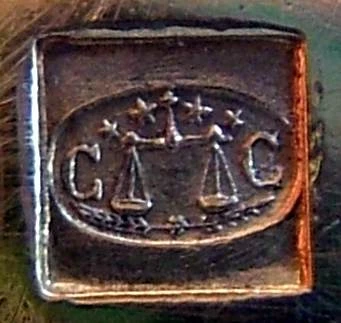
1862–1935
Square outer frame and a rosette in place of the earlier bee; this is the ordinary later CC plated mark.
stamped · Silver-plated metal · France
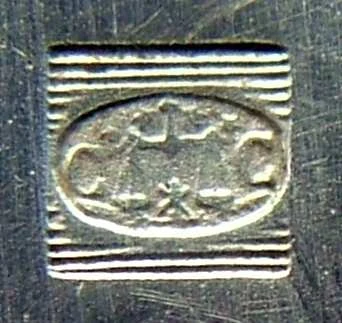
c. 1930–1935
CC initials combine with a lined field and bee, unlike the ordinary rosette CC square.
stamped · Silver-plated metal · France
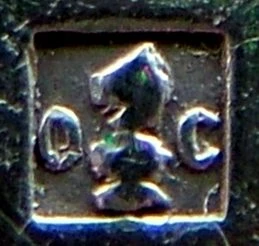
1935–1983
Chess-knight quality stamp without the later Roman grade numeral; compare post-1983 I or II versions.
stamped · Silver-plated metal · France
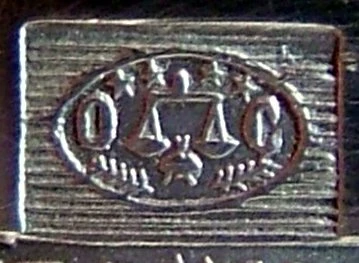
From 1935
OC initials and horizontally lined rectangular field distinguish it from CC marks; illustrated in the 1935–1983 group.
stamped · Silver-plated metal · France
Charles Christofle established the Paris business bearing his name in 1830. Trained in jewelry manufacture, he expanded from ornaments into objects for the table and interior. In 1842 he acquired rights to silver-plating and electrolytic gilding processes. These techniques helped the company produce silvered base-metal goods alongside precious-metal work, extending its range from cutlery and serving vessels to substantial decorative objects.
Exhibitions brought the firm public recognition, including the Paris industrial exhibition of 1839 and the Universal Exhibition of 1855. Royal commissions included a service for Louis-Philippe’s Château d’Eu and a large centerpiece for Napoleon III. The latter survives in the Musée des Arts Décoratifs in Paris. Christofle’s production combined technical development, repeatable manufacture and elaborate design for ceremonial settings.
The house also worked with artists and designers, including Gio Ponti, Jean Cocteau and Andrée Putman. Its marks reflect different materials and organizational periods: CC occurs on earlier work, while OC identifies Orfèvrerie Christofle. The related Gallia name appears on another range of silvered metalwork. Sterling-silver maker’s marks and the stamps used for silver-plated goods belong to separate systems.
Also known as: Charles Christofle · Christofle & Cie · Orfèvrerie Christofle · Orfèvrerie Gallia · Maison Christofle
A related Christofle range, not an unrelated factory. Some Gallia objects carry a smaller version of the intermediate CC mark.
Associated plated wares can carry ALFÉNIDE base-metal wording alongside Christofle marks; the alloy name is not a sterling guarantee.