
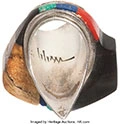
Designer marks
Charles Loloma hallmark
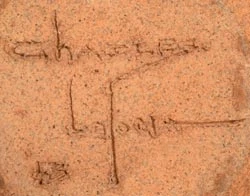
Charles Loloma hallmark includes incised “Charles / Loloma / 53” on Earthenware / stoneware. His wife, Otellie, also worked in ceramics.
- Active years
- From 1939
- Products
- Pottery, Jewelry, Paintings, Murals
- Marks
- 4
He made murals in 1939, pottery after postwar study, and jewelry from the mid-1950s into the 1980s. Died in 1991.
What to look for
- Compare how the name was made. Clay scratches, chisel cuts in metal and a raised signature formed in a casting are different forms.
- Read a pottery date separately from the signature. LOLOMA 51 occurs on a bowl dated 1951; another full-name signature carries 53.
- Keep 14K and 18K separate from the maker’s name. Those numbers describe gold fineness.
Marks & lettering
4 marks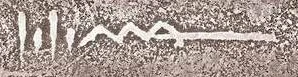
Undated
Loloma [raised signature]
Name stands in relief as an integral part of the tufa-cast pendant, unlike recessed chisel cuts or scratched ceramic lettering.
cast · Silver
Undated
Charles / Loloma / 53
Full first name and surname in two scratched lines, with a separate 53. Distinguish the existing arched LOLOMA 51 pottery signature.
incised · Earthenware / stoneware
Undated
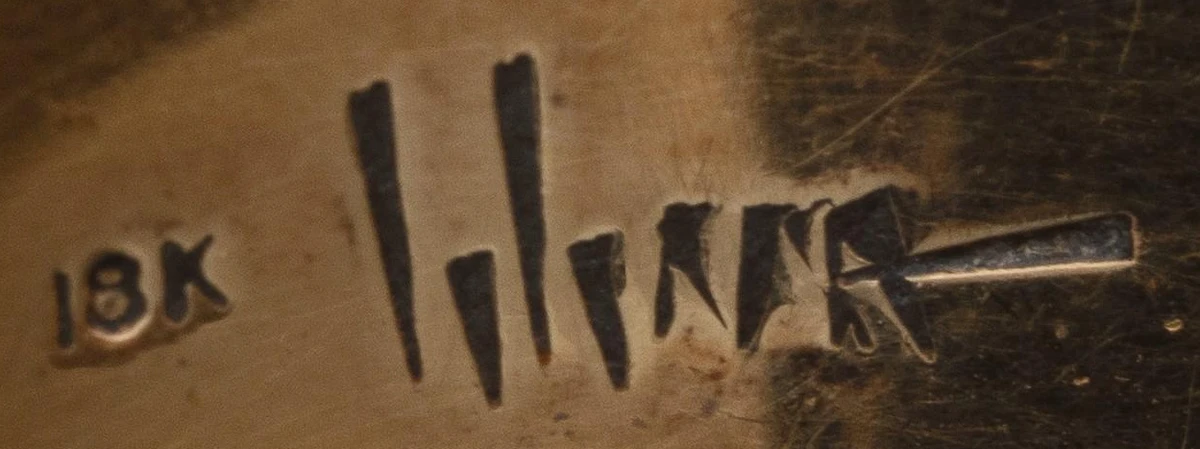
Loloma [stylized] / 18K
Eleven-stroke-style angular name cut into metal; 18K is a separate fineness inscription, not a second maker mark.
chisel cut · 18k gold
About Charles Loloma
Charles Loloma was born in 1921 at Hotevilla on the Hopi Reservation in Arizona. He first worked in painting, participating in mural work in San Francisco in 1939. After military service during the Second World War, he studied ceramics at the School for American Craftsmen at Alfred University. His wife, Otellie, also worked in ceramics. The couple later made and sold pottery at Lloyd Kiva New’s craft center in Scottsdale.
Lolomaware used wheel-thrown forms and kiln-fired glazes, differing from the hand-built methods associated with much Hopi pottery. Loloma increasingly concentrated on jewelry from the mid-1950s. He combined silver or gold with turquoise, lapis lazuli, coral, wood and other materials. His experiments included tufa casting, sculptural arrangements of stones and inlay concealed on the inner surfaces of jewelry.
Loloma taught in Arizona and at the Institute of American Indian Arts in Santa Fe. He returned to Hopi in the mid-1960s and continued developing his jewelry practice. Apprentices included his niece Verma Nequatewa, who became known as Sonwai. His ceramics and jewelry entered museum collections, including the Museum of Arts and Design and the Smithsonian American Art Museum. He died in Phoenix in 1991.
Also known as: Loloma · Lolomaware · Charles Sequevya Loloma
Look-alikes & how to tell them apart
Otellie Loloma
Charles’s wife made ceramics in the shared studio. Her own full-name signatures identify her work and must not be shortened to Charles’s attribution.
Sonwai / Verma Nequatewa
Loloma’s niece and apprentice continued a related jewelry tradition under her own name. A Sonwai attribution is not a Charles Loloma signature.
Imitations carrying Loloma signatures
Copied names occur on imitations. Compare the complete object, ownership history and lettering.