
Designer marks
Ostby and Barton hallmarks
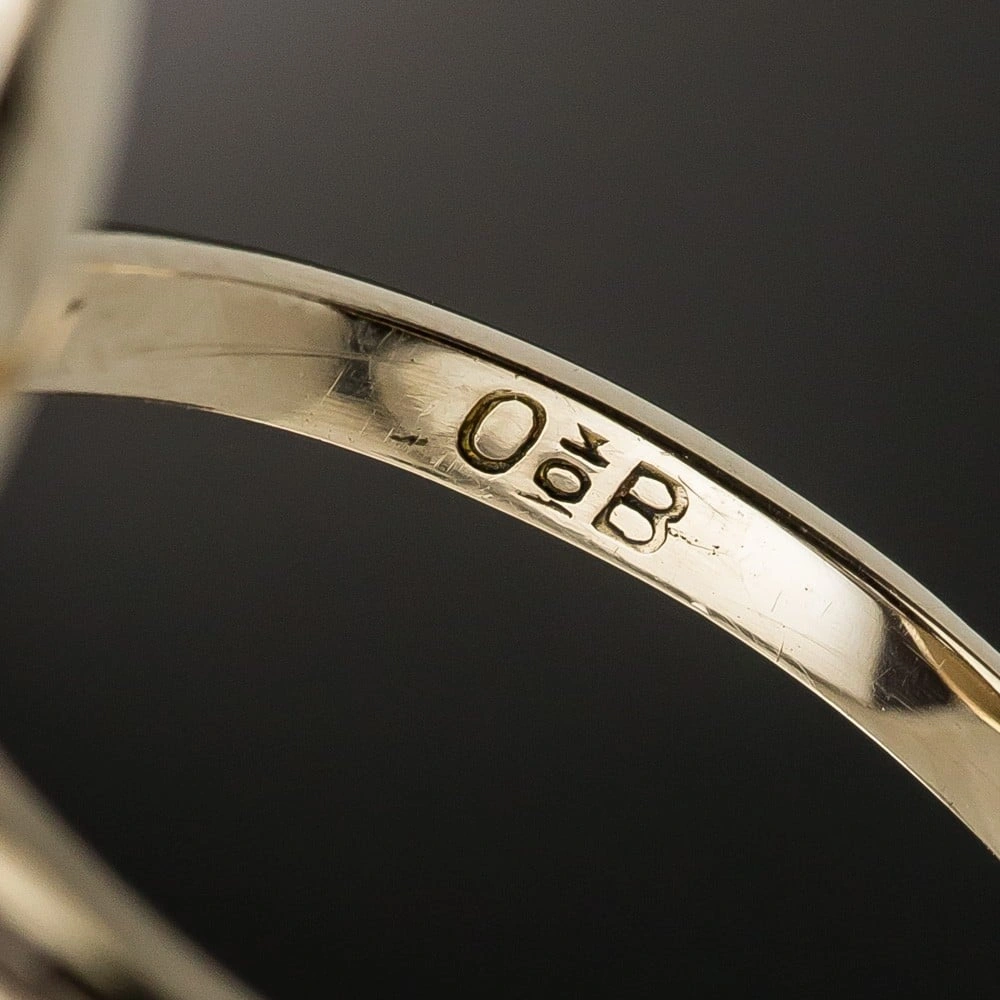
Ostby and Barton hallmarks include stamped “O 10K B” on 10-karat gold in Providence, Rhode Island. Ostby & Barton was active from 1879.
- Active years
- From 1879
- Country
- United States
- City / region
- Providence RI
- Products
- jewelry, Gold and gem-set rings, Wedding and children's rings, Gold-shell and sterling jewelry, Cufflinks, pins and pendants
- Marks
- 6
Founded in 1879; jewelry manufacture continued into the early 1950s. The later electrical-probe business was a separate activity.
What to look for
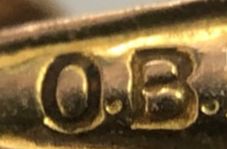
- Read O.B., O-B or OB with the metal wording. Gold, sterling and gold-shell products occur; the initials alone do not establish purity.
- Record devices separately: the eagle-and-arrows, target-like device, shield grouping and cross are not interchangeable. Read complete lettering on small children's-ring trade names such as Wee Tot.
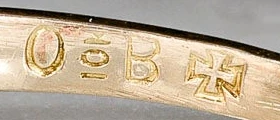
- The Maltese-style cross beside O 10K B is a company product-line mark used in a 1917 advertisement.
Marks & lettering
6 marksRIMark wording
Undated
RI
Providence RI, USA
c.1934 – c.1950: 118 Richmond St. Providence 2 | c.1950: Rings & Mountings

Undated
O 10K B
The metal-standard text separates O and B, with an adjacent cross. This differs from a compact punctuated O.B. punch.
stamped · gold · 10-karat gold · Providence, Rhode Island
One combined inscription photographed from the better of two views; cross does not establish personal authorship.

Undated
WEE TOT
Spelled-out children's-line name, rather than the company's OB initials or pictorial devices.
word-mark drawing · black
Mark drawing.
About Ostby & Barton
Ostby & Barton began in Providence, Rhode Island, in 1879, when Engelhart Cornelius Ostby and Nathan B. Barton formed a ring-manufacturing partnership. Ostby had trained as a jeweler in Norway before emigrating to the United States. The business incorporated in 1893 and developed a large factory operation at Richmond and Clifford Streets.
By the beginning of the twentieth century, the firm employed hundreds of workers. It made rings in many styles, from children's and plain bands to gem-set designs, and maintained tools and dies for repeat production. The factory also refined its gold scrap for reuse. Its broader jewelry output included cufflinks, pendants, pins and other accessories, sold in both domestic and overseas markets.
Ostby died in the Titanic disaster in 1912; his daughter Helen survived. The business continued under later family and company management, so an OB mark does not establish that a jewel predates his death. Twentieth-century advertising documents changing ring styles and several trade devices. Jewelry operations continued into the 1950s, and Clark & Coombs subsequently acquired tools, dies and machinery. The Ostby & Barton name later appeared in electrical-test equipment.
Also known as: OSTBY AND BARTON CO. · Ostby & Barton Co. · Ostby and Barton · O.B. · O-B · OB · Wee Tot · Ostby & Barton Company
Look-alikes & how to tell them apart
Uncas →
Uses inward-pointing arrows around a central device.
Uncas's U must not be read as Ostby & Barton's eagle or target. Inspect the center as well as the arrows.
Other OB initial marks
Two initials alone occur in several jewelry and silver contexts.
Compare the punctuation, cartouche and accompanying device; OB alone does not identify Ostby & Barton.