

Undated
GENUINE Barbie / BY MATTEL
White wrist tag with red script Barbie. Miss Barbie, Fashion Queen, Midge, Ken, Skipper and Allan have separate product labels.
printed label (catalogue illustration) · Printed paper
Other maker marks
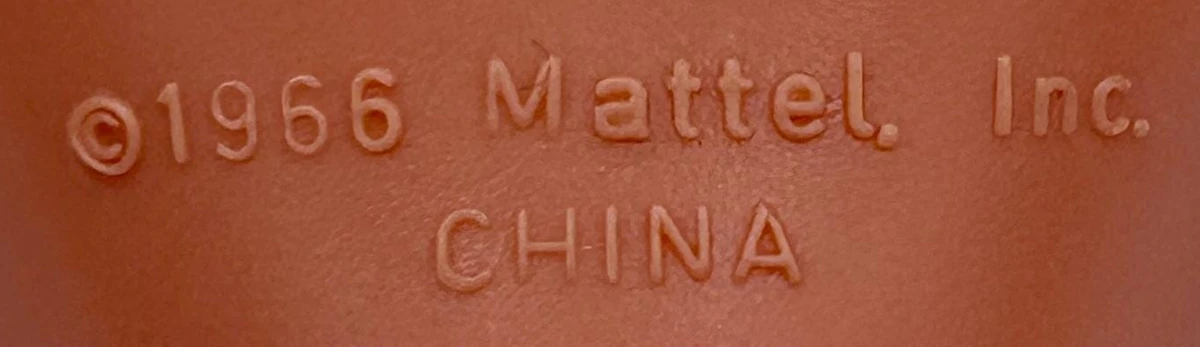
“©1966 Mattel, Inc. / CHINA” appears among Barbie marks from China. The company also produced collector editions and themed historical dolls.
Barbie introduced 9 March 1959; Mattel founded 1945. Molded component copyright dates are not the brand’s starting date or necessarily a doll’s manufacture year.
Undated
White wrist tag with red script Barbie. Miss Barbie, Fashion Queen, Midge, Ken, Skipper and Allan have separate product labels.
printed label (catalogue illustration) · Printed paper
Undated
Date and company name share the first line in mixed-case lettering; China is below, unlike the three-line Malaysian arrangement.
moulded · Plastic / vinyl · China
Undated
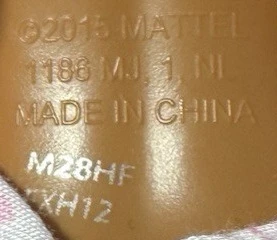
Modern multi-line inscription includes the address-like 1186 MJ 1 NL element, Made in China and separate production codes.
moulded · Plastic / vinyl · China
Undated
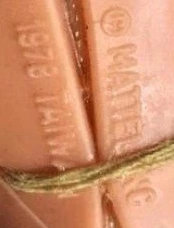
Vertical wording on the rear head mechanism/cover of Kissing Barbie, rather than the lower-back torso marking.
moulded · Plastic / vinyl · Taiwan
Undated
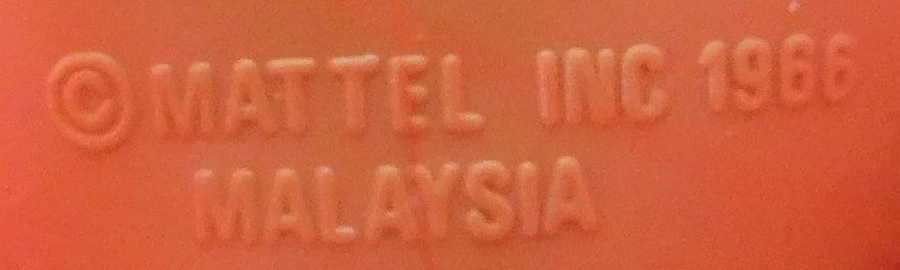
Copyright line with 1966 below the company name and Malaysia on a third line; distinguish the differently arranged China torso.
moulded · Plastic / vinyl · Malaysia
Mattel introduced Barbie at the American International Toy Fair in New York on March 9, 1959. Ruth Handler developed the fashion-doll concept after watching her daughter Barbara play with adult paper dolls. Barbie’s name came from Barbara. Mattel itself had begun in California in 1945 with Ruth and Elliot Handler and Harold Matson, initially making other products before concentrating on toys.
The first Barbie was presented as a teenage fashion model with a separate wardrobe. The range soon developed a family of characters and accessories: Ken appeared in 1961, Midge in 1963 and Skipper in 1964. Successive dolls changed hairstyles, facial painting, body construction and articulation. The Barbie name consequently identifies a continuing product family rather than one unchanged doll mold.
Mattel expanded Barbie’s occupations and appearances over the following decades. Black and Hispanic dolls carrying the Barbie name entered the range in 1980, alongside a growing international assortment. The company also produced collector editions and themed historical dolls. Its molded copyright statements identify particular sculpted components, while printed tags and packaging identify products and ranges. Different manufacturing countries and reused molds account for the variety of Mattel inscriptions found on surviving dolls.
Also known as: Mattel Barbie · Barbie doll · Barbie by Mattel, Inc.
Early Midge and Barbie shared body types, and a Midge body can also carry the Barbie name. Compare the face and full inscription.
A Mattel inscription identifies the manufacturer of a component. Compare the head and body with the same character and model.