
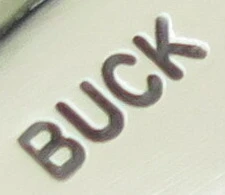
c. 1961–1967
BUCK
No country or model line. The illustrated factory-era family is dated circa 1961–1967 by Buck; wording alone cannot exclude earlier handmade work.
stamped · steel · United States
Other maker marks
Buck knife tang stamps are associated with pocketknives and fixed-blade knives from United States. Annual symbols were introduced in 1986.
1961 is incorporation of Buck Knives, Inc. The family’s knife-making tradition and H.H. Buck & Son business are earlier; 1902 is the claimed origin of Hoyt Buck’s tempering work.
c. 1961–1967
No country or model line. The illustrated factory-era family is dated circa 1961–1967 by Buck; wording alone cannot exclude earlier handmade work.
stamped · steel · United States
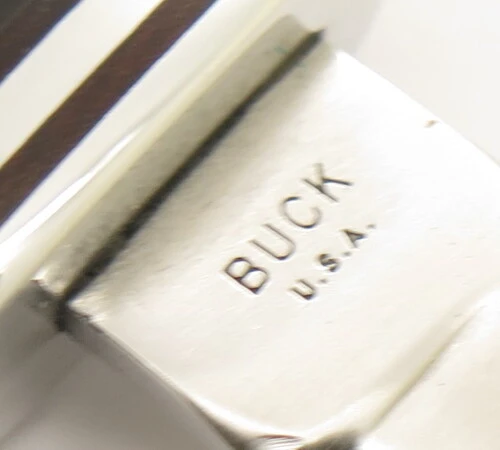
c. 1967–1972
Country wording was added for export; no model number line is present.
stamped · steel · United States
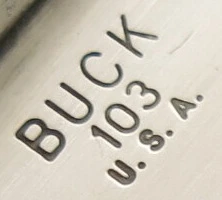
c. 1972–1986
Model number 103 sits between brand and country. Different model numbers alone are the same stamp family.
stamped · steel · United States
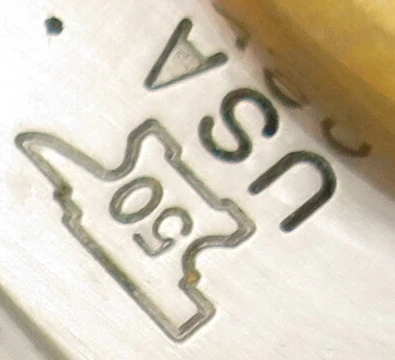
2014
The 50 inside the anvil identifies the 2014 anniversary version, rather than the 2002 centennial anvil.
stamped · steel · United States
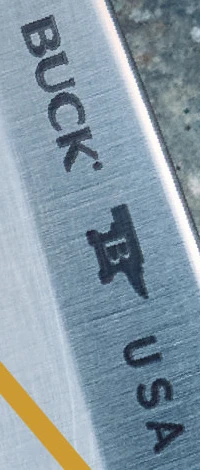
Undated
The B-in-anvil company emblem is accompanied by dark BUCK and USA wording on the blade, separate from the model/year code.
dark blade marking · steel · United States
Buck Knives grew from Hoyt Buck’s work with steel and handmade knives. During the Second World War he made knives from used files, and after the war he established a small business with his son Al in San Diego. Al continued after Hoyt’s death in 1949. The company incorporated as Buck Knives, Inc. in 1961, moving from a small mail-order operation towards factory production.
The Model 110 Folding Hunter, introduced in 1964, became central to the company’s expansion. Buck also made fixed-blade sporting knives, pocketknives and later specialised models. Production grew through larger premises in the San Diego area and El Cajon. Chuck Buck succeeded Al as company leader, followed by another generation of the family. In 2005 the manufacturing operation moved from California to Post Falls, Idaho.
Blade markings changed with the growth of the business. Early factory knives carried BUCK alone; U.S.A. was added in the later 1960s, followed by model numbers around 1971–1972. Annual symbols were introduced in 1986. Special editions and Custom Shop pieces can use additional devices, including an anvil. The factory’s long-running models also changed in handles, fasteners and other construction details, which help distinguish examples when a stamp spans several years.
Also known as: Buck Knives · H. H. Buck & Son · H.H. Buck and Son · Hoyt Buck · Al Buck · Buck Knives, Inc.
An anvil is not automatically a 2002 date. Buck retains anvil branding on customs, while a 50 inside the device belongs to the 2014 Model 110 anniversary.
Schrade and Camillus made some early Buck 300-series knives. BUCK remains the brand, but the stamp and construction must be matched to that model’s contract-production history.