
A E Gray and Co LtdMaker name
c. 1914–1918
black
black · Hanley and Stoke, England
all black galleon mark this mark used (note that the 'o' of 'Co' is within the letter 'C')
Pottery & porcelain
The name “Kirklands Etruria Embassy Ware” appears among Grays Pottery marks from Hanley and Stoke, England. Its mark period is 1938.
Wholesale/decorating business began 1907; incorporated 1912. Transition to Portmeirion followed the 1960 takeover and 1961 Kirkhams purchase; Portmeirion Potteries incorporated 1962.
c. 1914–1918
black · Hanley and Stoke, England
all black galleon mark this mark used (note that the 'o' of 'Co' is within the letter 'C')
c. 1914–1918
black · Hanley and Stoke, England
all black galleon mark this mark used (note that the 'o' of 'Co' is within the letter 'C')
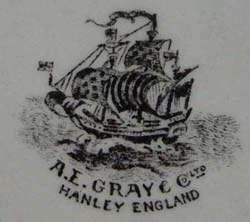
c. 1914–1918
The first galleon has a high detailed hull, distinct from the yellow-sailed second galleon.
printed · black · decorated ceramic · Hanley, Staffordshire, England
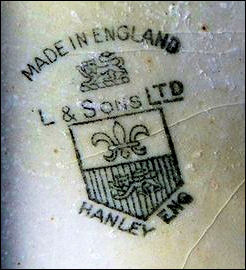
c. 1920–1945
Hanley and Stoke, England
Lancaster & Sons supplier’s mark on Gray’s Pottery ware.
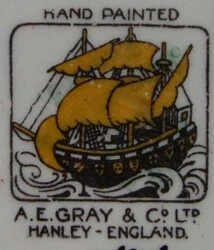
c. 1921–1928
Large yellow sails, decorative waves and a framed ship define the H1 second-galleon family.
printed · black, yellow or other catalogue colourway · decorated ceramic · Hanley, Staffordshire, England
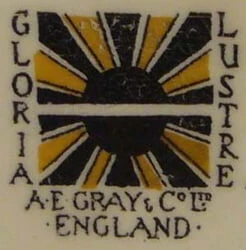
c. 1923–1928
Sunburst device identifies the Gloria Lustre family rather than one of the ship designs.
printed · black, yellow or other catalogue colourway · decorated ceramic · Hanley, Staffordshire, England
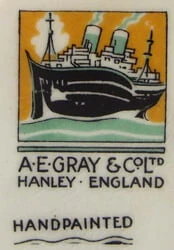
c. 1926–1928
A steam liner replaces the sailing vessel; this D7 version belongs to the Susie Cooper period.
printed · black, yellow or other catalogue colourway · decorated ceramic · Hanley, Staffordshire, England
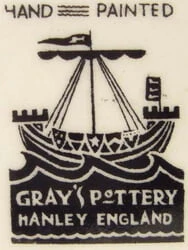
c. 1931–1933
Jack Bond’s stylised mediaeval ship is distinct from the realistic clipper and galleons.
printed · black · decorated ceramic · Hanley, Staffordshire, England
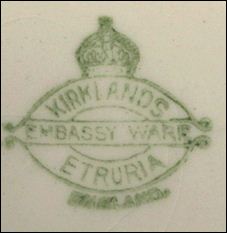
From 1938
Hanley and Stoke, England
Kirklands supplier’s mark on Gray’s Pottery ware.
From 1944
white · Hanley and Stoke, England
Suppliers of white-ware to Gray's: . Gray & Co were a decorating firm, buying in white-ware shapes from other manufacturers. They never made ware of their own. When the ware was made specifically for an order from Gray then there were generally no manufacturers marks and only the Gray backstamp is used. However when the ware was from a surplus of ware the manufacturers mark often appears and the Gray's backstamp was applied over the original stamp. Gray purchased ware from over 20 suppliers. However the main suppliers of earthenware blanks were Johnson Brothers, Lancaster & Sons ( Lancaster & Sandland) and Kirkland & Co. - in 1936 . Gray purchased an interest in Kirklands pottery to help ensure consistency of supply. In 1938 Kirklands was renamed to Kirklands (Etruria) Ltd. - for more detained information see Gray's Pottery list of of white-ware suppliers
Undated
Hanley and Stoke, England
Undated
Hanley and Stoke, England
the registration number 588114 shows that the design was registered in 1911
Undated
Hanley and Stoke, England
"New Trade Marks advertised for registration during November include : 336,196. China ware and earthenware pottery included in Class 16. A. E. Gray & Co, Glebe Works, Mayer-street, Hanley. Staffordshire." The Pottery Gazette - 1 Dec 1911
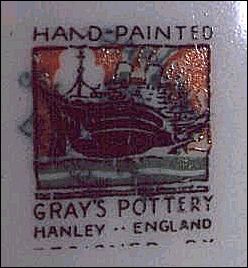
Undated
painted, printed · Hanley and Stoke, England
The Gray's clipper mark is printed over a Kirklands backstamp.
Undated
printed, painted · Hanley and Stoke, England
The Gray's clipper mark printed over a Lancaster & Sons backstamp
Undated
Hanley and Stoke, England
Undated
Hanley and Stoke, England
Albert Edward Gray established his pottery business in Stoke-on-Trent in 1907 after working as a pottery and glass salesman. A. E. Gray & Co. became a limited company in 1912. Its principal work was decoration: the company bought undecorated ceramic shapes from other manufacturers and applied painted, printed and lustre designs. Gray’s Pottery was a decorating business that bought ceramic bodies from other factories.
The company worked at the Glebe Works in Hanley before moving to Whieldon Road, Stoke, in 1933. Designers included John Guildford, Gordon Forsyth, Susie Cooper and Sam Talbot. Cooper joined in 1922 and left in 1929 to establish her own business. Gray’s output ranged from small souvenir wares to tableware, jugs and decorative pieces, with hand-painted patterns central to its reputation. Ship devices and the Gloria Lustre sunburst became recognisable backstamps.
White-ware suppliers included Johnson Brothers, Kirklands and Lancaster & Sons. Their marks can remain beneath or beside the Gray’s decoration stamp. Susan Williams-Ellis and Euan Cooper-Willis purchased Gray’s in 1960, followed by Kirkhams in 1961. The combined businesses became the basis of Portmeirion Potteries, incorporated in 1962. Early Portmeirion wares can preserve Gray’s wording during this transition.
Also known as: Grays Pottery · Gray’s · A E Gray · Albert Edward Gray · A. E. Gray & Co. Ltd.
Their maker stamps may occur on Gray’s decorated ware. Separate the original white-ware mark from the Gray’s ship or sunburst overstamp.
Cooper designed at Gray’s before 1929. A Gray’s liner or other AE Gray wording differs from the marks of her later independent business.
Early transitional products can carry both Gray’s and Portmeirion wording. The 1960–1962 ownership transition separates these from earlier Gray’s production.