
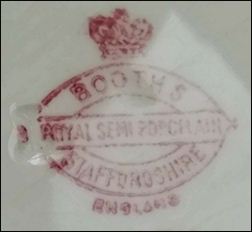
1891–1906
Booths Royal Semi Porcelain Staffordshire England
earthenware · Tunstall, England
Variant without Silicon China.
Pottery & porcelain
The name “Booths Silicon China Made in England 1750” appears among Booths pottery marks from Tunstall, England. Its mark period is 1912.
1891–1906
earthenware · Tunstall, England
Variant without Silicon China.
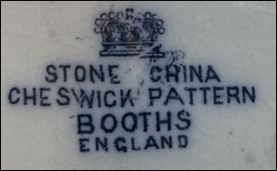
1891–1906
Marks without the trade name Silicon China date from 1891–1906.
Tunstall, England
Cheswick is the pattern name.
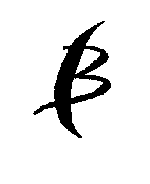
c. 1905–1920
Used circa 1905–1920 on opaque earthenware reproductions of eighteenth-century blue-and-white Worcester porcelain.
printed, painted · blue · earthenware · Tunstall, England
Blue printed or painted mark found on Booths reproductions of 18th-century blue and white Worcester porcelain NOTE: Booths' reproductions are of opaque earthenwares, whereas the originals were in transparent porcelain. Encyclopaedia of British Pottery and Porcelain Marks - Godden
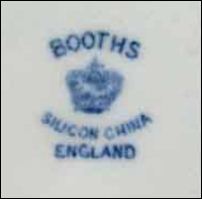
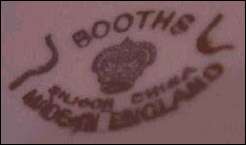
From 1906
Tunstall, England
typical marks with the trade name 'Silicon China' +
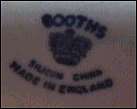
From 1906
Tunstall, England
typical marks with the trade name 'Silicon China' +
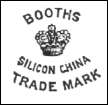
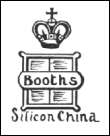
From 1912
This printed mark dates from 1912; 1750 on some variants is not the founding date of Booths Ltd.
printed · Tunstall, England
printed mark + Typical mark with or without "England" or "Made in England" underneath the mark. Often with "1750" divided either side of the mark. The date of 1750 is not that of Booths Ltd who started operation in 1891. The earliest date of Thomas Booth & Co. was at the Knowels Works in Burslem. The 1750 either refers to a distant relation or to the date that a potworks that Booths used was first established.
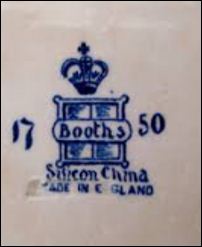
From 1912
This printed mark dates from 1912; the divided 1750 is not the founding date of Booths Ltd.
printed · Tunstall, England
printed mark + Typical mark with or without "England" or "Made in England" underneath the mark. Often with "1750" divided either side of the mark. The date of 1750 is not that of Booths Ltd who started operation in 1891. The earliest date of Thomas Booth & Co. was at the Knowels Works in Burslem. The 1750 either refers to a distant relation or to the date that a potworks that Booths used was first established.
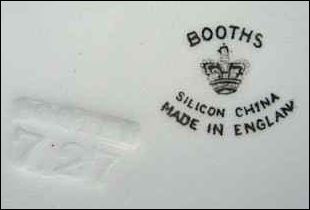
1927
The impressed 7.27 dates this example's manufacture to July 1927; it is not a mark-use interval.
printed, impressed · Tunstall, England
Printed mark accompanied by impressed and the manufacture date.

1930–1948
printed · Tunstall, England
Variants carry Booths Limited England or Made in Great Britain.
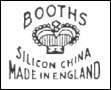
1930–1948
Printed variants began in 1930 and continued to 1948.
printed · Tunstall, England
Variants may read Booths Limited England or Made in Great Britain.
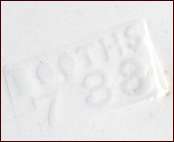
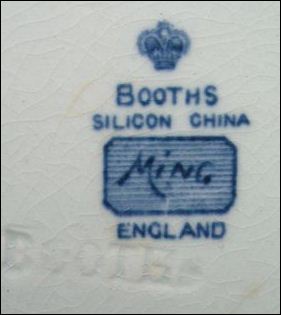
Undated
printed, impressed · Tunstall, England
Printed mark with impressed BOOTHS; Ming is the pattern name.
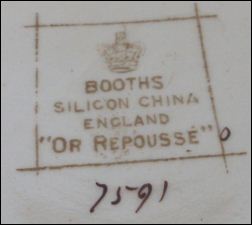
Undated
painted · Tunstall, England
Or Repoussé is a gilded pattern named after the metalworking technique; the hand-painted 7591 identifies the decorator who applied the gilding.
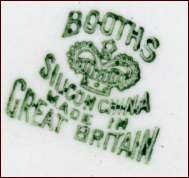
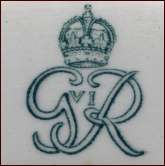

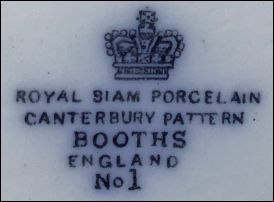
Undated
Tunstall, England
Royal Siam Porcelain occurs on a few Canterbury pieces; the source considers Siam an engraver's mistake for Semi.
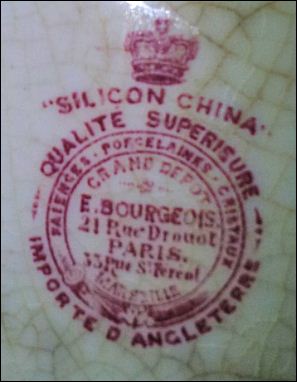
Undated
Tunstall, England
Booth’s supplied the Emile Bourgeois Grand Dépôt in Paris. The shop was established in 1863; that date does not date this mark.
Thomas Booth began pottery manufacture in Burslem in the 1850s and moved to Church Bank Works, Tunstall, in 1868. His son Thomas Gimbert continued independently in 1876; Frederick joined from 1883 to 1887. The business became a limited company around 1900. Charles H. Bowers became general manager in 1905. Booths later worked at the Swan and Soho Potteries and employed about 800 people by 1914.
The Pearson Group acquired an interest in the 1920s and later full ownership, retaining the Booths name. During the Second World War the factory made undecorated domestic and military canteen ware. Booths acquired Colclough in 1944 and merged with it as Booths & Colclough Ltd. in 1948. Booths developed from Thomas Booth's family pottery business and operated at Church Bank Works, Tunstall.
Thomas Gimbert Booth continued alone from 1876 and traded with his brother Frederick as T. G. & F. Booth from 1883 to 1887. It acquired Colclough China in 1944 and merged with it in 1948 to form Booths & Colclough Ltd. The Booth family pottery business began in Burslem in the 1850s and moved to Church Bank Works, Tunstall, in 1868. Thomas Gimbert Booth continued the business in 1876, joined by Frederick Booth during 1883–1887.
Also known as: Booths Ltd | pottery manufacturers | Tunstall | Stoke-on-Trent