

From 1928
CAMARK
Plain capitals without USA or a state outline; the collector catalogue places this version from 1928 into the early 1930s.
impressed · glazed pottery · Camden, Arkansas, United States
Pottery & porcelain
The name “CAMARK” appears among Camark Pottery marks on glazed pottery from Camden, Arkansas, United States. Its mark period is 1928.
Founded in 1926; Camden factory production began in 1927. Large-scale production declined in the 1960s; later retail and sporadic production continued into the early 1980s.
From 1928
Plain capitals without USA or a state outline; the collector catalogue places this version from 1928 into the early 1930s.
impressed · glazed pottery · Camden, Arkansas, United States
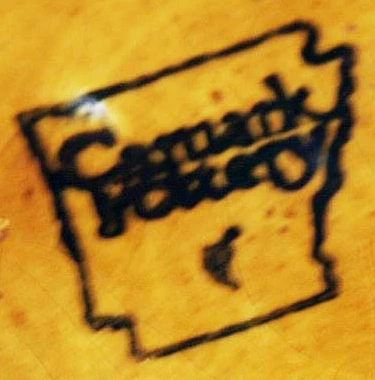
Undated
State outline is printed directly on the pottery rather than attached as a paper label.
printed · dark ink · glazed pottery · Camden, Arkansas, United States
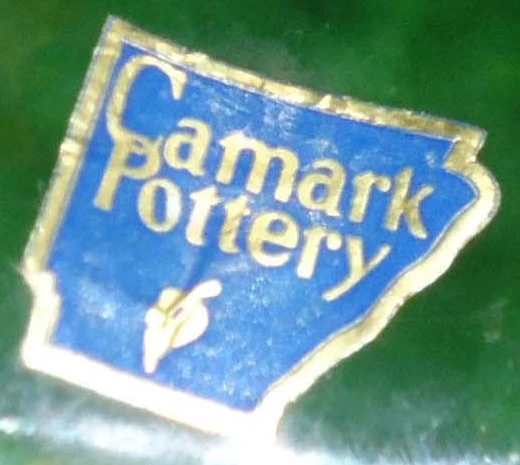
Undated
Arkansas-shaped paper label, distinct from the rectangular shape-and-finish ticket; the blue-and-gold example is assigned to the 1930s–mid-1940s.
label · gold and blue · glazed pottery · Camden, Arkansas, United States
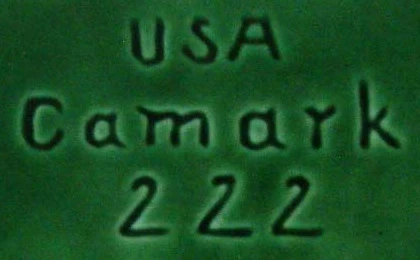
Undated
USA sits above the mixed-case name and a shape number, unlike the early plain CAMARK impression.
molded · glazed pottery · Camden, Arkansas, United States
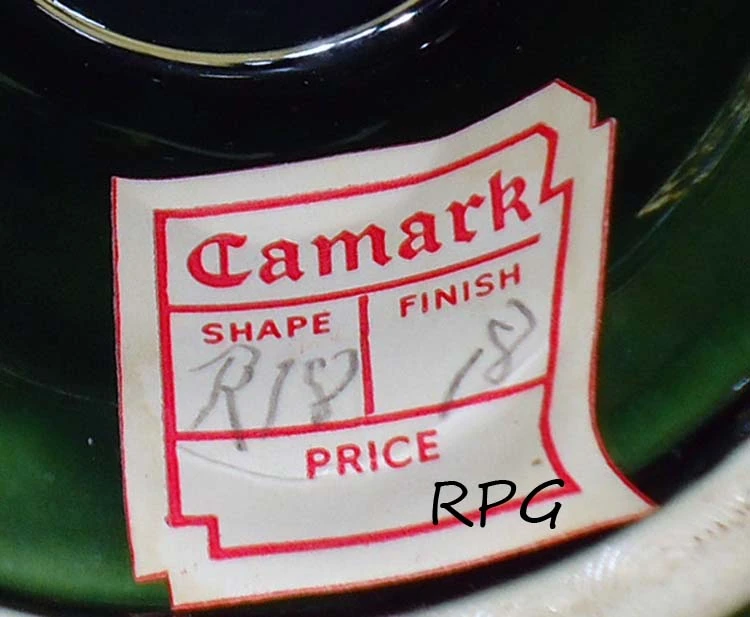
Undated
Ruled boxes and red border distinguish this production/retail ticket from the Arkansas-shaped label.
label · red and white · glazed pottery · Camden, Arkansas, United States
The Camden Art Tile and Pottery Company was founded in Camden, Arkansas, in 1926 by Samuel Jacob “Jack” Carnes and associates including John B. Lessell and Stephen Sebaugh. Its Camark name combined Camden and Arkansas. Lessell made the first designs in Ohio using Arkansas clay, but died in December 1926 before the Camden factory began production. His wife Jennie and daughter Billie moved to Arkansas to help establish the decorating department.
Factory production began in 1927. Early wares included lustred and iridescent pottery, followed by modernistic shapes and a wide variety of coloured glazes. Alfred Tetzschner introduced new designs, while Sebaugh and other experienced workers developed glaze treatments. The company increasingly used molds to make vases, decorative bowls, flower frogs, console sets and planters. Its range also included teapots, cups, saucers, salt and pepper shakers and wall plaques.
Carnes died in 1958. Mary Daniel acquired the business in the early 1960s and increasingly operated it as a retail shop using existing stock, with sporadic later production. The property and name subsequently passed to the Ashcraft family. Paper labels, impressed names, ink stamps and molded base lettering identify different parts of Camark’s output.
Also known as: Camark · Camden Art Tile & Pottery Company · Camden Art Tile and Pottery Company / Camark Pottery
Some early forms are similar or identical. A Camark label or name stamp separates Camark examples from pieces carrying RUMRILL or RED WING lettering.
John Lessell’s designs and glaze effects travelled between employers. A Lessell signature or a luster finish needs comparison with the complete form and any factory mark.