
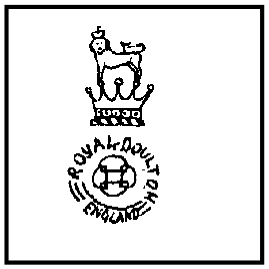
c. 1800–1899
ROYAL DOULTON ENGLAND
The source places the body mark at the end of the 19th century.
impressed · red · porcelain, faience · England, United Kingdom
The dark red colour describes the figures' body rather than the mark ink.
Pottery & porcelain
The name “Doulton Burslem England” appears among Doulton pottery marks from Burslem (and other locations), England. Its mark period is 1891.
c. 1800–1899
The source places the body mark at the end of the 19th century.
impressed · red · porcelain, faience · England, United Kingdom
The dark red colour describes the figures' body rather than the mark ink.
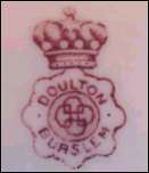
c. 1882–1891
Burslem (and other locations), England
Marks generally omit ENGLAND; this design also occurs without the .
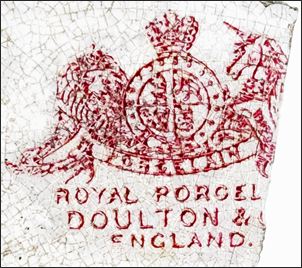
c. 1891–1902
Burslem (and other locations), England
Faux Royal Arms continued from Pinder, Bourne & Co. The caption also cites a hotel site operating in , which conflicts with the stated mark date.
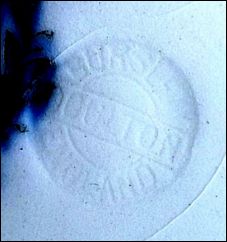
After 1891
The inclusion of England generally indicates a date after 1891.
impressed · Burslem (and other locations), England
the impressed mark - the inclusion of 'England' generally indicates a date post
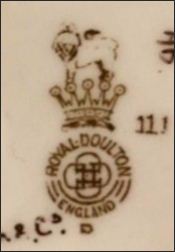
c. From 1902
Burslem, England
Standard trade mark introduced after the 1901 royal warrant.
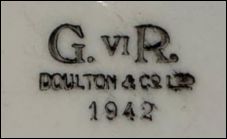
c. 1930–1939
The illustrated piece was manufactured in 1942; the royal cypher identifies British government property.
Burslem (and other locations), England
Government-contract canteen ware, most likely for the armed services.
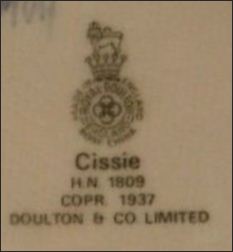
c. From 1930
Burslem, England
Made in England was added from ; the copyright and model numbers do not define mark-use dates.
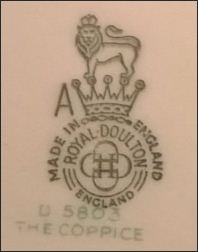
c. 1942–1952
The letter A indicates manufacture under the Wartime Concentration Scheme.
Burslem (and other locations), England
the inclusion of the letter A indicates that the ware was made under the provisions of the Wartime Concentration Scheme

From 1960
English Translucent China was introduced in January 1960.
Burslem (and other locations), England
English Translucent China introduced in January
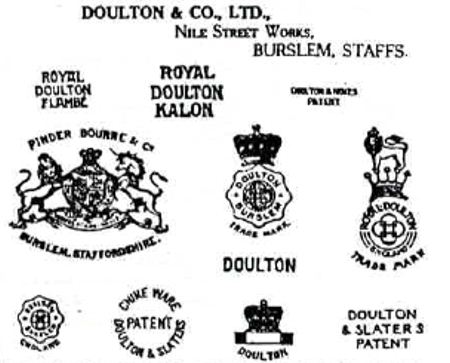
Undated
Composite mark illustration published in the 1917 Pottery Gazette Diary.
Burslem, England
Pottery Gazette Diary
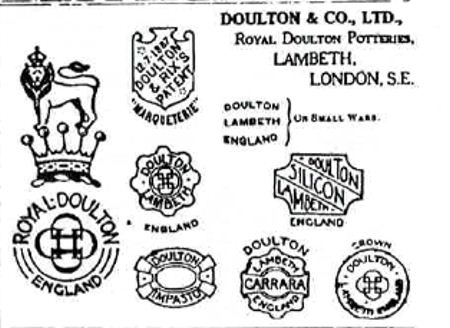
Undated
The illustration comes from a 1917 Pottery Gazette diary, an observation date.
Lambeth, London, England
Composite illustration of several Doulton marks and the Lambeth address.
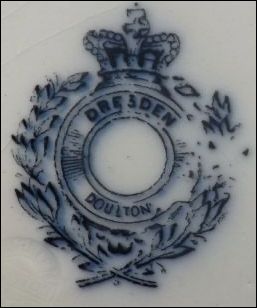
Undated
printed, impressed · Burslem, England
Early printed wreath-and- mark continued from Pinder partnerships; an impressed mark also appears on the example.
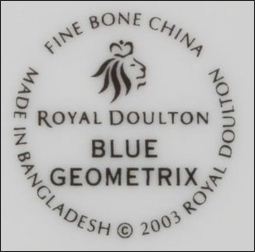
Undated
printed · green · bone china · England, United Kingdom
The caption discusses transfers of Royal Doulton production overseas during 2002–2005; these do not define this mark’s period of use.

Undated
printed · green · England, United Kingdom
2002 saw the closure of Doulton's Baddeley Green factory with the loss of 500 jobs and the transfer of the production of ' Royal Albert ' to . In March 2004 it was announced that the original Nile Street works, the only remaining Doulton UK manufacturing facility, would be closed. In February 2005 Waterford Wedgwood, who already had a large stake in Doulton shares, completed a nearly £40m take over of of Royal Doulton PLC. In April 2005 manufacturing at the Nile Street works ceased and production of the Royal Doulton, Minton and Royal Albert brands was transferred to factories of the Waterford Wedgwood group - most of which were overseas. » Made in England - does it matter?
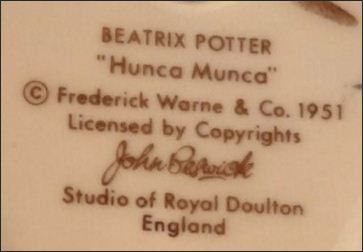
Undated
Burslem (and other locations), England
Doulton acquired John Beswick Ltd in 1969; this is an acquisition date rather than a mark-use date.
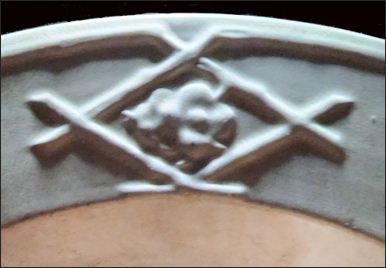
Undated
Illustrated decoration is on a plate fragment found at the Stoney Creek Falls Hotel site, Cairns; the hotel operated during 1887–1890.
Burslem (and other locations), England
The source describes a 12-inch plate with decoration repeated four times around the border.
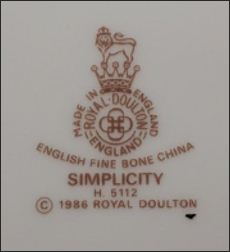
Undated
1986 is printed as a copyright date; the source does not give a complete use interval.
bone china · Burslem (and other locations), England
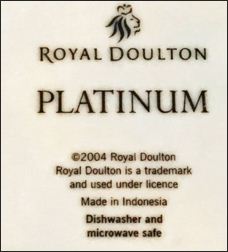
Undated
The pictured licence mark includes a 2004 copyright line; factory-transfer dates are company history.
printed · green · England, United Kingdom
Royal Doulton trademark used under licence; made in .
Doulton began as a partnership of John Doulton, Martha Jones and John Watts in Lambeth in 1815, making stoneware and pipes. John and Henry adopted the Doulton name in 1853. Henry joined Pinder, Bourne & Co. at Burslem in 1877; the business became Doulton & Co. in 1882 and incorporated in 1899. A royal warrant followed in 1901. The Lambeth studios closed during the group's 1955–1956 restructuring.
Doulton acquired Minton and Dunn Bennett in 1968, then Beswick and Webb Corbett in 1969. Pearson acquired Doulton in 1971 and combined it with Allied English Potteries. Royal Doulton PLC was formed in 1992. After factory closures in 2002, Waterford Wedgwood completed its takeover in February 2005; Nile Street production ended in April 2005. Doulton began in Lambeth in 1815 as a partnership of John Doulton, Martha Jones and John Watts, making stoneware.
Henry Doulton joined Pinder, Bourne & Co. at Nile Street, Burslem, in 1877. After Pinder retired in 1881, the Doultons continued the business; it became Doulton & Co. in 1882 and was incorporated as Doulton & Co. Ltd in 1899. Doulton began with John Doulton, Martha Jones and John Watts at Lambeth in 1815, making stoneware and pipes. Henry Doulton joined Pinder, Bourne & Co at Nile Street, Burslem, in 1877.
Also known as: Doulton & Co · Doulton & Co (Ltd)