
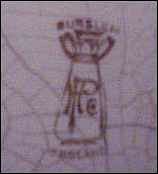
c. From 1904
Burslem H P Co England
earthenware · Burslem, England
The source records the mark in a 1917 trade diary.
Pottery & porcelain
Burslem, England, United Kingdom · 1885–1975 · 26 marks.
c. From 1904
earthenware · Burslem, England
The source records the mark in a 1917 trade diary.
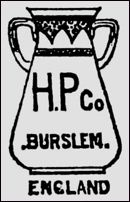
c. From 1904
earthenware · Burslem, England
The source records this Harvey Pottery mark in a 1917 trade diary.
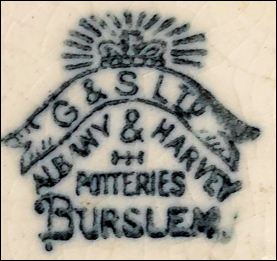
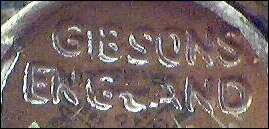
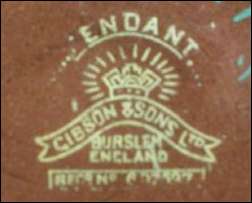
c. From 1912
earthenware · Burslem, England
PENDANT is the pattern name; the number beneath is its pattern registration number.
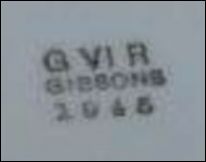
c. 1930–1939
The source identifies 1945 as the manufacturing year on government-supply ware, rather than a full mark-use interval.
earthenware · Burslem, England
The marks shown indicates that the ware was produced for and supplied to the British Government; it was ultimately property of the /Government, hence the GR-VI Cypher. This mark is there to distinguish the piece from being normal ‘utilitarian’ ware for public sale during the period surrounding the Second World War. Gibson ( and others ) were given government contracts throughout the late 1930s and into the 1940s (WWII) and produced canteen ware - most likely for the armed services. The year of manufacturer is generally included.
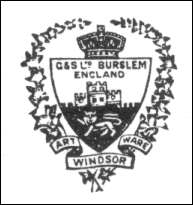
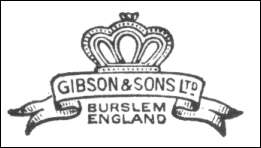
c. From 1930
The mark introduced around 1930 includes BURSLEM.
earthenware · Burslem, England
+ the mark introducuced has the place name BURSLEM
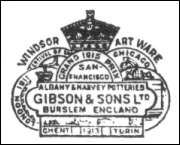
From 1930
The stamp commemorates the 1915 Panama-Pacific exposition; the source states use from 1930.
earthenware · Burslem, England
backstamp celebrating the 1915 Panama-Pacific International Exposition, San Francisco Godden 'Encyclopaedia of British Pottery & Porcelain Marks' notes that these two marks were in use +
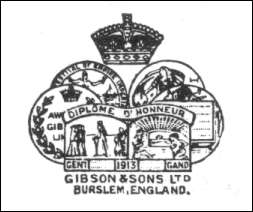
From 1930
1913 refers to the Ghent exhibition award; the source dates mark use from 1930.
earthenware · Burslem, England
1913 Ghent International Exhibition Gibson won a Diploma of Honour Godden 'Encyclopaedia of British Pottery & Porcelain Marks' notes that these two marks were in use +



c. From 1940
earthenware · Burslem, England
HAND PAINTED is wording describing the ware, not evidence of this mark's application.
c. 1950–1955
earthenware · Burslem, England
The source says a version bearing B was probably made under the Wartime Concentration Scheme.
c. 1950–1955
earthenware · Burslem, England
The source says a version bearing B was probably made under the Wartime Concentration Scheme.

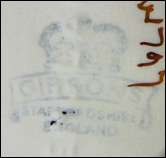
c. From 1950
From around 1950 the place name became STAFFORDSHIRE.
earthenware · Burslem, England
+ from the place name became STAFFORDSHIRE
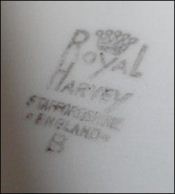
c. From 1950
From around 1950 the place name became STAFFORDSHIRE.
earthenware · Burslem, England
+ from the place name became STAFFORDSHIRE
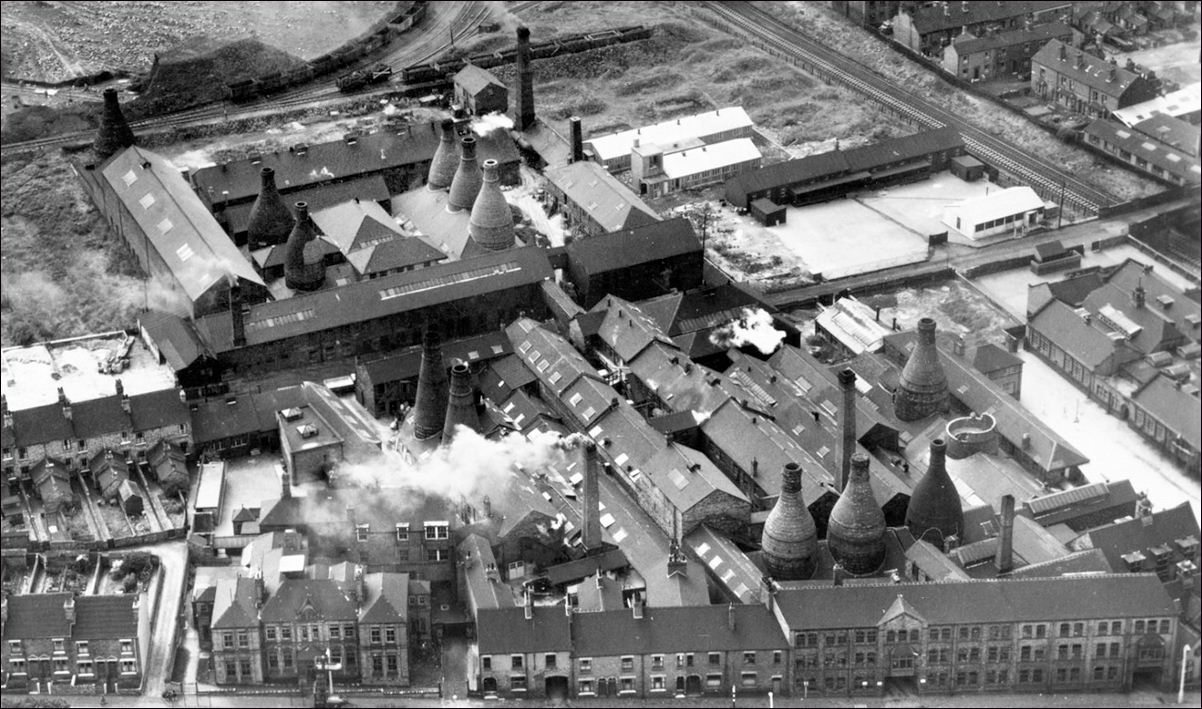
1951
earthenware · Burslem, England
The supplied image is a aerial factory photograph, rather than a mark.
c. From 1974
earthenware · Burslem, England
+ the Howard Pottery group (which Gibson was a part of ) was purchased by Tauton Vale in
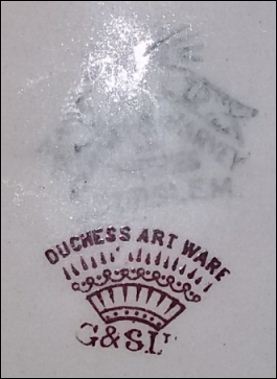
Undated
earthenware · Burslem, England
although well known for production of teapots Gibson also produced various types of art ware
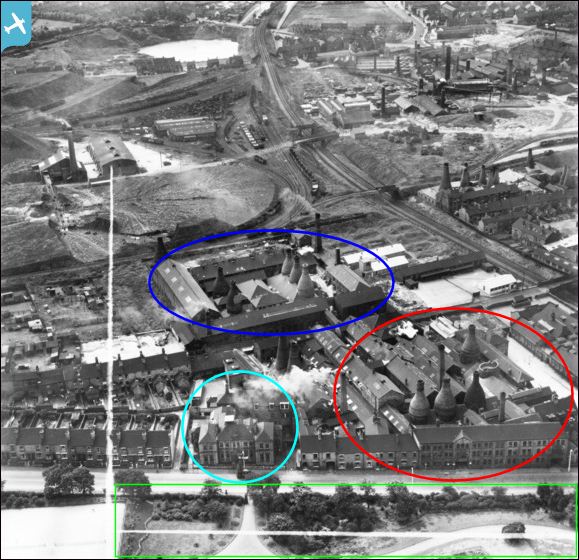
Undated
printed · white, green, light blue, red, blue · earthenware · Burslem, England
The image is an annotated 1951 factory aerial photograph, rather than a mark.
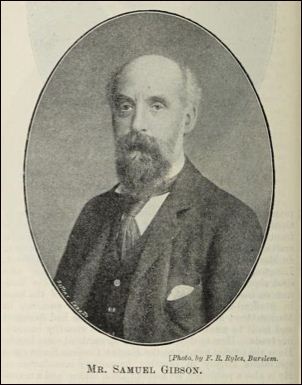
Undated
printed · earthenware · Burslem, England
In perhaps none other of the Pottery towns has the dignity of municipal life been maintained so consistently and at so high a level as at Burslem. Its town council is usually more thoroughly representative of the great industry of the district than those of neighbouring corporations, and its roll of mayors contains the names of many of the ablest local administrators the Potteries has ever produced. The gentleman upon whose shoulders the mantle of chief magistrate has fallen this year is well worthy to take his place beside any of them, for in Mr. Samuel Gibson, the head of the well-known firm of Gibson & Sons, Ltd., Albany and Harvey Potteries, the town possesses one who is held in the highest regard as well in public as in business and private life. His career, in many ways, is a remarkable one. The son of Mr. James Gibson, a respected tradesman of Tunstall, he was born in that town on August 27, 1843. He received the groundwork of his education under Mr. Henry Binnall, at Tunstall, and at the age of ten years he started his career in the packing house with Oulsnam & Holdcroft , of the Soho Works, Tunstall. From the packing house he passed to the glass warehouse, thence to the counting house, and, having acquired an all-round knowledge of the pottery trade, he ultimately reached a managership. Subsequently, 30 years ago, he set up business on his own account as a manufacturer of jet and Rockingham ware, in Moorland-road. Today the firm are among the largest manufacturers of this class of goods in Burslem, besides which other departments have been added from time to time, until almost every kind of ware is produced. The factory, which is situated near Burslem Station, gives employment to about five hundred hands. Some two years ago, for family reasons, the business was converted into a private limited liability company, of which Mr. Gibson is the chairman and managing director, while four of his sons, Messrs. A. H., F. W., Sydney, and Ernest Gibson, actively assist him in the conduct of the concern. The conversion has led to a rather singular contretemps. For a number of years, Mr. Gibson has been one of the largest ratepayers in the borough, he has sat upon the Council for a considerable time, he has been a burgess for more years than he cares to count, yet, as a consequence of the transfer of the business to the company, he was disfranchised at the last revision court. In Mr. Gibson’s case the absurdity of the matter is heightened by the fact that, not being a burgess, he was not qualified to be a town councillor. But, at the time of his disfranchisement, he was already a Councillor. Though the ratepayers of the North Ward are, for the time being, robbed of Mr. Gibson’s services in the Council Chamber, it is pleasant to remember that they have just returned one of his sons, Mr. A. H. Gibson, who promises to follow in his father’s footsteps. It was in 1898 that the Mayor elect entered the Burslem Council as a representative of the North Ward. The contest was a hardly-fought one, and Mr. Gibson was returned together with Mr. Edmund Leigh, of the Middleport Pottery, the latter receiving 1,045 votes, while his colleague polled almost exactly the same number, viz., 1,043. Since then Mr. Gibson has fought one other contested election. In the Council Chamber he has done valuable work upon the Highways and Finance Committees, and the Lighting Sub-Committee, while more recently, as Vice-Chairman of the Education Committee and Chairman of the Finance Committee, his duties have been more exacting still. The cause of education has no warmer friend than it finds in him, and, in this connection, we may recall that only a few months ago Mr. Gibson gave a sum of £1,000 to the Education Committee to establish a fund for the provision of food and clothing for necessitous scholars, stipulating that the beneficiaries should be over five years of age, as he holds with medical authorities, that more harm than good is done to children by sending them to school before they arrive at that age. Mr. Gibson is an omnivorous reader, and a great lover of books. One of the features of his charming residence at Wolstanton is its well-filled bookshelves. He is also a great traveller, and has explored all the northern countries of Europe, as well as portions of other continents. A considerable part of this year he has spent abroad, journeying in Egypt and elsewhere. He was at Naples recently whilst Vesuvius was in eruption, and his photographic albums - Mr. Gibson is a most enthusiastic and expert photographer - contain many interesting views reminiscent of his travels in many lands. Some of the most absorbing views were taken in Russia, where their owner narrowly escaped an unpleasant experience. He paid a visit to the Czar's palace at Peterhof, with a party of friends, and, quite unsuspectingly, proceeded to snap some of the prettiest pieces of scenery, blissfully unconscious of the fact that in Russia, visitors have incurred the displeasure of the law for photographing much less important places. An official was just approaching Mr. Gibson when a friend, who saw what he was doing, gave him a timely warning, and the camera disappeared, but not before Mr. Gibson had secured some admirable views of this forbidden ground. Though an active business man, Mr. Gibson has found an outlet for his energies and talents in many other directions, and in all his work lias been greatly assisted by his wife, who was a daughter of Mr. William Deeming, of Hanley. He has been a diligent worker in the Congregational cause, and is justly proud of several handsome addresses recognising his work which adorn the walls of his home. He possesses the Sunday-school Union diploma of honour for being associated with Sunday-school work for over forty years -an award only given to those who have spent that period in the service. For seventeen years, from January, 1887, to December, 1903, he was superintendent of the Wycliffe Hall Sunday-school, and on his retirement was presented by the officers, teachers, and scholars with an address expressing their deep regard for him. He is a lay preacher for the Potteries and District Association of Congregational Churches, and the treasurer and a deacon of the new Congregational Church in Moorland-road, opened a fortnight ago. He is a strong supporter of the temperance cause, has been a speaker on the Band of Hope plan for many years, and established the first Rechabite tent in Burslem. In politics Mr. Gibson is a Liberal and Free Trader. The warmest relations have always existed between Mr. Gibson and his employees, and the feeling of the workpeople towards him found expression in a very happy manner in August, 1895, when, on the occasion ol the marriage of one of his sons, they presented him (Mr. Gibson, sen.) with a fine portrait in oils of himself, accompanied by an address. The latter is one of Mr. Gibson's most treasured possessions, and speaks most eloquently of the regard his employees entertain for him. Last year the firm made a substantial money present to workpeople who had been in their employ for ten years and upwards, and of the five hundred hands, no fewer than one hundred participated in this generous gift. That 20 per cent, of the workpeople should have been in the one employ for so long a time is evidence of the strong personal ties which exist between employer and employed. Last year also Messrs. Gibson abolished all stoppages. They have also instituted the worthy example of paying wages on Friday. In adopting this course they have two objects in view, one that the wives of the workers should be able to make the best use of their money in the markets on Saturday mornings, and the other that the men and their families might be able to get away early on Saturdays, and thus take advantage of cheap trips into the country. Mr. Gibson has, moreover, established on his works an excellent savings bank, and, to encourage the workers in thrifty habits, 5 per cent, interest is paid on all their savings. There is a useful sick club in connection with the works, which frequently proves of great assistance when the breadwinner of a family happens to fall ill. Such thoughtful institutions as these have been greatly appreciated by the operatives, who are delighted at the honour bestowed upon their master by his selection as Mayor for the ensuing year.
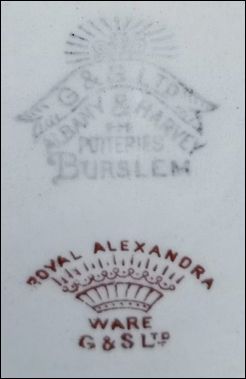
Undated
earthenware · Burslem, England
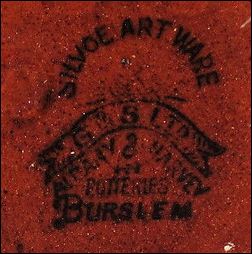
although well known for production of teapots Gibson also produced various types of art ware
Undated
earthenware · Burslem, England
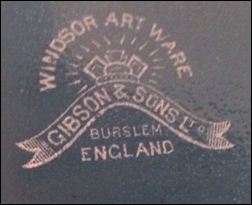
although well known for production of teapots Gibson also produced various types of art ware
Undated
earthenware · Burslem, England
although well known for production of teapots Gibson also produced various types of art ware
Gibson & Sons manufactured earthenware, particularly teapots, at the Albany and Harvey Potteries in Burslem. Samuel Gibson began trading under the name in 1885 after leaving Gibson, Sudlow & Co; the firm became limited in 1905.