
Undated
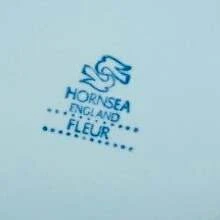
HORNSEA / ENGLAND / FLEUR
Open three-line name-and-pattern layout with dots differs from the circular name and care stamps. Different pattern names in this same layout are one family.
printed · blue · ceramic · England
Pottery & porcelain
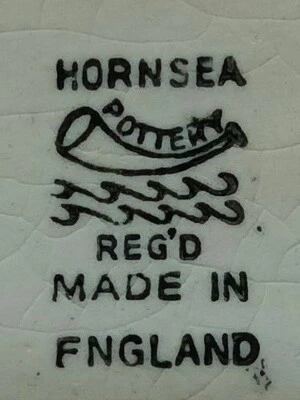
The name “HORNSEA / POTTERY / REG’D / MADE IN / ENGLAND” appears among Hornsea Pottery backstamps on ceramic from England.
Historical manufacturing business closed in April 2000. Later use of the Hornsea brand is a separate context.
Undated
Open three-line name-and-pattern layout with dots differs from the circular name and care stamps. Different pattern names in this same layout are one family.
printed · blue · ceramic · England
Undated
Hunting horn and sea waves are an earlier graphic, distinct from the later stylised device.
printed · black or brown · ceramic · England
Undated
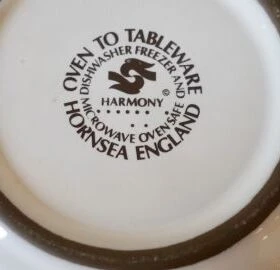
Concentric care-instruction wording distinguishes this from the simple company-name circle; HARMONY is a pattern name.
printed · black or brown · ceramic · England
Undated
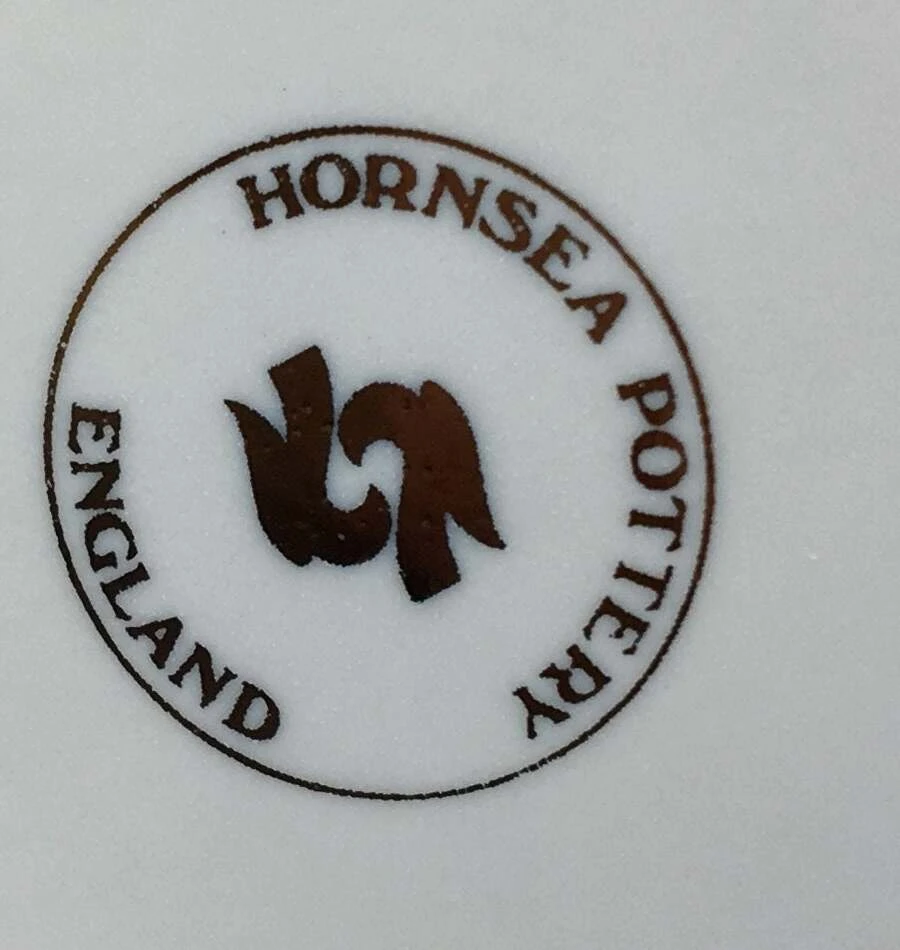
Complete circular company-name border distinguishes this from the open stacked name.
printed · black or brown · ceramic · England
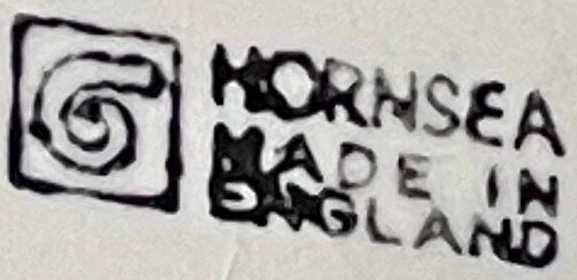
Undated
Square emblem and adjoining name differ from the circular horn stamp.
printed · black or brown · ceramic · England
Brothers Desmond and Colin Rawson began Hornsea Pottery in the seaside town of Hornsea, East Yorkshire, in 1949. Their first tourist souvenirs were plaster-of-Paris models made at home. They moved into clay production and larger premises, first at the Old Hall and then, in 1954, at Edenfield, a former brick and tile works. Early output included character jugs, posy vases and animal novelties.
The pottery developed a strong design identity through contributors including John Clappison, Marion Campbell and Alan Luckham. Complete tableware ranges became an important part of production from 1967. Clappison’s Heirloom and other patterned ranges helped make Hornsea familiar in domestic kitchens, while Martin Hunt designed the contrasting glazed and unglazed surfaces of Contrast. The business received Design Council awards and exported widely.
By 1974 the Edenfield works employed about 250 people and made roughly three million ceramic items a year. Expansion included a second factory at Lancaster, opened in 1976. The original site also developed as a visitor and shopping destination. Competition and declining business conditions affected the company in later decades, and it went into liquidation in April 2000. Hornsea Museum preserves a large collection spanning its fifty-one years of manufacture, from early souvenirs to later tableware.
Also known as: Hornsea Pottery · Hornsea England · Hornsea Pottery Company
Eastgate continued making Fauna designs after acquiring moulds and rights in 1967. Check for EASTGATE or WITHERNSEA and its gate or lighthouse device rather than attributing every animal-and-tree form to Hornsea.