

1806–1820
Mark image
The Prince of Wales backstamp ceased in 1820 when Spode became potter to King George IV.
Stoke-on-Trent, England
The source leaves open whether this backstamp was restricted to ware made specifically for the Prince of Wales.
Pottery & porcelain
England, United Kingdom · 1767–1833 · 12 marks.
1806–1820
The Prince of Wales backstamp ceased in 1820 when Spode became potter to King George IV.
Stoke-on-Trent, England
The source leaves open whether this backstamp was restricted to ware made specifically for the Prince of Wales.
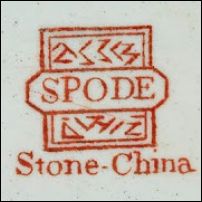
c. 1812–1833
Copeland dates this style to about 1812–1833; this red example is associated with the Royal Pavilion pagodas.
red · Stoke-on-Trent, England
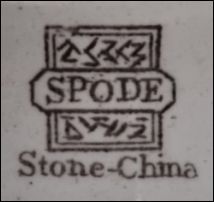
c. 1812–1833
The source rejects Godden’s circa 1805–1815 date for black and cites Copeland’s circa 1812–1833 for this style.
black · Stoke-on-Trent, England

1815–1833
Copeland dates this upper-case serif style to 1815–1833; the two illustrated marks occur on the same object.
Stoke-on-Trent, England
Numbers below this style are thought to be clay-workers’ marks.
1815–1833
Copeland dates this upper-case serif style to 1815–1833; the two illustrated marks occur on the same object.
Stoke-on-Trent, England
Numbers below this style are thought to be clay-workers’ marks.

1822–1833
The source associates this mark with a new Stone China formula introduced about 1821–1822.
Stoke-on-Trent, England
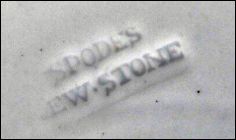
1822–1833
The source associates this mark with a new Stone China formula introduced about 1821–1822.
Stoke-on-Trent, England
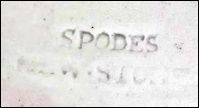
1822–1833
The source associates this mark with a new Stone China formula introduced about 1821–1822.
Stoke-on-Trent, England
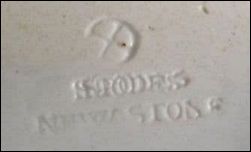
1822–1833
The source associates this mark with a new Stone China formula introduced about 1821–1822.
Stoke-on-Trent, England
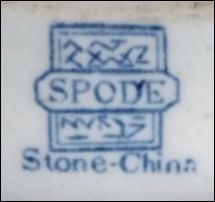
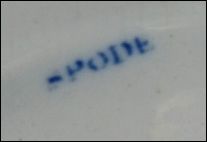
Undated
Stone-China stamps of this style date to the early nineteenth century.
blue · Stoke-on-Trent, England
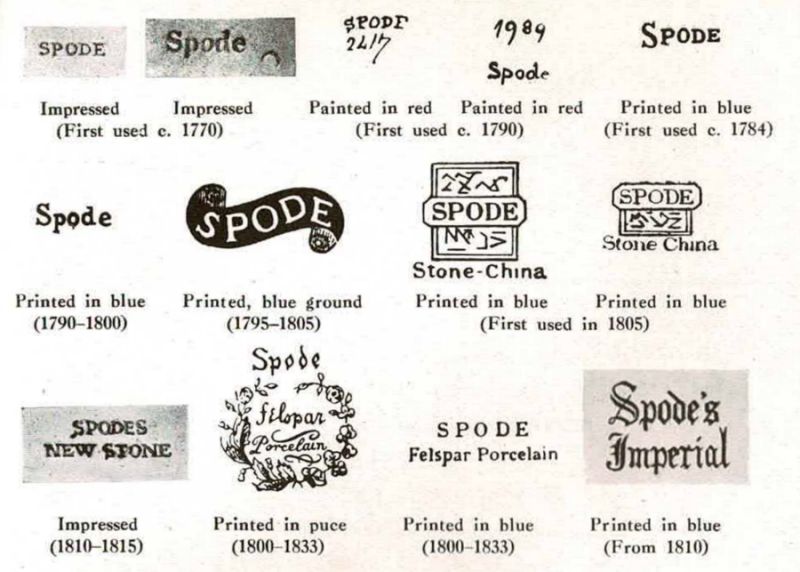
Undated
Reference chart illustrating different Spode marks used during 1770–1833.
Stoke-on-Trent, England

Undated
The caption dates the half mark to about 1815–1833, then gives about 1812–1833 for the wider style.
Stoke-on-Trent, England
Josiah Spode I worked with Thomas Whieldon and later managed the Stoke works before establishing his own businesses. He purchased the continuing Spode factory in 1776; the company also used 1770 as its traditional founding date. His son Josiah Spode II continued the pottery after 1797, and William Taylor Copeland acquired it from the trustees in 1833, forming Copeland and Garrett.
Also known as: Josiah Spode I & II · Spode & Mountford · Spode & Tomlinson