
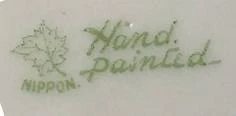
c. 1891–1911
Hand Painted / NIPPON
Maple leaf rather than wreath or rising sun.
printed backstamp · porcelain · Japan
Pottery & porcelain
The name “Hand painted / M / NIPPON” appears among Morimura Brothers Nippon marks on porcelain from Japan. Its mark period is 1911–1921.
Trading-company roots 1876; independent New York business 1878, Morimura Brothers name 1881. Associated porcelain factory established 1904. Present trading company continues; the five illustrated formats concern early porcelain.
c. 1891–1911
Maple leaf rather than wreath or rising sun.
printed backstamp · porcelain · Japan
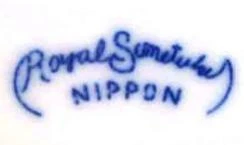
From 1906
Royal Sometuke wording identifies this format.
printed backstamp · porcelain · Japan
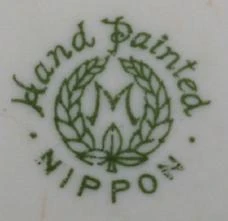
1911–1921
Central M within a wreath, not a maple leaf.
printed backstamp · porcelain · Japan
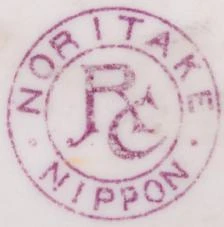
1911–1921
RC monogram enclosed by circular Noritake/Nippon lettering.
printed backstamp · porcelain · Japan
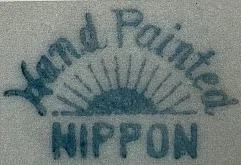
1911–1921
Sun rays replace the letter-and-wreath centre.
printed backstamp · porcelain · Japan
Ichizaemon Morimura VI and his younger brother Toyo established Morimura Gumi in Tokyo in 1876. Toyo travelled to the United States and joined the Hinode Shokai retail business in New York that year. He established Hinode Shokai Morimura Brothers in 1878; the business became Morimura Brothers in 1881. Early exports included Japanese antiques, pottery, fans, dolls and other goods.
Porcelain became an important part of the trade. In January 1904, the founders established Nippon Toki Gomei Kaisha, the predecessor of Noritake, with a factory in the Nagoya area. This brought manufacturing into a business that had developed through buying, decorating and exporting Japanese wares. The factory pursued white porcelain suitable for Western table services while decorated ornamental wares remained part of the export range.
Early porcelain carries several symbols associated with the business: a maple leaf, an M within a wreath, RC initials and a rising sun. Nippon names Japan rather than a separate factory. Factory marks can also occur on undecorated blanks later painted by another business. The Morimura trading company and the Noritake manufacturing company developed as distinct businesses within the wider group.
Also known as: Morimura Bros. · Morimura Kumi · Hinode Shokai Morimura Brothers · Nippon Toki Gomei Kaisha (associated manufacturer) · Morimura Brothers / Morimura Gumi
Copied maple-leaf, wreath, RC and rising-sun marks occur on later reproductions. The symbol alone does not authenticate an object.
An American decorator whose mark may accompany a Noritake blank mark. Its leaf and company wording identify the decoration rather than replacing the Japanese manufacturer’s identity.