
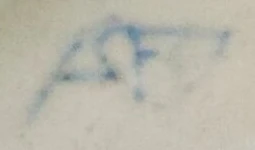
Undated
AFS
Anna Frances Simpson’s overlapping initials distinguish her decoration from Irvine’s looped cipher.
painted · blue · earthenware · New Orleans, Louisiana, United States
Pottery & porcelain
Newcomb Pottery artist marks include impressed “NEWCOMB / COLLEGE” on earthenware in New Orleans, Louisiana, United States.
Original art-pottery enterprise 1895–1940; preparatory ceramic teaching began 1894. The separate Newcomb Guild revived the mark in 1942 and ended in 1952.
Undated
Anna Frances Simpson’s overlapping initials distinguish her decoration from Irvine’s looped cipher.
painted · blue · earthenware · New Orleans, Louisiana, United States

Undated
Full institutional name is written out instead of the enclosed NC initials.
impressed · earthenware · New Orleans, Louisiana, United States
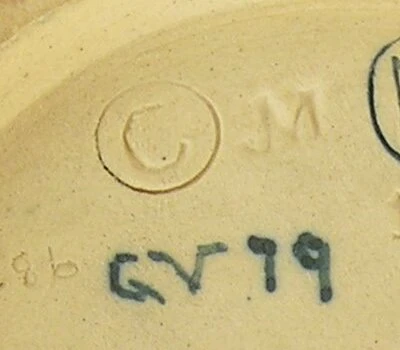
Undated
Sadie Irvine’s decorator cipher is separate from the nearby impressed JM potter mark.
incised · earthenware · New Orleans, Louisiana, United States
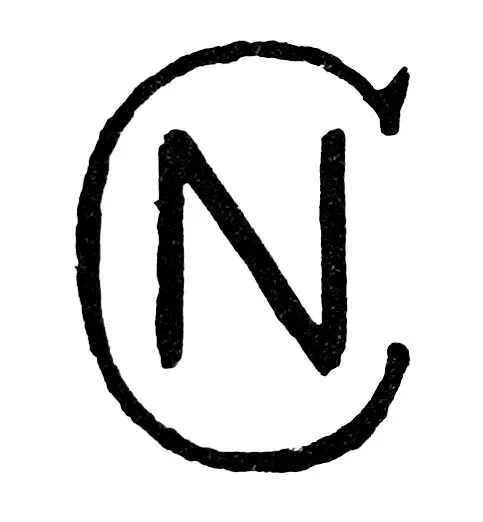
Undated
Factory monogram identifies Newcomb College, separately from decorator and potter initials.
impressed · earthenware · New Orleans, Louisiana, United States
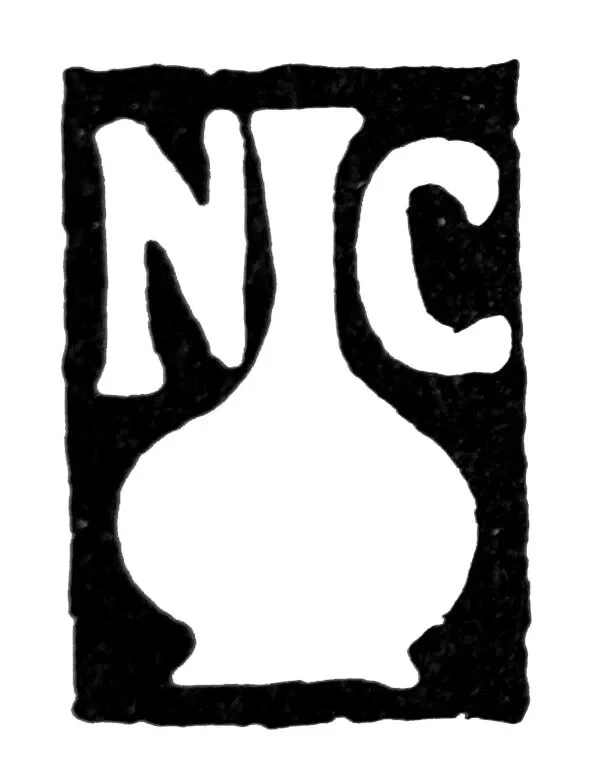
Undated
Paper label with a vase-shaped negative space differs from the incised circular NC.
label · paper · New Orleans, Louisiana, United States
Newcomb Pottery developed within the art department of H. Sophie Newcomb Memorial College in New Orleans, the women’s coordinate college of Tulane University. Ceramic instruction began with Mary Given Sheerer’s arrival in 1894, and the art faculty launched the pottery enterprise in 1895. The programme combined training, design and commercial production, giving women graduates a way to earn income through their craft.
Ellsworth Woodward and Sheerer encouraged useful forms decorated with plants and wildlife of the Gulf South. Professional potters, particularly Joseph Fortune Meyer, generally formed the vessels, while women artists chose forms and developed decoration. Early glossy wares used strong outlines and stylised natural motifs. Later matte and semi-matte surfaces supported relief carving, soft blue and green palettes, and Louisiana landscapes. Sadie Irvine and Anna Frances Simpson were among the prominent decorators.
Each piece could carry several different signs: the college monogram, a decorator’s cipher, a potter’s mark, and inventory or registration codes. The registration system introduced in 1901 helped track individual pieces. The original commercial enterprise closed at the end of the 1939–1940 academic year as the college redirected its art teaching. A smaller Newcomb Guild programme revived production and the Newcomb mark in 1942, continuing until 1952. These later wares belong to a distinct phase of the institution’s ceramic history.
Also known as: Newcomb College Pottery · Newcomb College · Newcomb Enterprise · Newcomb Pottery, H. Sophie Newcomb Memorial College, Tulane University
This separate artist worked in the late twentieth century and signed Newcomb in flowing script. His stoneware signature is not the Newcomb College NC emblem.
The college revived the Newcomb mark for a smaller programme from 1942 to 1952. Match the ware and registration context rather than assuming every NC stamp belongs before 1940.
Both made American art pottery with natural motifs. Rookwood’s RP factory device differs from Newcomb’s enclosed N/C; compare the factory mark separately from the artist initials.