
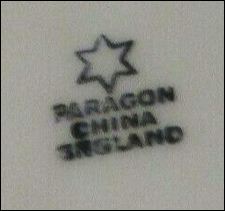
c. 1913–1919
Paragon China England
This mark was used by the predecessor company, Star China Co.
Longton, England
Pottery & porcelain
Longton, England, United Kingdom · 1920–1991 · 11 marks.
c. 1913–1919
This mark was used by the predecessor company, Star China Co.
Longton, England
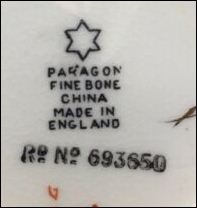
c. 1920–1932
Registration number 693650 dates the pattern registration to 1922, rather than defining the full mark-use period.
Longton, England
The company continued the earlier China mark with the addition of Fine Bone China.
c. 1920–1932
Registration number 693650 dates the pattern registration to 1922, rather than defining the full mark-use period.
Longton, England
The company continued the earlier China mark with the addition of Fine Bone China.
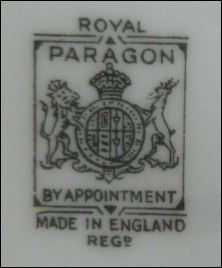
c. From 1933
The mark follows the royal warrant granted in 1933; the source also records a version without Royal.
Longton, England
The source states that use of Royal Paragon was stopped because it was not permitted by the terms of the royal warrant.
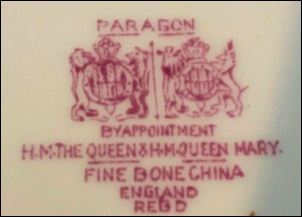
c. 1939–1949
Longton, England
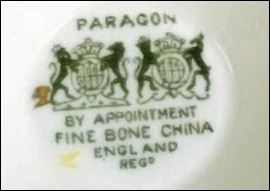
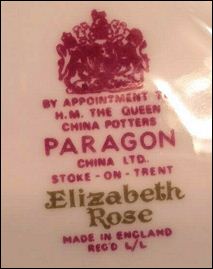
c. From 1957
Longton, England
Elizabeth Rose is the pattern name.
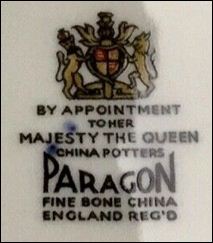
c. From 1957
Longton, England
Radstock is the pattern name.
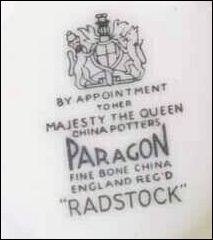
c. From 1957
Longton, England
Radstock is the pattern name.
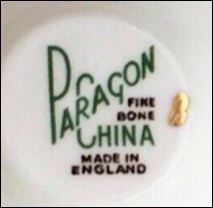
c. 1960–1972
The source tentatively dates this mark to about 1960–1972.
Longton, England
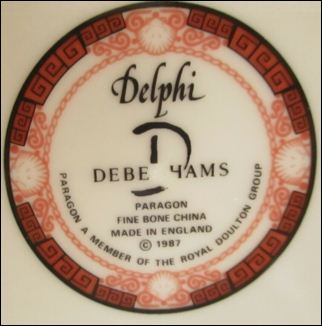
1972–1989
The source dates marks referring to the Royal Doulton Group to 1972–1989.
Longton, England
The Delphi pattern range was produced for Debenhams.
Paragon China manufactured fine bone china at the Atlas Works in Longton, Stoke-on-Trent. It originated as the Star China Company in 1899, operated as Paragon China Company from 1920, and became Paragon China Ltd in 1930. The Wild group acquired it in 1960; it later belonged to Allied English Potteries and Royal Doulton. The Paragon name was largely absorbed into Royal Albert by 1989 and discontinued around 1991.