
Pottery & porcelain
Pewabic Pottery marks
Pewabic Pottery marks include impressed “PEWABIC / DETROIT; Pp monogram” lettering. Pewabic worked in Detroit, Michigan, United States.
- Active years
- From 1903
- Country
- United States
- City / region
- Detroit, Michigan
- Marks
- 5
Pewabic name adopted 1903; prior experimental and Revelation work predates it. Continuing pottery with a mid-1960s institutional transition.
What to look for
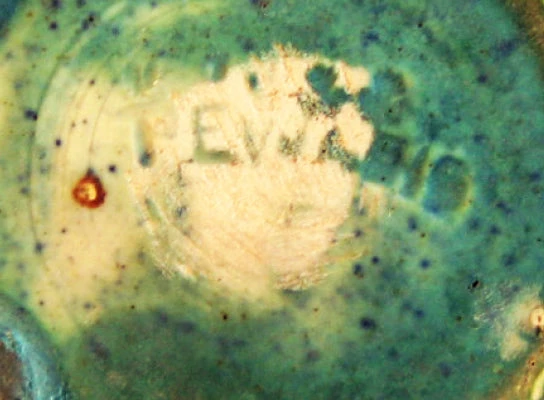
- The early leaf mark has maple leaves over PEWABIC. These are leaves rather than Rookwood’s flames.
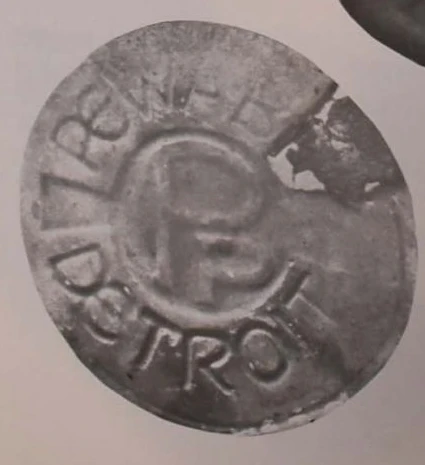
- Read the circular stamp’s center as well as its outer lettering. A Pp monogram, smaller wording, and an empty center distinguish different devices.
- Separate the factory name, Detroit stamp and individual maker’s initials. A potter’s initials beside a factory mark do not create another factory design.
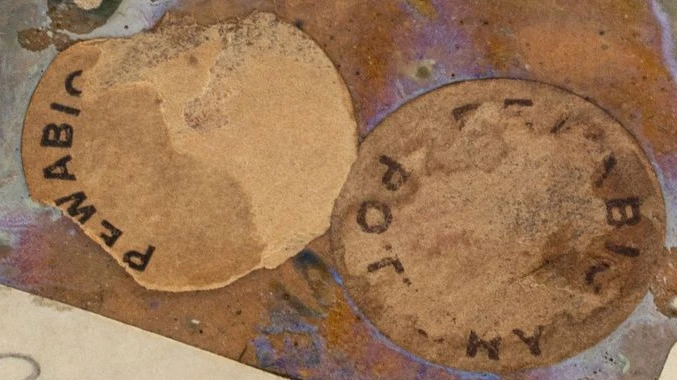
- Round paper labels can survive on the base beside an impressed mark. Inventory labels and penciled collection numbers are separate from the factory label.
Dated marks & timeline
5 marks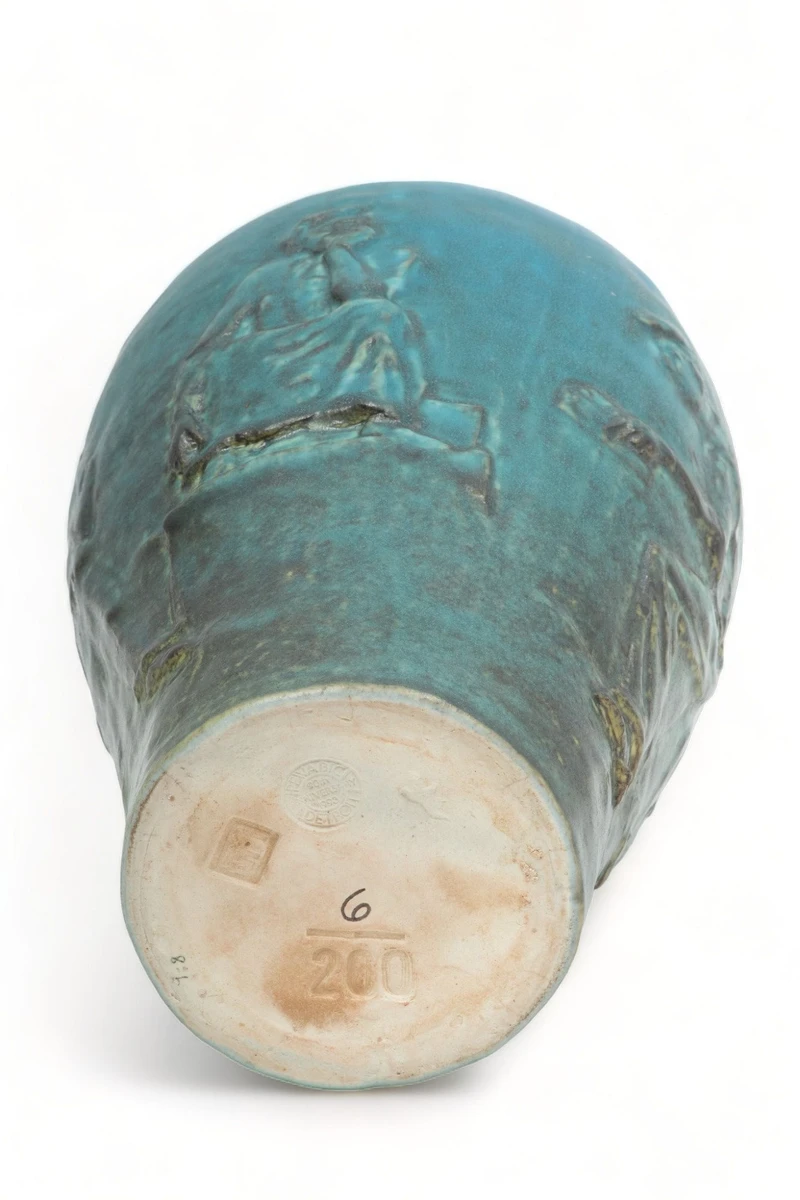
Undated
PEWABIC / DETROIT; smaller central inscription partly indistinct
Bordered seal contains central text, unlike the open circle of separately spaced letters; 200 is a separate form number.
impressed
Undated
PEWABIC / POTTERY
Applied paper medallion reads Pottery rather than an impressed Detroit stamp. Black versus sepia printing alone is not another design.
label
Undated
PEWABIC / DETROIT; Pp monogram
Large central Pp monogram distinguishes it from the text-filled seal and open letter ring.
impressed
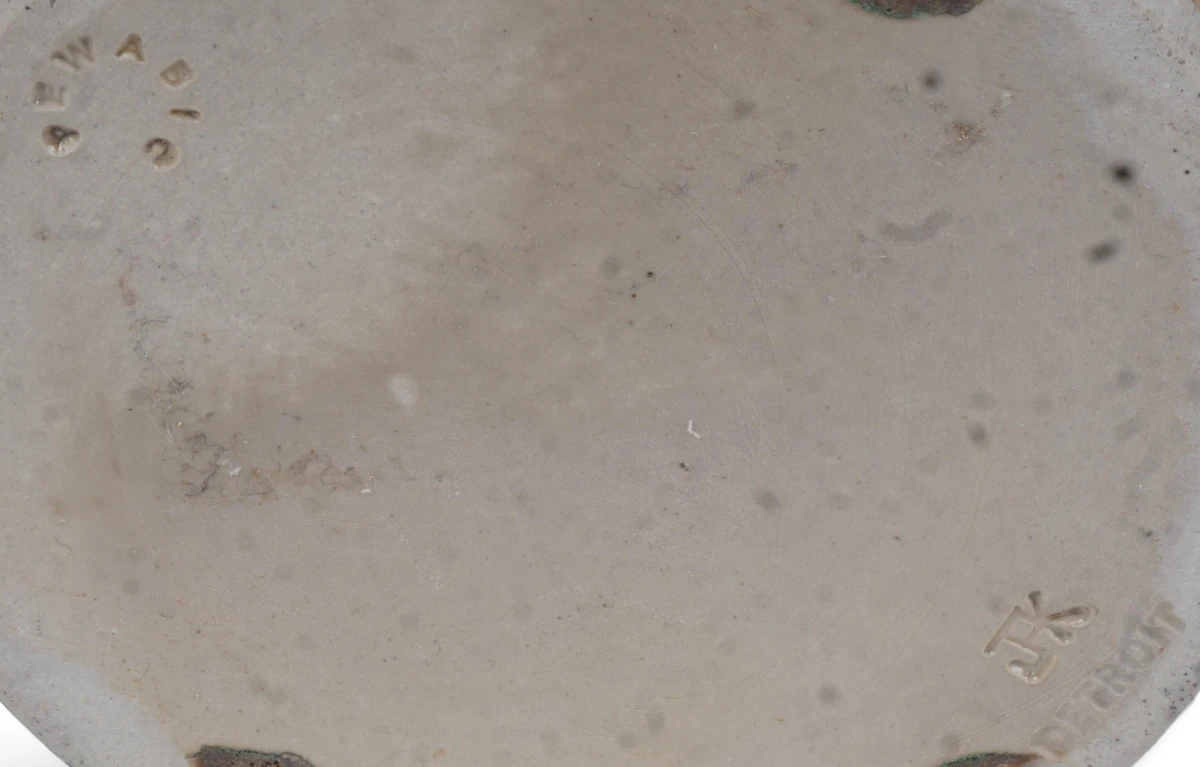
Undated
PEWABIC; separate DETROIT and JPK
Only PEWABIC forms this letter ring; Detroit and a potter’s monogram are stamped separately.
impressed
About Pewabic
Pewabic Pottery began in Detroit in 1903 through the partnership of artist Mary Chase Perry, later Stratton, and kiln manufacturer Horace J. Caulkins. Their experiments in clay and glazes developed into a pottery in a rented carriage house in the Brush Park neighborhood. A substantial order from the Chicago retailer Burley & Company helped establish the business and the Pewabic name.
The workshop produced vessels and architectural tiles, becoming closely associated with Detroit’s Arts and Crafts movement. Matte glazes, flowing colors and metallic iridescence distinguished its pottery. In 1907 production moved to a purpose-built studio on East Jefferson Avenue. Tile commissions extended its work into homes, schools, churches and public buildings, including projects far beyond Michigan.
Caulkins died in 1923, and Stratton continued directing the pottery until her death in 1961. Longtime assistant Ella Peters helped maintain operations. Henry Caulkins transferred the property to Michigan State University in the mid-1960s, and it reopened as a university ceramics center in 1967. The Pewabic Society formed in 1979 and took ownership in 1981. Production, architectural tile work and ceramics education continued under nonprofit stewardship.
Also known as: Pewabic Pottery · Pewabic Society · Mary Chase Perry Stratton · Mary Chase Perry · Revelation Pottery (predecessor work) · Pewabic Pottery; operated by the Pewabic Society
Look-alikes & how to tell them apart
Rookwood Pottery →
Early Pewabic maple leaves have been mistaken for flames. Rookwood’s flame device surrounds the RP monogram; Pewabic’s leaves accompany its written name.