
Porzellanfiguren Gräfenthal GmbHMaker name
c. 1875–1879
impressed
impressed · Gräfenthal, Germany
Used from around , the basic impressed version without any additions.
Pottery & porcelain
The name “ERPHILA” appears among Carl scheidig porcelain marks from Gräfenthal, Germany. Its mark period is 1906–1935.
Private Scheidig business 1906–1972; state successor to 1990; later GmbH deleted from register in May 2009.
c. 1875–1879
impressed · Gräfenthal, Germany
Used from around , the basic impressed version without any additions.
c. 1875–1879
Gräfenthal, Germany
Used from around , here with a border enclosing the mark.
c. 1875–1879
Gräfenthal, Germany
Used from around in this form, registered at the at the Herzogliches Landgericht Gräfenthal on -03.
c. 1875–1879
impressed · Gräfenthal, Germany
Used from around , the basic impressed version without any additions.
1879–1886
Gräfenthal, Germany
Used between , another example with the "Dep." addition.
1879–1886
Gräfenthal, Germany
Used between , the common version with the "Dep." addition.
From 1886
blue · Gräfenthal, Germany
Used onwards, blue version with the "Foreign" addition. Two horizontal bars, but normal middle ornament.
From 1886
green · Gräfenthal, Germany
Used onwards, another example in green.
From 1886
red · Gräfenthal, Germany
Used onwards, here in red, the crown shows two horizontal bars and a raised middle ornament.
From 1886
blue · Gräfenthal, Germany
Used onwards, here in blue, again two horizontal bars and raised middle ornament. (Picture: Lars Melin)
1906–1935
red · Gräfenthal, Germany
Used between , here the also common red version. (Picture: Dianne Pickering)
1906–1935
green · Gräfenthal, Germany
Used between , green eagle carrying an arrow and the initials " " for Carl Scheidig .
1906–1935
Gräfenthal, Germany
Used between , example of the previously shown mark together with the mark of Ebeling & Reuss of Philadelphia.
1935–1972
label · Gräfenthal, Germany
Used between , paper label with "Scheidig Kunst", the crowned eagle and "Gaäfenthal, Thür." (short for "Thüringen").
1935–1972
impressed · Gräfenthal, Germany
Used between , a stylized crowned eagle with " " on its chest, here smudged by the impressed "Foreign".
1935–1972
green · Gräfenthal, Germany
Used between , with the addition "Kunstporzellan". Green example. (Picture: Marcus W. Brast)
1935–1972
Gräfenthal, Germany
Used between , note the " " on its chest. (Picture: Jeannine Wargacki)
1935–1972
Gräfenthal, Germany
Used between , here with the trade name addition "Kronenadler" ("crowned eagle"). (Picture: Stephanie Harris)
1935–1972
red · Gräfenthal, Germany
Used between , with the addition "Kunstporzellan". Red example.
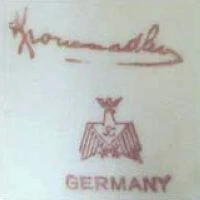
c. 1935–1972
Kronenadler script above the eagle; country wording beneath.
printed
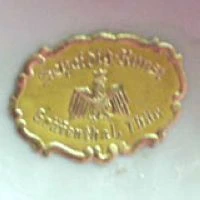
c. 1935–1972
Applied gold ornamental label explicitly names Scheidig Kunst and the locality.
label
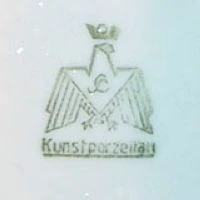
c. 1935–1972
Underlined Kunstporzellan below the eagle replaces the Kronenadler script.
printed
c. 1952
Gräfenthal, Germany
Used around ?, badly smudged version of the mark that was unidentified for a long time. (Picture: Peter Farrell)
c. 1952
green · Gräfenthal, Germany
Used around ?, a green version that is also nearly unreadable. (Picture: Janet Ferguson)
c. 1952
underglaze, painted · Gräfenthal, Germany
Used around ?, "hand painted" above "18" and "59" above "under glaze". (Picture: Karen Kast-McBride)
c. 1952
Gräfenthal, Germany
Used around ?, another example.
c. 1952
Gräfenthal, Germany
Used around ?, same as before but this time accompanied by a "Made in " stamp. (Picture: Richard Binkele)
To 1972
brown · Gräfenthal, Germany
Used , brown version, otherwise same as before.
To 1972
blue · Gräfenthal, Germany
Used , earlier blue version with additional "Made in East Germany". (Picture: Barbara Perry)
To 1972
red · Gräfenthal, Germany
Used , this is the newer and more detailed version in red of the crown used .
To 1972
blue · Gräfenthal, Germany
Used , later blue version but badly smudged, including "Made in ". (Picture: Lorraine Nicholls)
1972–1990
Gräfenthal, Germany
Used between , the crowned "S" over " ".
1972–1990
Gräfenthal, Germany
Used between , the crowned "S" over " ".
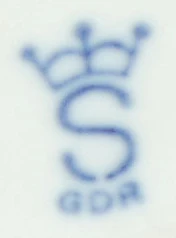
1985–1990
Gräfenthal, Germany
Used between , the crowned "S" over "Gräfenthal", note the addition stating "Germany".
1985–1990
Gräfenthal, Germany
Used between , the crowned "S" over "Gräfenthal", note the addition stating "Germany".
From 1990
Gräfenthal, Germany
Used until today.
Undated
green · Gräfenthal, Germany
Used between 1972 and around 1980, another example: the " " mark above a stamped "Germany" in dark green ...
Undated
impressed · green · Gräfenthal, Germany
Used between 1972 and around 1980, the " " mark (here in green above impressed "Germany") can also be found together with ...
Undated
red · Gräfenthal, Germany
but this time accompanied by a . See "Comments(s)" above.
Undated
green · Gräfenthal, Germany
a single crown, here also in green. See "Comment(s)" above.
Undated
Gräfenthal, Germany
This is claimed to be the first mark used but the capital letter "I" does not make sense as there is no relationship either to the location or company.
Carl Scheidig founded his porcelain factory at Gräfenthal in Thuringia in 1906. The district already had several competing porcelain manufacturers, but nearby railway access and an established supply network supported the new venture. Its range concentrated on figures: individual people, groups and animals, together with lamps, candlesticks, bookends and devotional objects.
The business acquired the porcelain factory at Reichmannsdorf in 1925. Its illustrated catalogues reveal a large and varied stock of models, reaching approximately 10,000 by 1955. Children, dancers, birds, dogs and religious figures formed part of that range. Model numbers impressed into the base connected individual pieces with the catalogue illustrations.
In 1972 the private firm was nationalized and continued within the Gräfenthal state porcelain organization. Older molds and marks remained in circulation alongside newer identities. After German reunification, a limited company resumed the Gräfenthal name and drew on surviving molds, catalogues and decoration records. That successor’s legal registration was deleted in May 2009. The earlier eagle devices, later crowned letters and changing country inscriptions reflect several organizational periods within the same manufacturing tradition.
Also known as: Porzellanfabrik Carl Scheidig KG · VEB Porzellanfiguren Gräfenthal · Carl Scheidig KG · Scheidig Kunst · Kronenadler · Porzellanfiguren Gräfenthal GmbH vormals Scheidig KG · Porzellanfabrik Carl Scheidig KG; later Porzellanfiguren Gräfenthal GmbH · Porzellanfabrik Carl Schneiders Erben · Porzellanfabrik Schneider & Hutschenreuther · Porzellanfabrik Unger, Schneider & Cie.
A separate local factory used crowned-G, arrow and scissors-related devices. The Scheidig surname and CS eagle must not be expanded as Schneider merely because both factories operated at Gräfenthal.
Some state-period Scheidig figures combine the eagle with a separate Wagner & Apel crown because earlier molds were reused. Record both devices and the model rather than treating an isolated crown as a complete identification.