
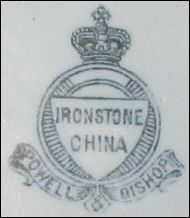
1867–1878
Ironstone China Powell & Bishop
printed · earthenware · Hanley
England occurs on some versions before it became mandatory for US exports in 1891.
Pottery & porcelain
On ironstone from Hanley, Powell and Bishop pottery marks carry “Ironstone China Powell & Bishop England”. The mark period is 1867–1878.
1867–1878
printed · earthenware · Hanley
England occurs on some versions before it became mandatory for US exports in 1891.

1867–1878
printed · ironstone · Hanley
Early printed variant including ENGLAND.
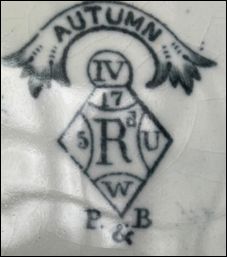
c. 1874–1878
Autumn pattern registered 17 March 1874, as shown by the registration diamond.
earthenware · Hanley

1876
The caduceus trademark was registered in 1876 and also used by later partnerships.
earthenware · Hanley
This mark (Caduceus) was registered as a trade mark by Powell & Bishop in and often appeared with the below it - the mark was also used by subsequent partnerships. Caduceus: A winged staff with two serpents twined around it, carried by Hermes (Greek God) it is a symbol of commerce. - see Wikipedia article on the Caduceus
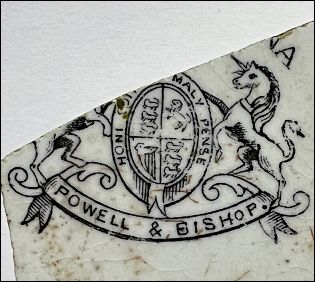
2026
The shard was found in Northern California in 2026; this is its discovery date.
earthenware · Hanley
Mark incorporates the British Royal Arms.

Undated
ironstone · Hanley
Incorporates the British Royal Arms.
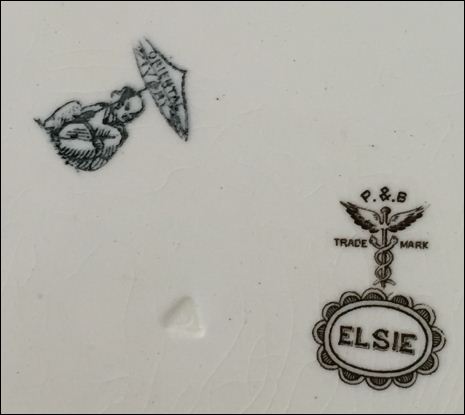
Undated
earthenware · Hanley
Elsie is the pattern name; the mark style continued under later partnerships.
Powell & Bishop succeeded Livesley, Powell & Co, founded in 1851. The business adopted the Powell & Bishop name in 1867 and made china and earthenware at Hanley. John Stonier joined in 1878, creating Powell, Bishop & Stonier. The caduceus trademark was registered in 1876 and continued under subsequent partnerships. The Hanley china and earthenware business began as Livesley, Powell & Co. in 1851. Livesley left in 1860; it became Powell & Bishop in 1867.
The business began as Livesley, Powell & Co. in 1851. Livesley left in 1860, and it was renamed Powell & Bishop in 1867. John Stonier joined in 1878, forming Powell, Bishop & Stonier.