
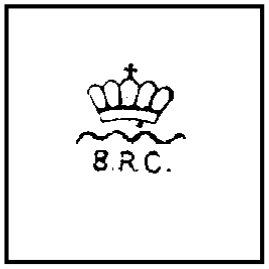
c. 1879–1999
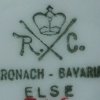
B.R.C.
printed · green · porcelain · Bavaria, Germany
Source dates this printed green mark into the 20th century.
Pottery & porcelain
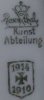
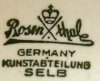
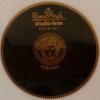
The name “Philipp Rosenthal & Co. Art Department” appears among Rosenthal marks on porcelain from Germany. Its mark period is 1916.
c. 1879–1999
printed · green · porcelain · Bavaria, Germany
Source dates this printed green mark into the 20th century.
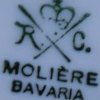
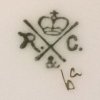
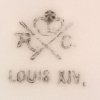
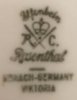
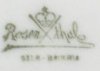
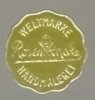
c. 1920–1939
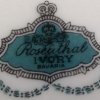
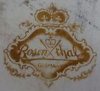
label · gold · porcelain · Germany
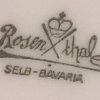
1926
A dot over the crossed strokes distinguishes the 1926 mark.
porcelain · Germany
1927
1927 variant distinguished by a dot below the crown and a dot above B.
porcelain · Germany
Rosenthal mark with a dot below and a dot above B.
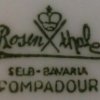
1927
Dots at both sides of Rosenthal distinguish the source’s 1927 mark.
porcelain · Germany
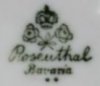
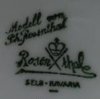

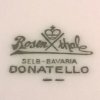
1929
The 1929 variant has two short lines below.
porcelain · Germany
Rosenthal mark with two lines.
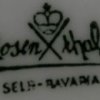
1930
1930 variant has dashes beside SELB-BAVARIA.
porcelain · Germany
mark with dashes left and right Selb Bavaria words.
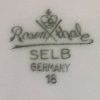
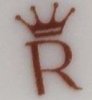

1932
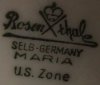
porcelain · Selb, Bavaria, Germany
Maria pattern; slash below the Rosenthal name.
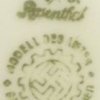
1934–1945
porcelain · Germany
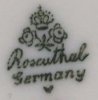
German Labor Front approval seal: Modell des Amtes Schönheit der Arbeit.
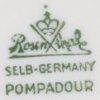
1941
porcelain · Selb, Germany
Pompadour pattern; dot above the .

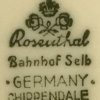
1950
porcelain · Selb, Germany
Dots appear on both sides of Germany.
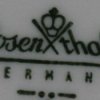
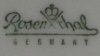
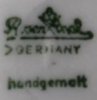
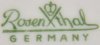
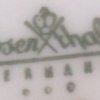
1958
Side dashes identify the 1958 variant; three dots beneath GERMANY indicate the Kronach factory.
porcelain · Germany
mark with dashes left and right the word . Three dots below the word point to Kronach factory.
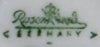
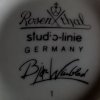
c. 1970–1989
porcelain · Germany
Used on items designed by Bjørn Wiinblad.
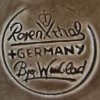
1985
A dot below the M in Germany identifies the source’s 1985 mark.
porcelain · Germany
Philipp Rosenthal began decorating porcelain at Erkersreuth near Selb in 1884, initially using Hutschenreuther whiteware. He established a whiteware factory at Asch in 1891 and expanded through acquisitions and art divisions. Forced from control under Nazi persecution in 1934, he left Germany in 1935. His son Philip regained control in 1950 and worked with designers including Bjørn Wiinblad, Hans Theo Baumann, Raymond Peynet and Tapio Wirkkala.
Waterford Wedgwood took control in 1997, and Sambonet acquired Rosenthal in 2009. Philipp Rosenthal began decorating porcelain at Erkersreuth near Selb in 1884 and established a factory at Asch in 1891. The company acquired other factories and opened art divisions in 1910 and 1920. Rosenthal lost control under Nazi persecution and left Germany in 1935. His son Philip regained control in 1950 and developed designer collaborations. Sambonet acquired Rosenthal in 2009.
Philipp Rosenthal began decorating bought-in porcelain near Selb in 1884 and established a factory at Asch in 1891. The business expanded through factory acquisitions and art divisions. Nazi persecution forced him from control in the 1930s. His son Philip regained control in 1950 and developed the company through collaborations with artists and designers.
Also known as: Rosenthal Company