
Pottery & porcelain
Royal Copenhagen marks
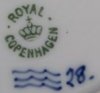
The name “COPENHAGEN” appears among Royal Copenhagen marks on porcelain from Denmark. Its mark period is 1974–1978.
- Active years
- From 1690
- Country
- Denmark
- City / region
- Copenhagen
- Products
- porcelain, porcelain table services, figures, commemorative plates, artist-designed ceramics
- Marks
- 11
Founded 1775; royal ownership from 1779; continued through private ownership and later corporate changes.
What to look for
- Find the three waves, then read the crown and full factory wording. Their combination distinguishes the version more precisely than a crown alone.
- Record the exact position of small dots or lines above and below letters. From 1935 these positions can supply a date or period, but the appropriate chart depends on the full mark.
- Separate painter initials and model numbers from the date indicator. A slash through the waves can denote a quality classification rather than a date.
Dated marks & timeline
11 marks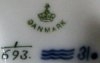
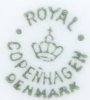
1944
COPENHAGEN
A bar above N in COPENHAGEN identifies the 1944 version.
porcelain · Denmark
Royal mark (a bar above N in ).

1950
COPENHAGEN
A dot below the second E in COPENHAGEN identifies the 1950 version.
porcelain · Denmark
Royal mark (a dot below second E in ).
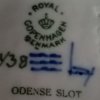
1957
Royal Copenhagen
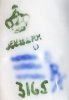
A dot under N identifies the 1957 version.
porcelain
mark with a dot under 'N' letter.
1959
DENMARK
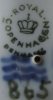
A U sign under R in DENMARK identifies the 1959 version.
porcelain
Royal Copenhagen mark (U sign under R in ).
1962
COPENHAGEN
A bar below C in COPENHAGEN identifies the 1962 version.
porcelain · Denmark
Royal mark (a bar below C in ).
1974–1978
COPENHAGEN
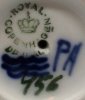
Date bar below E in COPENHAGEN; manufacturer chart: 1974–1978.
porcelain · Denmark
Royal mark (a bar below a letter E in a word).
1985–1991
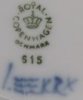
ROYAL
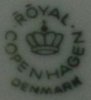
Bars above R and O in ROYAL identify the 1985–1991 version.
porcelain
Copenhagen mark (bars over R and O in ).
1992–1999
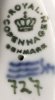
ROYAL
Bars above R and Y in ROYAL identify the 1992–1999 version.
porcelain
Copenhagen mark (a bar above letters R and Y in ).
Undated
COPENHAGEN
porcelain · Denmark
Lower N date indicator. The manufacturer’s current backstamp chart gives 1979–1983.
About Royal Copenhagen
Frantz Henrich Müller founded the Danish porcelain manufacture in Copenhagen in 1775 with royal support from Dowager Queen Juliane Marie. The crown took financial responsibility in 1779, and the business became the Royal Danish Porcelain Factory. Three blue waves, representing the Sound and the Great and Little Belts, became its enduring identifying device. Blue Fluted porcelain was part of the factory’s earliest production.
The factory made table services and decorative porcelain for the court and a wider market. It passed into private hands in 1868 and was acquired by the faience manufacturer Aluminia in 1882. Arnold Krog became artistic director in 1885. His work renewed the Blue Fluted designs and developed naturalistic underglaze decoration influenced by Japanese art.
Later production included dinnerware, figures, commemorative plates and artist-designed ceramics. The crown and factory wording changed over time, while the waves remained central. Dating marks introduced in 1935 use small positions above or below letters, and later systems can identify a range of years rather than one year. Painter signatures and model numbers form separate parts of the base marking.
Also known as: Den Danske Porcelainsfabrik · The Royal Danish Porcelain Factory · Den Kongelige Danske Porcelainsfabrik
Look-alikes & how to tell them apart
Bing & Grøndahl
Both Danish manufacturers made underglaze figures, tableware and collectible plates.
Royal Copenhagen uses three waves with its name or crown; Bing & Grøndahl marks use its own lettering and three-tower emblem. Read the base rather than attributing by subject.
Aluminia faience
Aluminia owned the porcelain factory, and associated corporate names can appear in descriptions.
Distinguish the actual factory mark and ceramic body. Shared ownership does not make every Aluminia-marked earthenware object Royal Copenhagen porcelain.