
Pottery & porcelain
Simon and Halbig doll marks
“SIMON & HALBIG” appears among Simon and Halbig doll marks from Germany. A impressed mark on porcelain from Germany has a 1905 period.
- Active years
- 1869–1932
- Country
- Germany
- City / region
- Gräfenhain and Hildburghausen, Thuringia, Thuringia
- Products
- porcelain, Bisque porcelain doll heads, Character heads, All-bisque dolls, Other porcelain wares
- Marks
- 5
Independent firm until Kämmer & Reinhardt acquisition in 1920; production continued under that ownership to 1932. Later Keramisches Werk(e) Gräfenhain is a successor, not the same company name.
What to look for
- Read the back of the head or shoulder plate below the wig. Record the entire name, S H or S & H, country, mould number and size separately. A mould number is not a calendar year.
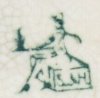
- The seated figure beside SH is a registered factory device, different from the incised doll-head inscriptions. A K R star accompanying Simon & Halbig identifies the commercial partnership rather than an extra Halbig logo.
- Treat the ampersand as a clue to a later inscription format, generally described as beginning in 1905. It is not enough to date a complete doll independently of its mould, body and provenance.
Dated marks & timeline
5 marks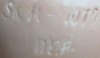
Undated
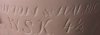
SIMON & HALBIG / K R
incised · porcelain · Germany
Combined head-producer and customer stamp: Simon & Halbig supplied the head; K R with star identifies Kämmer & Reinhardt. Any faint lower mould or size number is untranscribed.
Undated
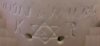
S H
The seated-figure trademark was registered in 1875.
porcelain · Germany
Seated figure beside an S H block; trademark registration and doll manufacture are separate dates.
About Simon & Halbig
Simon & Halbig was a Thuringian porcelain manufacturer established in 1869 by Wilhelm Simon and Carl Halbig. Its factories at Gräfenhain and Hildburghausen became known for bisque doll heads. The firm supplied other doll businesses as well as producing heads sold under its own name. A finished doll can therefore combine a Simon & Halbig head with a body and commercial identity from another company.
Customers included German manufacturers such as Heinrich Handwerck, Cuno & Otto Dressel and Kämmer & Reinhardt, together with French and American businesses. The heads ranged from conventional child faces to character models and other specialized types. Incised mould numbers distinguished models, while separate numerals could identify sizes. Glass eyes, painted features and carefully formed ears and mouths were important parts of their appearance.
The relationship with Kämmer & Reinhardt became particularly close in the early twentieth century. In 1920, Kämmer & Reinhardt acquired Simon & Halbig, and doll production continued until 1932. Combined marks preserve the connection between the head producer and the doll firm. Subsequent production associated with Keramisches Werke Gräfenhain used the KWG identity and belongs to a later chapter of the site's history.
Also known as: Simon and Halbig · S & H · SH · Simon & Halbig Porzellanfabrik
Look-alikes & how to tell them apart
Kämmer & Reinhardt
Its star and initials occur with Simon & Halbig on supplied heads.
Transcribe both names and the K R star. The combined inscription records different roles in the doll's production; the star alone is not a Simon & Halbig signature.
Heinrich Handwerck and other customer doll firms →
Their names may appear on heads made by Simon & Halbig.
Check the whole head inscription and the body's marks. A customer name or replacement body does not change the maker of a separately signed head.
Keramisches Werke Gräfenhain
Successor activity at the same locality.
KWG is a later identity. Keep KWG moulds and marks separate from S & H rather than extending all original marks to 1943.