
Pottery & porcelain
St Amand pottery marks
The name “Nouvelles Usines Ceramiques du Nord St. Amand Made in France” appears among St Amand pottery marks from Saint-Amand, France.
- Active years
- From 1705
- Country
- France
- Products
- earthenware, porcelain
- Marks
- 86
Dated marks & timeline
86 marks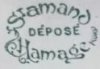





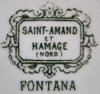
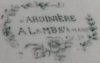

c. 1900–1999
A. Lebacqz & M. Bouchart St. Amand lion Trianon pattern early
The Trianon lion mark dates to the early twentieth century.
red
20th century red mark

c. 1900–1999
A. Lebacqz & M. Bouchart St. Amand lion early
The source dates this lion mark to the early twentieth century.

c. 1900–1999
A. Lebacqz & M. Bouchart St. Amand the early twentieth-century
The source dates this black mark to the early twentieth century.
black


1908–1962
Ceranord France Semi-Porcelaine Chambord pattern
Saint-Amand-les-Eaux, France
Chambord pattern.
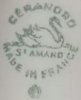

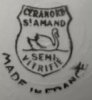





Marks 25–72

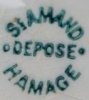


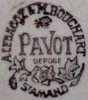




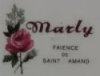

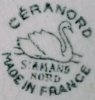
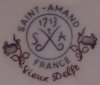
Undated
Saint-Amand
Saint-Amand, France
Vieux Delft pattern; date unknown. 1713 is part of the wording.

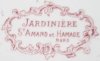

Undated
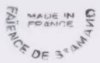
Faience de St Amand France
faience · France
Exact dating unknown; 1713 is part of the mark wording.
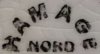


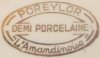
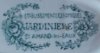
Undated
ETABLISSEMENTS CERAMIQUES JARDINIERE ST AMAND-LES-EAUX
Saint-Amand-les-Eaux, France
Jardiniere pattern; date unknown.
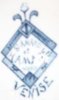



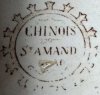

Undated
Mark image
Saint-Amand, Cher, France
Fournier Demars was a liqueur manufacturer active from the end of the nineteenth century; that activity date is not a mark-use period.
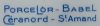


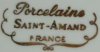


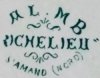

Undated
SOCI
impressed · Saint-Amand, France
Société des Grands Établissements Céramiques mark; date unknown.

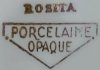
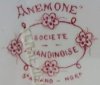

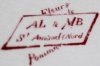
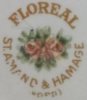


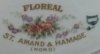
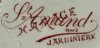

Marks 73–86

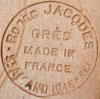
Undated
stoneware
stoneware · Saint-Amand-en-Puisaye, France
Roger Jacques lived from 1920 to 2001; these are biographical dates, not a mark-use interval.
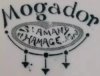


Undated
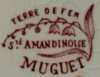
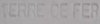
TERRE-DE-FER
impressed · earthenware · Saint-Amand, France
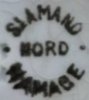
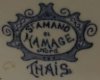
Terre de Fer Sait Amand et Hamage impressed mark used on fine .
Undated
Mark image
Saint-Amand-en-Puisaye
Eugène Lion was a Carriès-school ceramic artist; 1867–1947 are his life dates, not this mark's use dates.


Undated
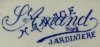
Saint Amand
1713 is part of the stamp wording; the source explicitly says the mark’s date is unknown.
France



About St. Amand
Nicolas Desmoutiers established a Saint-Amand faience factory in 1705, followed by Pierre-Joseph Fauquez's separate factory in 1718. The Fauquez family continued until 1794; soft-paste porcelain was added in 1771. A later factory was managed by Dorchies and Herbo from 1810 to 1817, then by Maximilien Joseph de Bettignies from 1818, who developed Moulin des Loups. Dubois and Bloquiaux later took over.
The firm became Manufacture de Faïence et de Porcelaines in 1887 and opened Wandignies-Hamage in 1896. Société Amandinoise began in 1900; Ceranord followed in 1908. Later names included St Amand-Orchies-Hamage and Moulin des Loups-Hamage. Wandignies-Hamage closed in 1952, other factories by 1954 and Ceranord in 1962. Saint-Amand had several ceramic factories. Nicolas Desmoutiers founded an earthenware works in 1705 and Pierre-Joseph Fauquez established another in 1718.
The Fauquez family made tin-glazed earthenware and later soft-paste porcelain. A nineteenth-century works developed into Moulin des Loups. A new Wandignies-Hamage factory opened in 1896 using Saint Amand et Hamage Nord marks. Nicolas Desmoutiers founded one in 1705; Pierre-Joseph Fauquez established another in 1718. Later businesses developed at Moulin des Loups and Wandignies-Hamage. The Société Amandinoise de Faïencerie opened in 1900, and Ceranord was founded in 1908.