
Ware & regional marks
Talavera pottery marks
Talavera pottery marks include painted “URIARTE / TALAVERA / PUE. MEX. / [codes and initials]” on tin-glazed earthenware in Puebla, Mexico.
- Country
- Spain
- Products
- tin-glazed earthenware, tableware, vases, tiles, architectural ceramics
- Marks
- 6
Ceramic traditions and processes extend from the sixteenth century to modern workshops; no single factory owns the tradition.
What to look for
- Read the workshop name and place together: Puebla/Méx. identifies a Mexican context, while Spanish Talavera workshop signatures have their own histories.
- Separate a workshop name from painter initials, model codes and a written month/year. The 11/2020 inscription on the illustrated La Reyna plate dates that example.
- A calligraphic TALAVERA signature in the Ruiz de Luna style is a specific workshop format, not a generic mark for every Talavera pot.
Key makers & their marks
6 marks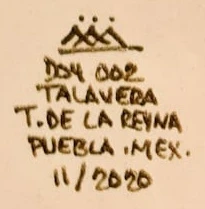
Talavera de la Reyna
2020
DO4 002 / TALAVERA / T. DE LA REYNA / PUEBLA . MEX. / 11/2020
Written month/year dates this individual plate.
painted · black or dark brown · tin-glazed earthenware · Puebla, Mexico
Talavera Armando
Undated
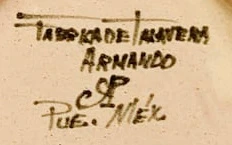
TALAVERA / ARMANDO / [initials] / Pue. Méx.
ARMANDO wording distinguishes the workshop; the additional initials are not a date.
painted · black or dark brown · tin-glazed earthenware · Puebla, Mexico
Talavera Celia
Undated
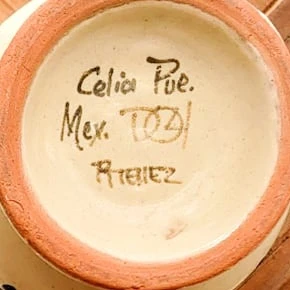
Celia / Pue. / Mex. / DO4 / [painter name]
Celia and the separate painter line identify this workshop format; DO4 is not a year.
painted · black or dark brown · tin-glazed earthenware · Puebla, Mexico
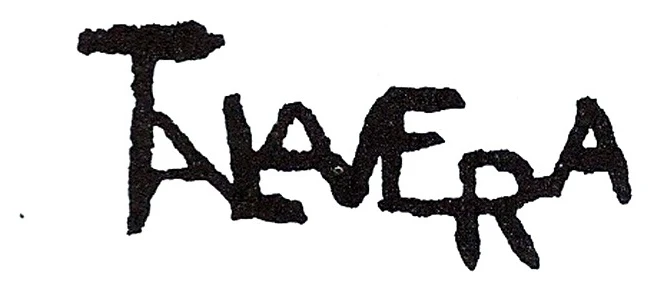
Ruiz de Luna, Guijo y Cía.
Undated
TALAVERA
Interlaced lettering distinguishes the early workshop signature from later name-and-moon factory marks.
painted · black or dark brown · tin-glazed earthenware · Talavera de la Reina, Spain
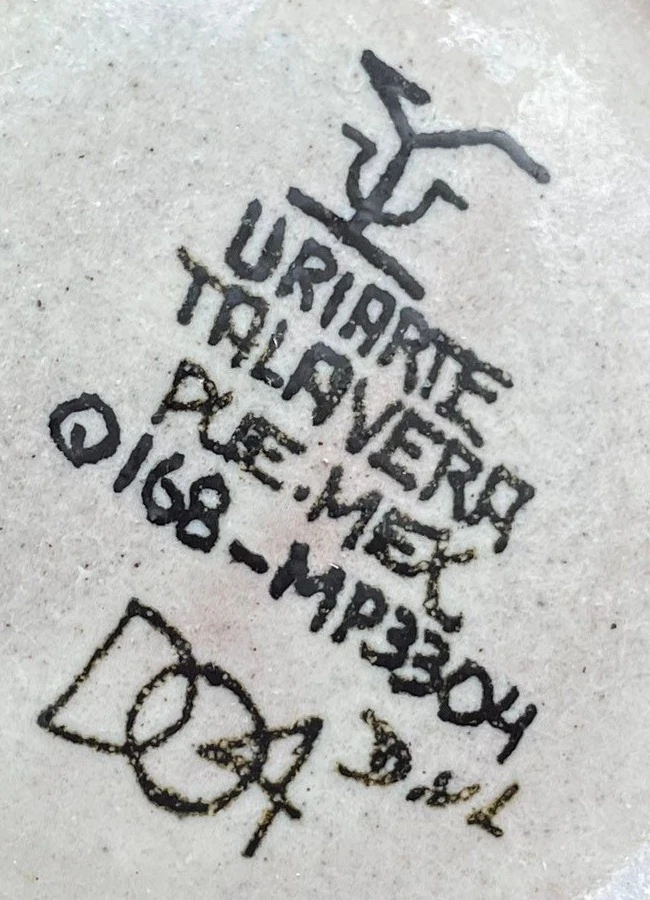
Uriarte Talavera
Undated
URIARTE / TALAVERA / PUE. MEX. / [codes and initials]
Full URIARTE name separates this base from other Puebla workshops; accompanying codes are not assigned a year.
painted · black or dark brown · tin-glazed earthenware · Puebla, Mexico
About Talavera
Talavera names related traditions of decorated earthenware in Spain and Mexico. The Spanish centres are Talavera de la Reina and El Puente del Arzobispo; the Mexican tradition is associated with Puebla and Tlaxcala. Their workshops make domestic vessels, decorative objects and architectural ceramics, combining prepared clay bodies, opaque glazes and painted ornament.
The techniques preserve practices established in the sixteenth century. Knowledge of clay preparation, shaping, glaze and pigment mixtures, decoration and kiln firing passed through families and workshop apprenticeships. Mexican Talavera became widely used during the colonial period for both household and architectural purposes. Uriarte, founded in Puebla in 1824, became an important continuing workshop.
In Spain, the early twentieth-century Ruiz de Luna enterprise helped revive historic Talavera designs and developed distinctive factory signatures. Modern Mexican workshops also identify their output with names, places and individual painters’ initials or codes. These marks belong to particular workshops rather than to one universal Talavera manufacturer. In 2019 UNESCO inscribed the artisanal making processes of the Spanish and Mexican communities together on its Representative List of Intangible Cultural Heritage.
Also known as: Talavera de la Reina ceramics · Talavera Poblana · Talavera of Puebla and Tlaxcala · Talavera pottery traditions of Spain and Mexico
Look-alikes & how to tell them apart
Spanish Talavera versus Mexican Talavera
The traditions share a name and decorative vocabulary. Place wording and an identified workshop signature distinguish the illustrated groups.
Generic Talavera-style souvenir pottery
Colourful floral decoration alone does not identify one of the named workshops. Compare the complete signature and place wording with that workshop’s examples.