
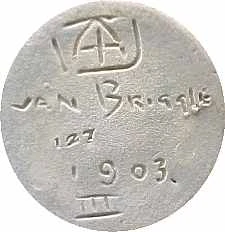
1903
VAN BRIGGLE / 1903 / III / 127
The full four-digit 1903 date distinguishes this early format; 127 is the shape number.
incised · ceramic; tile for the VBPC example · Colorado Springs, Colorado, United States
Pottery & porcelain
Van Briggle marks include impressed “V B P C” on ceramic; tile for the VBPC example in Colorado Springs, Colorado, United States.
Founded in 1901; the business closed in the 2010s.
1903
The full four-digit 1903 date distinguishes this early format; 127 is the shape number.
incised · ceramic; tile for the VBPC example · Colorado Springs, Colorado, United States
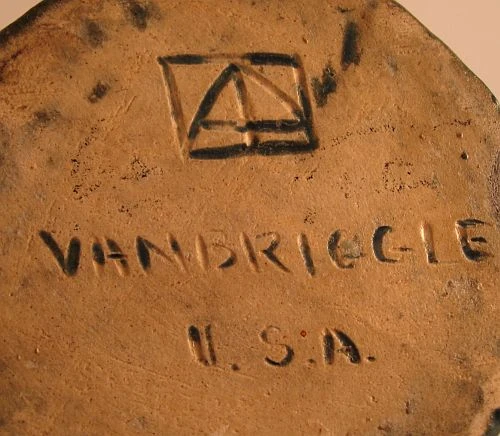
1922–1926
U.S.A. is added beneath the company name on this export-era format.
incised · ceramic; tile for the VBPC example · Colorado Springs, Colorado, United States
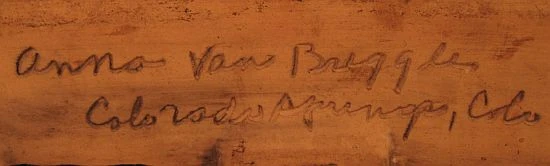
c. 1955–1968
Anna precedes Van Briggle on the glossy-ware line; it is distinct from the standard AA brand.
incised · ceramic; tile for the VBPC example · Colorado Springs, Colorado, United States
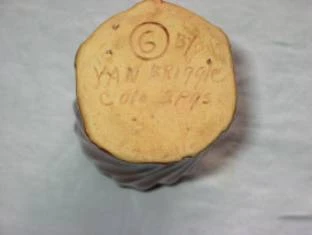
1956
Circled G identifies the short-lived Gold Ore glaze line.
incised · ceramic; tile for the VBPC example · Colorado Springs, Colorado, United States
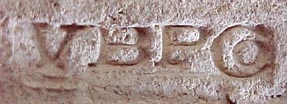
Undated
Abbreviated VBPC die occurs on tiles rather than the full incised vase signature.
impressed · ceramic; tile for the VBPC example · Colorado Springs, Colorado, United States
Artus Van Briggle established his pottery in Colorado Springs in 1901. He had trained in Cincinnati and worked as a decorator at Rookwood before moving to Colorado for his health. His experiments focused on matte glazes and sculptural ceramic forms. Anne Gregory, an artist he had met in Paris, joined him in the enterprise; they married in 1902.
The pottery’s early vases combined modelled flowers, flowing lines and figures with softly coloured glazes. Its work received international attention through exhibitions in Paris and at the 1904 St Louis World’s Fair. Artus died in July 1904, leaving Anne to continue the business. She developed designs and oversaw its expansion, including the Memorial Pottery building, before selling her interest in 1912.
Later owners continued the Van Briggle name through changing locations and product ranges. The pottery made bowls, vases, figurines, flower frogs, lamps and architectural tiles. Mid-century production included high-gloss Anna Van Briggle pieces and the Gold Ore glaze line. The familiar conjoined AA device remained an identifying feature, supplemented by company names, place wording and individual workers’ initials. Production continued until 2012.
Also known as: Van Briggle Art Pottery · Van Briggle Pottery and Tile Company · Anna Van Briggle (line) · Van Briggle Pottery Company
Artus worked at Rookwood before establishing Van Briggle. Rookwood’s RP-and-flames device differs from Van Briggle’s conjoined AA.
Dryden and Van Briggle share parts of the mid-century clay and glossy-ware story. Read the full name; a glossy glaze or buff clay alone does not identify either pottery.