
Undated
James Payne
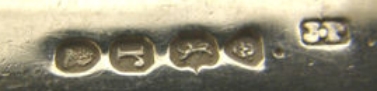
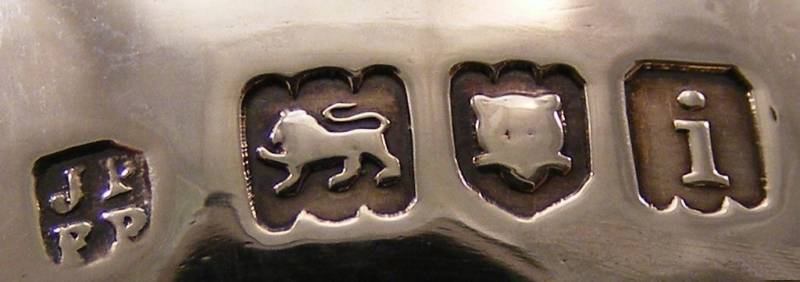
James Payne J.P with the illustrated London 1832 hallmark group.
Illustrated London 1832 hallmark.
Read the stamp
JP is used by several silver makers and sponsors. James Payne’s J.P is illustrated with London 1832 hallmarks, John Power’s JP with Dublin 1804, and John Pittar’s J.P with Dublin 1791 and 1808; the full hallmark group separates them.
Undated
James Payne J.P with the illustrated London 1832 hallmark group.
Illustrated London 1832 hallmark.
Undated
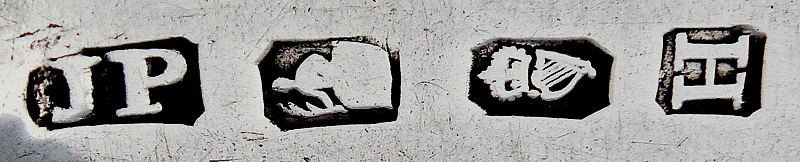
John Power JP beside the illustrated Dublin 1804 group.
Captioned hallmark: Dublin 1804.

Undated
John Pittar J.P; examples have Dublin 1791 and 1808 hallmarks. The current maker label is incorrectly a hallmark date.
Examples include Dublin 1791 and 1808 hallmarks.
Undated
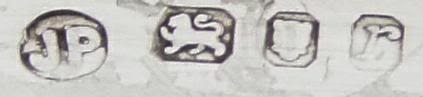
John Pinches JP in a circle, with London 1975 hallmarks.
Captioned hallmark examples: London 1975; London 1972.
Undated
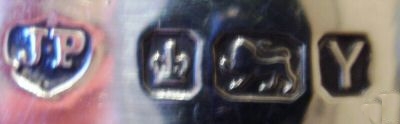
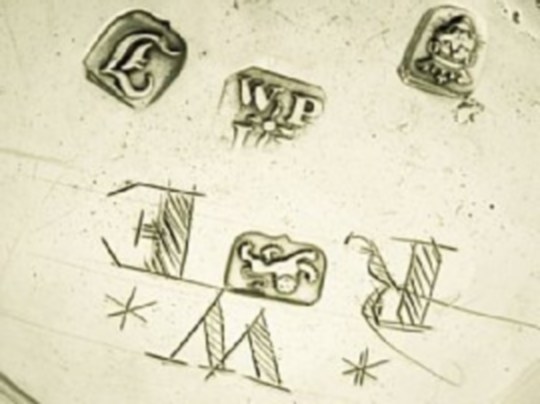
JP shield attributed to John Pinder & Co, subsequently James Pinder & Co, with Sheffield 1891 hallmarks.
Illustrated hallmark dated 1891.
Sheffield
into a shield John Pinder & Co -subsequently James Pinder & Co- 1891 hallmark.
Several makers used it, including John Power, John Pittar, James Payne, John Pinches and Pinder. Match the punch shape and accompanying hallmark group.
JP is a name or responsibility mark. The separate standard mark identifies the silver fineness.
Pinches used several shields; the maker of the octagonal Birmingham example is unidentified. The initials and border need the assay context.
Undated
Illustrated hallmark dated 1891.
Sheffield
into a shield John Pinder & Co -subsequently James Pinder & Co- 1891 hallmark.
Undated
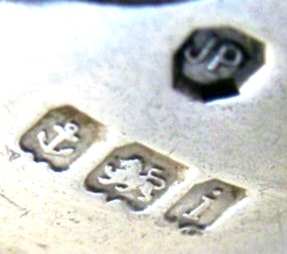
Illustrated hallmark dated 1908.
Birmingham
into an octagon not identified 1908 hallmark.
JP can be a maker’s or sponsor’s mark, and several unrelated firms used those initials. In a British or Irish hallmark group, this punch identifies the registered person or business that submitted the object for assay. That person could be a manufacturer, retailer or importer. The precious-metal standard is shown separately. Read the complete group before choosing a JP name: preserve stops between the letters, the outline of the punch and the surrounding town, standard and date marks. A plain pair of initials is not a silver grade.
John Pittar’s J.P appears in a chamfered rectangular punch on illustrated Dublin hallmarks dated 1791 and 1808. Another Dublin JP belongs to John Power, represented by an 1804 example. James Payne’s J.P appears with a London hallmark dated 1832. Each date belongs to its own hallmark group. Dublin’s crowned harp and Hibernia belong to a different hallmarking tradition from London’s leopard’s head. The accompanying symbols help separate the candidates even when the maker’s two letters are similar.
John Pinches used several JP punch shapes, including circular, oval and chamfered forms, on medals and other silver. The illustrated London examples include 1972 and 1975 hallmarks; neither date means the company used only one JP design in that year. A JP shield with a Sheffield hallmark identifies John Pinder & Co, subsequently James Pinder & Co. Compare the shield with the complete assay group. The maker of the octagonal JP stamp with Birmingham hallmarks is unidentified; the shield alone does not identify John Pinches.
A second row or an added company abbreviation can change the answer. JP over FP is the Pairpoint brothers’ combined mark, while WP over JP belongs to William and James Priest. JP &Co identifies John Pound & Co. Retain all the letters when comparing the stamp. On a spoon, preserve the full group on the stem; on hollowware, check the underside and detachable parts. A date letter must be read with its office, letter style and shield rather than matched as a loose alphabet character.