
Undated
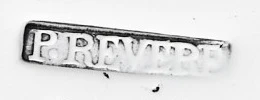
P.REVERE
Initial P precedes surname; inherited punch shared with Paul Revere Sr.
stamped · silver · Boston, Massachusetts
Silver
Paul Revere silver hallmarks include stamped “P.REVERE” on silver in Boston, Massachusetts. Paul Revere silver was active from 1755.
Silver workshop active from the mid-1750s into the early 1800s. Personal silver work diminished around 1800. Retirement in 1811 refers to his copper business.
Undated
Initial P precedes surname; inherited punch shared with Paul Revere Sr.
stamped · silver · Boston, Massachusetts
Undated
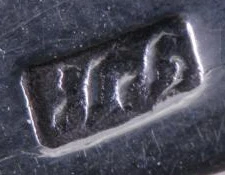
Italic initials in a rectangular punch, distinct from the upright surname punches.
stamped · silver · Boston, Massachusetts
Undated
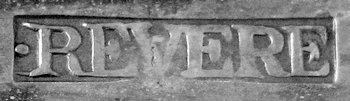
Pellet precedes the surname inside the rectangular punch.
stamped · silver · Boston, Massachusetts
Undated
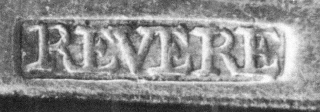
Narrow upright serif lettering within an oblong punch; no initial or leading pellet.
stamped · silver · Boston, Massachusetts
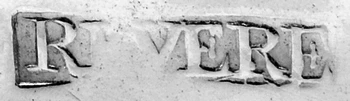
Undated
Separate catalogue alternate with broader letter proportions and wide spacing; the central strike is incomplete.
stamped · silver · Boston, Massachusetts
Paul Revere Jr. was a Boston silversmith, engraver and metalworker. He learned the trade from his father, Apollos Rivoire, who had adopted the name Paul Revere. His father died in 1754, before the younger Revere was legally old enough to control the business. He took charge of the family shop in the mid-1750s, retaining its tools, customers and some of its marking punches.
The workshop made household and personal objects, from spoons and buckles to tankards, porringers and elaborate tea services. Apprentices and journeymen helped produce the silver. Engraving customers’ initials, arms and inscriptions, repairing objects and assessing silver were also parts of the business. The surviving daybooks record substantial production both before and after the American Revolution.
Revere’s silver changed with fashion, from Rococo forms to simpler Neoclassical designs. His son Paul Revere III also worked in the shop as the older Revere expanded into other industries. He opened a foundry in 1788 and a copper mill in Canton in 1801. His personal silver work diminished around 1800, although objects from the family workshop continued into the early nineteenth century.
Also known as: Paul Revere · Paul Revere II · Paul Revere Jr. · Paul Revere Jr. (Paul Revere II)
Father and son shared the P.REVERE punch. This porringer dates to about 1750–1770 and can be attributed to the father or son.
Revere-style bowls may carry STERLING, another manufacturer’s trademark or REPRODUCTION. A horseman or patriot’s head is not an eighteenth-century Revere workshop mark.