
Hocking Glass Company
1905–1937
HG Co.
This HG Co. logo precedes the merger-era anchor-over-H design.
printed · United States
Read the stamp
Depression glass is the coloured and clear, machine-made household glass associated mainly with the 1920s and 1930s in the United States. Factories in Ohio, Pennsylvania, Indiana and West Virginia produced inexpensive plates, cups, bowls, serving pieces and kitchenware. Shops sold it cheaply, while food companies and other businesses used pieces as premiums. Pink, green, amber, yellow and cobalt blue occur in different patterns; not every factory made every pattern in every colour.
Hocking Glass Company
1905–1937
This HG Co. logo precedes the merger-era anchor-over-H design.
printed · United States
Hazel-Atlas Glass Company
From 1923
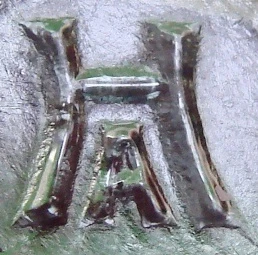
The lower A has a straight triangular outline; it is not the curved arms of an anchor.
moulded · glass · United States
Anchor Hocking Glass Corporation
From 1937
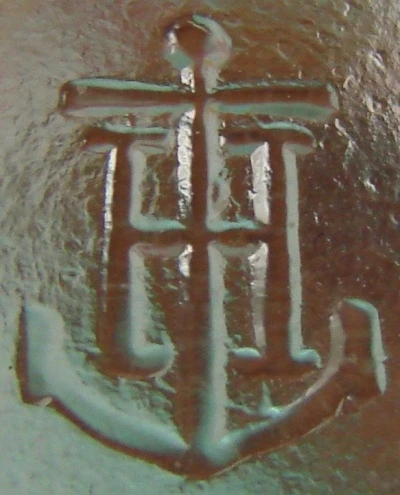
The anchor identifies Anchor Hocking; its 1937 beginning excludes an earlier Hocking date for a mark applied during manufacture.
moulded · glass · United States
Federal Glass Company
Undated
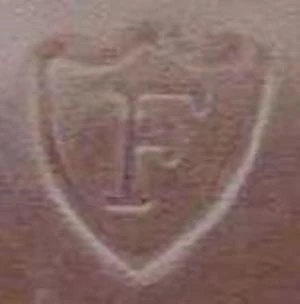
The shield surrounds a single F; it is unrelated to Fire-King wording.
moulded · glass · United States
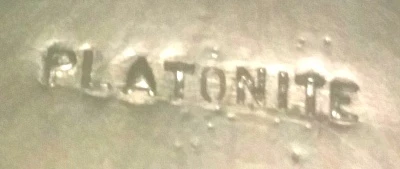
Hazel-Atlas Glass Company
Undated
The brand wording identifies the opaque glass line rather than an individual pattern.
moulded · glass · United States
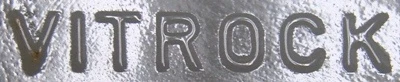
Hocking / Anchor Hocking
Undated
The VITROCK word identifies Hocking opaque glass; distinguish it from later British pottery using the same trade name.
moulded · glass · United States
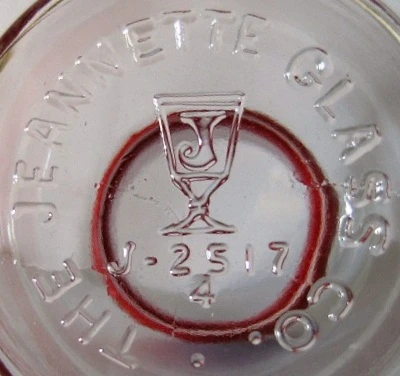
Jeannette Glass Company
Undated
A goblet surrounds the J rather than a square or triangle; the full company name is legible.
moulded · glass · Jeannette, Pennsylvania, United States
McKee Glass Company
Undated
The small c and closing circle separate this maker from a bare M or later unrelated McKee lettering.
moulded · glass · United States

McKee Glass Company
Undated
Read the full company name; the photographed example is a drink dispenser, not a pattern-specific tableware stamp.
moulded · glass · United States
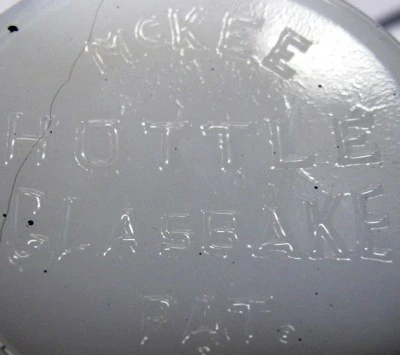
McKee Glass Company
Undated
The additional McKee name distinguishes this version from Jeannette-era Glasbake wording.
moulded · glass · United States

McKee Glass Company; later users of McKee moulds
Undated
The mark identifies a trade line and mould heritage; its survival on a later pressing does not establish a McKee production date.
moulded · glass · United States
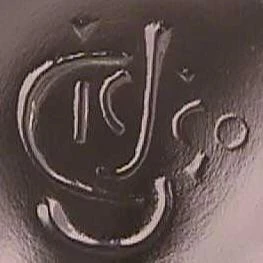
United States Glass Company
Undated
Compare all interlaced letters and the small Co; an isolated curved stroke is insufficient to identify the company.
moulded · glass · United States
The seven major producers were Indiana, Hocking, Federal, U.S. Glass, Jeannette, MacBeth-Evans and Hazel-Atlas. McKee made related kitchen and pressed glass. Many genuine pieces have no permanent maker mark. Identification begins with the moulded pattern, shape, dimensions and colour, then any mark or surviving label. Floral sprays, geometric panels, rim shapes and handle forms often distinguish pieces that look similar at first glance.
Marks identify a manufacturer or product line more often than an exact year. Hazel-Atlas used H over A, Federal used F in a shield, and Anchor Hocking used an anchor over H after the 1937 merger. Platonite, Vitrock and Glasbake are product names, not interchangeable names for all opaque glass. Earlier marks and later production from the same firms overlap the collecting field. A surviving company logo therefore needs to agree with the pattern and colour. Reproductions and later reissues can repeat an old pattern, and reused moulds can even retain its original trade mark.
Inspect the bottom and the underside of handles in raking light; record any surviving paper label.
Identify the pattern before treating an unmarked piece as unknown: compare rim, centre motif, handle and foot.
Measure the exact piece and compare the combination of pattern, size and colour with a catalogue.
Read H over A, anchor over H and shield-F as different company marks.
Check whether a brand belongs to early kitchenware or later production; do not use a company foundation date as an object date.
Depression glass is inexpensive pressed tableware associated with the late 1920s, 1930s and early 1940s. Begin with the complete pattern: the border, central motif, ribs, flowers and decoration under the base. Match the object form as well as the ornament. A cup, creamer and small bowl from one service can have different handles, feet or rim treatments. Record height, rim diameter and base shape so that a similar floral design does not become a mistaken match. Pink, green, amber and colourless glass each occur in several patterns; colour alone does not name a manufacturer.
A fine raised seam forms where sections of a mold meet. It identifies molding, rather than a particular decade. Depression glass commonly received little hand finishing, so seams, small bubbles, straw marks and slight irregularities may survive. These manufacturing features are different from chips and cracks. Elegant glass of the same period often received more hand work, such as polished seams, ground bases, cutting or acid etching. A smooth base or etched flower therefore needs comparison with that manufacturer’s pattern and finishing, rather than an automatic Depression glass label.
Look under the base for a molded emblem. Hazel-Atlas used H over a smaller A; Federal used F in a shield; Anchor Hocking used an anchor combined with H. Many earlier Hazel-Atlas tableware pieces were unmarked, and Federal also made much unsigned Depression glass. These companies continued making glass beyond the Depression years, so a company logo identifies its user more readily than the age of the object. The illustrated marks below are manufacturer comparisons, not three signed Depression-era patterns. A plain mold number also needs the pattern and form to become useful.
Check whether the exact pattern, object and colour were made in the original production run. Some patterns continued for decades; others were revived by the original maker or a successor, and some were copied by different factories. The NDGA distinguishes reproductions from later original-company production. Its pattern table flags both, so a copied floral design is only the start of a comparison. Look at the clarity and placement of the ornament, the handle attachment and dimensions of the specific form. Wear, a mold seam or an attractive old-fashioned colour cannot by itself settle the production period.
| Pattern | Maker | Original production listed by NDGA |
|---|---|---|
| Cherry Blossom | Jeannette | 1930–1939 |
| Madrid | Federal | 1932–1939 |
| Royal Lace | Hazel-Atlas | 1934–1941 |
Wheeling, West Virginia; factories in several US states · 1902–1964 as a company lineage, including Continental Can ownership after the 1950s.
Royal Lace, Florentine, Moderntone and Ovide tableware; Platonite and kitchen glass.
Lancaster, Ohio, United States · Hocking 1905–1937; Anchor Hocking from the 1937 merger.
Cameo, Block Optic, Princess, Mayfair and other tableware; Vitrock opaque glass.
Columbus, Ohio, United States · 1900–1979.
Madrid, Sharon, Patrician and other coloured tableware; tumblers and institutional glass.
Pittsburgh, Pennsylvania, then Tiffin, Ohio, United States · 1891–1962; headquarters Pittsburgh until 1938, then Tiffin, Ohio.
Aunt Polly, Floral and Diamond Band and other tableware.
Jeannette, Pennsylvania, United States · 1898–1983.
Adam, Cherry Blossom, Doric, Iris and Windsor tableware and kitchen glass.
Dunkirk, Indiana, United States · Founded 1907; Depression patterns introduced 1923–1933.
Avocado, Tea Room, Lorain, Horseshoe and other pressed tableware.
Pittsburgh and Charleroi, Pennsylvania, United States · Formed 1899; acquired by Corning in the 1930s; name continued afterwards.
American Sweetheart, Dogwood, Petalware and Chinex tableware.
Jeannette, Pennsylvania, United States · McKee family glass businesses from the nineteenth century; Jeannette factory 1888–1951 before Thatcher ownership.
Opaque kitchenware, Prescut pressed glass, Glasbake ovenware, dispensers and novelties.
An old pattern or PRES CUT wording can survive on a later pressing. Check the colours and exact shapes of the early line.
H over A, an anchor over H and F in a shield identify three different businesses. The H-over-A mark contains no anchor.
Hand-finished glass from firms such as Cambridge and Heisey can resemble machine-made Depression tableware. Compare the pattern and finishing rather than assigning an era from colour alone.
The J-in-triangle attribution is disputed between Jeannette and D. C. Jenkins. It is excluded from the counted examples; do not substitute it for Cambridge’s C-in-triangle.
The Fire-King wording belongs to later Anchor Hocking ovenware. It is not an alternate reading of Federal’s shield-F.
Identify Depression glass by matching the complete pressed pattern, object shape, dimensions and original colours. Many pieces are unsigned, and the same pattern can occur in later production or reproductions, so a colour or maker logo alone does not establish its age.

Undated
Hazel-Atlas H over A: a manufacturer emblem, also used on containers and later glass; many Depression tableware pieces are unsigned.
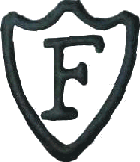
Undated
Federal F in a shield: identifies the company, whose tableware spans Depression and later production.

Undated
Anchor Hocking anchor/H: compare the complete logo, then identify the pattern and form to establish the production period.
Match the complete pattern and form, then compare dimensions and the colours used for that form.
No. Those colours occur in several periods and many factories’ products. The pattern, shape and production history identify the glass.
A seam shows that a mold was used. Both original and later pressed glass can have seams.
Check whether the pattern and form were reproduced, then compare colours, dimensions and moulded details with an original example.
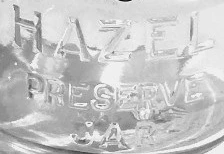
bottleinfo.historicbottles.com
c. From 1923
HA monogram between HAZEL and PRESERVE; other examples place the monogram on the base.

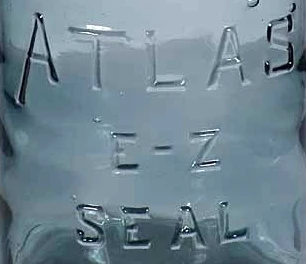
bottleinfo.historicbottles.com
Undated
Large arched ATLAS above E-Z SEAL on a wire-bail jar; full product wording distinguishes the design.
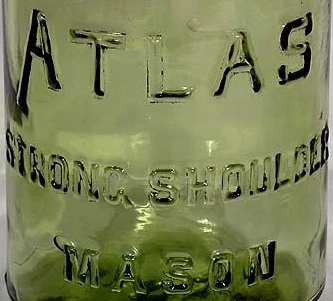
bottleinfo.historicbottles.com
Undated
Three-line product inscription; the STRONG SHOULDER wording differentiates this jar from E-Z Seal and plain Atlas marks.
Undated
glass
………………………….. A & J Manufacturing Company, Binghamton, New York. A&J specialized in manufacturing kitchen-related products such as mixers and egg beaters, and evidently the company had a business arrangement with Hazel Atlas Co. to mark certain accompanying products. The most commonly seen item marked with those initials is a pitcher or large measuring cup that also served as the bottom container for a food mixer. That pitcher was patented in 1923. A & J was acquired by EKCO, of Chicago, IL, in 1929. Since those pitchers (in a medium green typical of Hazel Atlas during the Depression era) are fairly common and must have been made in large numbers, it is probable that many were made after 1929, continuing to carry the “A & J” marking after EKCO acquired the company.
Undated
glass
…………………….. Airko Manufacturing Company, Clermont, Florida. This mark (often hard to read, and at a glance may be mistaken for Anko, Arko, Aiko or Aiiko) is seen on at least two styles of clear shakers. The most common type features horizontal raised rings or ribs encircling the shaker, similar in appearance to the Depression-era “Manhattan” pattern made by Anchor Hocking. Those shakers apparently date from the 1930s-1950s and their actual manufacture is attributed to Hazel Atlas Company and/or Anchor Hocking (if you know which is correct, please let me know!). They were advertised as featuring a special design that helped keep the salt dry and free-flowing in humid weather. For an example of an advertisement, please see this page: Airko Shakers Advertisement – Chataboutdg.com
Undated
label · glass
Federal Glass used the F-in-a-shield mark until the factory closed in 1979. Its output included Depression glass, milk glass and decorated commemorative mugs.