
Undated
M. & S. Mfg. Co. Inc.
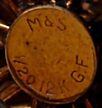
M&S 1/20 12K GF: fraction, layer fineness and construction abbreviation in one stamp.
Read the stamp
Gold filled means a gold-alloy layer mechanically bonded to a base-metal core, usually marked GF. In 1/20 12K GF, the 12-karat layer is 5% of the article’s metal weight, so the pure-gold share is 2.5%, rather than the whole piece being 12K gold.
Despite the name, a gold-filled item has gold alloy on the outside and another metal in its core. Manufacturing bonds sheets of karat gold to a base metal, commonly brass, using heat and pressure. The layered stock is then formed into jewelry or findings. White, yellow and rose gold-filled surfaces can be made; the colour describes the gold alloy used for the covering, not a different meaning of filled. A gold-filled mark describes construction rather than naming a designer.
In 1/20 12K GF, one twentieth of the metal weight is the outer 12K alloy. One twentieth is 5%; 12K is 12 parts gold out of 24, or 50% gold. Multiplying gives 2.5% fine gold in that metal weight. A 1/20 14K GF stamp also identifies a 5% gold-alloy covering, but its finer 14K layer contains a larger fine-gold proportion. The numerator and denominator do not describe layer thickness in microns. Retain the entire fraction rather than reading only 12K or 14K.
GF abbreviates gold filled. Under the US marking guidance, the mechanically applied gold-alloy covering must account for at least one twentieth of the article’s metal weight to use that term. RGP means rolled gold plate, another mechanically applied covering designation that can be used with a smaller stated fraction. GP means gold plated, while HGE means heavy gold electroplate. Neither abbreviation turns a base-metal core into karat gold throughout. A fraction such as 1/40 belongs with its covering description and cannot simply be read as the ordinary 1/20 gold-filled grade.
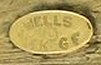
Look on a clasp, chain end tag, ring interior or the back of a pendant or brooch. A complete inscription can combine the maker’s name with a fraction, karat and GF or GOLD FILLED wording. WELLS 14K GF, for example, separates Wells as the company from the 14K gold-filled construction. Initials without a karat or covering context can instead be a maker’s signature. Preserve punctuation, fractions and adjacent words when comparing the mark.
A bonded gold layer is thicker than ordinary thin electroplating, but it is still a covering over a different core. Wear or deep engraving can expose the base metal, particularly at edges. That exposed area explains a colour change without changing what the original GF inscription means. When identifying the piece, compare protected areas with worn ones and keep the maker’s mark separate from the construction stamp.
Undated
M&S 1/20 12K GF: fraction, layer fineness and construction abbreviation in one stamp.

Undated
L.S.P. Co. 1/20 12K GOLD FILLED: the covering term is written in full beside the maker initials.
Undated
WELLS 14K GF: 14K describes the gold-alloy layer, while Wells identifies the maker.
It is a mechanically bonded layer of gold alloy over a different metal core, rather than gold alloy throughout.
The 12K gold-alloy layer is one twentieth, or 5%, of the metal weight. Since 12K is half gold, the fine-gold share is 2.5% of that metal weight.
GF names a mechanically bonded covering with the gold-filled weight requirement. GP and HGE describe plating constructions and need their own reading.
No. The karat applies to the gold-filled covering; the core is a different metal.