
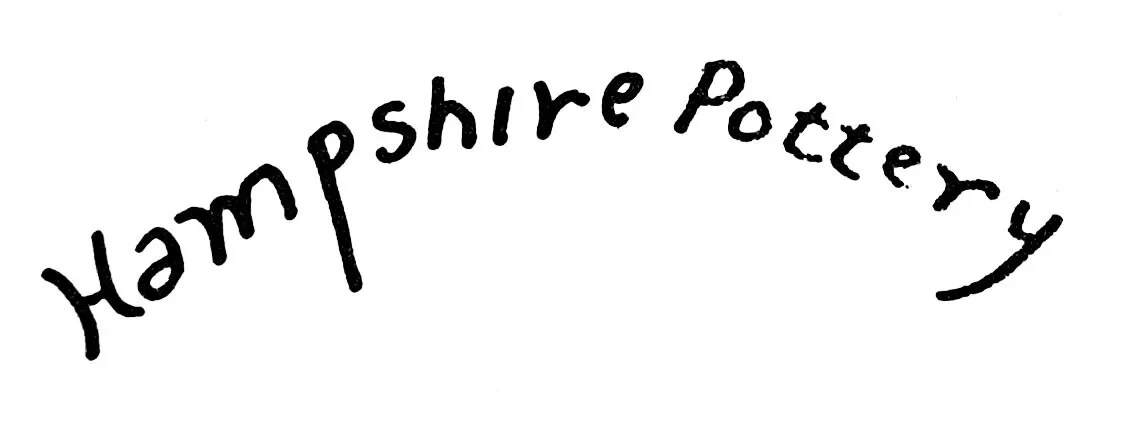
Undated
Hampshire Pottery
The loose script and full Pottery wording differ from the single straight HAMPSHIRE stamp.
impressed or incised · earthenware · Keene, New Hampshire, United States
Pottery & porcelain
Hampshire Pottery marks include impressed or incised “Hampshire Pottery” on earthenware in Keene, New Hampshire, United States.
Interrupted in 1917; reopened after World War I and closed permanently 1923.
Undated
The loose script and full Pottery wording differ from the single straight HAMPSHIRE stamp.
impressed or incised · earthenware · Keene, New Hampshire, United States

Undated
HAMPSHIRE alone differs from the longer Hampshire Pottery inscription.
impressed · earthenware · Keene, New Hampshire, United States
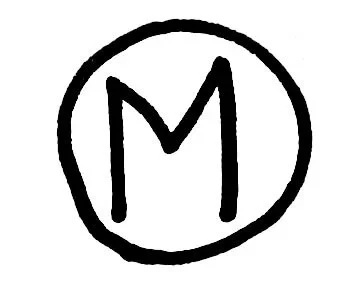
Undated
M in O commemorates Robertson’s wife Emoretta; it is not a date or shape number.
impressed · earthenware · Keene, New Hampshire, United States

Undated
The broad horizontal signature crosses the circular company-name band.
printed · red · earthenware · Keene, New Hampshire, United States

Undated
An inner KEENE N.H. place line and diagonal signature distinguish it from the simpler round stamp.
printed · red · earthenware · Keene, New Hampshire, United States
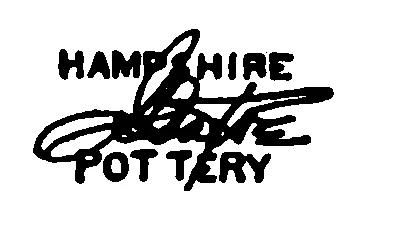
Undated
No circular border; large signature strokes cross the two-line name.
printed · red · earthenware · Keene, New Hampshire, United States
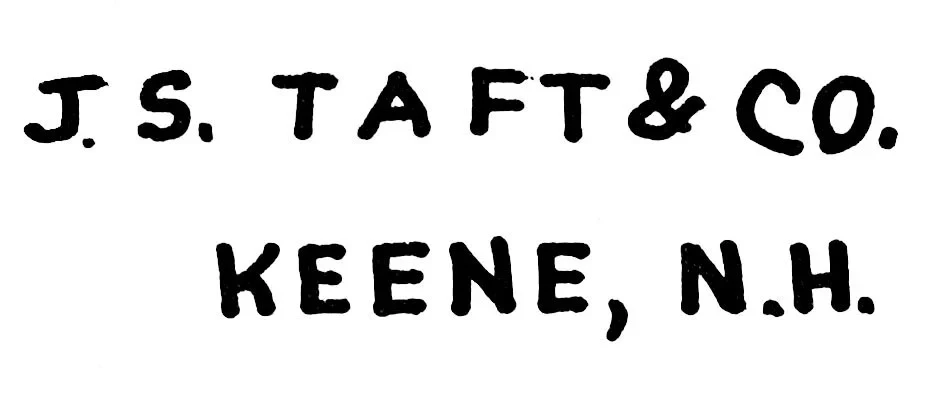
Undated
The proprietor’s name and town appear without the usual Hampshire wordmark.
impressed · earthenware · Keene, New Hampshire, United States
James Scollay Taft and his uncle James Burnap established Hampshire Pottery in Keene, New Hampshire, in 1871. The first products were practical earthenware, including jars, jugs, flowerpots and milk pans. The business recovered from an early fire and expanded into majolica and other decorative wares. By 1904 it was also making white-bodied souvenirs with printed views for summer resorts.
The pottery’s best-known art wares developed around the work of chemist Cadmon Robertson, who joined in 1904. He worked on a large range of glaze formulas, including the greens, blues and other colours associated with Hampshire vessels. Many forms were moulded, with glazing giving them their final surface character. A conjoined M and O on Robertson designs commemorates his wife Emoretta. Hampshire also used its full name, the J. S. Taft firm name and printed souvenir stamps.
Robertson died in 1914. Taft sold the pottery to George Morton, formerly connected with Grueby, in 1916. Production stopped during the First World War in 1917 and resumed after the war, increasingly concentrating on hotel and restaurant china and mosaic floor tiles. The business closed permanently in 1923. Its matte green art pottery belongs to the same collecting field as Grueby and other American Arts and Crafts wares.
Also known as: J. S. Taft & Co. · Hampshire Pottery Works · Hampshire Pottery, J. S. Taft & Company
Both made matte green Arts and Crafts wares. Match the Hampshire or Taft lettering and M-in-O device; Grueby uses its own name and often a lotus emblem.
Some Hampshire forms copied Amphora models. Shape alone cannot separate them; check the maker name and marks on the underside.