
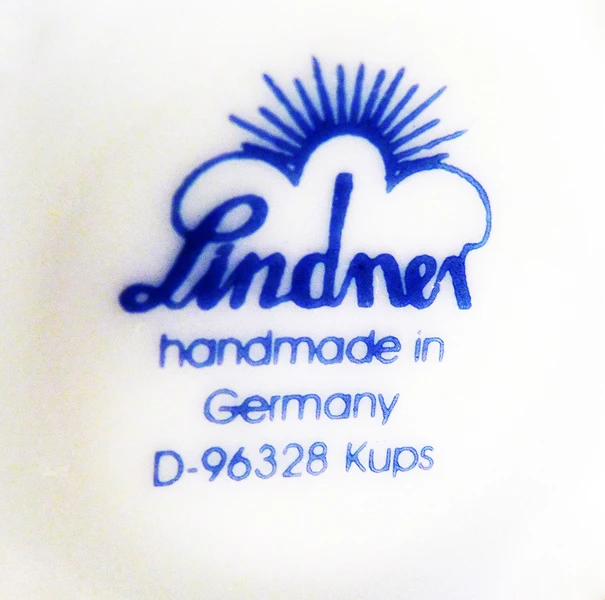
Undated
Lindner / handmade in / Germany / D-96328 Küps
Five-digit 96328 address uses the postcode system introduced in 1993; exact stamp introduction remains unproved.
printed · blue · porcelain · Küps, Bavaria, Germany
Pottery & porcelain
Lindner porcelain marks include printed “Lindner / Handarbeit / W.Germany / original handgemalt” on porcelain in Küps, Bavaria, Germany.
Municipality and trade partner give 1932; collector accounts give 1928. Foundation year disputed; company still represented as operating.
Undated
Five-digit 96328 address uses the postcode system introduced in 1993; exact stamp introduction remains unproved.
printed · blue · porcelain · Küps, Bavaria, Germany
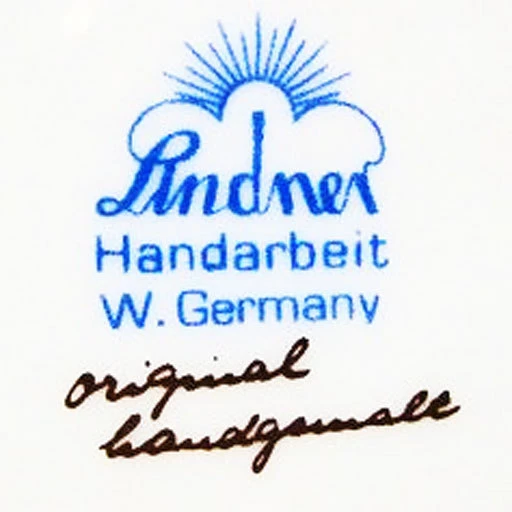
Undated
Handarbeit and W.Germany distinguish this layout; the handwritten handgemalt note is supplementary.
printed · blue · porcelain · Küps, Bavaria, Germany
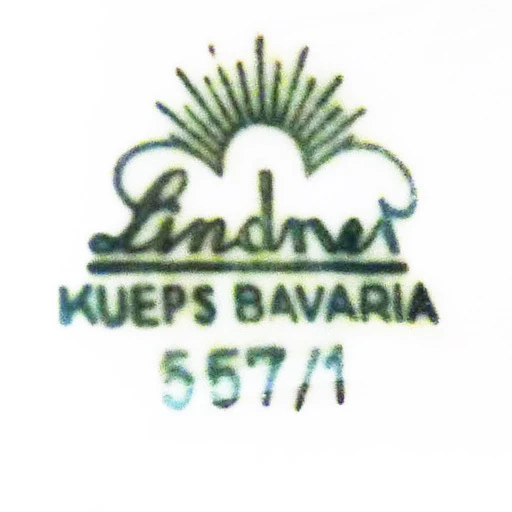
Undated
KUEPS BAVARIA without a country line distinguishes this layout; 557/1 is not assigned a year.
printed · green · porcelain · Küps, Bavaria, Germany
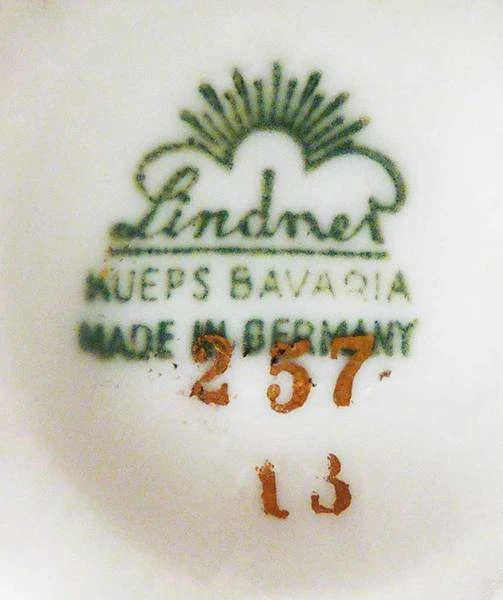
Undated
The MADE IN GERMANY line is part of this stamp; painted numbers are separate production/decor codes.
printed · green · porcelain · Küps, Bavaria, Germany
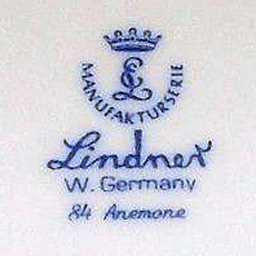
Undated
Crowned monogram and series legend distinguish this from the usual fan device; 84 Anemone is not treated as a calendar date.
printed · blue · porcelain · Küps, Bavaria, Germany
Lindner Porzellan developed at Küps in Upper Franconia under Ernst Lindner, who had worked at the local Edelstein porcelain factory. The early business decorated purchased white porcelain before expanding its own production. Small decorative objects, brooches and pendants formed part of its initial range, followed by gift wares and table services.
The factory became associated with finely painted decoration, cobalt-blue grounds and gold ornament. Its services drew on Saxon and Thuringian traditions, while mid-century work also included flowing, asymmetrical vases and other contemporary shapes. Family members Hans and Ludwig Lindner took important roles in sales, production and design after the war.
Werner Gossel took over the business in 1990. The later range extended into practical kitchen and bathroom porcelain alongside the ornate tableware and gift pieces. Lindner continued the town’s long porcelain tradition and maintained a factory outlet at Küps. Its base stamps use several versions of the script Lindner name and a radiating, fan-like device, sometimes with place wording, Handarbeit, a series name or the company’s postal address. Those additions are useful distinctions when comparing otherwise similar signatures.
Also known as: Lindnerporzellan K.G. · Lindner Porzellan · Lindner Küps · Lindner Porzellanfabrik KG, Küps
The 1887 Mitterteich factory lineage is separate from Ernst Lindner’s later Küps business. Read Küps and the script/fan device rather than matching the surname alone.
The firms shared a town and an early supply connection. Similar forms can occur with different factory stamps; Lindner’s name identifies the decorating/manufacturing business illustrated here.