
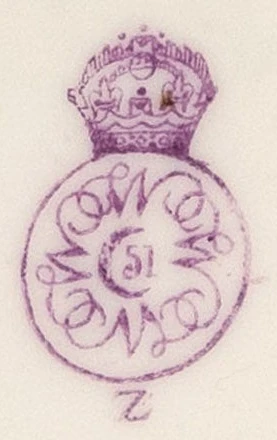
1888
51 / Z
The letter Z and absence of ENGLAND separate this example from the post 1891 wording and dot-code seals.
printed · bone china · Worcester, England
Pottery & porcelain
On bone china from Worcester, England, Royal Worcester marks carry “BONE CHINA / ROYAL WORCESTER / MADE IN ENGLAND / 51”.
Worcester lineage begins 1751; the Worcester Royal Porcelain Company Limited formed 1862. Historic Worcester manufacture ended 2008–2009; Portmeirion acquired the brand and intellectual property in 2009 and continues the brand.
1888
The letter Z and absence of ENGLAND separate this example from the post 1891 wording and dot-code seals.
printed · bone china · Worcester, England
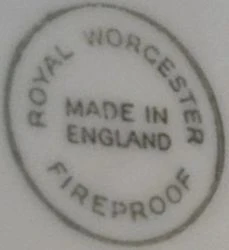
From 1931
FIREPROOF oval has no crown/51 emblem and differs from the later FLAMEPROOF script-W stamp.
printed · porcelain · Worcester, England
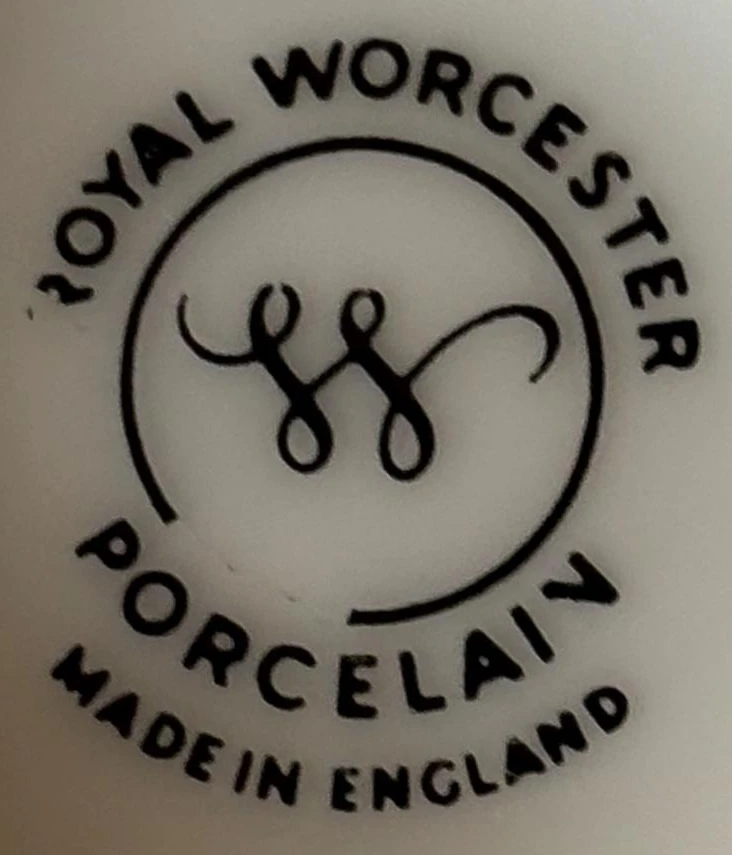
c. 1950–1983
A single large W replaces the crown and 51 emblem; the coddler-specific PORCELAIN wording sits below the circle.
printed · porcelain · Worcester, England
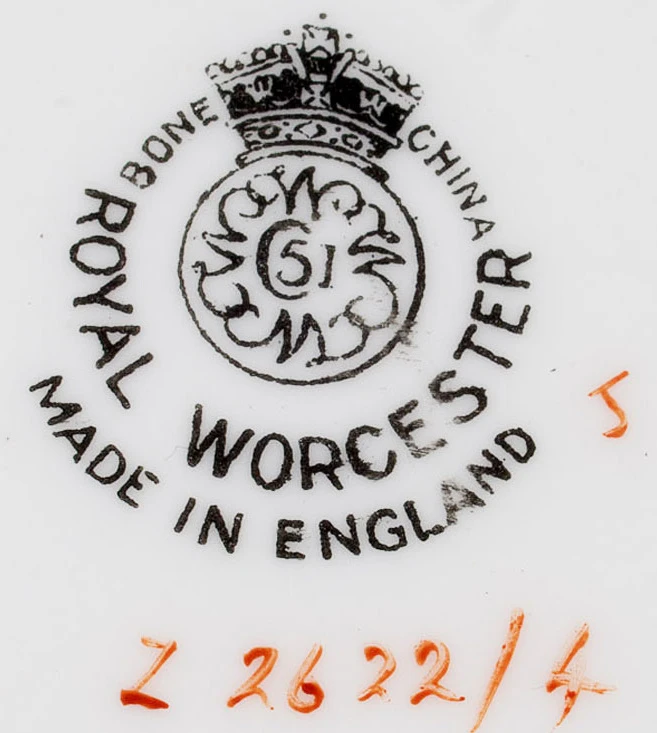
Undated
Added BONE CHINA and full MADE IN ENGLAND surround the traditional crown device.
printed · bone china · Worcester, England
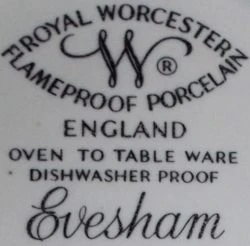
Undated
FLAMEPROOF PORCELAIN, DISHWASHER PROOF and Evesham wording distinguish it from the plain FIREPROOF oval.
printed · porcelain · Worcester, England
Worcester porcelain began in 1751 with a partnership that included Dr John Wall and the apothecary William Davis. The early factory produced tableware and decorative porcelain, with successive ownership under the Flight and Barr families. In 1840 their business merged with the separate Chamberlain factory. Kerr and Binns followed in 1852, concentrating manufacture at the Severn Street works.
The Worcester Royal Porcelain Company Limited was formed in 1862 with Richard William Binns and Edward Phillips as joint managing directors. Victorian production expanded into figures, vases and exhibition pieces as well as table services. The factory worked in bone china, Parian, earthenware and other ceramic bodies. Japanese, Persian and European historical styles influenced its decorative wares. Grainger’s factory was acquired in 1889 and Hadley’s business in 1905.
During the twentieth century Royal Worcester made painted cabinet pieces, figures, domestic tableware and heat-resistant cooking porcelain. Egg coddlers developed their own sequence of base stamps. Historic manufacture at Worcester ended in 2008–2009. In 2009 Portmeirion acquired the Royal Worcester trade name and intellectual property, continuing the brand with tableware and gift collections.
Also known as: Worcester Royal Porcelain Co. · Royal Worcester Porcelain · Royal Worcester Vitreous · Royal Worcester Crownware · The Worcester Royal Porcelain Company Limited / Royal Worcester
Grainger marks include G & Co. or a shield and Royal China Works wording. They belong to a separate Worcester factory acquired by Royal Worcester in 1889; the ordinary Royal Worcester device has the central crescent/51 and four scrolls.
Both English factories used crowns. Derby marks commonly combine a crown with crossed batons or D/Derby wording; Worcester’s familiar device encloses a crescent and 51 within four scrolls. Read the full name.