
Undated
Gold N Diamonds
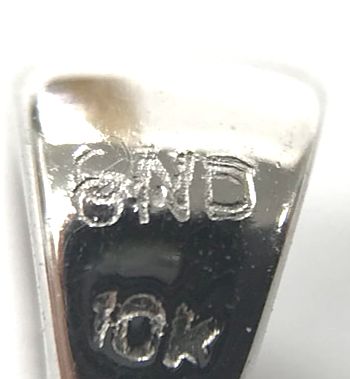
GND with 10K inside a ring: the karat notation gives the same conventional grade as 417, while GND is separate maker lettering.
Read the stamp
417 means 41.7% gold, the millesimal fineness mark conventionally equivalent to 10-karat gold. Read any following GF, GP or HGE letters as part of the stamp because they describe a gold layer.
The number 417 expresses gold fineness in parts per thousand: 417 parts gold in 1,000 parts alloy, or 41.7%. The karat system expresses the same grade as ten parts gold out of twenty-four. Dividing 10 by 24 gives approximately 41.67%, conventionally rounded to 417 in millesimal notation. The remaining proportion consists of alloying metals. A 417 stamp is therefore a gold-quality designation, rather than a maker name, model number or date. The equivalent wording may be 10K, 10KT or 10 KARAT.
Yellow, white and rose gold can all have the same gold fineness. Their colour depends on the other metals mixed with the gold; white gold may also have a rhodium surface finish. The number alone does not identify the alloy recipe. Compare similar-looking stamps carefully: 375 means 37.5% gold, commonly nine-karat; 585 means 58.5%, commonly fourteen-karat; and 750 means 75%, eighteen-karat. None of those figures is interchangeable with 417. Colour and brightness cannot distinguish these grades reliably.
Keep the entire inscription together. GF means gold filled; GP means gold plate; RGP means rolled gold plate; HGE means heavy gold electroplate. These descriptions concern a gold layer over another metal. In a mark such as 10K GF, the ten-karat figure describes the gold alloy in the layer, rather than saying that the entire article is ten-karat gold. A fractional prefix can describe the layer’s weight proportion. A separate maker name or initials identifies the responsible business and is a different part of the inscription.
On a ring, inspect the inside of the shank. On chains and bracelets, examine the clasp and the small terminal tag, keeping their inscriptions separate if they differ. A replacement component can carry its own quality mark. Country wording such as ITALY adds an origin claim; it does not change what 417 means. Marking systems differ between countries, and a single number is not equivalent to a complete assay-office hallmark. Counterfeit and misleading stamps exist: identify the full group of marks before treating the claimed fineness as confirmation of the metal.
Undated
GND with 10K inside a ring: the karat notation gives the same conventional grade as 417, while GND is separate maker lettering.
Undated
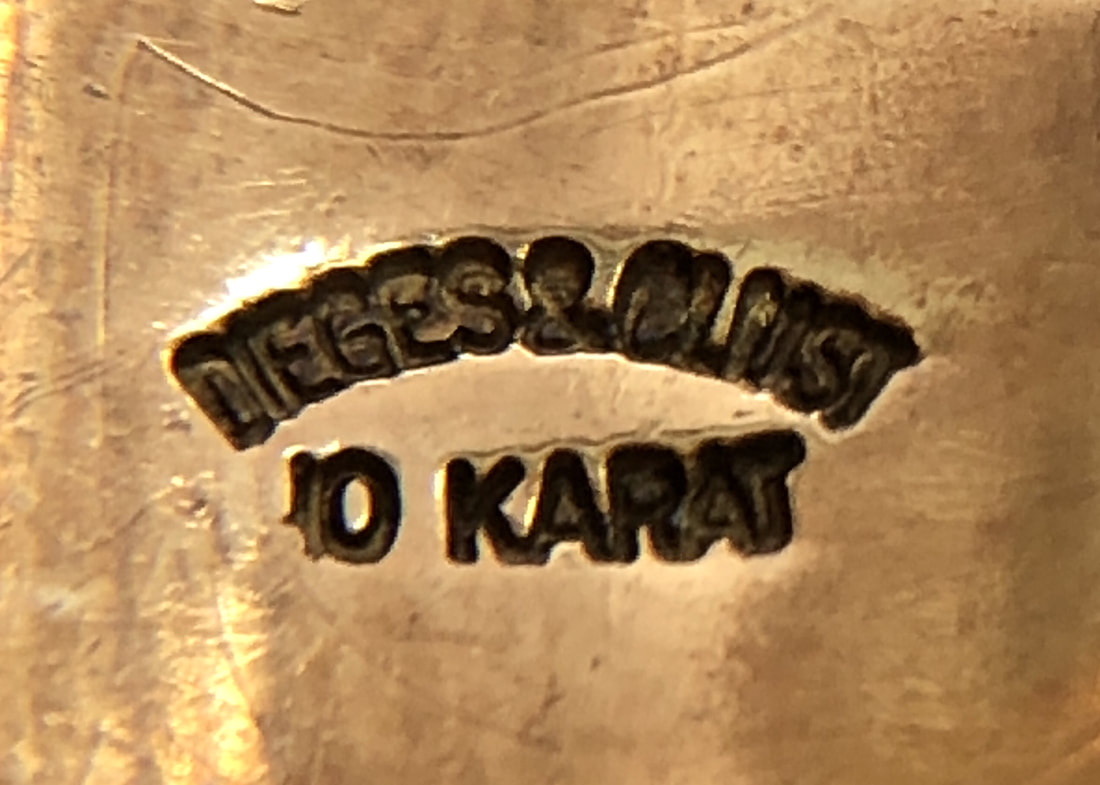
DIEGES & CLUST above 10 KARAT: the gold grade written out rather than expressed as 417.
Undated
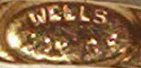
WELLS 10K G.F.: the GF suffix makes this a gold-filled description, unlike a plain 417 or 10K alloy mark.
It is a gold fineness claim of 417 parts per thousand, or 41.7% gold, conventionally called 10K.
They describe the same conventional grade. Ten divided by twenty-four is about 41.67%, rounded to 417 in thousandths.
A plain 417 mark describes a gold alloy. GF, GP, RGP or HGE wording indicates a layer and changes how the full mark should be read.
No. ITALY is an origin claim; 417 remains the fineness claim.