
Undated
furniture maker marks
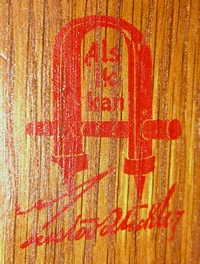
Gustav Stickley compass and full-name red signature, the company’s approximately 1905–1912 form; distinguish it from the L. & J. G. clamp.
Read the stamp
Furniture marks can identify a manufacturer, cabinetmaker, retailer or designer; look under seats and tops, inside drawers and on cabinet backs. Read the whole label and separate its company name from model, order, assembly and manufacturing-date information.
Furniture marks can be paper labels, ink stamps, burned-in brands, metal plates or handwritten inscriptions. Check the underside of a seat or tabletop, drawer interiors and bottoms, the back of a cabinet and the underside of its case. Location varies by maker and furniture form. Herman Miller, for example, places manufacturing labels under chair seats, tables or other product undersides. Copy the full text and photograph the mark in place, so its attachment to the furniture remains clear.
A name can identify the manufacturer, cabinetmaker, retailer, designer or trade association. These roles are not interchangeable. The Metropolitan Museum’s John Elliott looking glass carries Elliott’s label as retailer, rather than maker. Later furniture likewise appears with store names even when a separate factory made it. Words such as made by, manufactured by, designed by or sold by help establish the role. A trade-association label can instead concern material or membership. Read the entire label before treating its most prominent name as the factory.
Stickley gives useful examples of pictorial shop marks: Gustav’s joiner’s compass differs from L. & J. G. Stickley’s handscrew clamp. Modern labels can carry several kinds of number together. Herman Miller separates product/model information, manufacture date and order information. Stickley also stamps a cabinet fitter’s initials on some backs and numbers hand-fitted drawers so each returns to its correct opening. Those assembly numbers are not a universal date code. Decode a lone number with the maker’s own system to identify a model, worker or year.
Logo variants can suggest a period: the red Gustav Stickley full-signature compass dates to about 1905–1912, and the L. & J. G. Handcraft clamp to about 1906–1912. Later Mission reissue labels began in 1989, so an Arts and Crafts appearance alone does not establish early manufacture. Compare the label with the model, dimensions, joinery and hardware. A patent date on a hinge, lock or mechanism dates a legal protection for that design, rather than automatically the manufacture of the complete cabinet. Read any actual manufacturing-date field separately.
Undated
Gustav Stickley compass and full-name red signature, the company’s approximately 1905–1912 form; distinguish it from the L. & J. G. clamp.
Undated
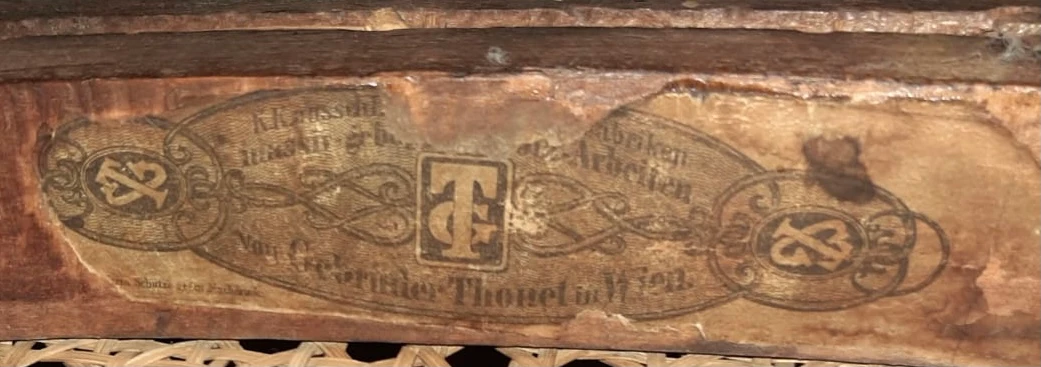
Gebrüder Thonet paper label with GT monograms and Wien wording; the full label is more informative than a bare impressed number.
Undated
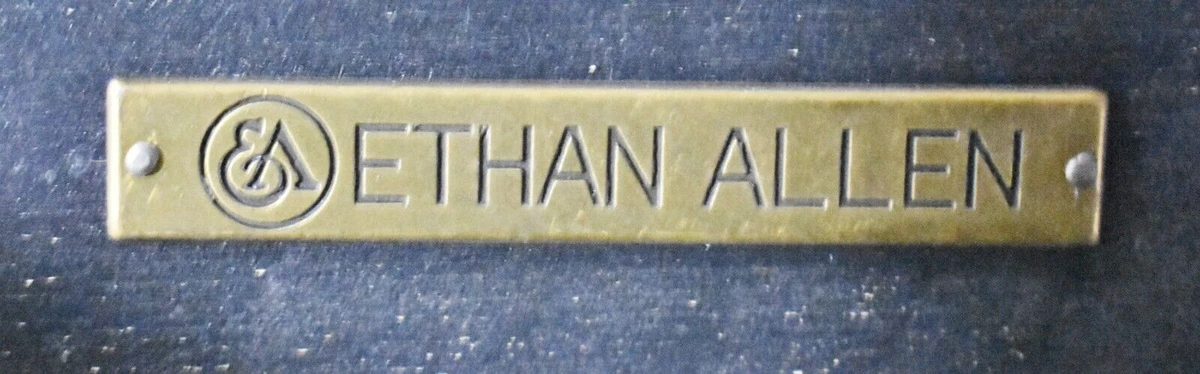
EA monogram and ETHAN ALLEN name on an applied metal plate; this example has no established exclusive use interval.
Check drawer interiors and bottoms, the underside of seats and tabletops, cabinet backs and the underside of the case.
No. It can name the retailer or another participant. The label on the Met’s John Elliott looking glass names the retailer.
Only when the maker’s format supports that reading. Numbers can identify models, orders, parts or drawer positions.
It dates the patent for the named design or fitting. Look separately for a manufacturing date and compare the rest of the construction.