
Undated
disston saw medallion
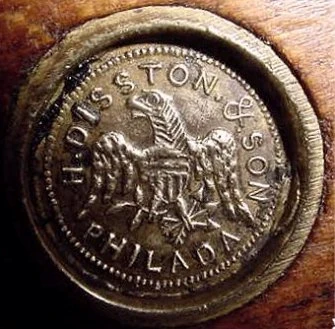
One-son eagle medallion: H. DISSTON & SON, approximately 1865–1871; the one-son wording did not always accompany a keystone.
Identification guide
Date a Disston saw medallion by its complete wording, eagle or keystone design, and fastener construction. The SON change belongs to 1865 and SONS to 1871, but overlapping stock and replacement parts mean the medallion must be checked against the blade and handle.
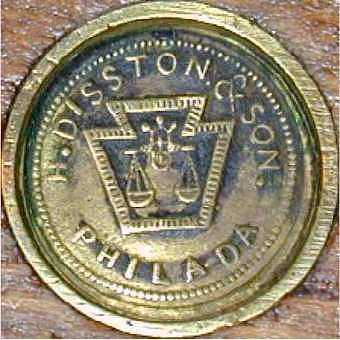
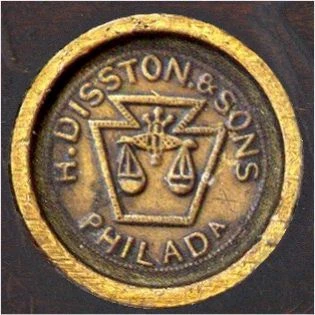
The brass medallion is a decorated saw-handle fastener, also called a label screw. Read all of its lettering before comparing the eagle or keystone. H. DISSTON belongs to the earlier company wording; DISSTON & SON follows Hamilton joining the business in 1865; DISSTON & SONS follows Albert joining in 1871. The change refers to adult sons entering the firm. It is not a record of their births, and the plural wording continued long after the initial change.
Early eagle medallions have several variants, including different bird poses, stars and forms of the Philadelphia abbreviation. Their smaller differences do not consistently establish an exact year. The one-son period includes both an eagle design and the more familiar keystone-and-scales device. In the mid-1870s, the fastener changed from split or spanner nuts to cap screws, and the medallion edge began to stand above the wood. Examine the opposite side of the handle as well as the decorated face.
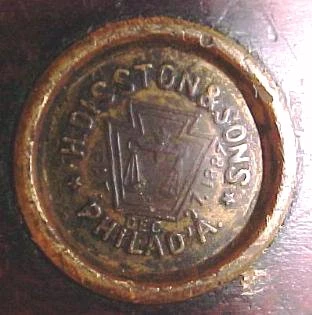
A keystone medallion reading H. DISSTON & SON, together with split-style nuts, fits the approximately 1865–1871 one-son period. Change SON to SONS while retaining split nuts and the comparison moves into the early 1870s, approximately 1871–1875. A medallion bearing the December 27, 1887 patent date points to the later Glover fastener design, used after the patent rather than proving that the saw was made on that day. The detailed study groups those patent-date examples from about 1888 into the early 1890s.
Later medallions shorten the company wording and change the locality inscription. The later Philadelphia forms date to about 1896–1917 and 1917–1940. USA wording appears by 1940; changes in the medallion edge and quality of lettering then distinguish approximate 1940–1947, 1947–1953 and 1953–1955 groups. Match the whole face and profile rather than choosing a date from the word USA alone. These periods describe logo variants, rather than decoding a manufacturing year.
Read the blade etch or stamp, model and handle shape alongside the medallion. Old stock crossed name changes: a one-son blade can have a sons medallion, and earlier eagle medallions continued on some later blades. Medallions and handles can also be transferred during repairs. A Warranted Superior medallion does not identify Disston by itself; several manufacturers used that wording. If the blade and handle disagree with the medallion comparison, keep their clues separate rather than forcing the whole saw into one narrow period.
Undated
One-son eagle medallion: H. DISSTON & SON, approximately 1865–1871; the one-son wording did not always accompany a keystone.
Undated
H. DISSTON & SONS keystone medallion in the early-1870s split-nut group, approximately 1871–1875.
Undated
Glover patent-date medallion: the 1887 date concerns fastener design; the illustrated group is approximately 1888–early 1890s.
Match the full inscription, emblem, edge profile and reverse fastener, then compare the blade etch, model and handle.
The singular followed Hamilton joining in 1865; the plural followed Albert in 1871. Old stock means blade and medallion wording can overlap.
It identifies the Glover fastener patent, not the saw’s exact manufacture date. The patent-date medallion belongs to later production.
No. Multiple saw manufacturers used Warranted Superior medallions, and replacement fasteners also exist.