
Undated
milwaukee date code
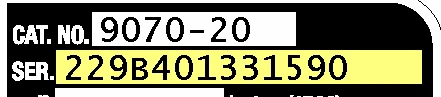
Manufacturer’s 9070-20 nameplate example: serial 229B401331590 decodes to week 33 of 2001.
printed nameplate illustration
Identification guide
In Milwaukee’s 13-character tool serial, characters 6–7 give the year and 8–9 give the manufacture week. Battery stamps and other rating-label formats use different layouts, so identify the model and complete code before decoding it.
Read the label attached to the tool housing. It carries the model or CAT. NO. and a separate serial number; those fields do different jobs. A catalogue number identifies the model, while the serial identifies a production unit. The nameplate position varies by tool. For the recalled impact-wrench family, it is on the body. Photograph the complete label, including spaces, letters and leading zeros, rather than copying only the digits that resemble a year.
Milwaukee’s 13-character tool format, effective April 1992, divides into a three-character prefix, one revision letter, one plant digit, two year digits, two week digits and four unit digits. Count from the start of the full serial, including letters. Characters 6–7 are the manufacture year; characters 8–9 are the production week. The revision letter follows the prefix and identifies the service-parts revision. It is not a month letter.
Split this serial as 229 / B / 4 / 01 / 33 / 1590. The prefix is 229, revision is B and plant code is 4. The date portion 01 / 33 means week 33 of 2001. The final 1590 is the unit number within that week. The illustrated nameplate separately says CAT. NO. 9070-20. Neither the opening 229 nor the model number is the date. Reading only the beginning would miss the actual date fields.
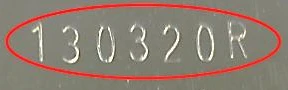
A battery’s date belongs to the battery, independently of the tool fitted to it. Battery-pack codes can be heat-stamped on the top housing or printed on the lower housing and nameplate. The precise location depends on the battery catalogue number. The photographed 130320R stamp uses 13 for 2013, 03 for March, 20 for the day and R for the plant. Older battery formats include 4297S, meaning week 42 of 1997, and 070628, meaning June 28, 2007. The tool position-counting rule does not apply to those short stamps.
A European rating plate can show separate model, serial and date fields. In the illustrated M18 CIW12 label, 001978 is separate from L2012. Match the layout before applying the 13-character tool rule. Decode older or differently formatted numbers with the system for that model. Keep the tool and battery records separate even when they were purchased together; they can have different production dates.
Undated
Manufacturer’s 9070-20 nameplate example: serial 229B401331590 decodes to week 33 of 2001.
printed nameplate illustration
Undated
Photographed battery heat stamp 130320R: March 20, 2013; R identifies the plant.
heat-stamped

Undated
European M18 CIW12 rating label: product reference 4331 35, serial 001978 and a separate L2012 field; its format differs from the 13-character US serial.
printed nameplate illustration
In the 13-character tool serial, read characters 6–7 as the year and 8–9 as the week. Check the complete layout first.
In that format, the two year digits follow the three-character prefix, revision letter and plant digit. The manufacturer’s 01 example means 2001.
Battery formats vary. For example, 130320R is a year/month/day stamp, while 4297S is week/year plus a plant letter.