
Identification guide
Snap-on date code
Snap-on began stamping annual hand-tool date codes in 1927: 7, 8, 9 and 0 identify 1927–1930 on the early tools. Later years use symbols and decade-specific digit shapes, so match the exact stamp to its chart rather than reading a digit as the final year number.
Find the small code, not the model number
Inspect both sides of a wrench or ratchet and the wall of a socket near its logo, size and model marking. The annual code is usually much smaller than the main inscription. A fraction such as a socket size and a model designation identify the tool; they are not the annual symbol. Keep the tool oriented with its name readable and photograph the code straight on. A curved or partly worn stroke can make a date symbol look like a letter, fraction or stray scratch.
How the hand-tool code changed
The first sequence is straightforward: 7 for 1927, 8 for 1928, 9 for 1929 and 0 for 1930. A dash can appear before or after the digit. The next years introduce symbols: an asterisk for 1931, a three-lobed outline for 1932 and a four-cornered outline for 1933. From 1934, stylised numerical forms provide a recurring structure, with a different visual treatment for later decades. The 1950s forms tend to have rounded tops or bottoms; the 1960s row has angular forms. Preserve the shape as well as the apparent numeral.
Worked readings from actual sockets
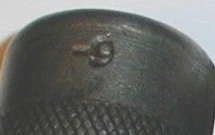
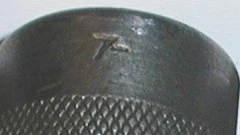
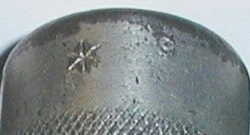
In the photographed socket group, the first socket’s small 9 reads as 1929 and the second socket’s 7 reads as 1927. The third shows a prominent asterisk together with a smaller 9: it carries both 1931 and 1929 stamps. Read both markings instead of discarding the faint one. Early dates also related to the limited guarantee period, and some tools were stamped again later. A double-stamped tool therefore needs the individual stamps described rather than a single year assigned from whichever is easiest to see.
Similar digits in later decades
The chart’s outline is the important distinction. For example, its 1980 mark is a diamond, while the 1990 mark is a looped form resembling a crossed zero. A plain transcription of both as 0 would lose the useful information. Compare complete strokes, open sides, crossbars and curves. Use the tool’s model and construction to check that the proposed period makes sense. Actual stamps can be less regular than the printed chart, particularly on curved sockets.
Power tools use their own serial formats
The annual hand-tool symbol chart is not a universal decoder for every Snap-on product. The CTM550/800 torque-tool manual, for example, specifies YYWWEEXXXX: year, week, engraver code and serial sequence. Read that product’s serial fields rather than looking for a vintage socket symbol. Likewise, an absent or illegible hand-tool code needs comparison of logo, model and construction; it does not supply a calendar year by itself.
Examples
Undated
snap on date code
Socket with a smaller 9 (1929) beside an asterisk (1931): a real double-date example.
stamped
Frequently asked questions
How do I read a Snap-on date code?
Find the small separate symbol near the tool markings and match its complete shape to the year chart. Early 7, 8, 9 and 0 stamps identify 1927–1930; later styles need their decade row.
Where is the Snap-on tool date code?
Look around the socket wall and near the logo or model on wrenches and ratchets, checking both sides. Keep size fractions and model numbers separate from the small year symbol.
Why does a Snap-on tool have two date codes?
Some early tools were stamped again later. One socket has a 1929 digit 9 and a 1931 asterisk; read both codes.
Can I use the hand-tool date-code chart for a Snap-on power tool?
Use the model’s manual. For example, the CTM550/800 serial format has separate year and week fields rather than the vintage hand-tool symbol system.