
Undated
zippo date codes
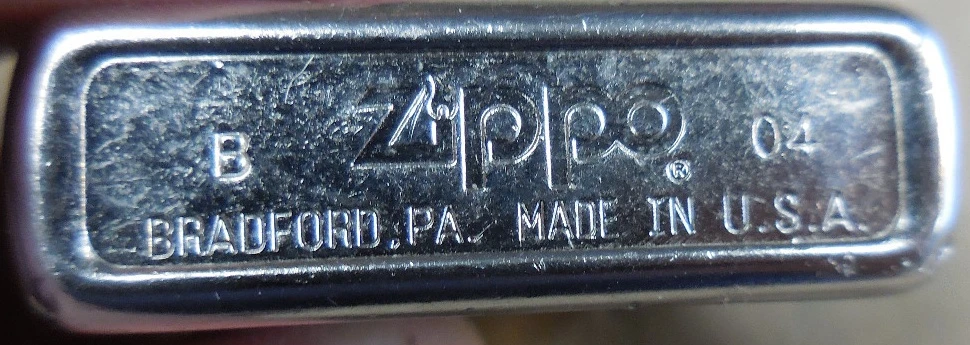
B 04: February 2004, read from the month letter and year on opposite sides of the logo.
stamped
Identification guide
On a modern Zippo case, the letter A–L gives January–December and the two digits give the year: C 19 means March 2019. Older cases use dots, lines or Roman numerals, with a separate early chart for Slim lighters.
Turn the closed lighter over and read the small marks on either side of the Zippo logo. Keep the entire bottom stamp visible, including Bradford or other location wording, patent numbers and any REPLICA inscription. The case-bottom code dates the case. Cases and inserts are made separately before assembly, so even an original pairing can have different dates. The removable insert can also be replaced; record its markings independently. A later insert does not change the date stamped into an older case.
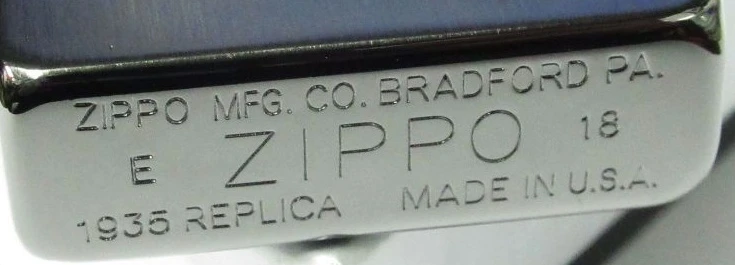
The month letters run in order: A January, B February, C March, D April, E May, F June, G July, H August, I September, J October, K November and L December. In the photographed B 04 case, B is February and 04 is 2004. The E 18 replica case reads May 2018. Its separate 1935 REPLICA wording names the historical design being reproduced, rather than giving the manufacture year of that particular case.
The letter-and-year system began on 1 July 1986, with months G–L and the Roman numeral II. For later years add 1984 to the Roman numeral’s value: III is 1987, X is 1994, XV is 1999 and XVI is 2000. F XV therefore means June 1999. From 2001, the year changed to two digits, beginning 01. Read XVI as a year code rather than as a model or a day of the month. Some transition-year 2000 bases show both 2000 and XVI.
For regular lighters, the official chart shows dots for 1958–1965, vertical lines for 1966–1973, forward slashes for 1974–1981 and backslashes for 1982 to the first half of 1986. Count marks separately on the left and right. A regular case with one dot on the left and none on the right reads 1965; one vertical line on the left reads 1973. The system records a year, not a month. Early Slim lighters use a different dot sequence: the Slim chart shows one left dot in 1964 and no dots in 1965.
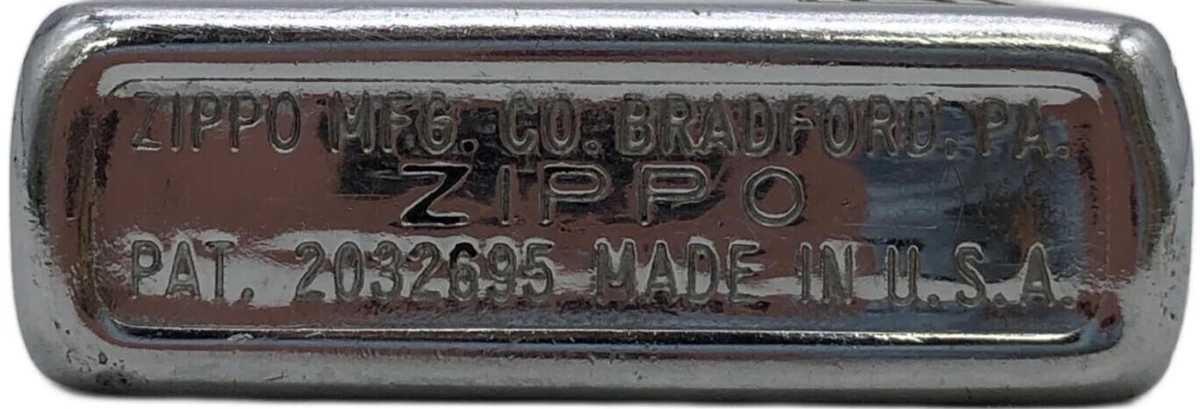
Before the regular annual chart, the logo, construction and patent inscription help place a case within a period. PAT. 2032695 on the illustrated block-letter base belongs to the chart’s circa 1937–1950 layout, not a year numbered 2032695. The script logo was phased into bottom stamps around 1955; the flame-style logo entered them in 1980. These broad logo periods help check a reading but do not override a complete date code or explicit replica wording.
Undated
B 04: February 2004, read from the month letter and year on opposite sides of the logo.
stamped
Undated
E 18 beside 1935 REPLICA: May 2018 production of a historical-style design.
stamped
Undated
Block ZIPPO logo and PAT. 2032695: an early layout whose patent number is not an annual date code.
stamped
For a modern case, read the A–L month letter and the two-digit year on either side of the logo. C 19 means March 2019; use the appropriate older chart for dots, lines or Roman years.
Cases and inserts are manufactured separately before assembly, so their dates can differ from the start. Inserts are also replaceable. Date the case from its bottom and record the insert separately.
The early dot sequences differ. For example, a single left dot dates a regular case to 1965 but a Slim to 1964.
No. It names the reproduced design. The pictured E 18 example was made in May 2018.