
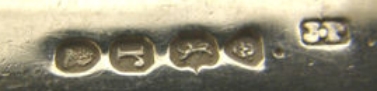
Undated
James Payne
James Payne: JP initials within a London 1832 hallmark group, a comparison for reading the sponsor and accompanying punches.
Illustrated London 1832 hallmark.
Read the stamp
Silver spoon hallmarks can identify the responsible maker or sponsor, silver standard, assay office and hallmark date. Inspect the back of the handle and the bowl junction, then distinguish the stamped group from owner engraving and plate descriptions such as EPNS or A1.
Turn the spoon over and inspect the back of the handle, stem and junction near the bowl. A group of small struck punches often carries more information than the decorative front. The Fitzwilliam Museum’s serving spoon examples place the marks on the back of the handle; other historic spoons have punches nearer the bowl. Keep the spaces and sequence visible in a close photograph. A large engraved monogram on the terminal usually records ownership, while the smaller repeated maker punch belongs to the identification of the silver.
Separate the sponsor’s initials, precious-metal standard, assay-office symbol and date letter. The lion passant is a traditional sterling symbol in an English group; London’s leopard’s head identifies the assay office. Historical Dublin groups can include a crowned harp and Hibernia. Their letters must be compared with Dublin tables, rather than a London alphabet. A sponsor is the registered party responsible for submitting the object, and can be a retailer or importer as well as its maker. The hallmark date records assay; it is different from a later inscription celebrating a birthday or marriage.
On American silver, STERLING or 925 states a standard of 92.5% silver, while COIN conventionally describes 90% silver. A maker or retailer name may sit alongside that wording. EPNS means electroplated nickel silver: the silver is a coating on another alloy. EPBM instead names electroplated Britannia metal. A1 is a plating quality designation, rather than a sterling fineness mark or an assay-office date. Silver-coloured spoons can therefore carry very different material descriptions; read the full wording before comparing makers with similar initials.
Date letters repeat in different cycles. Match the letter’s typeface, capital or lower-case form and surrounding shield to the correct office table. A patent date on American flatware concerns its design or invention; it is not automatically the year that particular spoon was made. An owner’s initials can be engraved after manufacture, and some spoons were engraved to match an older service. Keep those inscriptions apart from the struck hallmark group. The illustrated JP comparisons show why the same letters can identify different sponsors when the town marks and associated dates change.
Undated
James Payne: JP initials within a London 1832 hallmark group, a comparison for reading the sponsor and accompanying punches.
Illustrated London 1832 hallmark.
Undated
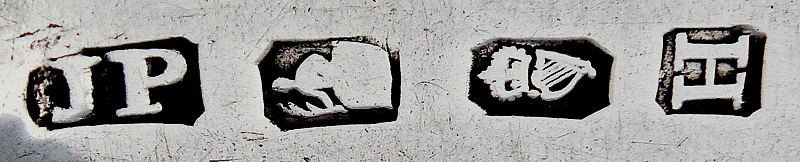
John Power: JP with Dublin 1804 punches; the town and standard context differs from London.
Captioned hallmark: Dublin 1804.
Undated
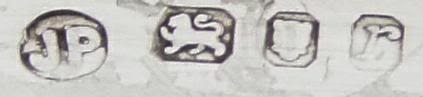
John Pinches: circular JP with London 1975 marks, demonstrating reuse of the same initials in a later group.
Captioned hallmark examples: London 1975; London 1972.
Usually on the back of the handle or stem; also inspect the area near the bowl and preserve the full group in a photograph.
EPNS means electroplated nickel silver. A1 is a plating quality designation. Neither is a sterling silver fineness mark.
They usually identify an owner. Compare the separate small struck sponsor or maker punch on the reverse.
Identify the assay office first, then match the complete date-letter punch to its table. A patent date or engraved presentation date serves a different purpose.