
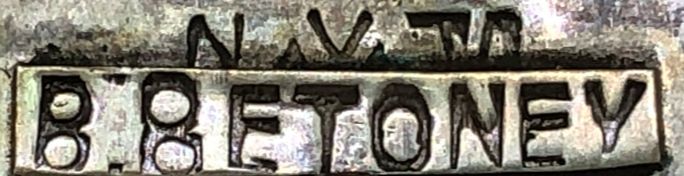
Read the stamp
Native American hallmarks
Native American jewelry hallmarks can identify an artist, a collaborating family or a workshop; read the complete name or symbol with its accompanying wording. STERLING or 925 separately describes the silver alloy, while a turquoise setting or arrow design does not identify the maker.
Read the artist’s signature before the style
An artist’s hallmark may be a name, initials or a pictorial symbol. Look on the back of a pendant or buckle and inside a cuff or ring, keeping the entire stamp visible in a photograph. Copy spelling, punctuation, lettering and the outline around the punch. Navajo and Zuni signatures are not interchangeable labels for a single jewelry style. A full name-bearing mark provides a more specific identification clue than a common decorative motif or the presence of turquoise.
Three signatures and what they identify
B. BETONEY NAVAJO is associated with Bill and Betty Betoney, who share the hallmark. It should not be reduced to a single B when searching for the maker. W Denetdale Navajo identifies the Navajo gold- and silversmith Will Denetdale; retain the surname and the lower line. EFFIE C. over ZUNI is the mark associated with Zuni silversmith Effie Calavaza. Her characteristic snake designs are useful companions to the signature, while the wording gives the direct name clue. These are artist or family marks rather than silver-fineness numbers.
A family mark can continue beyond one maker
EFFIE C. is also a family-workshop mark authorised for use by family members. It therefore needs a different reading from a signature used exclusively by one pair of hands. Calavaza also worked with her husband Juan; an Effie C., Zuni signature appears on a snake bolo tie. His JUAN C., ZUNI signature belongs to that related history. Compare the actual signature on the object rather than assigning every snake design to Effie or treating all Calavaza family work as the same mark.
STERLING, 925 and other material wording
STERLING and 925 describe silver containing at least 92.5% silver. They do not identify an artist or a tribal affiliation. Coin silver is a different alloy designation, 90% silver. Nickel silver, sometimes called German silver, is a copper-based alloy with nickel and zinc rather than a silver-purity standard. Keep these material terms separate from the artist mark. Jewelry made with similar stones and surface decoration can have different metal compositions.
Connecting a hallmark with the actual maker
The artist’s name, tribal affiliation, materials and purchase record should agree with the physical piece. In United States sales, a tribal description such as Navajo jewelry identifies who made it; it is not simply a colour palette or design category. A written receipt can preserve the named artist, silver standard and stone description together. Where a shop or family punch accompanies another signature, record both. The complete combination gives more useful information than choosing an artist from initials alone.
Examples
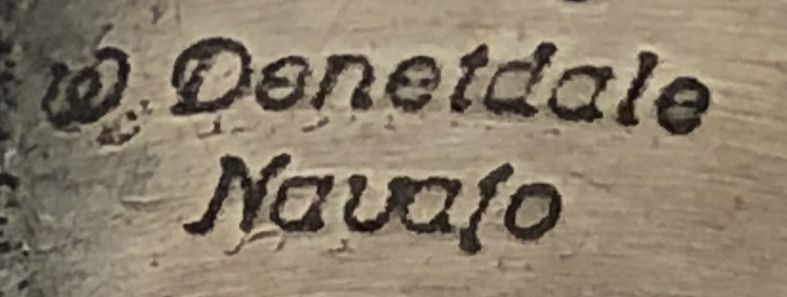
Undated
Will Denetdale
W. Denetdale / Navajo: the surname and lower line distinguish this signature from generic W initials.
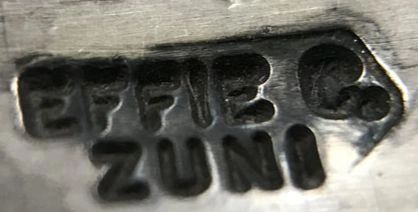
Undated
Effie Calavaza
EFFIE C. / ZUNI: a Calavaza family-workshop signature, read together with the design and object history.
Frequently asked questions
How do I identify Native American jewelry hallmarks?
Read the complete artist or workshop stamp, including its symbol and surname, then compare another example. Keep metal-purity stamps and shop marks separate.
Are Native American silver hallmarks the same as 925?
No. An artist hallmark identifies the maker or workshop; 925 and STERLING identify the silver standard.
What does EFFIE C. ZUNI mean?
It is associated with Zuni silversmith Effie Calavaza and her authorised family workshop. The stamp does not establish that Effie personally made every signed piece.
Do American Indian jewelry marks identify the tribe?
Some include wording such as NAVAJO or ZUNI; others are names or symbols. The maker’s tribal affiliation supplies that identification; jewelry style alone does not.